AI Agents for Customer Support: 10 Use Cases to Deploy First (2026)
Turn this article into takeaways for your work.


Each assistant summarizes the article only for you and suggests best practices for your work.
It's Monday morning and the queue has 340 tickets waiting. Some are a five-second password reset. Some are a customer about to churn. A human has to open every single one just to tell the difference. By lunch, the queue looks about the same, because new tickets keep arriving faster than anyone can read the old ones. That triage work, reading, sorting, and routing before anyone can actually help, is the first place most support teams put an AI agent to work.
This page maps where AI agents fit across a support team: what each one actually does, and which real blueprint to build from. For the underlying definition first, see what an AI agent actually is. If you already know your use case, jump to the table below.
What AI Agents Actually Do for a Support Team
A basic chatbot answers from a script and waves at a human once it runs out of road. An AI agent is different. It reads the ticket, checks your knowledge base and account history, decides whether it can resolve, deflect, or escalate, and then actually does one of those three instead of just suggesting it. The account history part matters more than it sounds: the same question from a customer on day one and a customer on their fifth ticket this month deserves a different response, and a script can't tell the two apart.
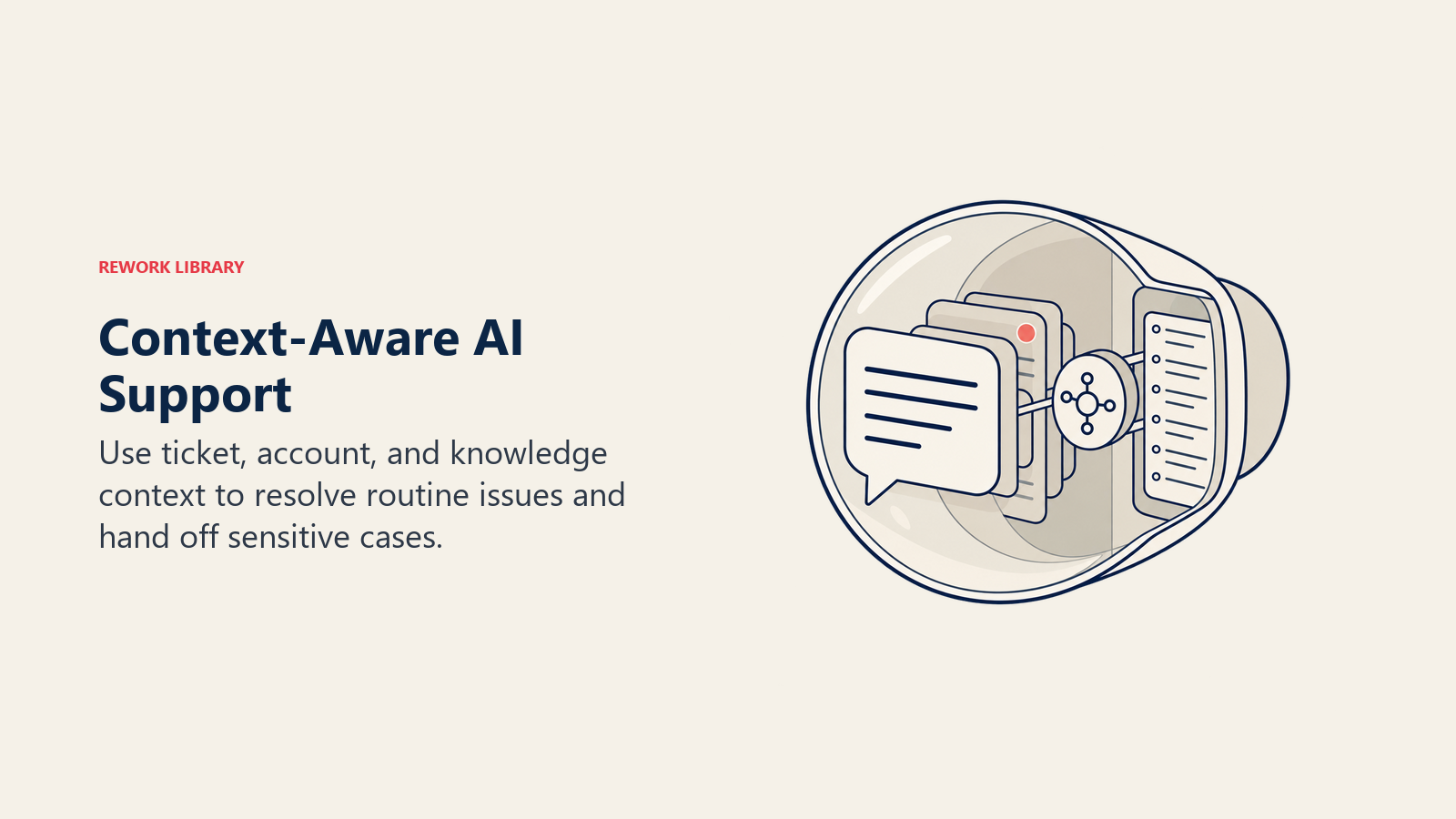
Support is one of the clearest fits for agents anywhere in a business. Volume is high, the common cases are genuinely repeatable, and a clean escalation path already exists in most help desks. The part worth getting right early is the boundary: what the agent resolves alone, what it asks a human about, and what it always hands off. The how an AI agent gets built guide walks through the six parts (role, tools, rules, scenarios, decision logic, guardrails) that make that boundary hold up under real ticket volume.
Key Facts: AI Agents for Customer Support
- Only 14% of customer service issues are fully resolved through self-service today, meaning 86% still end up in a human queue, per a 2024 Gartner survey.
- By 2029, Gartner predicts agentic AI will autonomously resolve 80% of common customer service issues without human intervention, cutting operational costs by 30%.
- As a practical benchmark, a well-configured deflection agent with a solid knowledge base often resolves 40 to 60% of eligible tickets without a human once it's tuned.
That's a wide gap between where most teams are today and where the category is headed. Support leaders feel that gap as headcount pressure: ticket volume keeps climbing while budget for adding people to answer it usually doesn't move at the same pace. Closing it starts with picking the one function below that touches the most tickets right now.
10 AI Agent Use Cases for Customer Support
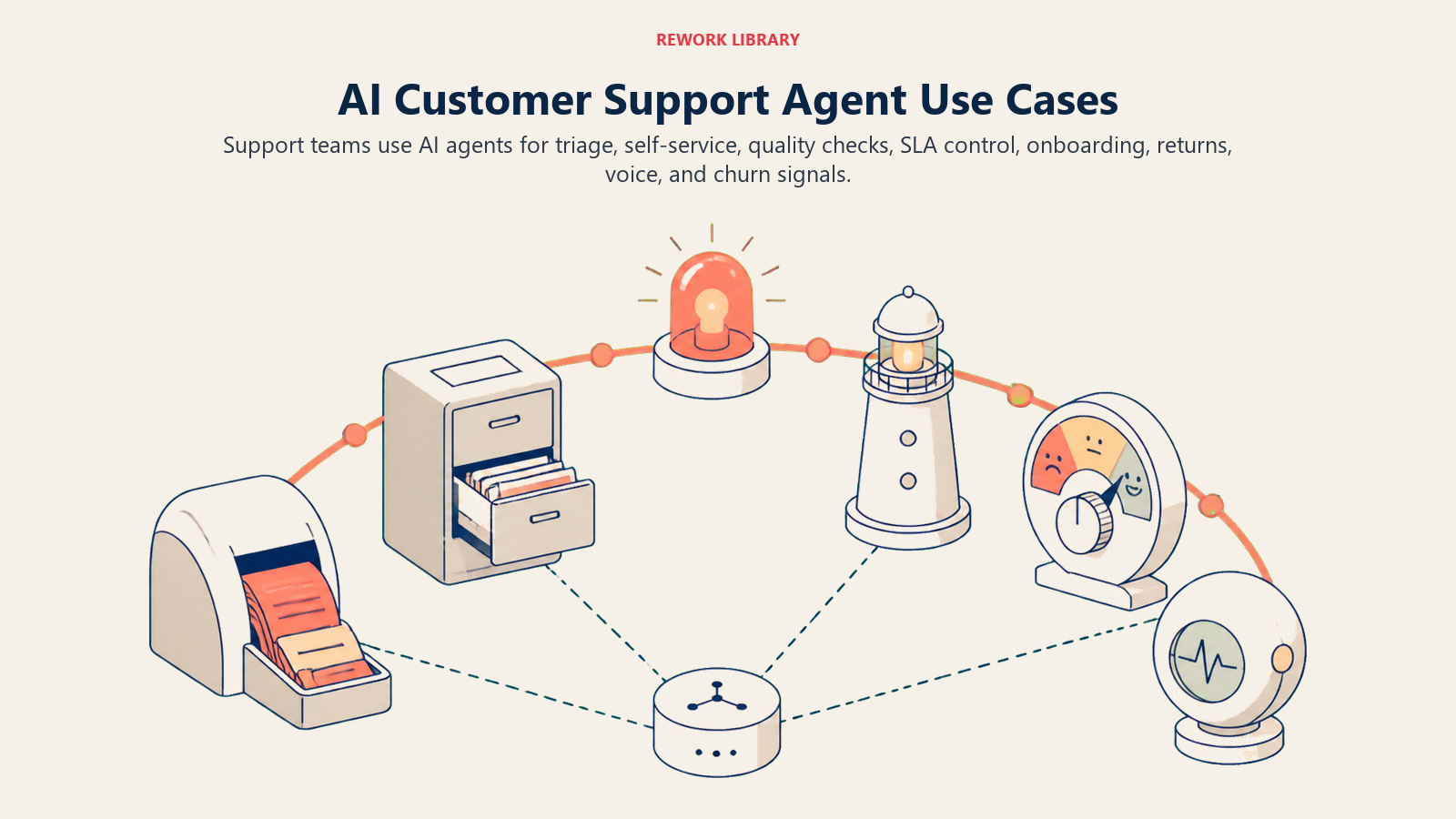
Each row is a distinct job. Support teams usually don't build all of these at once. Pick the one closest to today's biggest queue.
| Support Function | What the Agent Does | Blueprint |
|---|---|---|
| Ticket triage | Reads incoming tickets, classifies urgency and topic, and routes to the right queue or resolves outright | AI Support Triage Agent |
| Self-service deflection | Answers from your documentation only, cites the source article, and flags gaps in your knowledge base | AI Knowledge Base Agent |
| Chatbot quality monitoring | Reviews bot conversations for hallucinations and dead ends so issues get caught in minutes, not a quarterly review | AI Chatbot QA Agent |
| Escalation and SLA tracking | Tracks service level agreement (SLA) deadlines, pings the right owner, and escalates before a ticket breaches | AI Escalation Manager Agent |
| Satisfaction surveys | Times and sends CSAT and NPS surveys, then routes negative responses for fast human follow-up | AI CSAT Survey Agent |
| Review responses | Drafts, and within your approval rules posts, responses to public reviews across platforms | AI Review Response Agent |
| Customer onboarding | Walks new customers through setup steps and nudges the ones who stall out | AI Customer Onboarding Agent |
| Refunds and returns | Handles routine refund and return requests within policy limits, escalates the rest | AI Refund / Returns Agent |
| Voice support | Handles phone-based support interactions using the same rules as your other channels | AI Voice Call Agent |
| Churn risk and renewals | Watches usage and sentiment signals for churn risk and flags accounts before the renewal conversation | AI Renewal / Churn Agent |
Most support teams start with triage or self-service deflection, since those two touch nearly every ticket that comes in and free up first-response time immediately.
What Each Support Use Case Needs Before You Build It
A support agent can only resolve what your documentation covers and only act where your help desk lets it. Check the inputs below first, and decide where a person approves before the agent goes live.
| Use Case | Data and Systems It Needs | Where a Human Approves |
|---|---|---|
| Ticket triage | Help desk access, ticket history, your categories and priority rules, routing queues | Low-confidence or high-priority tickets go to a person; the agent never closes a ticket it is unsure about |
| Self-service deflection | A current knowledge base, product docs, account context | Anything without a matching source article escalates; gaps get logged for your content team |
| Chatbot quality monitoring | Bot conversation logs, a quality rubric, the source docs the bot should use | A support lead reviews flagged conversations and signs off on fixes |
| Escalation and SLA tracking | SLA tiers, ticket timestamps, an on-call or owner roster | A manager owns the escalation matrix; the agent only pings and escalates by it |
| Satisfaction surveys | Ticket status events, customer contact data, survey tool | Negative responses route to a person for follow-up before any reply goes out |
| Review responses | Review platform access, brand voice guide, approved response patterns | Drafts are approved by a person until the rewrite rate is consistently low |
| Customer onboarding | Product usage events, setup checklist, customer segment data | Accounts that stall past a set point go to a customer success manager |
| Refunds and returns | Refund policy, order and payment records, limits by amount | Anything over the policy limit, or outside the written rules, goes to a person |
| Voice support | Telephony integration, the same knowledge base and rules as other channels, call recording consent | An easy way to reach a human at any point in the call; legal reviews recording rules |
| Churn risk and renewals | Usage data, sentiment from tickets and surveys, renewal dates, CRM | A customer success manager decides what to do about a flagged account |
How to Get Started
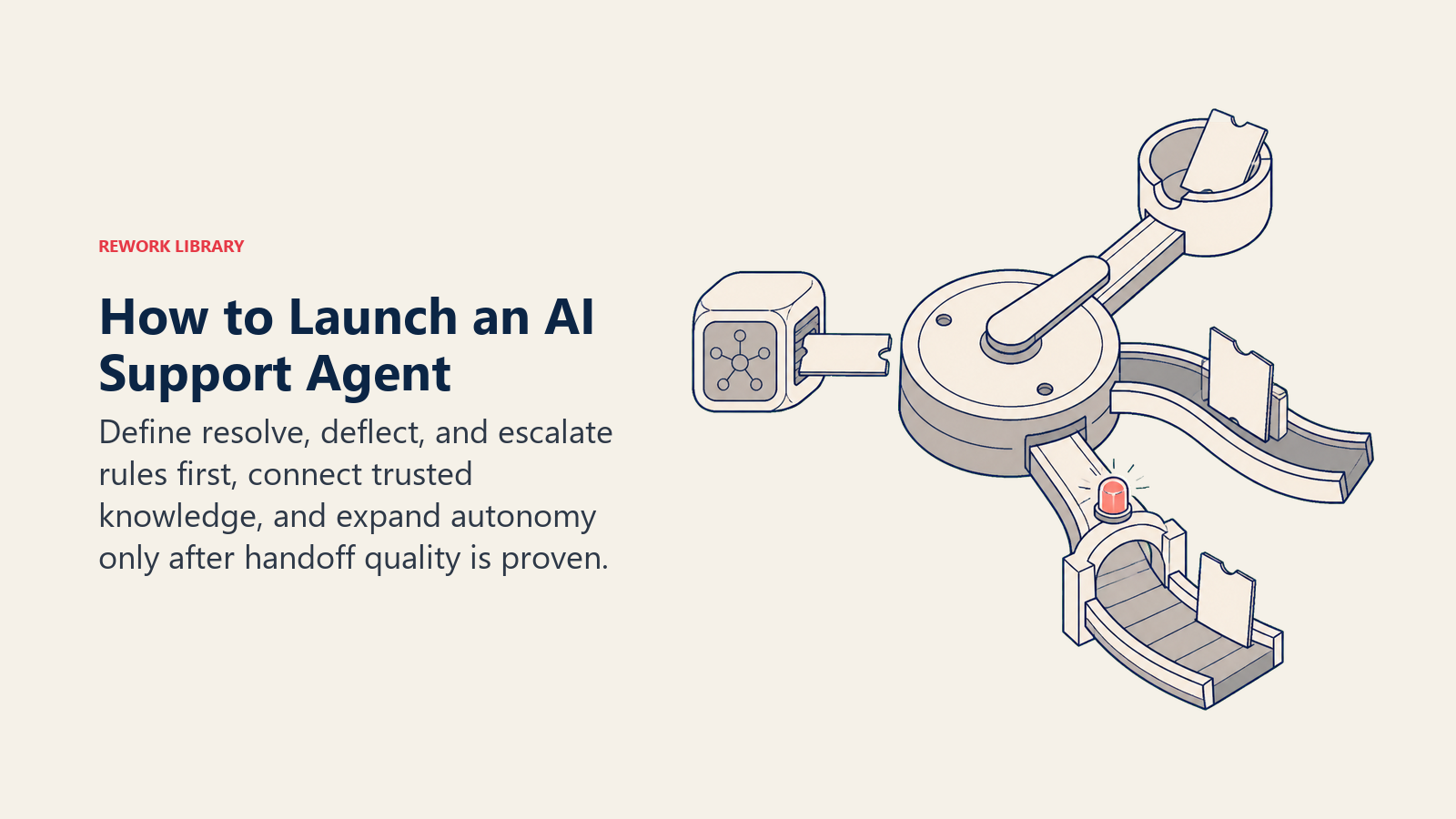
The Resolve, Deflect, or Escalate Test: before you configure anything, decide which of those three every common ticket type should default to. That's the entire shape of a support agent's job, and everything else is detail underneath it.
Write the rules down before the agent needs them. Your knowledge base, your refund policy, your SLA tiers, your escalation matrix: an agent can only be as accurate as what you've documented. Gaps in your docs become gaps in what the agent can safely resolve. The when to use an AI agent guide covers how to tell whether a process is documented well enough yet.
Connect it to your actual help desk. Zendesk, Intercom, and Freshdesk are the most common platforms this class of agent plugs into. If you're still comparing support tools or platforms, the support tools hub and the best AI customer service tools guide cover the current options side by side.
Start with deflection, not full autonomy. Let the agent answer the questions your docs already cover well, and route everything else. Expand its scope only after you can see the handoff accuracy holding up in practice, week over week, not just on a good day.
Watch the false-escalation rate as closely as the deflection rate. A deflection number alone can hide an agent that's quietly frustrating customers by not escalating fast enough. Track both, not just the one that looks good on a dashboard.
Keep the tone consistent across every channel. A customer who gets a warm, on-brand reply in chat and a cold, templated one over email notices the gap. Configure the agent's voice once, in writing, and apply it everywhere it operates instead of tuning it separately per channel.
How to Measure a Support Agent
Pull a baseline from your help desk before the pilot starts. Then watch quality metrics next to volume metrics, because volume alone can hide an agent that is closing tickets customers did not consider solved.
- Triage and deflection: deflection rate, first-response time, and handoff accuracy (how many escalations genuinely needed a person).
- Quality and satisfaction: CSAT on agent-handled tickets specifically, the reopen rate, and the false-escalation rate.
- SLA and escalation: the share of tickets that breach SLA, and how early the agent flagged the ones at risk.
- Refunds, onboarding, and churn: policy exceptions caught, setup completion rate, and how many flagged accounts a person actually acted on.
Where to Go Next
Start with whichever row in the table above matches today's biggest queue. If it's incoming ticket volume, read the AI Support Triage Agent blueprint first. If it's repetitive questions your docs already answer, start with the AI Knowledge Base Agent. Both share the same underlying design covered in how to build an AI agent.
Buying a Ready-Made Agent?
If you'd rather buy than build, see our ranked list of AI agents for customer service teams. It compares ready-made products and pricing, so you can judge vendors against the same use cases listed above.
