AI Agent Observability and Monitoring
Turn this article into takeaways for your work.


Each assistant summarizes the article only for you and suggests best practices for your work.
AI agent observability is the practice of instrumenting an agent so you can see every pass of its loop: what triggered it, what it decided, which tools it called and what came back, and where it handed off to a person. It goes further than watching whether a single output looks right, because an agent doesn't produce one output. It runs a chain of decisions and actions across a task, and a failure can hide anywhere in that chain. Without observability, you're trusting an autonomous system you can't actually see inside.
Why This Isn't the Same as Watching a Model
AI observability already covers the general case: logs, metrics, traces, and evaluations that tell you what an AI system is doing across its data pipeline, its model calls, and its outputs. Everything in that foundation still applies to agents. What changes is the unit you're watching.
A single model call has one input and one output. You can log it, score it, and move on. An agent run is a sequence, sometimes five steps, sometimes twenty, each one a fresh decision built on what happened in the step before. How AI agents work describes that sequence as a loop: perceive, reason, act, observe, repeat. Notice the word "observe" is already in there. That's the agent checking its own tool output before deciding what to do next, an internal, momentary check. Agent observability is a different thing: it's you watching the whole loop from outside, across every run, over time. The agent's internal observe step tells it whether one tool call worked. Your observability layer tells you whether the agent has been quietly making the wrong call for two weeks.
That distinction matters because an agent that's technically running fine, no crashes, no errors, can still be doing the wrong thing. It might call the right tool with subtly wrong parameters, loop through the same failed step a few extra times before giving up, or hand off to a human far more, or far less, than it should. None of that shows up as an error. All of it shows up in a trace, if you're capturing one.
What to Trace in a Single Agent Run
Treat every agent run as one traceable unit with a single ID that follows it from start to finish. At minimum, capture:
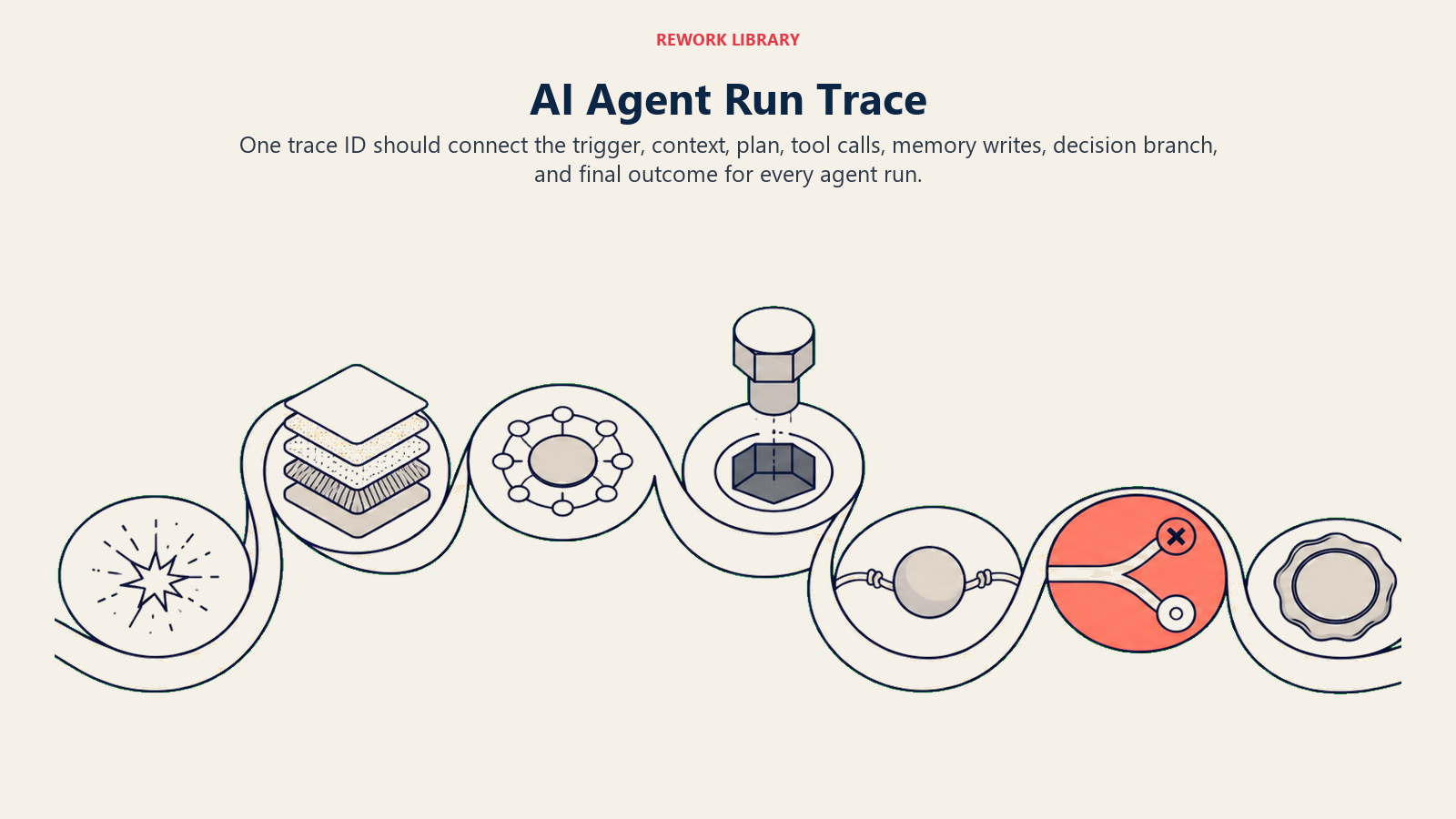
| Stage | What to record |
|---|---|
| Trigger | What started the run: a new message, a record change, a schedule |
| Context pulled | Which records, documents, or memory the agent read before deciding |
| Reasoning | The plan or next action chosen, and why, if your platform can surface it |
| Tool calls | Every tool called, the parameters sent, and the raw result returned |
| Memory writes | What the agent stored for later steps or later runs |
| Decision branch | Whether it acted automatically, asked a clarifying question, or handed off |
| Outcome | Goal met, stopped early, escalated, or failed, and why |
That last column, the "why," is the part teams skip and then regret. A log that says "handed off to human" tells you almost nothing. A log that says "handed off: reply contained a pricing question, outside agent's scope per rule 4" tells you whether the agent is handing off correctly or just handing off everything to stay safe. The decision logic building block covered in how AI agents work is exactly what you're auditing here, and you can't audit a rule you never logged.
The Metrics That Actually Matter for Agents
General AI metrics (latency, cost per request, error rate) still apply, but they don't tell the full story for something that runs in a loop. A handful of agent-specific metrics catch problems those general numbers miss.
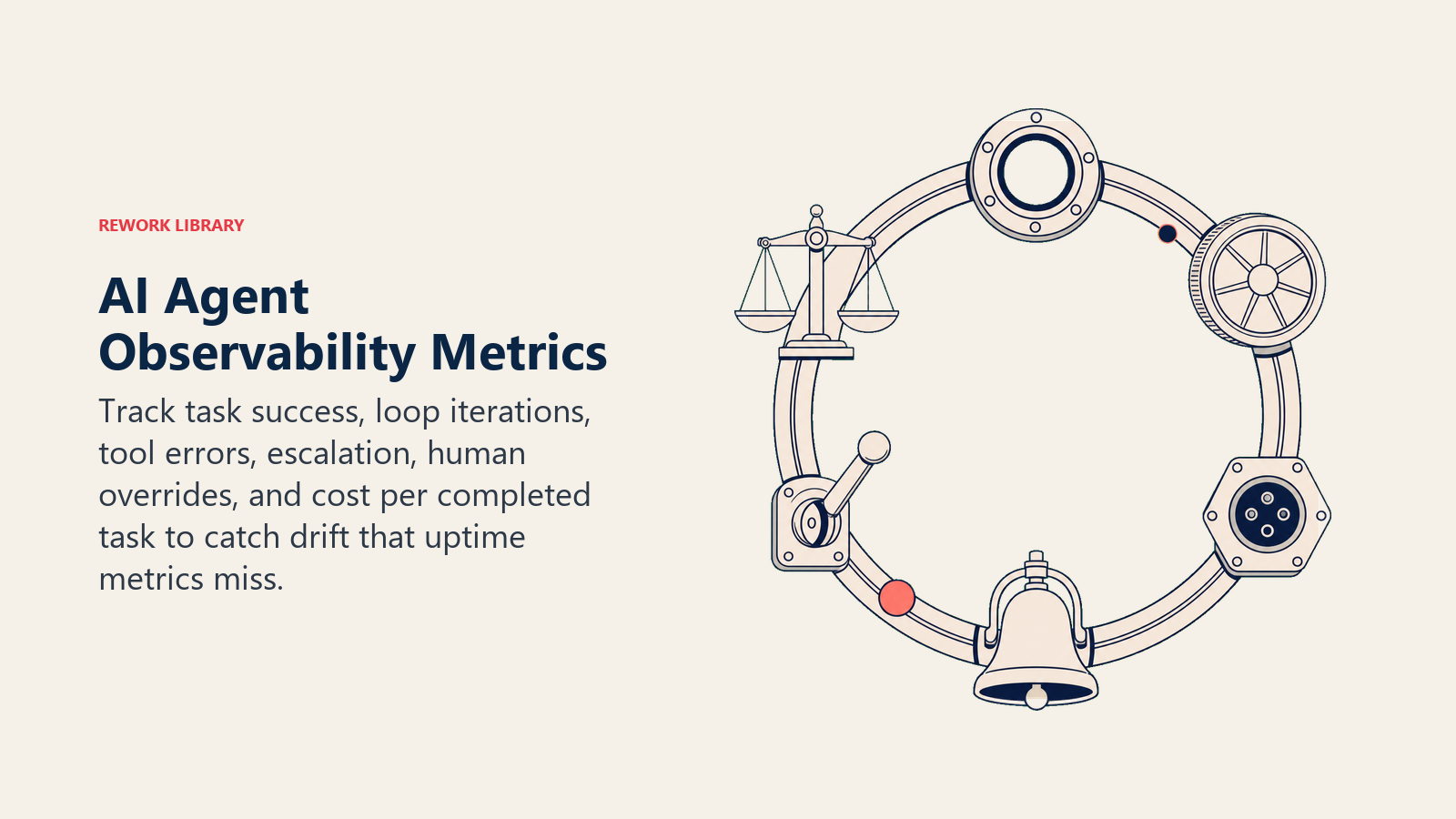
| Metric | What it tells you |
|---|---|
| Task success rate | Of all runs, how many actually reached the goal, not just finished without crashing |
| Loop iterations per run | A rising average often means the agent is struggling, not just being thorough |
| Tool call error rate | How often a tool call fails or returns something the agent mishandles |
| Escalation rate | What share of runs hand off to a human, and whether that share is trending up or down |
| Human override rate | How often a person reverses or corrects what the agent did, even when it didn't escalate |
| Cost per completed task | Total tokens and tool calls spent per successful outcome, not per run |
Escalation rate and override rate deserve more attention than they usually get. A rising escalation rate isn't automatically bad; it might mean the agent is correctly recognizing harder cases. But a rising override rate, humans quietly fixing what the agent did after the fact, is close to the clearest signal you'll get that something in the decision logic has drifted. Nobody is telling the agent it's wrong; they're just cleaning up behind it.
Failure Modes That Only Show Up in Agents
A few failure patterns are specific to loop-based systems and won't appear in a single-call observability setup at all.
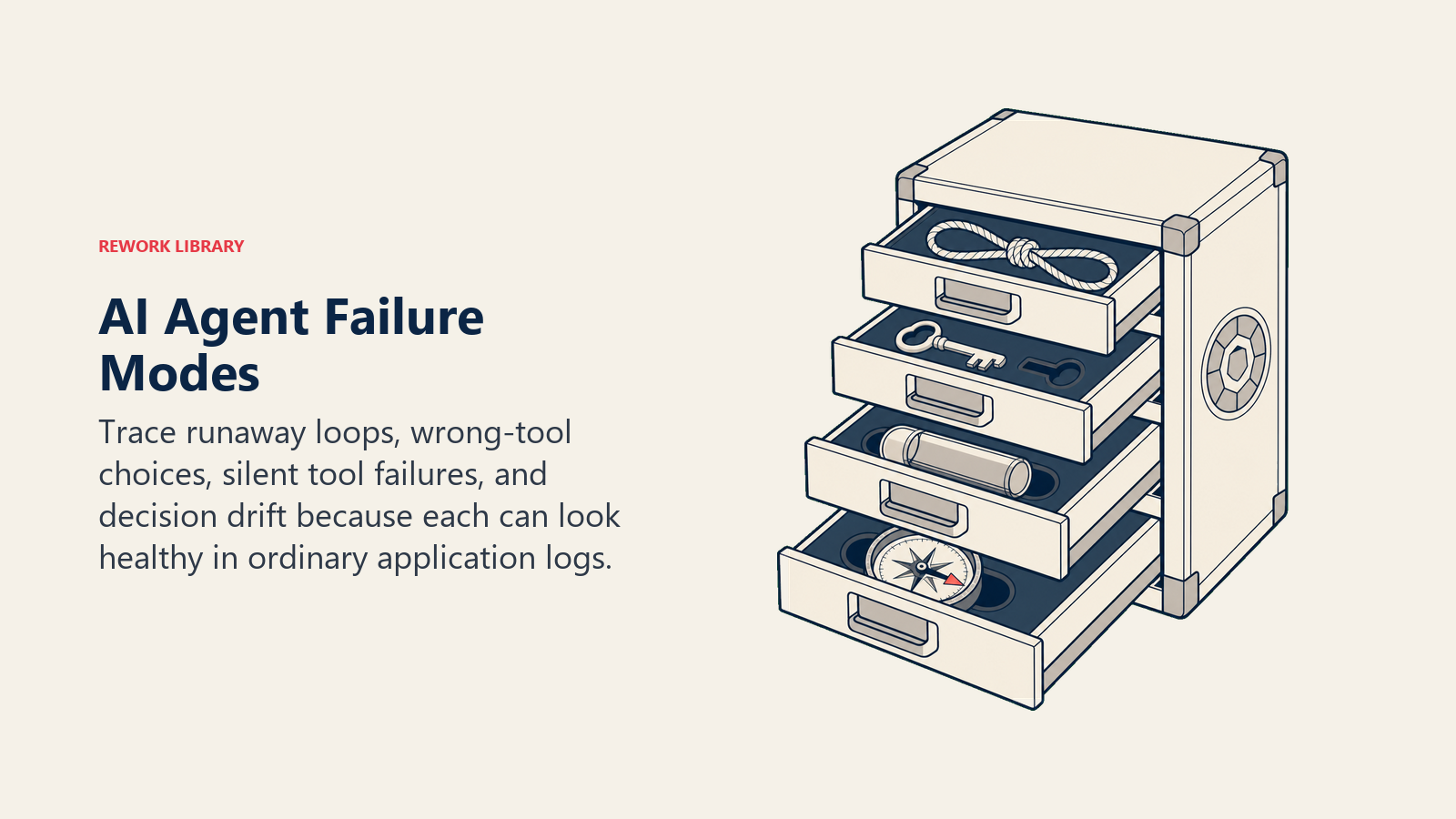
Runaway loops. The agent keeps trying a variation of the same failed action instead of stopping or asking for help. Without an iteration count per run, this looks like normal activity in your logs right up until the token bill arrives.
Wrong tool, right confidence. The agent picks a plausible-sounding tool for the situation and calls it correctly, but it's the wrong tool for the goal. The call succeeds, so nothing errors. Only a trace against the actual outcome catches it.
Silent tool failures. A tool call returns a result, but not the one the agent needed: an empty search, a stale cache hit, a partial record, and the agent proceeds as if it had what it needed. The Hallucination Risk by AI Pattern framing is useful here even outside a pure retrieval context: an agent that isn't checking whether its retrieved context is actually sufficient will confidently act on gaps.
Decision-logic drift. The agent's behavior on a given situation type slowly changes, not because you edited a rule, but because the underlying model version changed, a tool's output format changed, or an edge case started appearing more often. This is what evals are built for: sampling completed runs against a fixed rubric on a schedule, not just when something visibly breaks.
These are also, not coincidentally, close to the reasons agentic AI projects stall out. Gartner predicts that over 40% of agentic AI projects will be canceled by the end of 2027, citing escalating costs, unclear business value, and inadequate risk controls as the leading reasons. All three of those are observability problems in disguise. You can't manage a cost you're not tracking per task, you can't prove business value you're not measuring against a success rate, and you can't control a risk you can't see.
The visibility gap is measurable, too. In a 2026 Cloud Security Alliance survey on securing autonomous agents, only 28% of organizations said they could reliably trace an agent's actions back to a human or system across all their environments, and just 45% had end-to-end session tracing in place at all. Most teams running agents today are flying with partial instruments.
A Practical Starting Stack
You don't need a full platform on day one. A reasonable build order:
- Structured per-run logging first. Trigger, trace ID, every tool call and result, final outcome. This alone makes debugging a specific bad run possible instead of guesswork.
- Sample and review your highest-stakes agent. Pick the one agent with the most consequential actions, the one that touches money, customer data, or external communication, and have a person read 20 to 50 of its runs a week. This catches drift long before a metric would.
- Add distributed tracing once runs get long. When an agent chains several tools together, you need timing and outcome data at each step, not just a start and end time.
- Layer in automated evals last, once you have enough human-reviewed runs to calibrate what "good" looks like. An automated scorer with no human baseline just gives you a confident, ungrounded number.
The same evaluation and tracing tooling used for general AI observability, the kind covered in the AI observability overview, works for agents too. What's different is what you point it at: not a single response, but the whole run.
If you're evaluating engineering tooling to build this instrumentation on, our dev tools comparison covers platforms that support this kind of tracing and monitoring, and how to choose a DevOps platform walks through the CI/CD and monitoring questions worth asking before you commit to one.
Key Facts
- Agent observability traces the whole loop (perceive, reason, act, observe, repeat) across a run, not just a single model output.
- Log every tool call, its parameters, its result, the decision branch taken, and the reason for that decision, all under one trace ID per run.
- Task success rate, loop iterations, escalation rate, and human override rate catch problems that latency and error rate miss.
- Only 28% of organizations can reliably trace an agent's actions back to a human or system across all environments, per a 2026 Cloud Security Alliance survey.
- Gartner attributes over 40% of agentic AI project cancellations by 2027 to costs, unclear value, and weak risk controls, all things observability is built to catch.
Frequently Asked Questions about AI Agent Observability
What is AI agent observability?
It's the practice of instrumenting an AI agent so you can see what happens across its entire run: the trigger, the context it pulled, every tool call and result, the decision it made, and how it ended. It extends general AI observability to cover the multi-step loop agents run instead of a single model call.
How is agent observability different from regular AI observability?
General AI observability watches a system's logs, metrics, and traces, usually centered on individual model calls. Agent observability watches a full chain of decisions and tool calls that make up one run, under a single trace ID, because a failure in an agent can hide in any step of that chain even when no single step throws an error.
What should you log for every agent run?
At minimum: the trigger, the context the agent pulled in, the plan or action it chose, every tool call with its parameters and result, anything written to memory, which decision branch it took (act, ask, or hand off), and the final outcome with a reason.
What metrics matter most for AI agents?
Task success rate, loop iterations per run, tool call error rate, escalation rate, and human override rate. Override rate in particular, how often a person quietly corrects what the agent did, is one of the clearest early signs of decision-logic drift.
Do you need specialized tools for agent observability?
Not to start. Structured logging with a consistent trace ID gets you most of the way. Purpose-built tracing and evaluation platforms help once you have multiple agents running in production and need to compare runs at scale, but they're an upgrade, not a prerequisite.
Where to Go Next
Observability tells you what your agent is actually doing. Pairing that with AI agent security closes the other half of the picture: knowing not just what the agent did, but whether it was tricked into doing it. If you're still scoping which functions are ready for an agent in the first place, when to use an AI agent is a good next read, and the AI Risk Monitoring Agent and AI Security Monitoring Agent blueprints are worth studying too, since both are built almost entirely around the watch-and-alert pattern this article describes. Observability watches your own agents; if the question is the reverse, what other people's assistants say about your company, how to measure AI visibility covers the methods and their limits.
