AI Agents for Sales: 11 Use Cases to Deploy First (2026)
Turn this article into takeaways for your work.


Each assistant summarizes the article only for you and suggests best practices for your work.
A rep has 40 target accounts this week. She needs to research each one, draft real outreach, log every touch, and follow up on time. In practice, she gets through maybe half of that well. The rest gets rushed or skipped. That's the gap AI agents are built to close: not replacing the rep, but covering the repeatable work she doesn't have hours for.
This page is a map, not a pitch. It shows you which sales functions are a good fit for an AI agent, what each one actually does, and which real blueprint to open next. If you want the underlying definition first, start with what an AI agent actually is. If you already know what you're looking for, jump straight to the table below.
What AI Agents Actually Do for a Sales Team
An AI agent isn't a chatbot bolted onto your CRM, and it isn't a fixed automation running the same three steps no matter what happens. It reads the account, decides what the situation calls for, takes an action in your systems (sends an email, updates a stage, books a meeting), and hands off to a rep the moment the conversation needs a human judgment call: pricing, negotiation, or a relationship the agent doesn't have the context for.
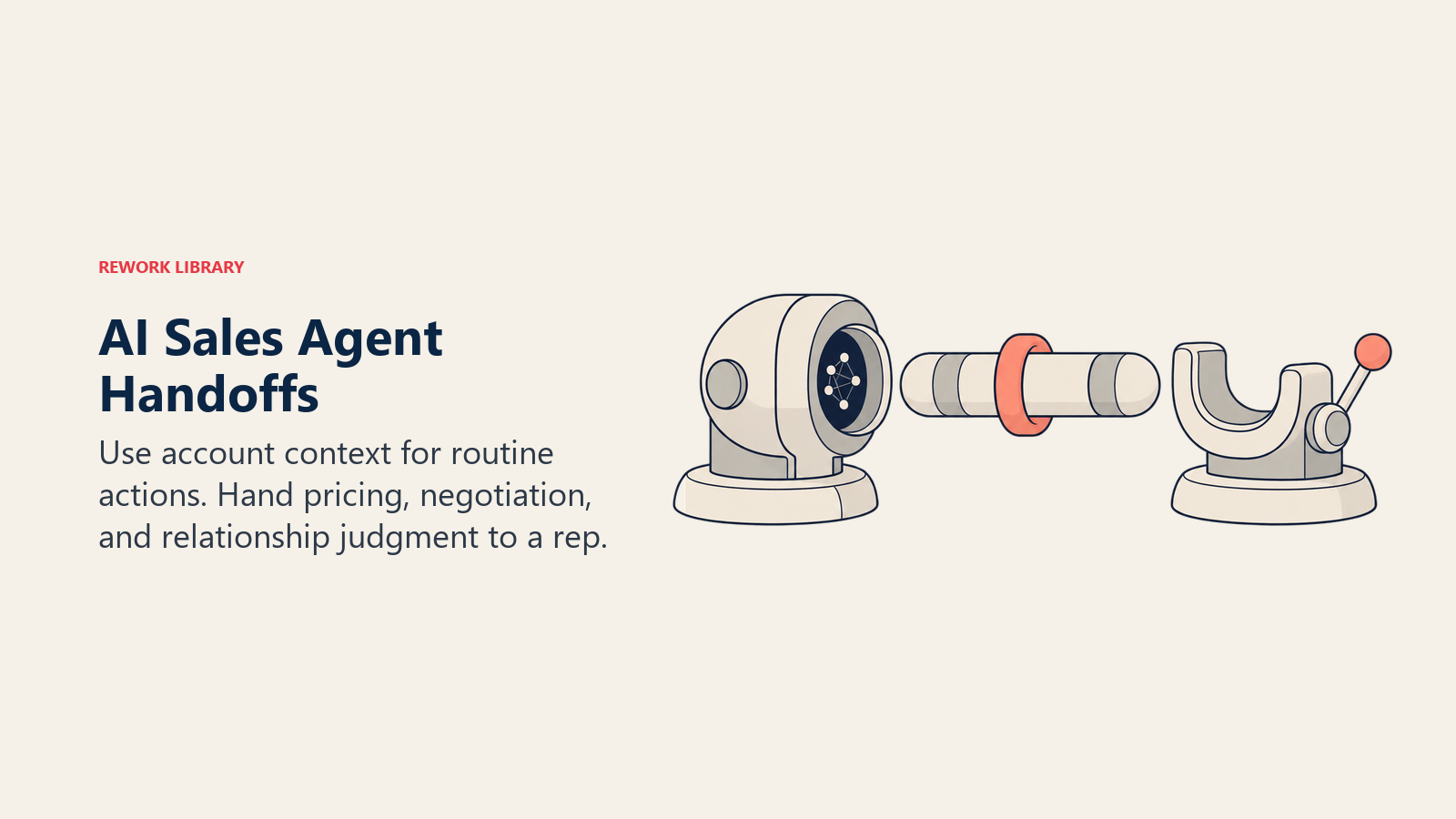
That handoff is the part worth understanding before you deploy anything. A well-built sales agent isn't judged by how much it automates. It's judged by how cleanly it knows when to stop. The how an AI agent gets built guide walks through the six parts that make that boundary reliable: role, tools, rules, scenarios, decision logic, and guardrails.
Key Facts: AI Agents for Sales
- AI saves sellers nearly five hours per week on average, but 72% of sales organizations fail to reinvest that time in high-value selling activity, per a Gartner survey of 210 chief sales officers (May 2026).
- Mature AI deployments in sales and marketing can increase leads by more than 50% and cut prospecting costs by up to 60%, according to McKinsey.
- Gartner projects that by 2027, 95% of seller research workflows will start with AI, up from under 20% in 2024.
The first stat is the one worth sitting with. The time savings are already real. Whether they turn into revenue depends on what you point the freed-up hours at, which is exactly why picking the right first agent matters more than automating everything at once.
11 AI Agent Use Cases for Sales Teams
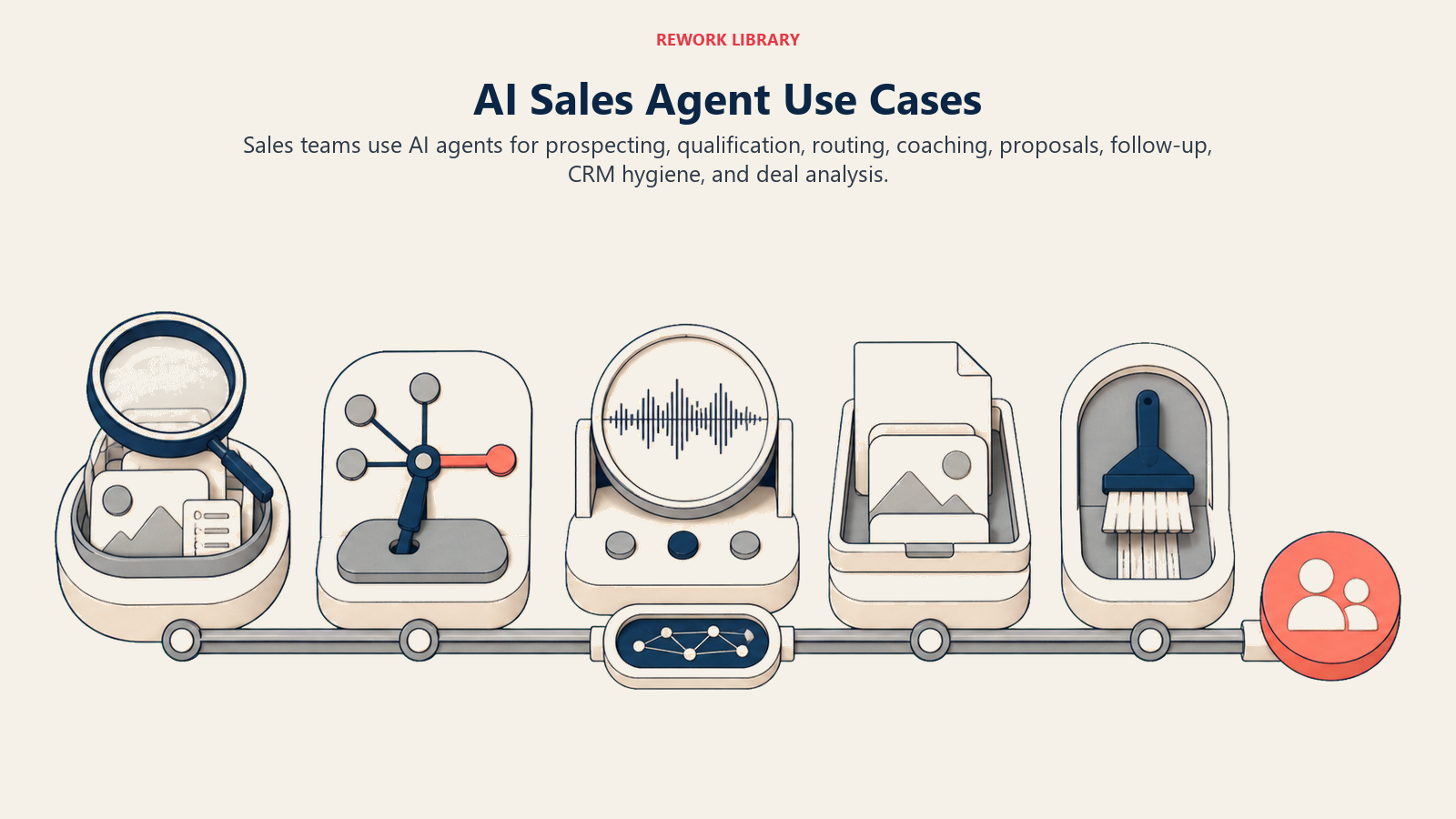
Each row below is a distinct job, not a feature. Pick the one that matches your loudest bottleneck first: where reps lose the most hours, or where deals stall the most often.
| Sales Function | What the Agent Does | Blueprint |
|---|---|---|
| Outbound prospecting | Researches accounts, drafts personalized sequences, follows up on schedule, hands off warm replies | AI SDR Agent |
| Pre-call and account research | Pulls firmographic and intent data into a briefing before every call or account touch | AI Account Research Agent |
| Inbound lead qualification | Scores and qualifies inbound leads against your ideal customer profile (ICP) before a rep spends time on them | AI Lead Qualifier Agent |
| Lead scoring and prioritization | Ranks the working list continuously so reps always know who to call next | AI Lead Scoring Agent |
| Lead routing | Sends each lead to the right rep or team by territory, size, or product fit the moment it arrives | AI Lead Routing Agent |
| Call and deal coaching | Reviews every rep call, not just the two a manager has time for, and flags coaching moments | AI Sales Coach Agent |
| Proposal and quote drafting | Assembles pricing-approved proposals and quotes from deal data instead of a rep starting from a blank doc | AI Proposal / Quote Agent |
| Follow-up discipline | Keeps every open deal on a follow-up cadence so nothing goes quiet when the pipeline gets full | AI Follow-Up Agent |
| CRM data hygiene | Cleans, dedupes, and fills gaps in CRM records so forecasting and routing run on accurate data | AI CRM Hygiene Agent |
| Competitive intelligence | Tracks competitor moves and surfaces the right battlecard the moment a deal needs it | AI Competitive Intelligence Agent |
| Win-loss analysis | Analyzes closed deals for the real reasons behind wins and losses, not the guessed ones | AI Win-Loss Analysis Agent |
Most sales orgs start with whichever row touches the most reps every single day. For a lot of teams that's prospecting or follow-up, since those are the two jobs that quietly slip first once a quarter gets busy. Which one is it for yours?
What Each Sales Use Case Needs Before You Build It
An agent is only as good as the data it can read and the rules it can follow. Before you open a blueprint, check that your CRM and your written process cover the inputs below, and decide in advance where a rep signs off.
| Use Case | Data and Systems It Needs | Where a Human Approves |
|---|---|---|
| Outbound prospecting | Written ICP, an account and contact source, CRM, a sending domain with warm-up history | A rep reviews the first sequence for each new segment; every warm reply goes to a person |
| Account research | CRM account records, firmographic and intent data, past call notes | Read-only briefs need no gate; a rep checks facts before they appear in outreach |
| Inbound qualification | Form and lead data, ICP and qualification criteria, CRM | Borderline scores route to a rep instead of auto-rejecting |
| Lead scoring | Won and lost deal history, engagement data, CRM | Sales ops reviews score thresholds on a fixed schedule |
| Lead routing | Territory, segment, and capacity rules; rep availability | Ops approves any rule change; conflicts and ties go to a manager |
| Call and deal coaching | Call recordings or transcripts, a coaching scorecard | A manager reviews flags before any feedback reaches a rep |
| Proposal and quote drafting | Approved price book, discount rules, deal data, proposal templates | Every send, and any discount above your threshold, needs sign-off |
| Follow-up discipline | Deal stages, activity history, email and calendar access | A rep approves messages on high-value or sensitive deals |
| CRM data hygiene | CRM records, dedupe and required-field rules, an audit log | Merges and deletions are logged and reversible; bulk changes need approval |
| Competitive intelligence | A list of approved sources, your battlecard library | Product marketing approves any new claim before it reaches a battlecard |
| Win-loss analysis | Closed-deal records, call notes, recorded loss reasons | An analyst validates the themes before they drive decisions |
How to Get Started
The Loudest Bottleneck Rule: build your first agent for whichever job costs you the most deals or the most hours today, not the one that sounds the most impressive in a demo.
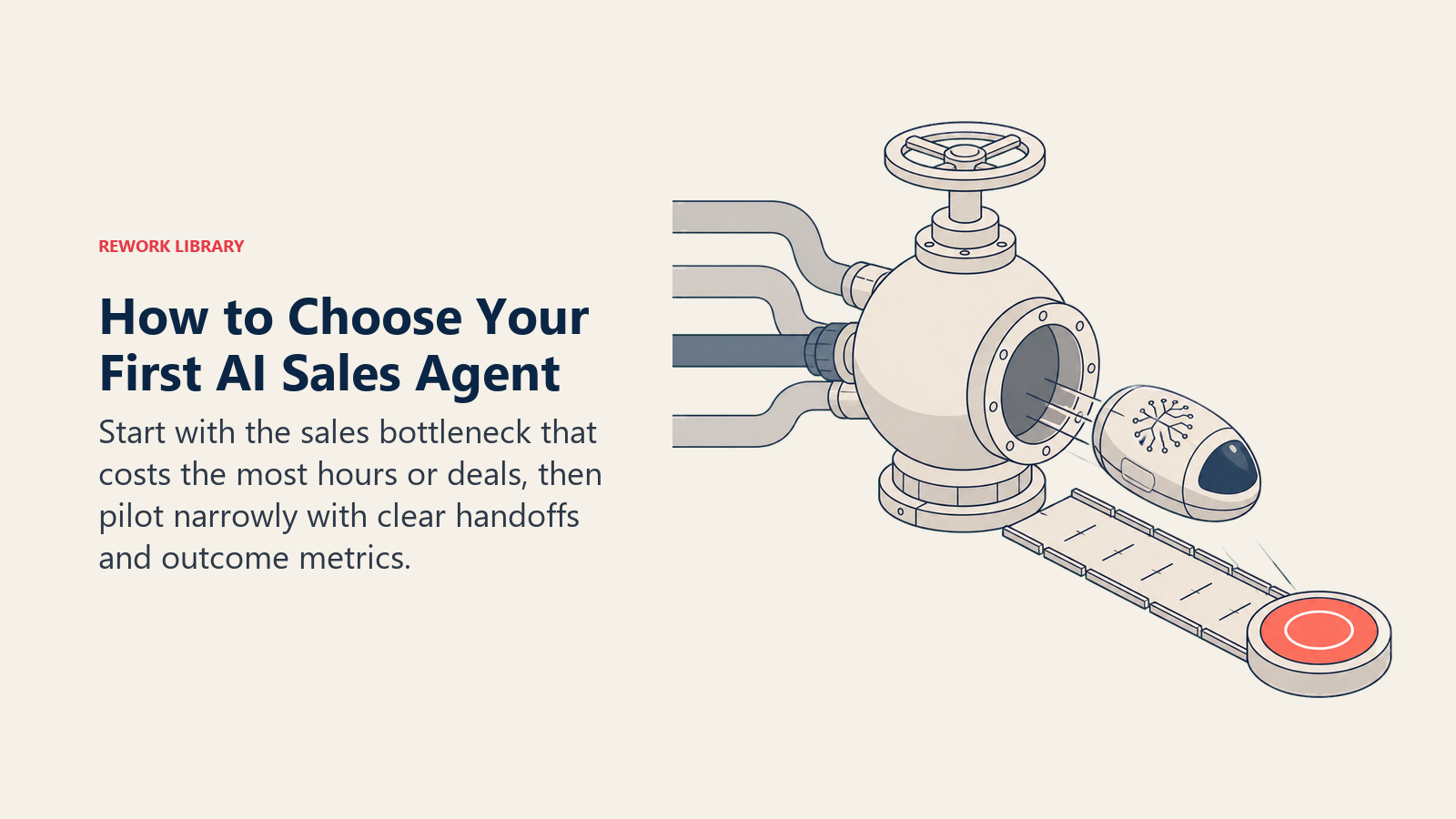
Define the process on paper first. An agent can only enforce rules you've actually written down: your ICP, your qualification criteria, your follow-up cadence, your escalation points. If that process only lives in your best rep's head, write it down before you automate it. The when to use an AI agent guide covers the signals that tell you a process is ready to hand to an agent, and the signals that say it isn't yet.
Connect it to a real CRM, not a spreadsheet. Every blueprint above needs somewhere to read lead data, log activity, and update stages. If you're still comparing CRMs or sales engagement platforms, the sales engagement tools hub and the best AI sales tools guide cover the current options side by side.
Pilot on a slice, not the whole team. Run the agent on one segment or one territory for a few weeks before rolling it out everywhere. You'll catch the edge cases your rules missed while the blast radius is still small.
Set the handoff before you set the automation. Decide what the agent handles alone, what it asks about, and what it always routes to a human, before it goes live. Every blueprint above documents this explicitly for its function, and that decision matters more than how much the agent automates.
Measure the metric that matters, not just volume. More emails sent or more calls logged isn't the win. Meetings booked, qualified pipeline created, and rep hours reclaimed for actual selling are.
How to Measure a Sales Agent
Record a baseline for two to four weeks before the pilot starts, so you have something honest to compare against. Then track the outcome each use case exists to change.
- Prospecting and follow-up: meetings booked and reply quality, not emails sent. Also track how often a rep rewrites what the agent drafted.
- Qualification, scoring, and routing: speed to first touch, and how often reps override a score or a route. A high override rate means the rules need work.
- Research, coaching, competitive intelligence, and win-loss: whether reps actually open and use the output, and how many flagged coaching moments get acted on.
- Proposals and CRM hygiene: time from request to sent quote, pricing errors caught at approval, and the share of records with every required field filled.
Frequently Asked Questions about AI Agents for Sales
What's the first AI agent a sales team should build?
Start with whichever job touches the most reps every day and has the clearest rules, usually outbound prospecting or follow-up discipline. Both run on well-documented cadences, so there's less risk of the agent needing judgment it doesn't have.
Do AI sales agents replace SDRs or account executives?
No. They take over the repeatable, high-volume parts of the job (research, sequencing, data entry, follow-up timing) so reps spend more time on the conversations that need a human: negotiation, objection handling, and relationship building.
What data does a sales agent need to work well?
A defined ICP, a CRM with clean and current lead data, and a documented process for the function it's covering. An agent without a written ICP wastes effort on bad-fit accounts, and an agent without clean CRM data has nothing reliable to act on.
How is an AI sales agent different from a sales engagement platform?
A sales engagement platform is a tool the agent uses, not the agent itself. Sequencing software sends what it's told to send. An agent decides what to send, when to send it, and when to stop, based on context the platform doesn't reason about on its own.
Can a small sales team use AI agents, or is this only for enterprise?
Small teams often see the fastest payoff, since they have the least spare capacity to absorb research, data entry, and follow-up manually. Start with one narrow agent instead of trying to automate the whole funnel at once.
How long before a sales agent shows results?
Most teams see the automation itself working within a few weeks. The bigger factor is trust: give it a defined pilot window, track handoff accuracy alongside volume metrics, and expand once both hold up.
Where to Go Next
Pick the row from the table above that matches your biggest bottleneck this quarter, and read that blueprint end to end before touching anything else. Each one includes the exact rules, decision logic, and a drop-in starter prompt you can adapt. If prospecting is the gap, start with the AI SDR Agent. If it's pipeline follow-through, start with the AI Follow-Up Agent. Either way, the how to build an AI agent guide is the shared foundation underneath all of them.
Buying a Ready-Made Agent?
If you'd rather buy than build, see our ranked list of AI agents for sales teams. It compares ready-made products and pricing, so you can judge vendors against the same use cases listed above.
