RAG for AI Agents: Grounding Agents in Your Data
Turn this article into takeaways for your work.


Each assistant summarizes the article only for you and suggests best practices for your work.
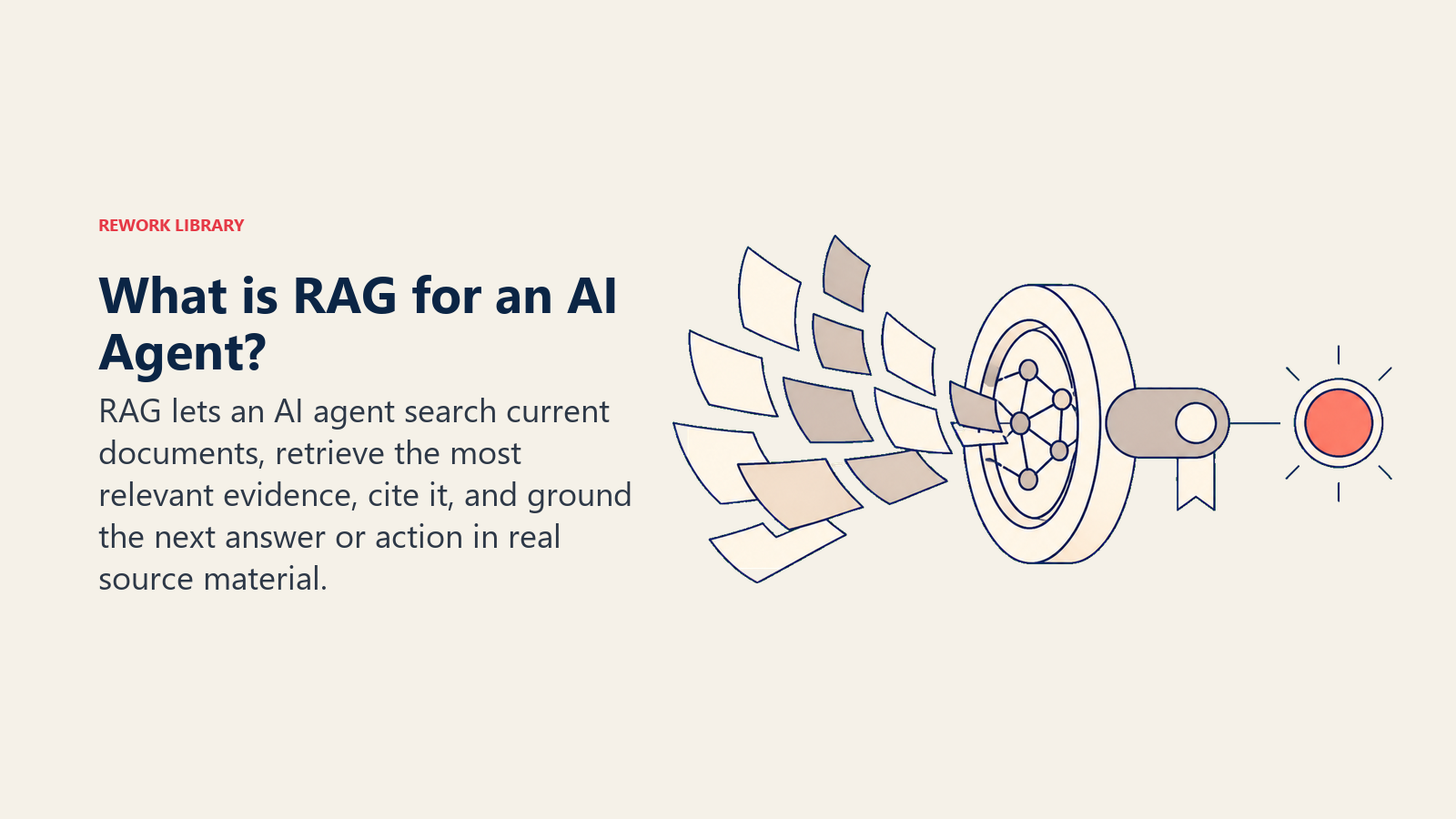
RAG, retrieval-augmented generation, is how an AI agent answers and acts using your actual documents and data instead of guessing from whatever a model happened to learn during training. The agent turns a question or task into a search, retrieves the most relevant chunks from a knowledge base, and generates its next step from only what it found, citing the source. For an agent, RAG isn't a bolt-on feature. It's the grounding layer that keeps every action tied to something real and current.
RAG in One Sentence, for an Agent
The core mechanic: retrieve first, generate second, and never skip the retrieval step. Retrieval-augmented generation as a technique was introduced by Lewis et al. in 2020, pairing a search step with a language model so the output is grounded in specific, verifiable source material rather than general training knowledge. Gartner recognized how central this has become to enterprise AI, publishing a dedicated Market Guide for Enterprise AI Search in September 2025 that names the convergence of search, RAG, and agentic AI as a primary market driver.
That glossary page covers the mechanics in depth: vector embeddings, the retrieval pipeline, chunking. The RAG Assistant pattern covers the standalone use case in depth too, a chatbot that retrieves once and answers, with its own ROI numbers and failure-mode breakdown. This page is about something narrower: how retrieval fits inside an agent that also reasons, uses tools, and takes action, not just a Q&A bot that answers and stops.
Why an Agent Needs Retrieval, Not Just a Bigger Prompt
The tempting shortcut is to skip retrieval and paste everything the agent might need straight into its prompt. That breaks down fast, for three reasons.
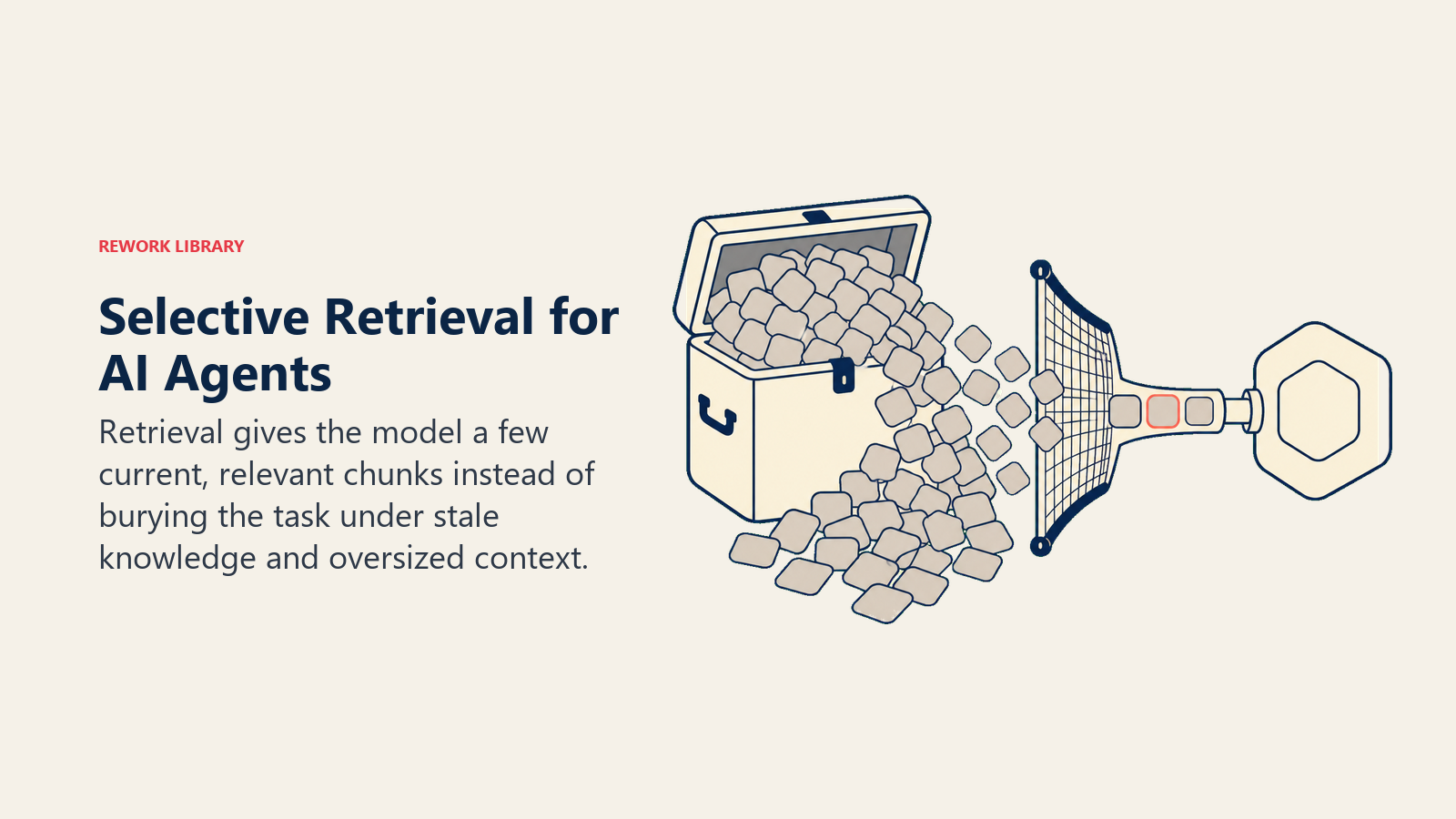
First, training knowledge goes stale the day it's frozen. A model trained months ago has no idea your return policy changed last week or that a customer's contract renewed yesterday. Retrieval pulls from a live source, so the answer is only ever as old as your last document update.
Second, a bigger context window isn't a free pass. Stuffing a full knowledge base into every prompt costs more in tokens and latency on every call, and research on long-context performance has repeatedly found that models don't use everything in a large context evenly. Relevant information gets missed more often the deeper it's buried, especially in the middle of a long input. Retrieval solves this by handing the model only the handful of chunks actually relevant to this specific question, instead of everything you own. AI Agent Memory covers this context-window limitation in more depth, since it's really a memory problem as much as a retrieval one.
Third, retrieval beats fine-tuning for anything that changes. Fine-tuning bakes knowledge into a model's weights, expensive to redo and stale again the moment a source document changes. Retrieval reads from the source at the moment of the question, so the next time someone asks, it already has the update.
Where Retrieval Sits in the Agent Loop
An agent doesn't retrieve once at the start and stop. Retrieval usually happens during perceive, when the agent gathers the context it needs to act, and it's really a tool call like any other: "search the knowledge base" sits in the agent's tool list next to "check the CRM" and "book the meeting."
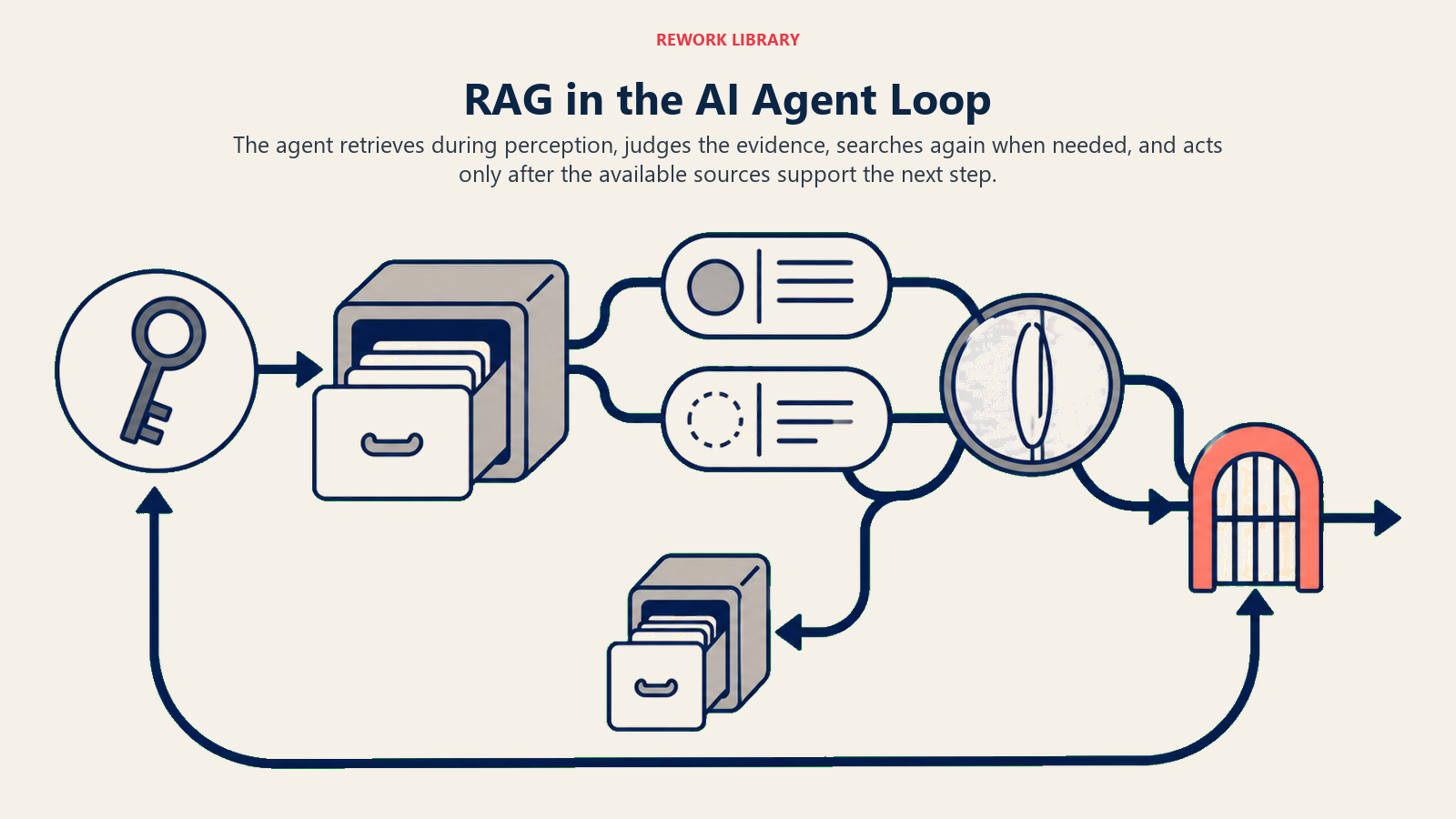
The difference between a standalone RAG chatbot and an agent using RAG shows up here. A standalone assistant retrieves once and answers. An agent can look at what it got back, notice the result is incomplete or contradictory, retrieve again with a narrower query, and only then decide what to do. That loop, retrieve, reason about what came back, maybe retrieve again, then act, is what makes it agentic instead of a single-shot lookup.
RAG vs. Tools vs. Memory: Picking the Right Grounding
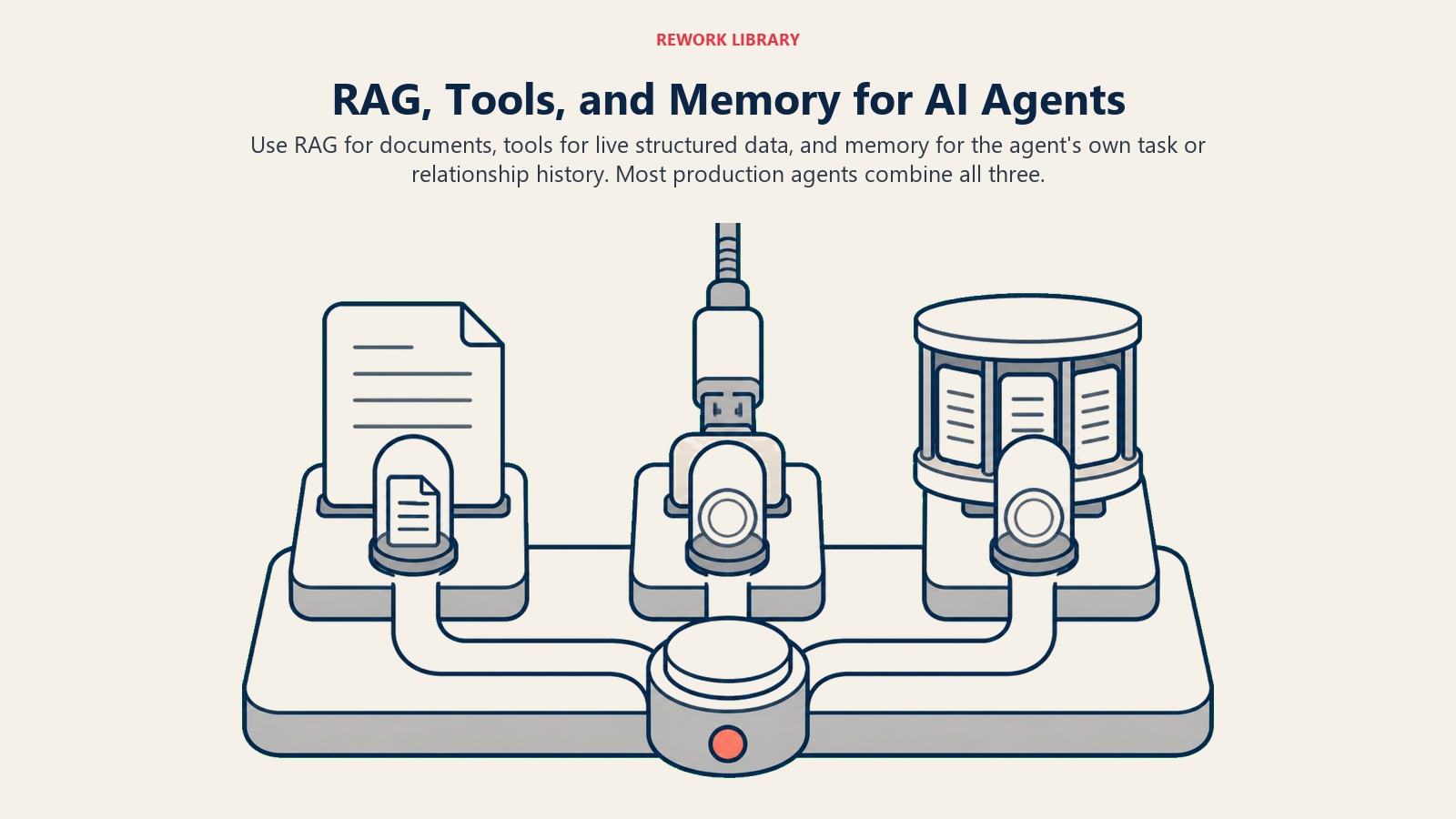
Not every fact an agent needs lives in a document. Knowing which grounding mechanism fits which kind of information keeps you from building the wrong thing.
| Grounding source | Best for | Example | How current the answer is |
|---|---|---|---|
| RAG (retrieval) | Unstructured knowledge: policies, wikis, contracts, documentation | "What's our parental leave policy?" | As fresh as the last document update |
| Tools and APIs | Structured, transactional, real-time data | "What's this customer's account tier?" or "Is Thursday at 2pm open?" | Live, at the moment of the call |
| Memory | The agent's own history with this task or user | "Did I already propose a time to this prospect?" | Specific to this run or relationship |
Most production agents use two or three of these together. The AI Knowledge Base Agent retrieves from your help center (RAG), checks the customer's account tier and version through the CRM (a tool call), and remembers whether this exact question already came up this session (memory) before deciding to answer, ask, or hand off. See AI Agent Memory for the short-term and long-term side of that third column.
RAG-Grounded Agents in Practice
The pattern holds across very different knowledge bases. Three examples from this library show the shape.
The AI Knowledge Base Agent retrieves from help center articles and internal wikis, answers using only what it finds, cites the source article by name in every reply, and, critically, flags the question as a content gap when retrieval comes back empty. Zero results isn't just a handoff trigger, it's a signal that tells your content team exactly what to write next.
The AI Policy Q&A Agent runs the same retrieve-then-cite pattern against a different corpus: the employee handbook instead of a support help center. It answers HR and IT policy questions strictly from what's written down, surfaces how recently the cited section was updated, and routes to HR the moment the handbook doesn't cover the question instead of guessing at company policy.
The AI Contract Review Agent uses retrieval differently: instead of answering a question, it retrieves your internal playbook (acceptable payment terms, liability caps, IP positions) and compares an inbound contract against it clause by clause, surfacing every deviation for a human to decide on. Same retrieve-then-ground mechanic, applied to comparison instead of Q&A.
If you're comparing platforms to build one of these, the knowledge base software buying guide and the support tools roundup both cover retrieval-friendly options worth a look.
The Mechanics, Briefly
Source documents get split into chunks, each chunk gets converted into a vector through an embedding model, and those vectors live in a vector database built for fast similarity search. A question gets converted into a vector the same way, the system finds the chunks whose vectors are closest to it, and those chunks, not the whole knowledge base, go into the model's context alongside the question. Chunk size, metadata filtering (department, document date, product version), and how often the index gets refreshed all affect answer quality more than which specific model you're generating with. For the full walkthrough of embeddings and vector search, see What Are Vector Databases?
Where RAG Breaks for an Agent
The same failure modes that hit a standalone RAG assistant hit an agent even harder, because an agent might act on a bad retrieval instead of just displaying it.
A stale knowledge base is the most common failure and the hardest to notice, because the agent still answers confidently. It's just answering from last quarter's policy. An unowned knowledge base drifts, and nobody notices until a customer acts on the wrong information.
A hallucinated citation is the most dangerous failure, because it looks like success: a confident answer with a source attached that, on closer inspection, doesn't actually say what the agent claimed. This is exactly the kind of failure the OWASP Top 10 for LLM Applications warns about under misinformation and overreliance risk: users trust a cited answer more than an uncited one, so a wrong citation does more damage than a plain wrong answer would.
Both failures point to the same fix: someone has to own the knowledge base, review it on a schedule, and treat every zero-result or low-confidence retrieval as a signal worth investigating, not noise to ignore.
When RAG Is the Wrong Tool for the Job
Retrieval doesn't solve every grounding problem. If information changes every few minutes (live inventory, today's calendar, this second's account balance), a tool call to the live system beats retrieval from an indexed copy that's already slightly out of date by the time it's indexed. And if users can already find the right document just fine, and the real problem is that nobody reads it, the fix might be better search or a shorter document, not a generative layer on top.
Anthropic's own guidance on building agents frames retrieval as one of three augmentations, alongside tools and memory, that turn a plain model into something that can actually do a job. None of the three substitutes for the other two. An agent that only retrieves can answer questions but can't act. An agent that only calls tools can act but can't explain a policy it was never given. Most well-built agents need all three, sized to what each part of the task actually requires.
Key Facts
- RAG grounds an AI agent's answers and actions in real documents and data instead of a model's frozen training knowledge, by retrieving relevant chunks before generating a response.
- Inside an agent, retrieval is typically a tool call the agent makes during its perceive step, and a capable agent can retrieve, evaluate what it got back, and retrieve again before acting.
- Knowledge in documents calls for RAG, live structured data calls for a tool or API call, and the agent's own task history calls for memory. Most real agents combine all three.
- The most dangerous RAG failure is a hallucinated citation: a confident answer with a source attached that doesn't actually support the claim, which is why a named content owner and a review cadence matter as much as the retrieval technology itself.
Frequently Asked Questions about RAG for AI Agents
What is RAG in the context of an AI agent?
RAG (retrieval-augmented generation) is how an AI agent grounds its answers and actions in real documents and data. Instead of relying on what a model learned during training, the agent searches a knowledge base, retrieves the most relevant material, and generates its next step from that retrieved content, citing the source.
Is RAG the same thing as an AI agent?
No. RAG is a grounding technique, not an agent by itself. A standalone RAG assistant retrieves once and answers a question. An AI agent can use RAG as one of several tools, retrieving, reasoning about what it found, sometimes retrieving again, and then taking an action, which is a broader loop than retrieval alone covers.
When does an agent need RAG instead of a regular tool call or API?
Use RAG for unstructured knowledge that lives in documents: policies, wikis, contracts, product documentation. Use a tool or API call for structured, real-time data like an account balance, a calendar slot, or an order status. Most agents need both, pointed at different kinds of information.
How is RAG for an agent different from the RAG Assistant pattern?
The RAG Assistant pattern describes a standalone chatbot that retrieves and answers, nothing more. RAG for an agent describes retrieval as one input inside a larger loop that also reasons, calls other tools, remembers prior steps, and takes action. The retrieval mechanics are the same. What surrounds them is not.
What's the biggest risk of using RAG inside an autonomous agent?
A hallucinated citation, where the agent generates a confident answer and cites a source that doesn't actually contain that claim, then acts on it. Because an agent can take real actions, not just display an answer, this failure mode can cause it to act on information that was never actually there. Regular spot-checks against a named knowledge base owner catch this before it compounds.
Where to Go Next
Retrieval is one of three ways an agent grounds itself in reality, alongside tools and memory. If your agent's knowledge problem is really a "remembering what already happened" problem instead of a "finding a document" problem, AI Agent Memory covers that side directly. And once retrieval is wired in, how to evaluate and test AI agents covers how to catch a bad retrieval or a hallucinated citation before it reaches a customer. Retrieval also runs on the other side of the table: when ChatGPT or Perplexity answers a buyer's question from the live web, it's retrieving someone's pages, and how to get cited in AI answers covers how each assistant sources an answer.

On this page
- RAG in One Sentence, for an Agent
- Why an Agent Needs Retrieval, Not Just a Bigger Prompt
- Where Retrieval Sits in the Agent Loop
- RAG vs. Tools vs. Memory: Picking the Right Grounding
- RAG-Grounded Agents in Practice
- The Mechanics, Briefly
- Where RAG Breaks for an Agent
- When RAG Is the Wrong Tool for the Job
- Key Facts
- Where to Go Next