Quota Attainment: How to Measure and Improve It
Turn this article into takeaways for your work.


Each assistant summarizes the article only for you and suggests best practices for your work.
Quota attainment is the metric that tells you, plainly, whether your sales team is performing or not. Most sales leaders check it monthly, but far fewer use it diagnostically to find what is actually holding reps back.
This guide covers the calculation, what good looks like by segment, and the six levers that move the number.
What is quota attainment?
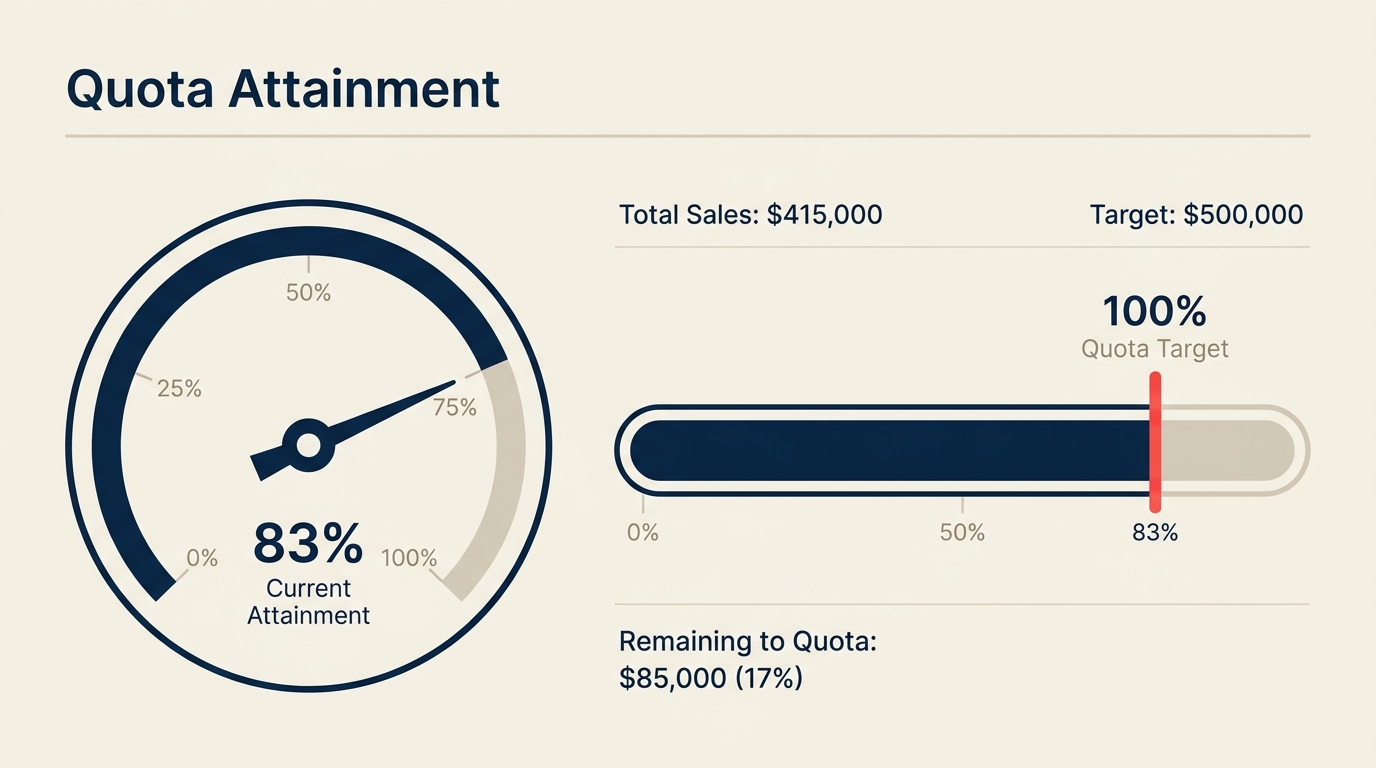
Quota attainment is the percentage of a sales target that a rep, team, or organization actually achieves within a defined period. The formula is simple: attainment equals actual revenue closed divided by quota, expressed as a percentage. If a rep's quarterly quota is $200,000 and they close $170,000, their attainment is 85%.
The metric works at every level. You can calculate it for an individual rep, a sales team, a product line, or the full organization. It is also time-bound, so comparing attainment across periods reveals trends that a single snapshot misses.
Key Facts
- Only 27% of sales representatives report consistently hitting their quota, reported in HubSpot's 2026 Sales Trends research, so most reps in most years land below their full target.
- Capacity is part of the story: sales reps spend 60% of their time on non-selling tasks, per the seventh edition of Salesforce's State of Sales research.
- Teams where sales ops sets quota bottom-up from pipeline data outperform top-down quota teams by roughly 10 percentage points on attainment (Forrester, 2023).
How to calculate quota attainment
The core formula:
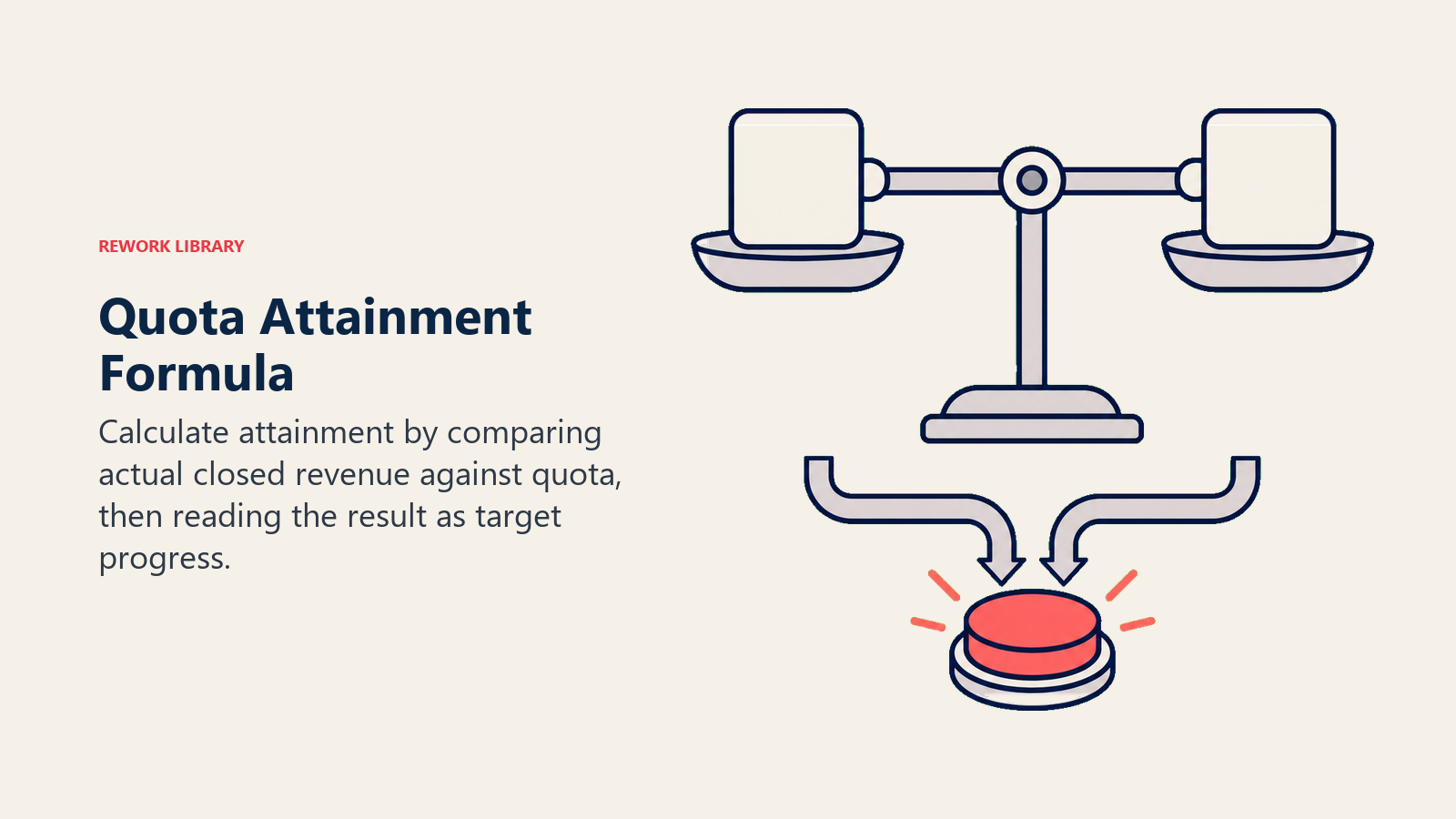
Quota Attainment (%) = (Actual Revenue Closed / Quota) x 100
Worked example
| Rep | Quota | Closed | Attainment |
|---|---|---|---|
| Ana Torres | $250,000 | $275,000 | 110% |
| Ben Park | $200,000 | $154,000 | 77% |
| Cora Lin | $180,000 | $180,000 | 100% |
| Dave Osei | $220,000 | $96,800 | 44% |
| Team total | $850,000 | $705,800 | 83% |
Three calculation variants
Individual attainment uses each rep's personal quota and their personal closed revenue. This is the most common form and drives individual compensation.
Team attainment aggregates all reps on a team or in a territory. A team can hit team attainment even when individual attainment is uneven, which is worth watching because it can mask underperformers.
Ramp-adjusted attainment applies to new reps still in their ramp period. A rep in month two of a six-month ramp might carry only 40% of full quota. Attainment is still calculated against their ramp quota, not the full target, so the number reflects fair performance rather than punishing ramping reps for not being fully productive yet.
For a deeper look at how quota feeds into broader revenue modeling, see pipeline coverage analysis.
What is a good quota attainment rate?
There is no universal answer, but there are useful benchmarks. The segment, motion, and deal size all shift the expected range.
| Segment / Motion | Typical attainment range | Notes |
|---|---|---|
| SMB (ACV below $25K) | 65-80% | High volume, shorter cycles, more variance |
| Mid-market (ACV $25K-$100K) | 60-75% | Mix of inbound and outbound |
| Enterprise (ACV above $100K) | 50-70% | Longer cycles, lumpy close timing |
| SDR/BDR (pipeline quota) | 55-75% | Activity-based, depends on ICP quality |
| Renewal / CS quota | 80-95% | Lower variance, churn-driven floor |
A useful rule of thumb: if fewer than 60% of reps hit their quota in a quarter, the quota is probably wrong, not the reps. If more than 90% hit it consistently, the quota is too easy and you are leaving revenue on the table.
The quota itself is doing two jobs at once: it is a performance standard and a planning input. When it is set wrong in either direction, attainment stops being diagnostic.
See sales quota for a full breakdown of how to set quotas that are actually calibrated to pipeline capacity.
Why quota attainment matters
Quota attainment is a lagging indicator, which means it confirms what already happened. But used well, it surfaces three things that require different interventions.
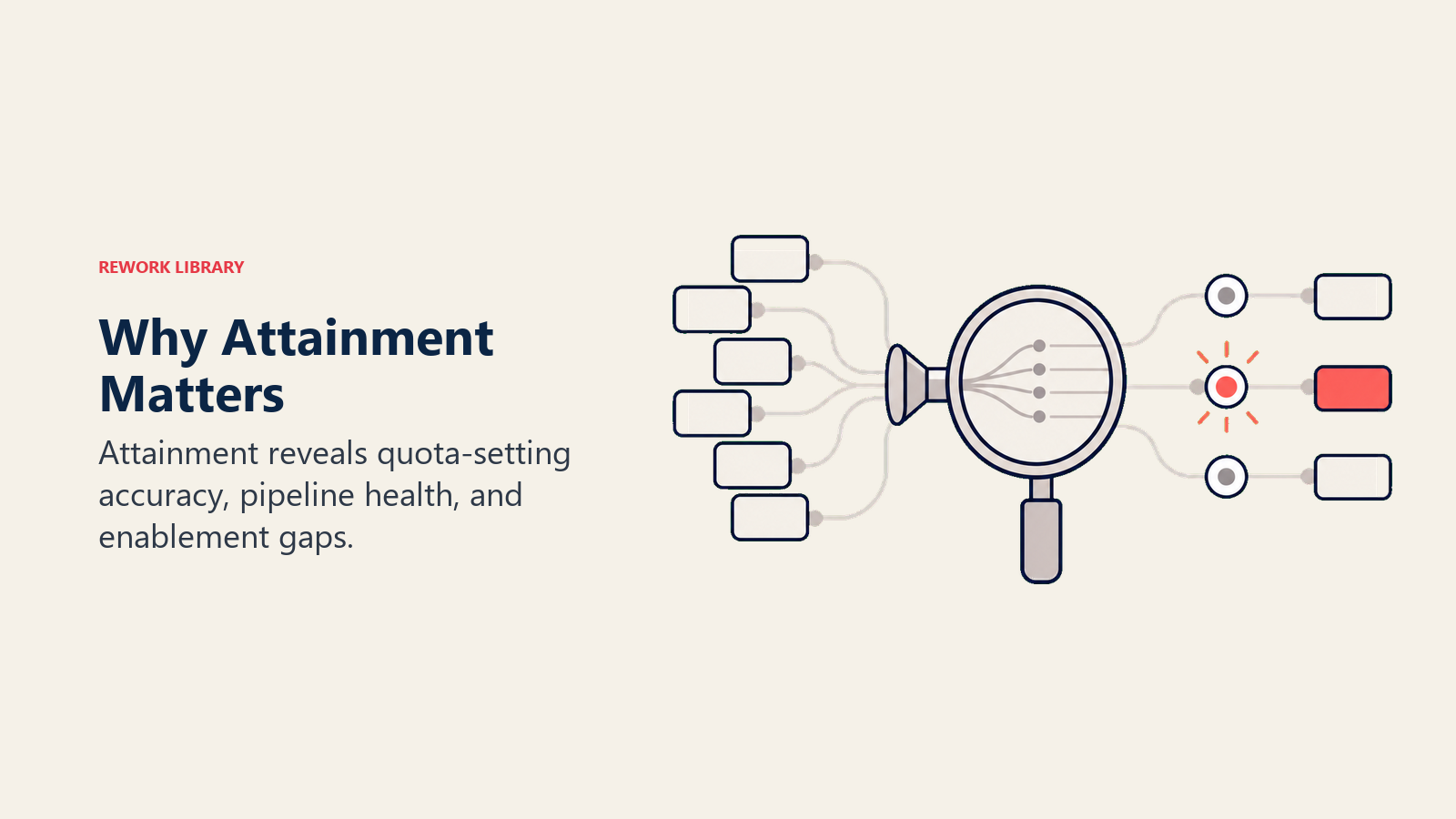
Quota-setting accuracy. Chronic underattainment (below 60% across the team) almost always points to a calibration problem. Quotas set from last year's actuals plus a growth percentage, without bottoms-up pipeline math, drift out of sync with the territory's real capacity.
Pipeline health. Mid-cycle attainment forecasts depend on whether the pipeline is real. A rep at 60% attainment with 4x pipeline coverage has a different problem than a rep at 60% attainment with 1.2x coverage. The former needs coaching; the latter needs pipeline. Connecting attainment to pipeline velocity and pipeline reviews makes that distinction visible.
Enablement gaps. When attainment clusters at the bottom (many reps in the 40-60% band), a systemic enablement problem is usually the cause, such as a new competitive threat, a product gap, or onboarding that does not reflect the current ICP. When attainment is bimodal (some reps at 120%, many below 60%), a coaching and territory equity issue is more likely.
Tracking win rate improvement alongside attainment tells you whether the gap is a volume problem or a conversion problem.
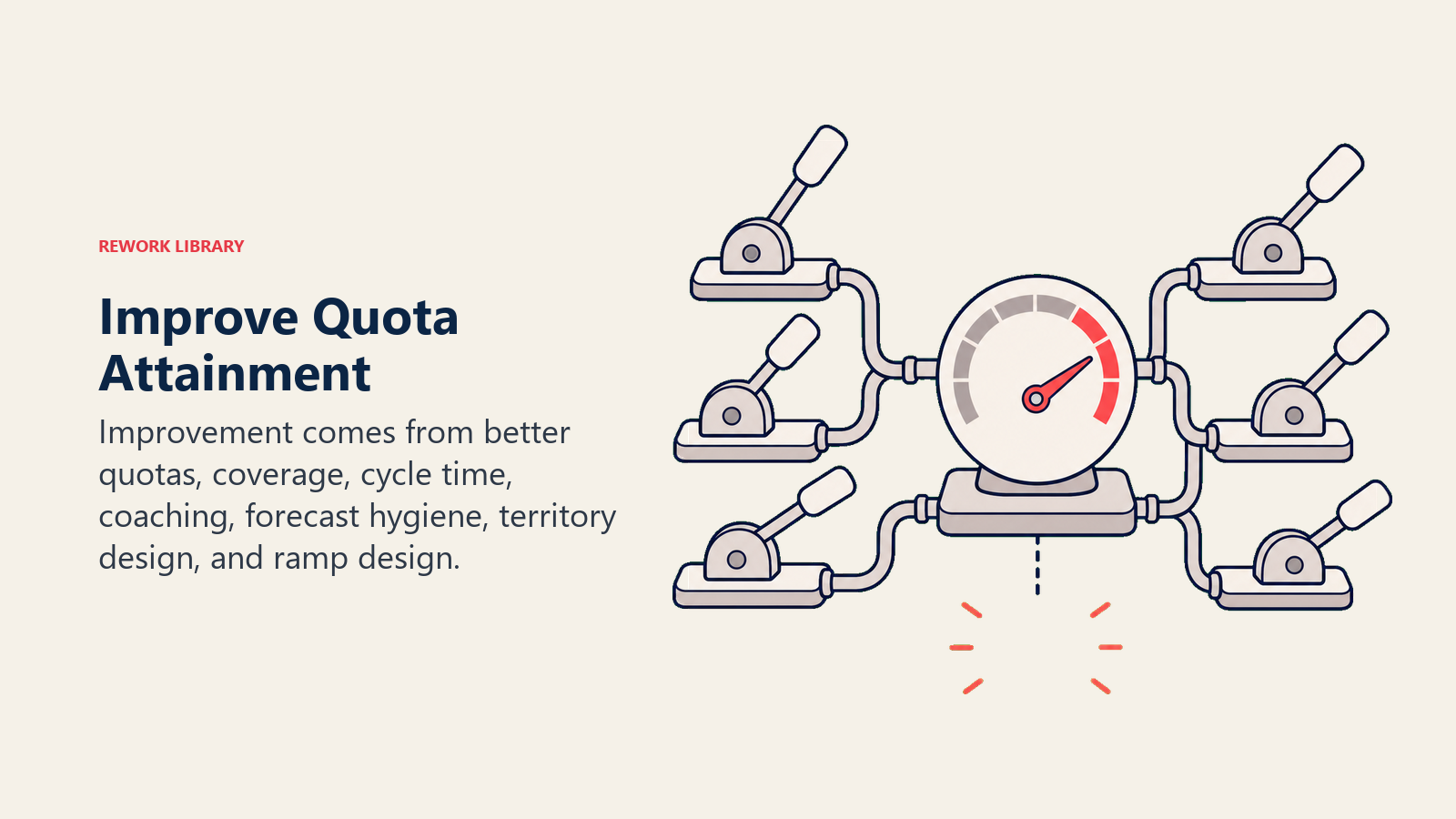
How to improve quota attainment
Step 1: Set quotas from the bottom up
Most quota problems start at the setting stage. A quota derived purely from "last year plus 20%" does not account for territory capacity, ramp time, historical pipeline conversion, or expected headcount changes. Build the quota from your average sales cycle length, pipeline coverage ratio, and close rate. If a rep historically converts 20% of pipeline and has a 90-day cycle, a $500,000 annual quota requires roughly $1,000,000 in active pipeline at any given time. Work backward from there.
Step 2: Fix pipeline coverage first
Reps cannot close what is not in the pipe. Before coaching on skills, confirm that every rep below 70% attainment has adequate pipeline coverage. The standard minimum is 3x for most B2B motions; 4x for enterprise. Check pipeline coverage analysis for the math.
Step 3: Shorten the sales cycle
Every extra week in the sales cycle is a week where a deal can go cold, the champion can change, or a competitor can re-enter. Map the time reps spend in each stage and find where deals stall. Common stall points include legal review, procurement, and multi-stakeholder alignment. For a full diagnostic, see sales cycle length.
Step 4: Coach to win rate, not just activity
Activity coaching (more calls, more emails) moves attainment temporarily. Win rate coaching moves it durably. Pull each rep's stage-by-stage conversion data and identify the specific stage where they lose disproportionately. A rep losing at the demo stage needs a different intervention than a rep losing at late-stage negotiation. Pair this with structured pipeline coaching cadences.
Step 5: Improve forecast hygiene
Reps who forecast accurately tend to attain more consistently. That sounds backward, but it is not: the discipline of committing to a close date and amount forces reps to have difficult qualification conversations they otherwise defer. Enforce commit hygiene through forecast accuracy tracking, and use the data to identify reps who consistently over-forecast (they may be sandbaggers) or under-forecast (they may be struggling with qualification).
Step 6: Fix territory and ramp design
Territory inequity is a quiet attainment killer. When one rep has a territory with 5x the addressable revenue of a peer on the same quota, the comparison is meaningless. Run a territory equity analysis at least once a year. For ramp, give new reps a realistic ramp schedule (typically three to six months to full quota) and track ramp-adjusted attainment separately. Blending ramping reps into team attainment calculations distorts the picture for everyone.
Common mistakes in quota setting
Sandbagging allowances baked into the number. Some managers set quotas high knowing reps will sand-bag their forecasts, then back-calculate to an attainable real number. This destroys trust in the process and makes it impossible to use attainment diagnostically. Fix the forecasting culture instead of inflating the quota to compensate.
Top-down-only quotas. Finance hands down a revenue target, it gets divided by headcount, and that becomes each rep's quota. No pipeline math, no territory analysis, no ramp accounting. The number is arbitrary relative to what is actually achievable, and attainment becomes a lottery rather than a measure of performance.
Ignoring ramp time. Treating a three-month-old rep the same as a two-year veteran on attainment reporting makes both numbers wrong. New reps look like failures; veterans look like they are carrying weight they are not. Segment the reporting by tenure cohort.
Single-metric quotas in multi-product orgs. A revenue-only quota incentivizes reps to chase the easiest close, not the most strategic deal. If product mix, expansion revenue, or new logo acquisition matter to the business, those should have their own quota components or at minimum their own attainment tracking lines.
For a broader view of how attainment connects to revenue forecasting, see revenue predictability and sales forecasting methods.
Quota attainment is most useful when it is read in context: alongside pipeline coverage, win rate, cycle length, and forecast accuracy. On its own, it tells you there is a problem. Combined with those signals, it tells you where to fix it.

Head of Enterprise Solutions
On this page
- What is quota attainment?
- How to calculate quota attainment
- Worked example
- Three calculation variants
- What is a good quota attainment rate?
- Why quota attainment matters
- How to improve quota attainment
- Step 1: Set quotas from the bottom up
- Step 2: Fix pipeline coverage first
- Step 3: Shorten the sales cycle
- Step 4: Coach to win rate, not just activity
- Step 5: Improve forecast hygiene
- Step 6: Fix territory and ramp design
- Common mistakes in quota setting