Board-Ready Revenue Reporting: What RevOps Should Prepare
Board-ready revenue reporting is not a prettier dashboard.
It is a disciplined view of revenue performance with definitions leaders can defend. The board needs to understand what changed, why it changed, what risk exists, and what the company is doing next.
RevOps prepares the operating layer. Finance owns the financial narrative. Revenue leaders own the performance explanation.
Forrester's RevOps operating model research is relevant because board reporting needs clear ownership, not only charts. McKinsey's B2B growth research also reinforces why growth quality, productivity, and repeatability matter more than surface-level activity metrics.
Key operating facts
- Board-ready reporting should explain performance, drivers, risk, and management action. A dashboard screenshot is not enough.
- RevOps prepares the operating evidence: definitions, source data, funnel analysis, forecast caveats, pipeline quality, and backup cuts. Finance owns financial reconciliation and the board model.
- The package should come from the normal revenue cadence, not from a separate pre-board scramble.
- Data caveats should be explicit. A clear caveat increases credibility because it tells the board how much confidence to place in the number.
Core reporting package
A board-ready package should pair operating metrics with their definitions, decision context, and known data caveats.

Turn this article into takeaways for your work.


Each assistant summarizes the article only for you and suggests best practices for your work.
| Section | What to include |
|---|---|
| Revenue performance | Plan vs actual, bookings, ARR or revenue trend |
| Pipeline | Pipeline created, coverage, source, segment |
| Forecast | Forecast accuracy, commit performance, slipped deals |
| Funnel | Stage conversion, velocity, bottlenecks |
| Retention | GRR, NRR, renewal risk, churn reasons |
| Expansion | Expansion pipeline and closed expansion |
| Data caveats | Known quality issues and confidence level |
RevOps responsibilities
RevOps should own:
- Metric definitions
- Data pulls
- Dashboard consistency
- Funnel analysis
- Forecast process inputs
- Data quality caveats
Finance should own financial rollup and board model. Sales, marketing, and CS should own performance explanations.
What makes reporting board-ready
A board-ready report should answer four questions:
- What happened?
- Why did it happen?
- What will happen next?
- What is management doing about it?
Dashboards often answer only the first question. Board reporting needs trend context, plan context, segment context, and decision context.
For example, "pipeline is $8M" is not board-ready. Better: "Current-quarter pipeline is 3.2x target, down from 3.8x last quarter. Late-stage coverage remains healthy in enterprise, but commercial coverage is below plan because inbound conversion fell and two reps are still ramping."
The second version gives leaders a picture they can discuss.
Reporting principles
Use these principles:
- Define every metric.
- Show trend, not only snapshot.
- Segment where aggregate data hides risk.
- Separate actuals, forecast, and pipeline.
- State data caveats plainly.
- Connect performance to management action.
- Keep the board view concise.
- Keep source detail ready for follow-up.
The board does not need every RevOps report. It needs the small set of operating facts that explain revenue quality.
Board package vs operating pack
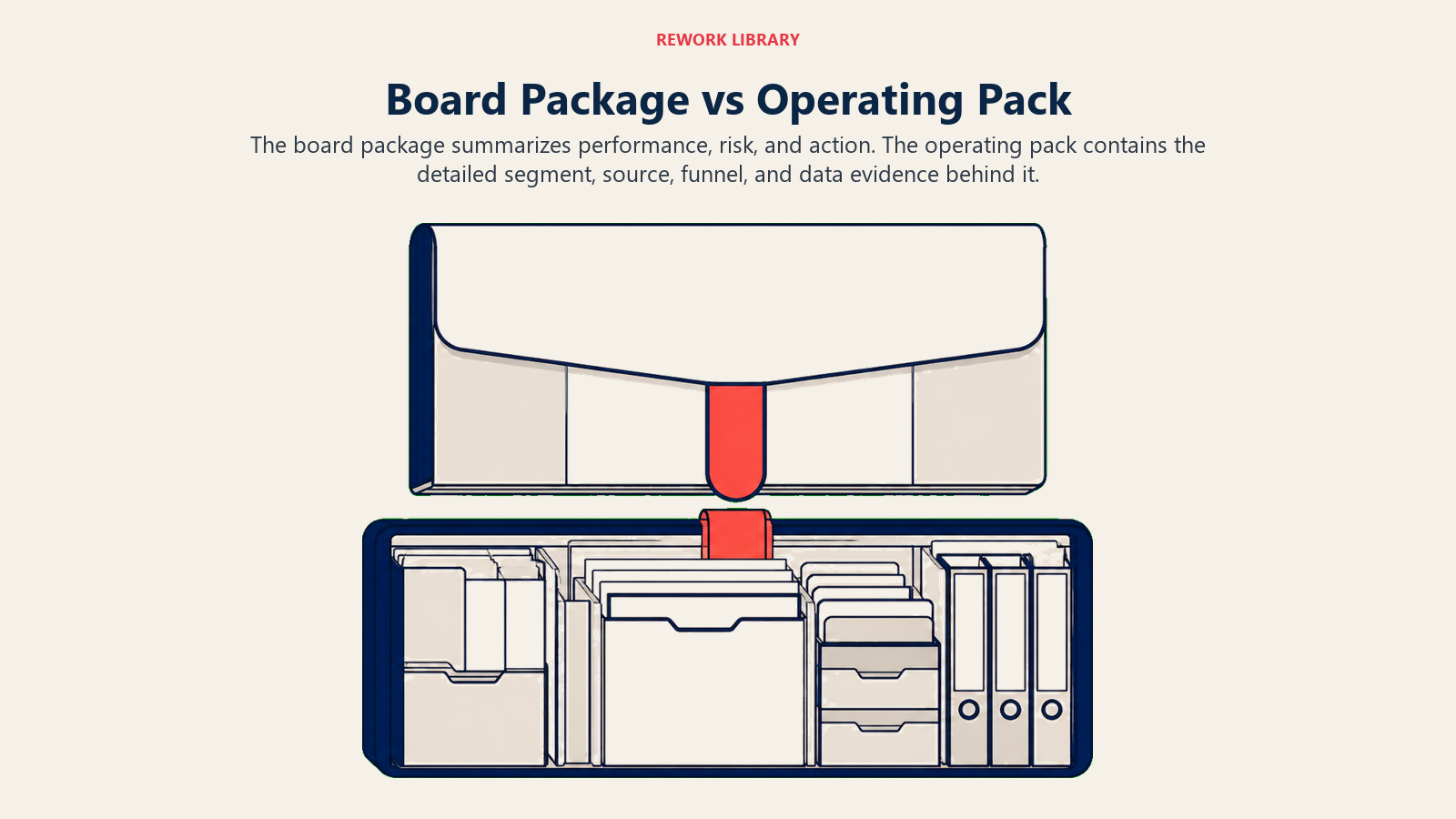
RevOps should prepare two levels of reporting: the board package and the operating pack.
| Reporting level | Audience | Purpose |
|---|---|---|
| Board package | Board, CEO, CFO, CRO | Explain performance, risk, and management action |
| Operating pack | Revenue leaders, RevOps, finance, functional owners | Diagnose drivers and prepare answers |
The board package should stay concise. It should show the story. The operating pack can carry the detail behind the story: source cuts, segment cuts, manager cuts, cohort views, funnel conversion, data-quality notes, and backup analysis.
This separation prevents two common failures. The first is overloading the board with every chart RevOps can produce. The second is stripping the package so far down that leaders cannot answer follow-up questions. A strong board package is simple on the surface and well-supported underneath.
Use this test:
| Board slide question | Operating pack support |
|---|---|
| Why did new ARR miss plan? | Segment, source, stage conversion, sales capacity, win-rate trend |
| Is next-quarter pipeline enough? | Coverage by period, stage quality, historical conversion, stale pipeline |
| Is forecast confidence improving? | Commit accuracy, slippage, category movement, manager calibration |
| Is retention risk contained? | Renewal cohort, health category, churn reason, top account risk |
| What is management doing? | Actions, owners, due dates, expected impact |
RevOps should build the operating pack before finalizing the board story. The story should be a summary of evidence, not a narrative created first and supported later.
Metrics by revenue motion
Board reporting should match the business model.
| Motion | Metrics to emphasize |
|---|---|
| New business | Pipeline created, coverage, win rate, sales cycle, forecast |
| Expansion | Expansion pipeline, product adoption, account penetration |
| Renewal | GRR, renewal risk, health, save rate, churn reasons |
| Usage-based | Consumption, activation, expansion signals, revenue volatility |
| Enterprise | Large deal risk, buying committee, sales cycle, slipped deals |
| SMB | Volume conversion, source quality, funnel speed, rep productivity |
RevOps should avoid copying a generic board template without matching the motion.
Metric definitions
Board reporting breaks down when definitions are loose.
Define:
- Bookings
- ARR
- New ARR
- Expansion ARR
- Contraction
- Churn
- GRR
- NRR
- Pipeline created
- Qualified pipeline
- Forecast category
- Commit
- Best case
- Sales cycle
- Win rate
Definitions should match the Revenue Data Dictionary. If finance, sales, and RevOps use different definitions, the board deck will turn into a reconciliation meeting.
Forecast section
The forecast section should include:
- Current forecast vs plan
- Change from prior forecast
- Commit accuracy trend
- Best-case conversion
- Slipped deals
- Large deal risk
- Data caveats
- Management actions
Use Forecast Governance as the source for categories and evidence rules. The board should not see a forecast number without knowing the confidence level and the main risks.
Pipeline section
The pipeline section should explain whether the future plan has enough real opportunity.
Include:
- Pipeline created by period
- Pipeline coverage by close period
- Coverage by segment
- Source quality
- Stage conversion
- Stage aging
- Stale pipeline caveats
- Pipeline required to hit plan
Pair Pipeline Coverage Ratio with conversion and sales cycle. A large pipeline number can be weak if it is stale, early-stage, low-fit, or closing outside the period.
Funnel section
The funnel section should explain how demand turns into revenue.
Include:
- Visitor to lead conversion where relevant
- Lead to qualified conversion
- MQL to SQL if used
- SQL to opportunity
- Opportunity to closed-won
- Conversion by source
- Velocity by stage
- Bottlenecks
The key is not to show every funnel metric. The key is to show the conversion points that changed and what the team is doing about them.
Retention and expansion section
For recurring revenue businesses, board-ready reporting must include customer revenue quality.
Include:
- Gross revenue retention
- Net revenue retention
- Renewal risk
- Churn reasons
- Expansion pipeline
- Expansion closed-won
- Customer health caveats
- Top accounts at risk
Customer success data may live outside the CRM. RevOps should work with CS and finance to make sure renewal and expansion reporting uses consistent definitions.
Data caveats
Data caveats are not weakness. They are part of responsible reporting.
Examples:
- Source attribution changed during the period.
- Renewal risk data is missing for one segment.
- Pipeline stage definitions changed mid-quarter.
- Forecast categories were recalibrated.
- One acquired business uses a different CRM process.
State caveats clearly and explain whether they affect trend interpretation, forecast confidence, or planning assumptions.
How to write data caveats
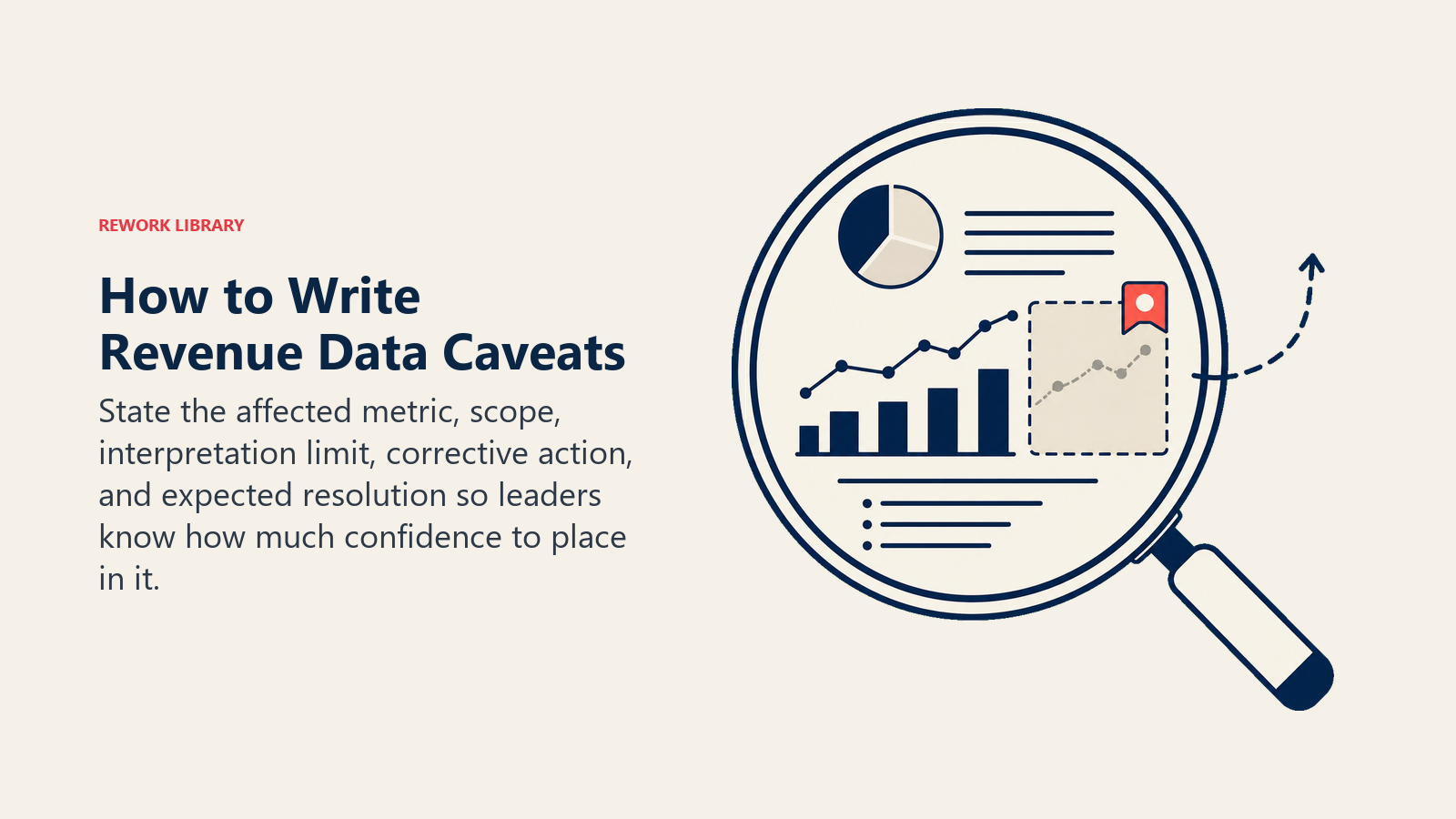
Data caveats should be specific enough to change interpretation, but not so detailed that they distract from the story.
Use three levels:
| Caveat level | When to use it | Example |
|---|---|---|
| Note | Data issue exists but does not change the headline | "One segment has delayed activity logging, but pipeline totals are reconciled." |
| Confidence caveat | Data issue affects trust in a metric | "Renewal risk coverage is incomplete for partner-managed accounts, so risk may be understated." |
| Interpretation caveat | Definition or system change affects trend comparison | "Stage definitions changed in April, so stage conversion before and after April is not directly comparable." |
Avoid vague caveats like "data may not be perfect." That does not help the board. A useful caveat states what is affected, why it matters, and what management is doing.
Good caveat format:
- What is affected
- How much of the data is affected
- Whether the trend is still directionally useful
- What action is underway
- When the caveat should be resolved
Example:
"Commercial renewal risk is underreported for partner-managed accounts because health fields are not yet integrated from the partner workspace. This affects 18 percent of renewal ARR. Finance and CS are treating the segment as medium confidence until the integration is live next month."
That caveat is not a weakness. It gives the board a more honest view of the number.
Board narrative
A strong board narrative is short:
- What changed.
- Why it changed.
- What risk remains.
- What management is doing.
RevOps should prepare the evidence that supports that narrative. The CRO, CEO, or CFO can then decide how to present the message.
Reporting workflow
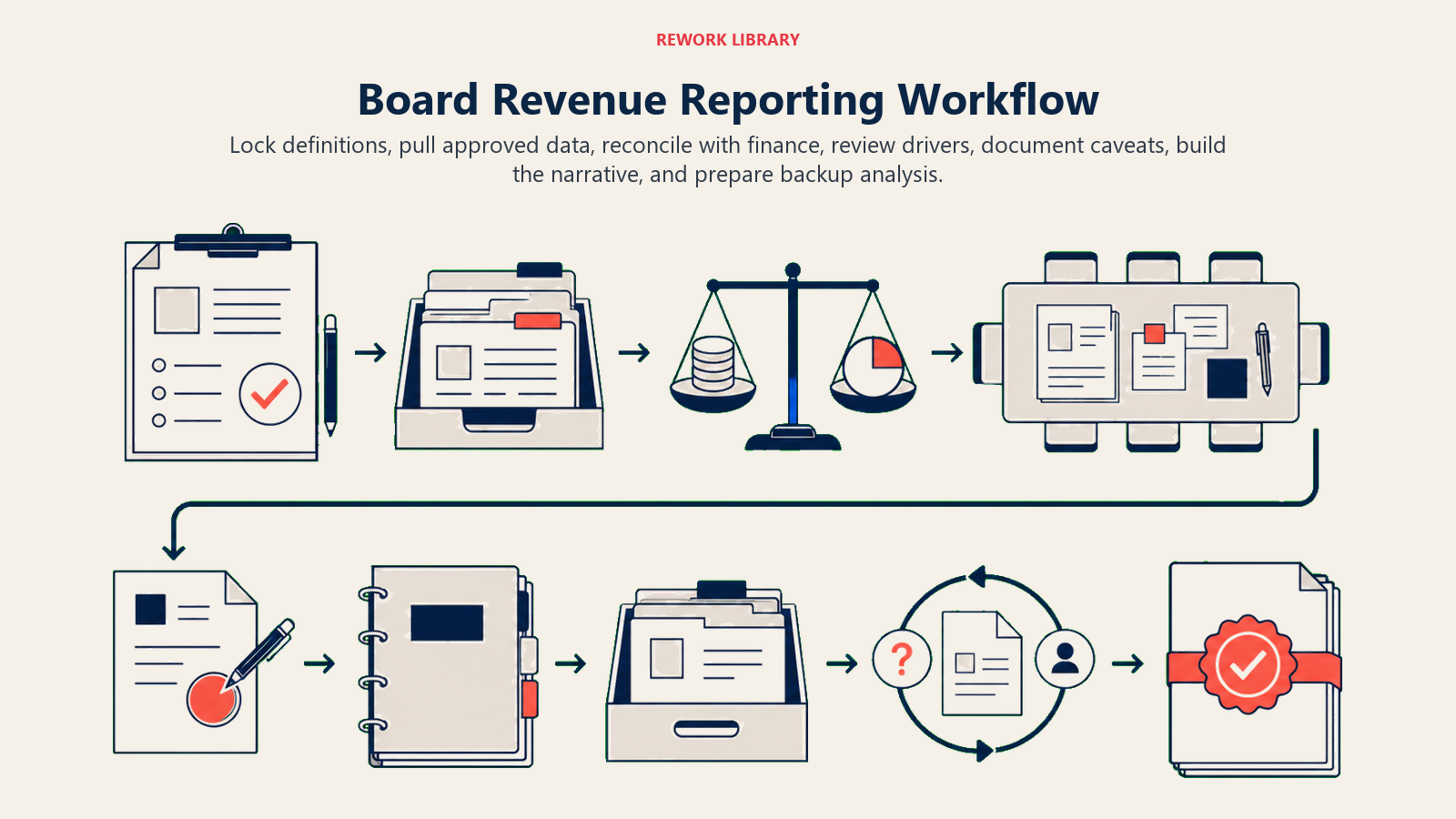
A practical workflow:
- Lock metric definitions.
- Pull data from approved sources.
- Reconcile with finance.
- Review with sales, marketing, and CS leaders.
- Document caveats.
- Build charts and narrative.
- Prepare backup cuts.
- Capture board questions for next cycle.
The backup cuts matter. The main deck should stay focused, but leadership should be ready to answer follow-up questions about segment, source, region, manager, or cohort.
Common mistakes
Too many charts. The board cannot see the story.
No definitions. Metrics become debatable.
No caveats. Weak data looks more certain than it is.
Only activity metrics. Revenue quality is unclear.
No management action. Reporting describes the problem but not the response.
Aggregate-only reporting. Segment risk stays hidden.
Readiness checklist
Before the board package is final:
- Metrics are defined.
- Sources are documented.
- Finance has reconciled key numbers.
- Forecast confidence is stated.
- Pipeline quality is visible.
- Customer revenue metrics are included where relevant.
- Caveats are written.
- Management actions are clear.
- Backup cuts are prepared.
What the checklist should prove
Board-ready revenue reporting should make leadership more credible. It should explain performance with enough clarity that leaders can defend the story, answer follow-up questions, and show what the company will do next.
Chart design
Board charts should be simple and defensible.
Use charts for:
- Plan vs actual trend
- Pipeline coverage by period
- Forecast change over time
- Funnel conversion trend
- Retention and expansion trend
- Segment performance
- Sales capacity risk
Avoid charts that require long explanations. If a chart needs five footnotes before it can be understood, it may belong in backup.
Every chart should have a message. A chart that only shows data but does not answer a board question is noise.
Backup analysis
RevOps should prepare backup analysis even when it does not appear in the main package.
Useful backup cuts:
- Pipeline by source
- Pipeline by segment
- Win rate by segment
- Sales cycle by deal size
- Forecast accuracy by manager
- Churn reasons by cohort
- Expansion by product
- Rep productivity by tenure
- Data-quality caveats by system
Backup analysis lets leaders answer questions without overloading the main deck.
Operating review before board
Before the board package is finalized, run an internal operating review.
Participants:
- CEO or operating lead
- CRO or revenue leader
- CFO or finance lead
- RevOps
- Marketing leader
- Customer success leader
Review the story, definitions, caveats, and likely questions. The goal is alignment before the board meeting, not surprise during it.
Example board narrative
Example:
"New ARR finished at 94 percent of plan. Enterprise outperformed because late-stage conversion improved, while commercial missed due to weaker inbound conversion and two ramping reps. Current-quarter forecast confidence is medium. Commit quality improved, but pipeline coverage for next quarter is below the threshold in commercial. Management is shifting campaign focus, tightening qualification, and pulling hiring forward for two commercial roles."
That narrative gives performance, cause, risk, and action. RevOps should provide the evidence behind each sentence.
Board reporting and data trust
Board reporting can expose data trust issues.
If leaders debate definitions during board prep, the company needs better metric governance. If finance and RevOps numbers do not match, the source-of-truth model needs work. If sales and marketing disagree on pipeline source, attribution rules need review.
Use board prep as a forcing function to improve the revenue data system. The goal is not to hide imperfections. The goal is to make the data reliable enough for decisions and honest enough about caveats.
Post-board follow-up
After the meeting, capture:
- Board questions
- Requested cuts
- Definition concerns
- Data caveats to fix
- Metrics to add or remove
- Follow-up owners
- Timing for next package
Board reporting should improve each cycle. If the same question appears every meeting, RevOps should either add the answer to the standard package or fix the underlying data gap.
Revenue reporting examples
Example: pipeline is above target, but win rate is falling. The board-ready story should not say pipeline is healthy without showing conversion risk. Leaders should explain source quality, stage mix, and management action.
Example: NRR is strong, but GRR is weakening. The board should see that expansion is masking churn. RevOps should separate expansion success from retention risk so leaders can act on both.
Example: forecast accuracy improved, but only because managers lowered commit late in the period. That may be better than missing the number, but it still shows weak early inspection.
Metrics to avoid overemphasizing
Some metrics are useful internally but weak as board headline metrics.
Avoid leading with:
- Raw activity volume without conversion
- Total lead volume without source quality
- Pipeline value without stage and timing
- Average deal size without segment mix
- Forecast number without confidence
- Customer health score without churn or expansion outcomes
These metrics can appear in backup, but board reporting should focus on revenue quality and management action.
Operating cadence
Board reporting should connect to the normal revenue cadence.
Weekly forecast calls feed forecast confidence. Monthly funnel reviews feed conversion analysis. Pipeline inspection feeds quality caveats. Finance reconciliation feeds plan and actuals. Customer success reviews feed retention and expansion.
If board reporting requires a separate scramble every time, the operating cadence is not mature enough. The board package should be the executive summary of a system that already runs.
Minimum viable board package
A small company can start with:
- Revenue plan vs actual
- Forecast and confidence
- Pipeline coverage
- Funnel conversion
- Retention or renewal risk
- Sales capacity
- Key risks
- Management actions
That is enough to tell a revenue story without overwhelming the meeting.
Quality bar
Before sending the package, ask:
- Can every metric be defined in one sentence?
- Can finance reconcile the headline numbers?
- Can revenue leaders explain the drivers?
- Can RevOps defend the source data?
- Are caveats honest and visible?
- Are actions specific enough to inspect later?
If the answer is no, fix the package before adding more charts.
Quality bar review questions
Before finalizing, ask one more set of questions:
- What would the board ask first?
- Which metric is most likely to be challenged?
- Which caveat could change interpretation?
- Which action needs clearer ownership?
- Which trend matters most for next quarter?
Good board reporting anticipates the discussion instead of only presenting the past.
The best package helps leaders speak with precision. It avoids surprise, shows risk early, and turns revenue data into an operating conversation the company can act on after the meeting.
Keep the story clear enough to repeat.
Keep the evidence ready for follow-up questions.
Board question prep
Before the meeting, RevOps should help leaders rehearse likely board questions.
Common questions include:
| Board question | Prep needed |
|---|---|
| Why did pipeline coverage move? | Source, segment, stage, and timing cuts |
| Is the forecast conservative or aggressive? | Commit accuracy, best-case conversion, caveats |
| What changed in win rate? | Segment mix, deal size, source quality, competitive notes |
| Are customers expanding enough to offset churn? | GRR, NRR, expansion, contraction, churn reasons |
| What is the biggest risk to next quarter? | Pipeline coverage, sales capacity, renewal risk, large deal slips |
| What action will management take? | Owner, due date, expected impact, inspection rhythm |
This preparation keeps the board conversation focused. Leaders do not need to memorize every backup cut, but they should know where the evidence lives and which caveats matter.
After the meeting, add unanswered questions to the next operating pack. If the board asks the same question twice, the answer probably belongs in the standard package or the revenue cadence.
Metric owner signoff
Every board-facing metric should have a named owner before the package is finalized.
Use a simple signoff model:
| Metric area | Primary signoff | RevOps role |
|---|---|---|
| Revenue actuals | Finance | Reconcile operating source fields |
| Forecast | Sales leadership and finance | Provide categories, movement, caveats |
| Pipeline | Sales leadership | Provide quality, coverage, stage, and source analysis |
| Funnel conversion | Marketing, sales, and RevOps | Validate lifecycle definitions and conversion logic |
| Retention | CS and finance | Align renewal, churn, and expansion definitions |
| Data caveats | RevOps and finance | State confidence and interpretation limits |
Signoff does not need to be bureaucratic. It prevents late surprises. If sales sees the pipeline slide for the first time during final deck review, the process is too late. If finance questions ARR definitions after the story is written, the source-of-truth model failed.
RevOps should run signoff before narrative polish. The numbers and caveats should be stable before leaders write the final message. Otherwise the story keeps changing as definitions are corrected.
Pre-board review checklist
Run a short internal review before the package goes out.
Ask:
- Does the headline story match the data?
- Are actuals reconciled with finance?
- Are forecast caveats stated plainly?
- Are pipeline quality and coverage both visible?
- Are customer revenue risks included where relevant?
- Are management actions specific enough to inspect later?
- Are backup cuts ready for likely questions?
- Are definitions consistent with prior board packages?
The last question matters. Boards notice when definitions change without explanation. If a metric changed, state the change and the impact. If the change makes the metric better, explain why. If it limits comparison to prior periods, say that directly.
Board-ready reporting is partly about trust. Clean signoff and clear caveats help leaders spend the meeting on decisions instead of reconciliation.
RevOps should keep a short record of what changed between board cycles: definitions, sources, caveats, package structure, and recurring questions. That record makes the next package faster to build and helps new leaders understand why the report looks the way it does.
Board reporting decision packet
A board-ready revenue report should make tradeoffs visible.
Include:
- Plan vs actual.
- Forecast confidence.
- Pipeline coverage and quality.
- Segment performance.
- Retention and expansion risk.
- Sales capacity risk.
- Data caveats.
- Decisions needed from leadership.
The board does not need every operating detail. It needs to understand whether the revenue system can support the plan, where risk is concentrated, and which management decisions are already underway.
Frequently Asked Questions about Board-Ready Revenue Reporting
What makes revenue reporting board-ready?
Consistent definitions, clear trend context, segment-level visibility, and honest caveats about data quality or forecast confidence.
Should RevOps present to the board?
Sometimes. More often, RevOps supports the CRO, CEO, or CFO with reliable operating data.
Learn more

Principal Solution Architect
On this page
- Core reporting package
- RevOps responsibilities
- What makes reporting board-ready
- Reporting principles
- Board package vs operating pack
- Metrics by revenue motion
- Metric definitions
- Forecast section
- Pipeline section
- Funnel section
- Retention and expansion section
- Data caveats
- How to write data caveats
- Board narrative
- Reporting workflow
- Common mistakes
- Readiness checklist
- What the checklist should prove
- Chart design
- Backup analysis
- Operating review before board
- Example board narrative
- Board reporting and data trust
- Post-board follow-up
- Revenue reporting examples
- Metrics to avoid overemphasizing
- Operating cadence
- Minimum viable board package
- Quality bar
- Quality bar review questions
- Board question prep
- Metric owner signoff
- Pre-board review checklist
- Board reporting decision packet
- Learn more