Source of Truth for Revenue Data: How RevOps Prevents Conflicting Numbers
Revenue teams do not need one system to store everything.
They need one source-of-truth model that tells every team which system wins for each question.
CRM may own opportunity stage. Marketing automation may own campaign membership. Billing may own subscription amount. Customer success may own health status. BI may combine them for reporting. RevOps governs how those truths connect.
Forrester's RevOps technology alignment research is relevant because source-of-truth problems usually appear when teams add tools without shared governance. Gartner's forecast confidence research is also a useful reminder that data trust affects revenue decisions, especially forecast and planning.
Key operating facts
- Source of truth does not mean one system owns everything. It means every important revenue question has a known winning system, owner, definition, and caveat.
- CRM often owns sales workflow data. Billing or finance may own revenue truth. Marketing automation may own campaign truth. CS may own customer health. BI may combine them for reporting.
- Source-of-truth governance should resolve conflicts before executive meetings. Leaders should debate strategy, not which spreadsheet is correct.
- The model should be visible in dashboards, field governance, intake, and the revenue data dictionary so teams can use it during real work.
Source-of-truth map
| Data type | Common source of truth |
|---|---|
| Lead source | Marketing automation or CRM, governed by RevOps |
| Account and opportunity ownership | CRM |
| Opportunity stage and forecast | CRM |
| Subscription and invoice data | Billing or finance system |
| Customer health | CS platform |
| Executive reporting | BI layer using governed definitions |
Governance rules
Define:
- Which system owns each data element
- Which integrations can write to it
- Which fields are read-only
- How conflicts are resolved
- Which reports use combined data
- Who approves changes
Document the model in the Revenue Data Dictionary.
Why source of truth breaks
Source-of-truth problems usually start small.
Marketing changes a source field. Sales edits an opportunity amount. Finance exports bookings into a spreadsheet. CS tracks renewal risk in its own tool. BI calculates pipeline with a slightly different definition than the CRM dashboard.
Each local decision may make sense. Together, they create conflicting numbers.
RevOps prevents this by defining which system wins, which team owns the field, and which reports use which definition.
Source-of-truth principles
Use these principles:
| Principle | Meaning |
|---|---|
| One owner per data element | Someone must own accuracy |
| One winning system | Conflicts need a defined winner |
| Read-only where possible | Downstream systems should not overwrite source data casually |
| Finance signs off on financial metrics | Planning numbers need financial governance |
| Caveats are visible | Reports should show known data issues |
| Change is logged | Definition changes should not be silent |
The model should make conflict resolution boring.
Business question first
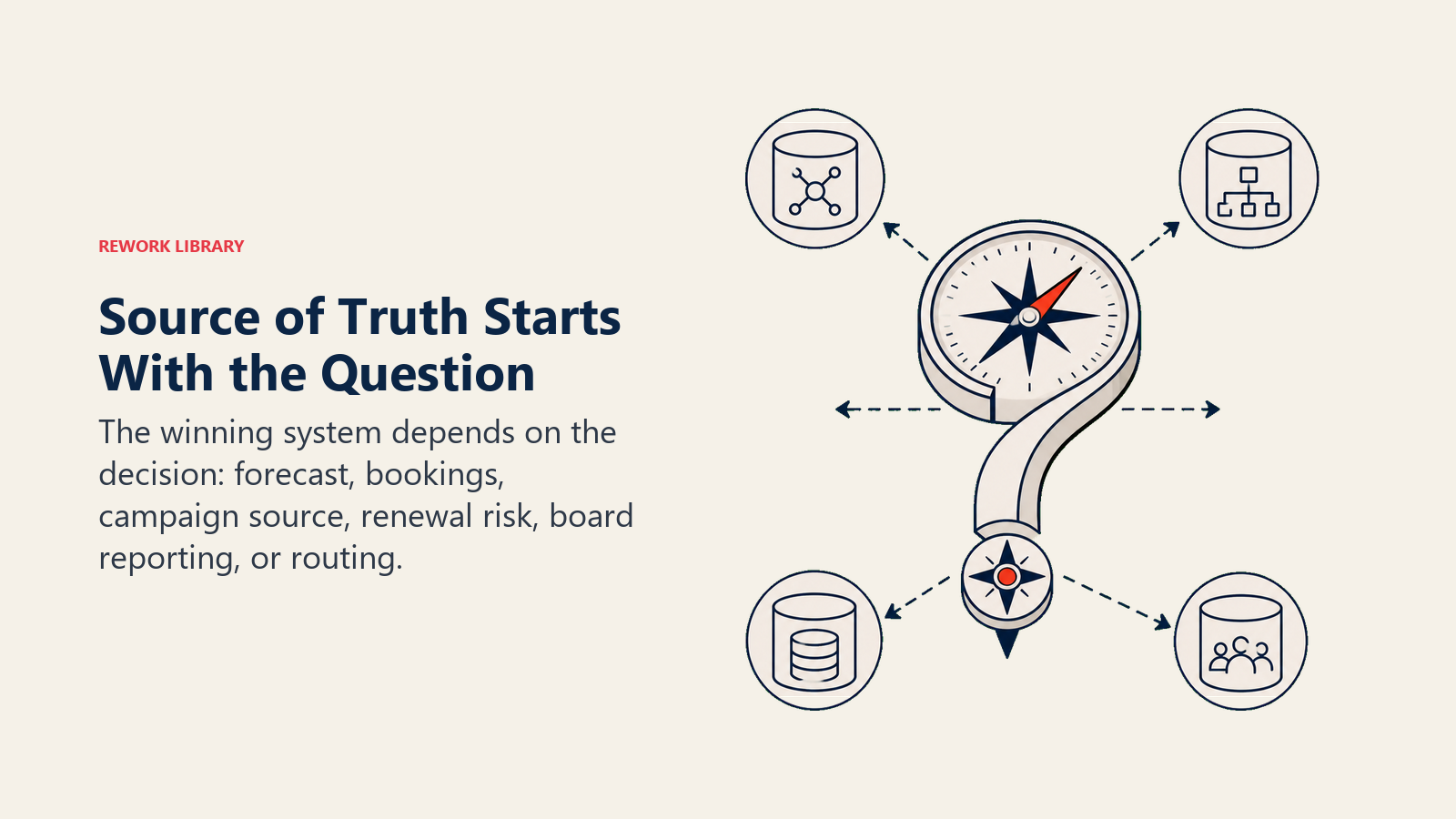
Source-of-truth decisions should start with the business question, not the system.
Turn this article into takeaways for your work.


Each assistant summarizes the article only for you and suggests best practices for your work.
| Business question | Likely source model |
|---|---|
| Which opportunities are in this quarter's forecast? | CRM with governed forecast definitions |
| What ARR did we book? | Finance or billing, reconciled with CRM closed-won data |
| Which campaign created this lead? | Marketing automation or governed source field |
| Which customers are at renewal risk? | CS platform plus finance renewal data |
| What is board-ready pipeline coverage? | BI or board package using governed CRM inputs |
| Which account owner should receive this lead? | CRM account ownership with routing rules |
The same data element can appear in multiple systems, but the question determines which one wins. CRM amount may be useful before contract signature. Billing amount may win after contract. Finance may own board-level revenue metrics even when CRM owns opportunity workflow.
Writing the question first prevents vague debates like "Is CRM the source of truth?" The better question is "source of truth for what decision?"
Data element map
Start with a practical map:
| Data element | Owner | Source of truth |
|---|---|---|
| Original lead source | Marketing Ops and RevOps | Marketing automation or governed CRM field |
| Current owner | Sales Ops or RevOps | CRM |
| Lifecycle stage | RevOps | CRM |
| Opportunity amount | Sales with finance rules | CRM until contract, then billing or finance |
| Forecast category | Sales and RevOps | CRM |
| Subscription amount | Finance | Billing system |
| Customer health | CS | CS system or governed CRM field |
| Renewal date | CS and finance | Billing, contract, or CRM based on model |
| Churn reason | CS with RevOps | CS or CRM |
| Board revenue metric | Finance | Finance or BI layer |
This table will differ by company. The important part is that it exists.
Conflict resolution
Write conflict rules.
Examples:
- If CRM amount differs from signed contract, contract or billing wins.
- If lead source differs between form and manual edit, original captured source wins unless RevOps approves correction.
- If customer health differs between CS note and health model, the health model wins for reporting and the note informs review.
- If BI and CRM pipeline differ, the documented executive reporting definition wins, and RevOps investigates the gap.
Without conflict rules, meetings become arguments.
Report-level source of truth
Some reports combine multiple systems.
For example, a board-ready revenue report may include CRM pipeline, billing ARR, finance plan, CS renewal risk, and marketing source. The report itself can be source of truth for board discussion only if each input has governed definitions.
BI is not a magic source of truth. It is a combined reporting layer. It needs definitions, owners, and caveats.
Change governance
Any source-of-truth change should include:
- Data element affected
- Old source
- New source
- Reason for change
- Systems affected
- Reports affected
- Historical impact
- Approval owner
- Launch date
This is especially important for executive dashboards and planning metrics.
Adoption model
A source-of-truth model only works if people use it.
RevOps should publish:
- Data dictionary
- Owner list
- Report catalog
- Change log
- Escalation path
- FAQ for common conflicts
When leaders ask "which number is right?", teams should know where to look.
Common mistakes
One system owns everything. This ignores the reality of billing, CS, marketing, and finance data.
No edit rules. Users overwrite fields that should be protected.
BI becomes a black box. Reports are trusted until no one can explain the formula.
Finance is excluded. Planning metrics drift from operating metrics.
No caveats. Weak data appears reliable.
Readiness checklist
Before rollout:
- Critical data elements are mapped.
- Owners are named.
- Winning systems are defined.
- Edit rights are clear.
- Conflict rules are written.
- Executive reports are tied to governed definitions.
- Change log exists.
The model is working when teams can resolve data conflicts by rule instead of hierarchy.
Example conflict workflow
When two numbers conflict, use a simple workflow:
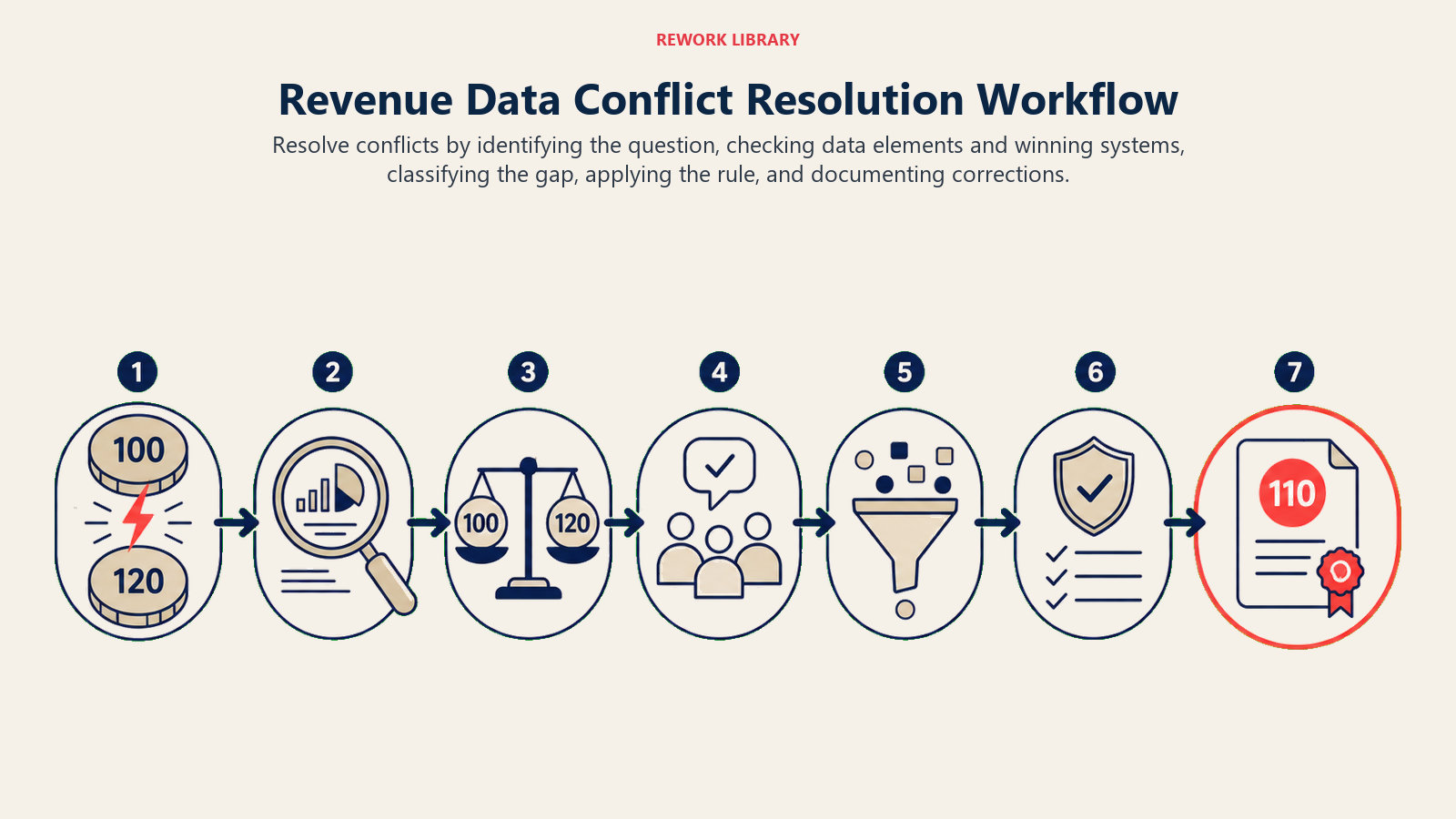
- Identify the business question.
- Identify the data elements involved.
- Check the source-of-truth map.
- Check whether the conflict is data, definition, timing, or transformation.
- Apply the written conflict rule.
- Document any correction.
- Update the map if the rule was missing.
This prevents a common pattern where the loudest leader picks the number.
Timing conflicts
Some conflicts happen because systems refresh at different times.
For example, CRM may show a closed-won deal today, billing may update tomorrow, and BI may refresh overnight. That is not necessarily a data-quality problem. It is a timing caveat.
RevOps should document refresh cadence for critical reports:
- Real time
- Hourly
- Daily
- Weekly close
- Monthly finance close
Finance metrics may intentionally lag operating metrics. That should be visible.
Data contract
For important fields, create a data contract:
| Field | Contract |
|---|---|
| Owner | Who is accountable |
| System | Where the value lives |
| Edit rule | Who can change it |
| Validation | What makes it valid |
| Sync | Where it flows |
| Reporting use | Which reports depend on it |
This gives systems teams and business owners the same reference.
Executive reporting
Executive reporting needs stricter governance than team dashboards.
Before a metric appears in executive or board reporting, confirm:
- Finance approves the definition.
- RevOps approves operating data source.
- Functional owner understands performance accountability.
- Data caveats are documented.
- Historical trend is comparable.
This prevents board reporting from becoming a manual reconciliation exercise.
Source-of-truth health checks
Track:
- Number of conflicting reports
- Unknown source rate
- Manual field edit rate
- Sync error volume
- Fields with no owner
- Metrics with no definition
- Reports with undocumented formulas
These are operating health signals.
Source-of-truth rule
A source-of-truth model should answer "which number should we use?" before the meeting starts. If leaders are resolving source conflicts live in leadership meetings, RevOps has more governance work to do.
Source-of-truth examples
Example: pipeline coverage.
Pipeline coverage should use CRM opportunities, but only if stage, close date, amount, and forecast category are governed. Finance may approve the coverage formula. RevOps may own the data-quality caveats. Sales owns pipeline performance.
Example: NRR.
NRR may use billing or finance data as the source of truth, with CS health and renewal risk as operating context. CRM alone may not be enough because renewals, contractions, and expansions depend on contract and billing truth.
Example: campaign ROI.
Marketing automation may own campaign membership. CRM may own opportunity and closed-won data. BI may combine them. RevOps should define how lead source, influence, and revenue are connected.
Source-of-truth catalog
Create a catalog with:
- Business question
- Data element
- Source system
- Owner
- Edit rule
- Reports affected
- Caveats
- Escalation owner
Keep the catalog short at first. Start with the data elements leaders argue about most.
Escalation model
When a source conflict is not covered:
- RevOps identifies the conflicting systems.
- Finance weighs in if the metric affects planning or board reporting.
- Functional owner explains workflow needs.
- Systems owner explains technical constraints.
- Executive sponsor decides if tradeoffs remain.
- RevOps updates the model.
This turns a conflict into better governance.
Data trust score
RevOps can score critical data:
| Score | Meaning |
|---|---|
| Green | Owner, source, edit rule, and report use are clear |
| Yellow | Definition exists but quality or ownership is weak |
| Red | Conflicting sources or no clear owner |
Use this score in dashboard caveats. If pipeline source is yellow, leaders should know before they use it for planning.
Common operating issues
Shadow spreadsheets. Usually a sign that official reports lack trust or timing.
Manual field edits. Often a sign that source rules are not enforced.
Metric duplicates. Different teams create local versions of the same metric.
Unknown ownership. No one fixes a broken field because everyone uses it but no one owns it.
Common operating issues checklist
Before calling the model done:
- Every executive metric has a source.
- Every source has an owner.
- Every owner can approve changes.
- Every conflict has a rule or escalation path.
- Every dashboard has visible caveats.
- Every major definition change is logged.
Source-of-truth work is never fully finished, but it should be governable.
Practical warning
Source-of-truth work can become abstract if it is not tied to disputes.
Start with the questions leaders already argue about:
- Which pipeline number is right?
- Which source created this deal?
- Which ARR number should finance use?
- Which customer health status is current?
- Which renewal date is official?
- Which churn reason should be reported?
Use those disputes to build the first version of the model. This makes the work practical and easier to adopt.
Practical warning operating examples
If two pipeline reports disagree, RevOps should check whether they use the same opportunity stages, close-date window, amount field, owner filter, and excluded records. The answer may be a report logic issue, not a data issue.
If marketing and sales disagree on source, RevOps should check capture rules, manual edit history, campaign hierarchy, and opportunity association. The fix may require field locks or better lead-to-account matching.
If finance and sales disagree on revenue, RevOps should check timing. Sales may be looking at closed-won bookings while finance is looking at billed or recognized revenue. Both can be correct for different questions.
Practical warning adoption rule
Publish the source-of-truth model where people work. Link it from dashboards, field governance docs, and RevOps intake. If people only see it during onboarding, they will forget it during real disputes.
The model should be easy to consult in the moment a conflict appears.
Risk checklist
Before rollout, test the model against real conflicts from the last quarter.
Pick examples:
- One pipeline number dispute
- One source attribution dispute
- One finance vs CRM revenue mismatch
- One customer health or renewal risk mismatch
- One dashboard definition conflict
For each example, confirm that the model tells teams which source wins, which owner can approve changes, and which caveat should appear in reporting.
If the model cannot resolve real conflicts, it is too theoretical.
Practical rule
The best source-of-truth model reduces meeting friction. Teams may still debate strategy, but they should not spend executive time deciding which system to trust. That decision should already be governed.
The model should also protect team trust. Marketing should know source data will not be casually overwritten. Sales should know pipeline rules are consistent. Finance should know planning metrics are approved. CS should know renewal and health signals are not ignored. RevOps holds those rules together so each function can use the data with less negotiation.
When the source-of-truth model works, teams still have hard conversations, but they start from the same evidence.
That shared evidence is the point. RevOps is not trying to remove disagreement. It is trying to remove avoidable confusion before leaders make decisions.
That difference is what makes the model worth maintaining.
It should be reviewed whenever a major report changes.
Ownership review
Review source-of-truth ownership whenever the business adds a motion, system, segment, or reporting package.
Ask:
- Which new data elements were created?
- Which system captures them first?
- Which system should win for reporting?
- Which team owns accuracy?
- Which reports or workflows depend on the value?
- Which users can edit it?
- Which caveats should appear in executive views?
Ownership drift is usually quiet. A field starts as a local CS note, becomes part of renewal risk, then appears in finance planning without a clear owner. Or a marketing source field starts as campaign context, then becomes attribution for budget decisions. RevOps should identify when a local field becomes a shared revenue field and move it into governance.
This is also why source-of-truth work should not live only in documentation. It should be part of systems intake, dashboard review, board reporting prep, and post-incident cleanup after data conflicts.
Report catalog
Source-of-truth governance should include a report catalog for leadership-facing views.

| Catalog field | Why it matters |
|---|---|
| Report name | Prevents duplicate reports with similar names |
| Business question | Explains why the report exists |
| Audience | Shows who should use it |
| Source systems | Makes dependencies visible |
| Metric definitions | Prevents formula drift |
| Owner | Gives someone accountability |
| Refresh cadence | Explains timing differences |
| Caveats | Shows limits before decisions are made |
| Replacement or retirement date | Prevents stale reports from staying alive |
The catalog does not need to include every personal report. Start with executive dashboards, forecast packets, board reporting, funnel reports, renewal reports, and source attribution views. Those are the reports most likely to create conflict if definitions drift.
A report catalog also helps when leaders ask for a new view. RevOps can check whether an existing governed report already answers the question. If not, the new report gets an owner and definition before it becomes another unofficial source of truth.
Source-of-truth decision packet
When teams disagree about a number, RevOps should document the decision instead of relying on memory.
| Item | Example |
|---|---|
| Business question | What number are leaders trying to answer? |
| Approved metric | Qualified pipeline created |
| Source system | CRM opportunity object |
| Required filters | Segment, period, stage, source, owner |
| Exclusions | Test records, duplicates, partner placeholders |
| Final owner | RevOps with finance signoff |
| Review cadence | Quarterly or when lifecycle rules change |
The packet turns conflict into governance. Once the decision is written, teams can improve the source instead of rebuilding the number differently every time.
Frequently Asked Questions about Source of Truth for Revenue Data
Is the CRM always the source of truth?
No. CRM is often the source of truth for sales and opportunity data. Billing, CS, marketing automation, or BI may own other data types.
Who owns the source-of-truth model?
RevOps should own the model with finance, systems, marketing, sales, and CS input.
Learn more

Principal Solution Architect
On this page
- Source-of-truth map
- Governance rules
- Why source of truth breaks
- Source-of-truth principles
- Business question first
- Data element map
- Conflict resolution
- Report-level source of truth
- Change governance
- Adoption model
- Common mistakes
- Readiness checklist
- Example conflict workflow
- Timing conflicts
- Data contract
- Executive reporting
- Source-of-truth health checks
- Source-of-truth rule
- Source-of-truth examples
- Source-of-truth catalog
- Escalation model
- Data trust score
- Common operating issues
- Common operating issues checklist
- Practical warning
- Practical warning operating examples
- Practical warning adoption rule
- Risk checklist
- Practical rule
- Ownership review
- Report catalog
- Source-of-truth decision packet
- Learn more