Creative Leadership: How to Build Organizations That Generate Original Ideas
Turn this article into takeaways for your work.


Each assistant summarizes the article only for you and suggests best practices for your work.
Creative leadership is the practice of building organizational conditions where original thinking can consistently emerge, survive evaluation, and reach execution. It is a distinct leadership discipline from managing creative output, approving creative work, or being personally creative. The creative leader's job is not to be the best idea generator. It is to run an organization where the best ideas can surface from anywhere.
What is creative leadership?
Most organizations say they want creativity. Most organizations also systematically suppress it. The approval processes, the risk management structures, the quarterly planning cycles, the performance reviews that reward consistency over experimentation: all of these, individually rational, collectively produce environments where the smart career move is to be reliably competent rather than occasionally brilliant.
Creative leadership is the discipline of resolving this tension. It requires leaders who understand both how original thinking works (and what kills it) and how execution discipline works (and why it cannot be abandoned in favor of pure ideation). The leaders who do this well run organizations that are both generative and disciplined, both comfortable with uncertainty and capable of shipping.
The framework is not new. Psychologists, educators, and organizational researchers have studied creative work for decades. What is more recent is the recognition that creativity is not a fixed personality trait that some people have and others lack. It is a capability that organizations either cultivate or extinguish, depending on how they structure work, evaluate performance, and manage risk.
Key Facts
Research from organizational psychology consistently finds that intrinsic motivation, doing work for its own interest and challenge, produces higher creative output than extrinsic motivation such as bonuses or competitive incentives, particularly for complex problems requiring novel solutions.
Studies of creative industries (film, design, software, advertising) find that the most consistently innovative teams balance psychological safety (openness to ideas) with cognitive diversity (different ways of thinking), and that neither factor alone predicts creative output as reliably as the combination.
Longitudinal research on R&D organizations finds that teams with explicit creative-process norms (structured idea generation separate from idea evaluation) produce more novel and implementable solutions than teams where ideation and criticism happen simultaneously.
The conditions creative leaders build
Creative leadership is primarily an environmental discipline. The leader's job is to build and maintain conditions where creativity can happen. Those conditions have five components.
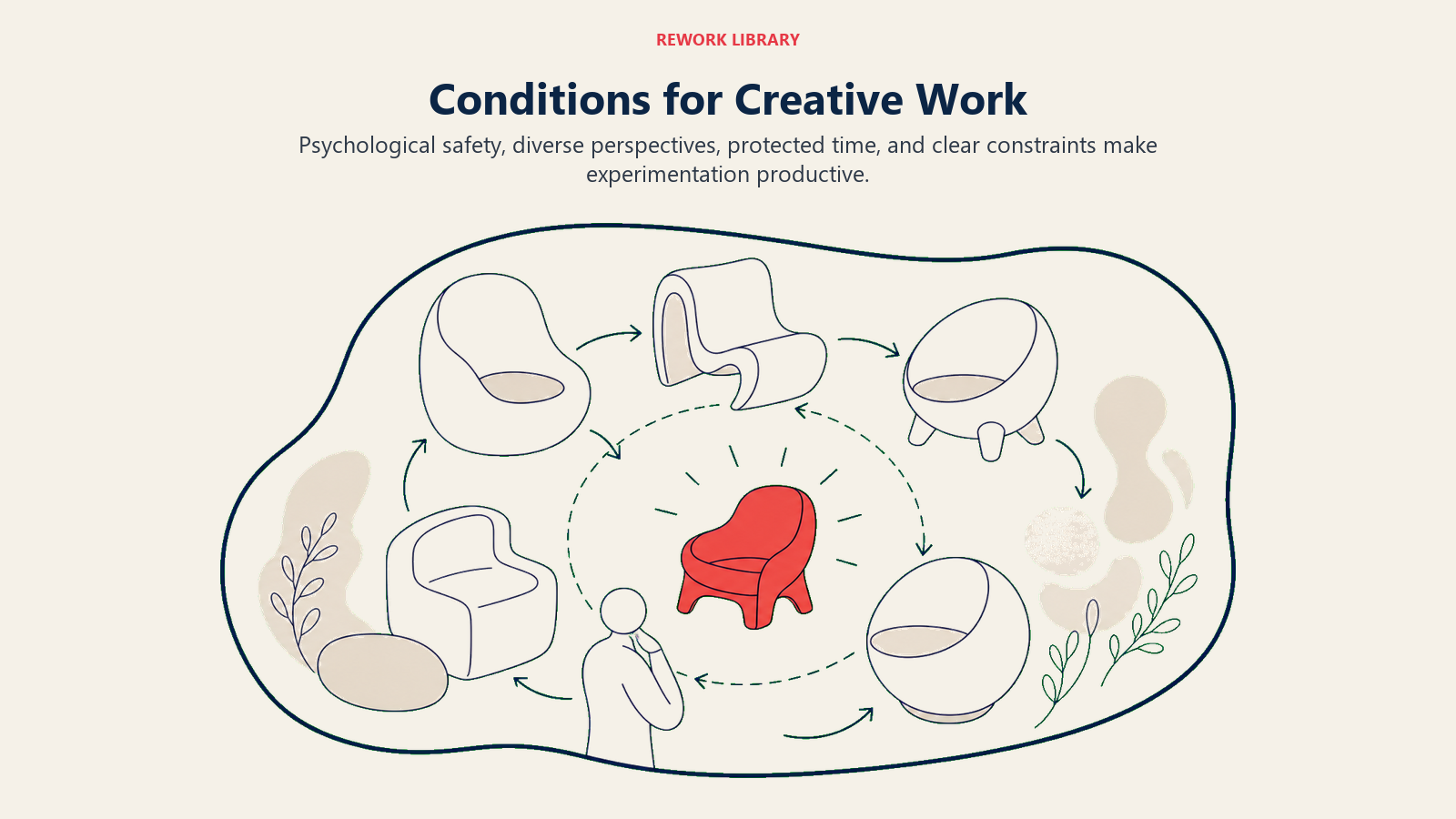
Psychological safety without false harmony. Psychological safety is the single most consistent predictor of creative output in team research. When people feel safe raising unconventional ideas without social risk, they do. When they don't, they self-censor. But creative leaders also know that psychological safety does not mean conflict-free environments. Real creative tension, where ideas are challenged rigorously, is part of what produces original solutions. The goal is safety to propose, not safety from criticism.
Autonomy over how, not just what. Research on creative motivation consistently shows that intrinsic interest in the work, the experience of genuine autonomy in how to approach a problem, drives more creative output than extrinsic rewards. Creative leaders find ways to give people meaningful control over their methods even within defined objectives. This does not mean removing accountability. It means not micromanaging the path to the outcome.
Diversity of perspective, not just diversity of background. Demographic diversity is one source of cognitive diversity, but not the only one. Teams that include people with different disciplinary training, different problem-solving styles, and different mental models of how the domain works generate more novel combinations than teams that are uniform in any of these dimensions. Creative leaders actively manage the cognitive composition of their teams, not just the demographic representation.
Structured separation of generation and evaluation. The most consistent process finding in creativity research is that mixing idea generation with idea evaluation, allowing criticism to flow freely during the generative phase, suppresses creative output. Creative leaders build explicit separations: brainstorming phases where judgment is suspended, followed by evaluation phases where ideas are rigorously stress-tested. The separation is process design, not a soft permission to avoid accountability.
Tolerance for productive failure. Organizations that punish all failure teach people to avoid all risk. Organizations that reward all attempts regardless of outcome teach people that outcomes don't matter. Creative leaders build cultures where the distinction is between intelligent failure (well-reasoned bets that didn't work) and negligent failure (poor process or avoidable mistakes). The first type gets examined and learned from. The second gets addressed.
Creative leadership vs related approaches
| Dimension | Creative leadership | Transformational leadership | Servant leadership |
|---|---|---|---|
| Primary focus | Organizational conditions for original thinking | Inspiring belief in a new direction | Supporting team members' growth and wellbeing |
| What the leader does | Designs environment, manages tension | Articulates vision, models values | Removes obstacles, develops people |
| Role of the leader's ideas | One source among many | Often the central source | Subordinate to the team's direction |
| How risk is handled | Explicit tolerance for intelligent failure | Risk is subsumed into the vision | Risk is reduced through support |
| When it works best | Organizations that need sustained innovation | Strategic inflection points | Teams building skill and confidence |
Creative leadership and transformational leadership are often paired. Transformational leaders provide the strategic direction and energy that makes creative work feel purposeful. Creative leaders provide the structural conditions where that energy can translate into actual original output. The two are complementary, and many effective leaders practice both, but they require different skills and operate on different mechanisms.
How creative leaders handle the creativity-execution tension
The most common failure mode in organizations that try to build creative cultures is the loss of execution discipline. Creativity becomes an excuse for missed commitments, unclear ownership, and process avoidance. The best creative leaders solve this with explicit architectural choices, not just culture.
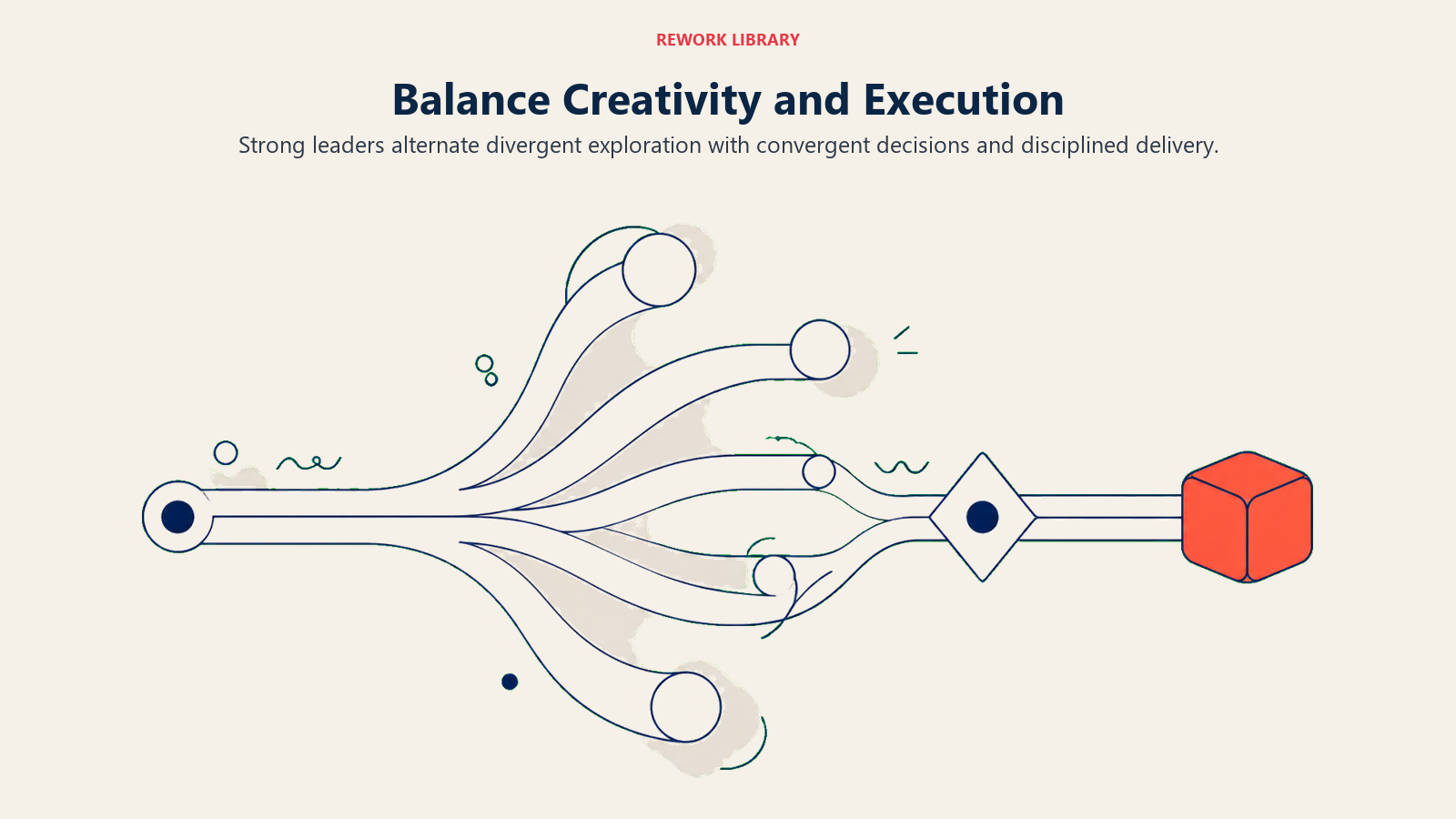
Time-bounded creative space. Rather than creating a generally permissive environment where creative work and operational work intermingle, effective creative leaders create explicit, time-bounded spaces for creative work. Sprint-based exploration, quarterly innovation cycles, dedicated "unstructured" time that is genuinely protected from operational pull: these structures honor both creative work and execution discipline without pretending the two are always compatible.
Clear ownership of decisions. Creative processes produce many ideas. At some point, someone has to decide which idea to pursue. Creative leaders make this transition explicit: the generative phase has clear end conditions, the evaluation criteria are known in advance, and the decision authority is unambiguous. Ambiguity about who decides is one of the most effective ways to kill both creative risk-taking and execution follow-through.
Metrics for exploration, not just delivery. Standard operational metrics measure delivery: on time, on budget, on specification. Creative organizations need additional metrics for the exploration phase: how many distinct approaches were considered, how quickly promising experiments were identified and amplified, how many cheap experiments were run before a large bet was made. Without these, the pressure of delivery metrics will always crowd out exploration time.
Protection of creative teams from operational complexity. Creative work requires sustained attention. The meeting rhythms, approval processes, and administrative overhead that are appropriate for operational teams disrupt creative teams disproportionately. Effective creative leaders actively manage the interface, reducing coordination burden on creative teams without allowing them to operate in isolation from the rest of the organization.
Building creative leadership skills
Creative leadership is not a personality type, but it does require specific capabilities that not all leaders have developed by default.
Comfort with ambiguity. Creative processes are inherently ambiguous in the early stages. Leaders who need resolution before they can provide direction will consistently shut down creative work before it has time to develop. Building comfort with "we don't know yet" as a legitimate organizational state is a real skill, and one that can be developed through deliberate practice.
Active listening for unconventional ideas. Most organizational communication is implicitly screened for ideas that fit the current strategic frame. Creative leaders develop the ability to listen for ideas that challenge the frame itself. This requires deliberately suspending pattern-matching to established categories and attending to what is being said rather than how it fits with what you already believe.
Feedback that develops rather than judges. The feedback most leaders give is evaluative: good, bad, needs work. Creative work, especially in early stages, responds better to developmental feedback: what is promising here, what questions this raises, what would need to be true for this to work. Developing this feedback capability takes practice and usually requires unlearning evaluation-heavy habits from performance management contexts.
Skill at recognizing creative talent in non-obvious places. Creative leaders know that the most original thinkers in an organization are not always the most confident, the most senior, or the most verbally fluent. Building practices for discovering and developing creative talent broadly, rather than relying on who speaks up in meetings, expands the creative capacity of the organization.
Common failure modes
Confusing ideation with creativity. Organizations that run brainstorming sessions and call it a creative culture have confused a single technique with a systematic capability. Ideation is one step in a creative process. Organizations need the full sequence: space for exploration, processes for evaluation, resources for development, and support for execution.
Rewarding creative personality over creative output. Some people signal creativity loudly (unconventional ideas, challenging established practices, aesthetic preferences for novelty). This is not the same as producing valuable creative output. Organizations that reward the performance of creativity rather than its results attract a particular type of performer and lose people who do their most original thinking quietly.
Protecting creative teams from all external input. Isolation can feel like protection, but creative work benefits from specific types of external constraint and input. Customer problems, market realities, and operational constraints are not enemies of creativity. They are the friction that makes creativity productive. Entirely isolated creative teams often produce work that is internally elegant and externally irrelevant.
Failing to transition from exploration to execution. Creative leadership requires knowing when exploration is done. Organizations that never commit to an approach, always leaving open the possibility of a better idea, fail to execute. The creative leader's job is to make the exploration phase rigorous and time-bounded, then make the commitment to execute clearly and without ambiguity.
Frequently Asked Questions about Creative Leadership
Can creative leadership work in highly regulated industries?
Yes, but with adjustment. Regulated industries have real constraints on what can be changed. Creative leadership in these contexts applies to how work is done, how processes are designed, and how customer problems are framed, even where the regulatory output is fixed. Some of the most productive creative work in regulated industries has happened around process efficiency, user experience, and risk management approaches, not the regulated output itself.
How do you measure whether creative leadership is working?
The metrics that matter are lagging indicators (novel products launched, new market segments entered, efficiency improvements from process innovation) and leading indicators (idea volume from non-senior sources, experiment rate, time from idea to pilot). The ratio of ideas from the front lines versus senior leadership is one of the cleaner signals of whether creative leadership is working at the organizational level.
Is creative leadership compatible with high-accountability cultures?
Yes, and the best creative organizations have both. The mistake is thinking high accountability means evaluation at every step, including the early generative stage. Accountability applies to outcomes and to the quality of the process. It applies at the end of exploration phases, when decisions are made and commitments assumed. Applying accountability pressure during the generative phase is the most reliable way to suppress creative output.
How do you sustain creative culture through growth and scale?
The honest answer is that it is hard. The organizational structures that enable execution at scale (standardization, hierarchy, process consistency) are in tension with the conditions that enable creativity (autonomy, experimentation, tolerance for deviation). Sustaining creative culture through growth requires deliberately protecting the conditions for creativity as a strategic priority, not assuming they will persist on their own.
The organizations that sustain creative output over long periods do not rely on particularly creative individuals. They build systems that consistently produce creative work from people of ordinary creativity, by managing the conditions under which thinking happens. That is the creative leader's actual job: not to have the best ideas, but to build the organization that does. See adaptive leadership for the related framework on mobilizing people through challenges that require behavioral change, and psychological safety for the foundational condition that creative environments require.
