Group Fitness Trends & Programming: What Members Want in 2025 and Beyond
Turn this article into takeaways for your work.


Each assistant summarizes the article only for you and suggests best practices for your work.
Group fitness drives gym growth because class attendees churn at roughly half the rate of floor-only members. The 2025 winners aren't chasing every format, they read their own demand data, align classes to member demographics, and program with the 60/20/20 framework so the class habit becomes a retention moat competitors can't copy.
Group fitness is the closest thing to a guaranteed retention machine the fitness industry has produced. Members who attend classes regularly cancel at roughly half the rate of members who only use the gym floor. That single statistic should reframe how every gym owner thinks about programming: it's not a schedule to fill, it's a retention system to engineer.
But the formats that build the class habit shift faster than most gym schedules do. The spin craze of the 2010s gave way to HIIT, which is now fragmenting into shorter, smarter formats. Yoga and Pilates, written off as niche a decade ago, are now core programming pillars in gyms that used to only offer cardio machines and dumbbells. Recovery classes went from afterthought to waitlisted. And strength-based group formats are growing in a market that was once dominated by cardio-heavy programming.
Understanding what's driving these shifts, and more importantly how to apply that understanding to your specific member base, is what separates gyms that program with discipline from those that chase every trend without building anything sticky. Your gym business model and positioning will shape which formats resonate most with your specific audience.
Key Facts: Group Fitness Retention
- Group fitness participants churn at 25-30% annually vs 45-55% for floor-only members (IHRSA)
- 62% of gym members cite group classes as a primary reason for joining their current gym (Les Mills Global Consumer Research, 2024)
- Classes with waitlists consistently show 40% higher member renewal rates than same-format classes without waitlists
IHRSA research confirms that members who attend group fitness classes are significantly less likely to cancel than those who only use the gym floor, making class programming one of the highest-leverage retention investments a gym can make.
Current Demand Trends: What's Growing and What's Fading
HIIT is evolving, not dying. The 60-minute HIIT class that dominated programming in 2018 is losing ground to 30-45 minute formats. ACE Fitness research on fitness trends confirms that shorter, high-intensity formats and mind-body modalities are among the fastest-growing class categories heading into 2026. Members want the intensity but not the time commitment. Formats like short-burst metabolic conditioning, tabata-style circuits, and what some operators call "express intensity" classes are growing because they fit into the lunch hour or the post-work slot without eating into evening plans. The old assumption that longer equals better value is reversing in group fitness.
Functional fitness is maturing. What started as a fringe category is now a programming staple. Members want to move better, not just look different. Classes built around mobility, movement quality, and real-world strength patterns are attracting the 35-55 age bracket that struggled to connect with traditional aerobics formats. Functional formats also cross-sell well into personal training, which makes them doubly valuable from a revenue perspective.
Mind-body is having a genuine resurgence. Yoga and Pilates aren't new, but they're growing at rates most gym owners didn't expect. Post-pandemic, members are booking mind-body classes for reasons that go beyond flexibility: stress management, sleep, mental clarity. Breathwork as a standalone programming format is emerging from boutique studios into mainstream gym schedules. If your mind-body programming is still one yoga class on Sunday morning, you're leaving significant retention and revenue on the table.
Strength-based group formats are the fastest-growing category. Barbell clubs, Olympic lifting sessions, powerlifting-focused group classes, and structured progressive programming in a group setting are pulling members who previously only worked with personal trainers. This format works particularly well for the 25-40 demographic that has a fitness background but wants the accountability and social structure of a group setting. These members are also prime candidates for personal training upsell programs once they've built a class habit.
Recovery classes are programming staples, not extras. Foam rolling sessions, guided stretching classes, and recovery-focused yoga are no longer niche. They're often among the highest-rated classes on member feedback surveys, and they serve as a bridge for members who want gym access on days they're not up for intensity.
Reading Member Demand Accurately
National trend data tells you what's happening across the industry. Your own data tells you what's happening in your gym.

Waitlist data is your clearest demand signal. If you have a consistent 8-person waitlist on Tuesday evening Pilates but half-empty mats on Wednesday morning yoga, the data is telling you something specific: the format works, but the time slot is undersupplied. The gym that adds a second Tuesday Pilates before experimenting with a new format is making a smarter programming decision.
Attendance trend lines matter more than absolute numbers. A class that draws 12 people consistently is more valuable than a class that peaked at 20 but is now averaging 9. Declining attendance is an early warning signal, not a reason to immediately cancel a format. Investigate first: Has the instructor changed? Has a competing time slot drawn off attendees? Is the format genuinely losing traction, or is it a scheduling issue?
Member surveys should be structured, not open-ended. "What classes do you want?" produces noise. "Which of these three formats would you attend if we offered it on Thursday at 6pm?" produces actionable data. Quarterly surveying with format-specific options gives you a read on latent demand before you commit to schedule changes. Pair survey data with your member feedback loops and tracking systems for a fuller picture of demand.
Local demographics diverge from national patterns regularly. A gym in a university town with a 22-28 median member age will see different format preferences than a suburban gym whose members skew toward 35-50. The U.S. fitness club membership data on Statista shows significant regional variation in participation rates that reinforces why local data should always take priority over national averages. National reports are useful context, but they can't substitute for knowing your own member base.
The 60/20/20 Programming Framework
Gyms that program reactively end up with schedules that shift every quarter, frustrate members who've built a habit around specific classes, and exhaust instructors who have to constantly learn new formats. A more disciplined approach is the 60/20/20 framework.
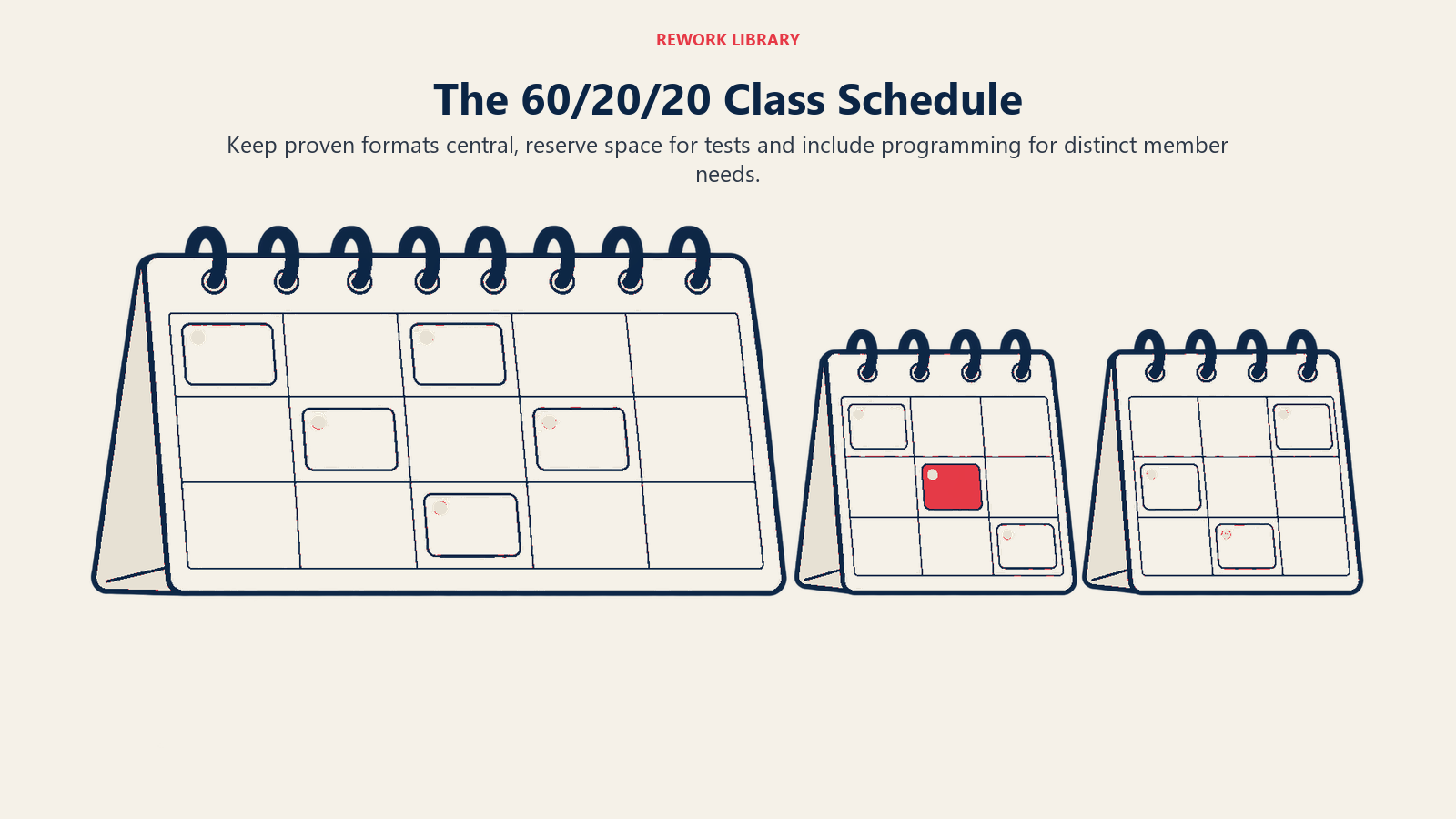
60% Core Formats. These are the formats that your member base has validated over time. They have consistent attendance, stable instructor rosters, and strong member sentiment. Don't touch these unless attendance data gives you a clear reason. For most gyms, core formats include at least one strength-based class, one cardio format, and one mind-body offering.
20% Trending Formats. These are formats you're testing based on member demand signals and industry trends. Run them for a defined period (12-16 weeks minimum) before evaluating. Set a minimum attendance threshold before the trial period ends. If they don't hit the threshold, you have data to support the decision to cancel. If they exceed it, they're candidates to move into the core 60%. Strong performance here may justify expanding into a full specialty fitness program with its own pricing tier.
20% Specialty/Demographic-Specific Programming. This is where you serve specific member segments: corporate wellness classes at lunchtime, senior fitness programming at 10am, youth classes on weekend mornings. These don't need to hit the same attendance thresholds as core programming because they serve retention functions for specific member groups who'd have fewer reasons to stay without them.
Managing format sunsets. When a class has to go, the handling matters. Give members 6-8 weeks' notice. If possible, offer an alternative in the same time slot. Direct affected members toward the replacement individually rather than relying on a general announcement. A class sunset done poorly creates cancellations. Done well, it's barely noticed.
Demographic Alignment in Programming
Programming that ignores member demographics produces schedules that serve the gym owner's preferences, not the member's. The ACE guide on the changing face of group fitness notes that shorter class formats and multi-modal programming have been driven largely by demographic shifts and changing member time constraints.
Gen Z members (18-26) want short, intense formats and social energy. They're comfortable with digital booking, expect a quality playlist, and are often drawn to community-oriented formats where they recognize other members. They're also the demographic most likely to book via app and cancel last-minute, so waitlist management matters more for classes targeting this group. A strong member app engagement strategy is particularly important for retaining this cohort.
Millennial members (27-42) are your most reliable class attendees when the format fits their schedule constraints. They typically have more rigid time windows (before work, lunch hour, or after kids are in bed). Predictability and consistency matter - they plan their week around class times. They're also the demographic most likely to follow a specific instructor, which makes instructor retention especially important for this group.
Members 45 and older are the most underserved segment in most gym programming calendars. They respond well to functional formats, recovery-focused classes, and mind-body programming. They're also typically the most loyal members if they find formats that work for them. Programming a 10am strength-based class for this demographic isn't catering to seniors - it's capturing a retention-rich segment that most competitors ignore.
Corporate wellness programming deserves its own programming track at many gyms. Lunchtime express classes (30-minute formats), early morning formats before 7:30am, and online or hybrid options for remote workers can unlock employer-subsidized membership arrangements that reduce churn and create B2B revenue streams. If your gym is near an office district, this is an underutilized segment, and it pairs naturally with a formal corporate wellness partnership program.
Seasonal programming and fitness challenges anchor members to the gym during low-motivation periods. January challenge programming is expected. But gyms that build a September back-to-routine challenge, a summer endurance series, or a holiday fitness event create multiple commitment moments throughout the year that reduce the typical seasonal churn spikes. These events also support broader community building in fitness studios that makes members genuinely reluctant to leave.
Programming as a Retention and Differentiation Strategy
The gyms winning on group fitness aren't offering the newest formats. They're the ones that read their specific member base accurately and program with discipline. They know their core formats and protect them. They test new formats with defined criteria and exit gracefully when the data doesn't support continuation. They align their schedule with who their members actually are, not who they wish their members were.
Group fitness done well is a differentiation strategy that's genuinely hard to copy. A competitor can match your equipment, price your membership similarly, and open a second location near you. But they can't replicate the community, the instructor relationships, and the class habit your members have built over years of consistent programming. That's the real competitive moat group fitness builds - and it starts with programming decisions that are smarter than trend-chasing. Combine strong programming with a well-optimized class schedule for peak and off-peak hours and the retention advantage compounds over time.
Frequently Asked Questions about Group Fitness Programming
Why does group fitness improve gym retention?
Members who attend classes regularly cancel at roughly half the rate of floor-only members, around 25-30% annual churn versus 45-55%. Classes build a habit, a schedule, and relationships with instructors and other members, which together create strong reasons to keep paying.
What group fitness formats are growing in 2025?
Shorter 30-45 minute HIIT formats, functional fitness for the 35-55 age bracket, mind-body classes like yoga, Pilates, and breathwork, strength-based group formats such as barbell clubs, and recovery classes like guided stretching and foam rolling. Longer is no longer assumed to mean better value.
What is the 60/20/20 programming framework?
It splits the class schedule into 60% proven core formats you protect, 20% trending formats you test for 12-16 weeks against a minimum attendance threshold, and 20% specialty or demographic-specific programming (corporate, senior, youth) that serves retention for specific member groups.
How should gyms read member demand for classes?
Use your own data first. Waitlists signal undersupplied time slots, attendance trend lines matter more than single-class peaks, and structured surveys with specific format-and-time options produce actionable answers. Local demographics often diverge from national trend reports, so prioritize your member base.
How do you retire a class without losing members?
Give 6-8 weeks' notice, offer an alternative in the same time slot where possible, and reach out to affected members individually rather than relying on a general announcement. Handled well, a format sunset is barely noticed; handled poorly, it triggers cancellations.
Learn More