Family Plans & Group Memberships: Pricing and Retention Strategies

Turn this article into takeaways for your work.


Each assistant summarizes the article only for you and suggests best practices for your work.
When one family member cancels, everyone usually follows. But the inverse is also true: when an entire household is on a family plan, almost no one cancels. The social friction of "I want to quit the gym but my partner and kids use it too" is one of the most powerful retention mechanisms in fitness, and most gym operators are leaving it completely untapped.
Family and group membership plans serve two business functions simultaneously, and that dual value is undersold by most operators. They're a retention anchor that makes it psychologically and logistically harder for households to cancel. And they're an acquisition tool, because a family plan converts a prospect who was on the fence into a household commitment that brings 2 to 5 members in one deal. McKinsey's fitness consumer research confirms that building strong communities and shared experiences is now a differentiating factor for fitness operators, family plans operationalize exactly that advantage. This multi-member dynamic works alongside your gym referral program, since family plan members refer at 1.7x the rate of individual members.
Getting the pricing right is where most gyms stumble. Price family add-ons too high and no one takes them. Price them too low and you cannibalize your individual membership revenue. This guide gives you the framework to find the balance.
Key Facts: Group Membership Retention
- Multi-person household memberships have 58% lower annual churn than individual memberships (IHRSA, 2024)
- Converting a single-member account to a family plan reduces that account's 12-month cancellation probability by 62%
- The average household LTV for family plans is 2.8x the individual member LTV, not simply 2x, because both the term and the size increase
- Family plan members refer at 1.7x the rate of individual members (shared social networks, shared experience)
The Different Types of Group Membership Structures
Group memberships aren't one thing. They serve different audiences and different strategic goals. Know which type you're building before you price it.
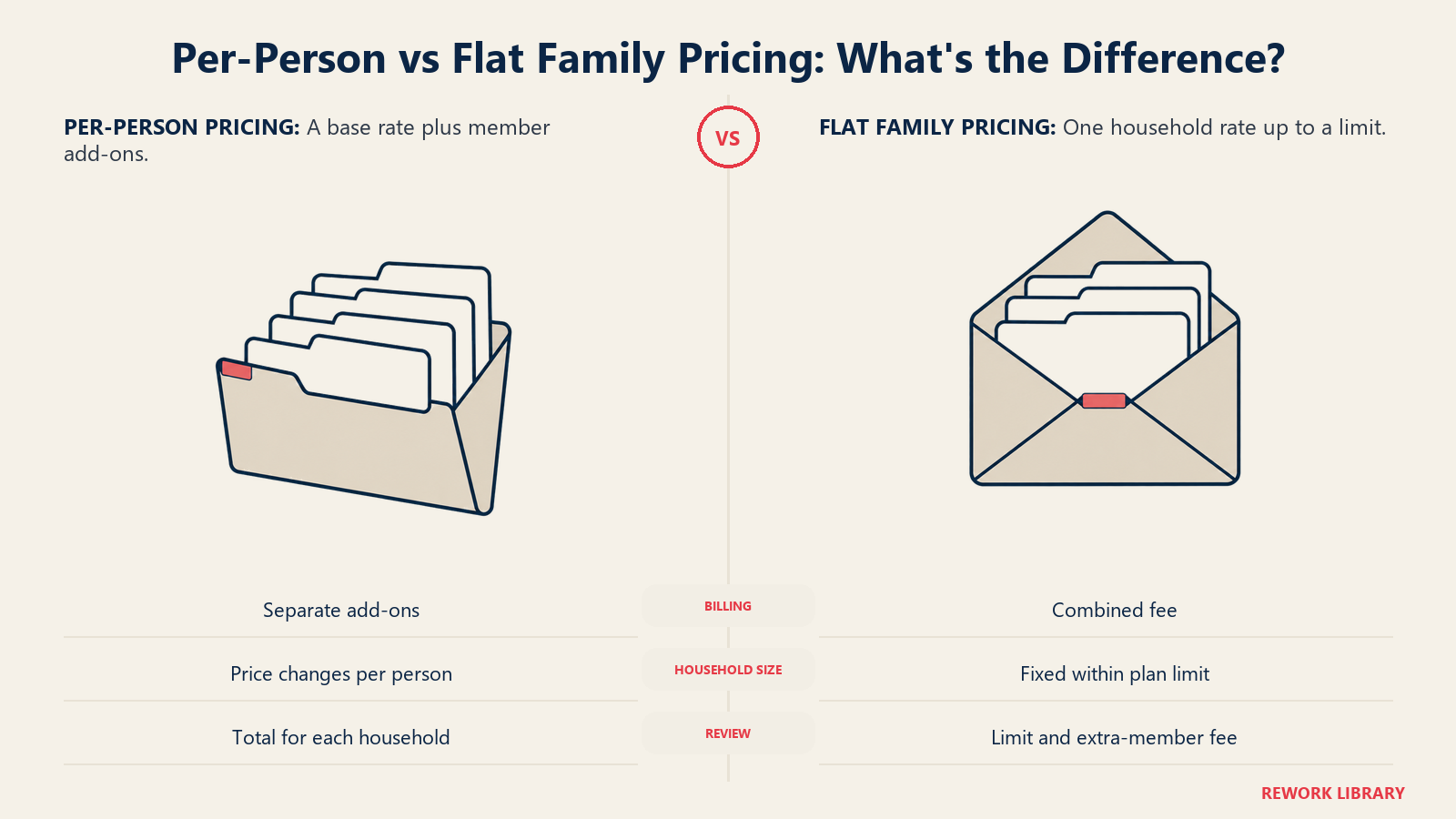
Family plans cover immediate household members: a primary member, their spouse or partner, and dependent children up to a defined age (typically 18 or 21). Family plans usually offer a per-person incremental add-on rate rather than a flat family fee, though both structures exist. The goal is to increase household participation, which directly increases retention.
Couples plans are a simplified version of family plans for households without children. A two-person plan at a price that's meaningfully lower than two individual memberships combined. Couples plans are often an acquisition tool: "Bring your partner for $25/month extra" is a compelling offer at sign-up that adds a second member with near-zero acquisition cost. The pricing psychology of presenting the total household cost versus per-person savings dramatically affects conversion rates for these plans.
Buddy plans are informal pair pricing used as acquisition tools. "Refer a friend, and you both pay the buddy rate." Different from a standard referral program in that both parties get a permanent pricing benefit as long as they're both active. When one cancels, the other loses the rate, which creates a mutual retention incentive.
Corporate group memberships are employer-negotiated access for teams, covered in detail in the corporate wellness partnerships article. The group dynamic exists here too: when a company's wellness program brings 15 employees into your gym, the social connection among coworkers becomes a retention driver independent of the corporate contract.
Pricing Family Plans: The Two Models
There are two pricing approaches for family memberships, and which one you choose affects both your revenue and your conversion rate significantly.
Model 1: Per-Person Incremental Pricing
The primary member pays the standard individual rate. Each additional family member is added at a discounted per-person rate. Example:
- Primary member: $60/month
- Spouse/partner add-on: $35/month (42% discount)
- Child add-on (per child): $20/month
- Family of 4 total: $60 + $35 + $20 + $20 = $135/month
Pros: Transparent, easy to understand, scales naturally with family size, and the primary member rate remains unchanged (protecting your individual membership pricing).
Cons: Larger families can perceive the total price as high even if per-person costs are reasonable. Admin is slightly more complex with multiple line items per account.
Model 2: Flat Family Rate
All family members in the household pay one combined monthly fee, regardless of household size up to a defined maximum. Example:
- Household rate: $110/month for up to 4 members
- Additional members above 4: $20/month each
Pros: Extremely easy to understand, feels like a "deal" for larger families, simple billing.
Cons: Small households (2 members) may compare it to two individual memberships and find it a worse deal. The perceived value varies by family size.
Which model to choose: Per-person incremental pricing works better when your average household is 2 to 3 members. Flat family rates work better when your market has a high proportion of larger families (3+ children), because the flat rate looks increasingly attractive as family size grows.
Pricing floor rule: Your family plan's per-person effective rate should never be less than 65% of your individual membership rate. Below that floor, you risk training your market to expect discounts, and prospects who don't have families may push back on individual pricing. Your membership tier structure should define which tier family add-ons map to, so the access rights are clear for each household member.
Household LTV calculation: For a family of 4 on the incremental model above ($135/month), assume an average tenure of 24 months (significantly higher than the individual average of 14 months due to retention anchor effects):
- $135 x 24 months = $3,240 household LTV
- Individual member equivalent: $60 x 14 months = $840 each
- Four individual members: $3,360, but with zero retention anchor and four separate acquisition costs
The family plan isn't necessarily a higher total revenue than four individual memberships. But it's far more durable revenue, acquired at a fraction of the cost per member.
What to Include in Family Plans
Family plans need clear rules about what each member gets and what's shared. Ambiguity here creates friction at check-in and disputes about billing.
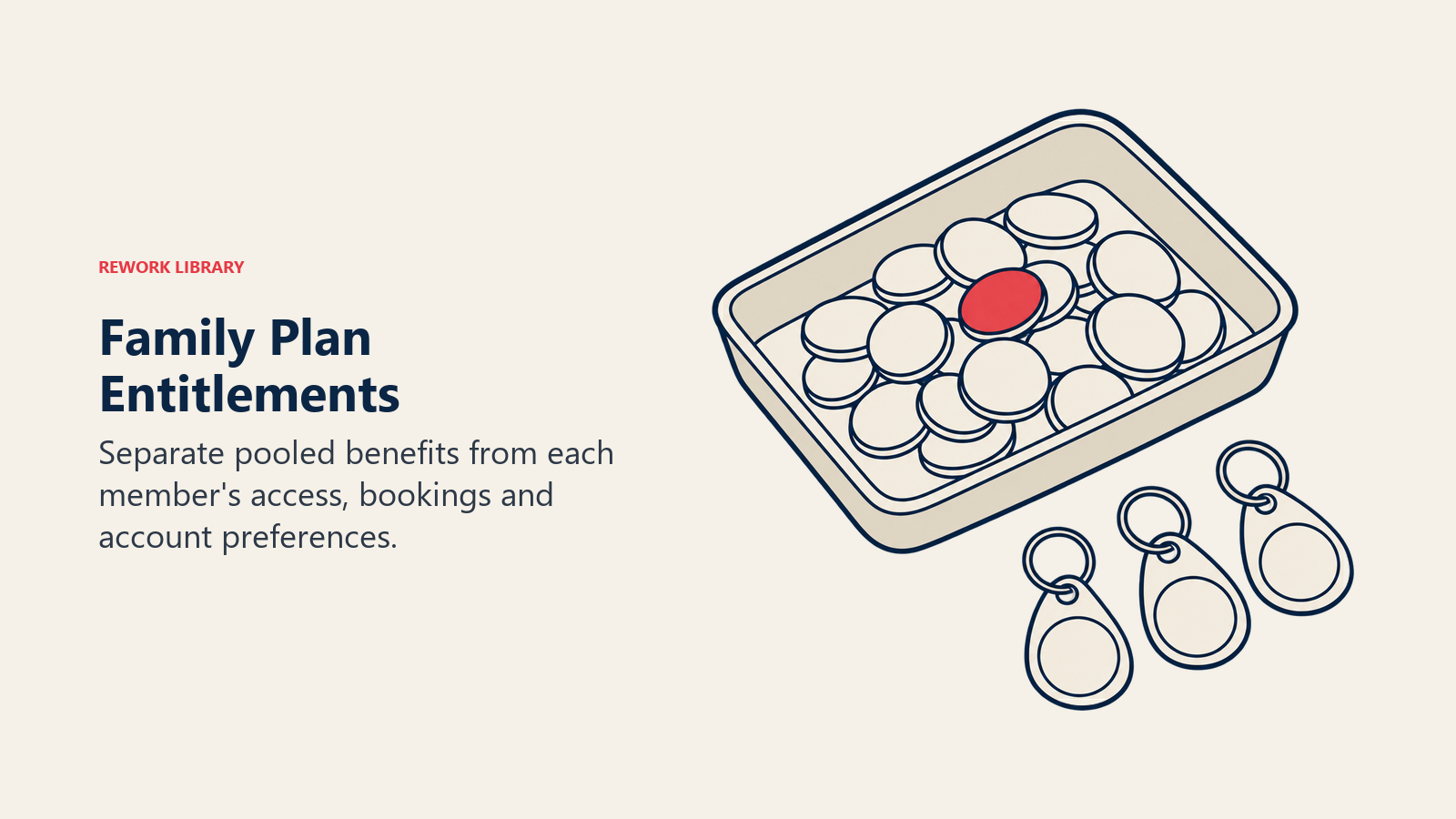
Shared benefits (both/all members use from a common pool):
- Guest passes: A family of 3 gets 3 combined guest passes per month, not 3 per person
- Class credits: If your plan includes credits, pool them. A family of 3 gets 12 credits per month to use collectively, not 4 per person
- Corporate perks: Group lockers, shared booking benefits
Individual benefits (each member gets their own):
- Check-in access: Each member has their own key fob or app account
- Fitness assessments: Each member gets their own quarterly assessment
- Class booking history and preferences: Tracked per person
Children's access rules: Define clearly what age children can access independently versus with a parent. Most gyms set this at 14 or 16 years old for independent access to the main gym floor, with full access at 18. Children under 14 may have restricted hours or require parent supervision. Make this explicit in the plan agreement.
What to exclude from family add-on pricing: Don't include unlimited personal training in family add-on pricing. PT credits are a premium service that should be separately purchased or available only on the primary member's VIP tier. Bundling PT into family plans at add-on prices destroys your PT revenue margin. Instead, use the personal training upsell process to introduce PT to family members individually after they've built a habit.
Marketing Family Plans: When and How to Present Them
The timing of the family plan offer matters as much as the offer itself. Done at the wrong moment, it feels like an upsell. Done at the right moment, it feels like a solution to a problem the prospect was already thinking about.
At initial sign-up: Always ask the question. "Are you coming in alone, or do you have a partner or family who might join with you?" This isn't a sales tactic. It's relevant to which plan the prospect needs. If they mention a partner or children, immediately shift to the family plan overview. You've just potentially doubled the value of the deal with one question.
At 30 days: Members who have built a habit by day 30 are the most likely to convert a partner. A 30-day check-in message: "Great to see you've been coming in consistently. Have you thought about bringing [your partner/your family] in? Our family add-on for the first month is on us if you add them this week." The zero-cost first month removes the trial friction.
Seasonal moments: Back to school (September), New Year, and spring fitness pushes are when household members collectively think about fitness. A seasonal campaign: "Make fitness a family habit this fall. Add a family member at 50% off for the first 3 months." These campaigns work best as limited-time offers with a clear end date. Pair seasonal family campaigns with a community event or open house where the whole household can experience the gym together before committing.
At milestone check-ins: When a member mentions their partner wants to start working out, or their teenager needs a training environment, your staff should have a family plan offer ready. Train your team to recognize these comments as conversion opportunities, not just conversation.
The upsell conversation script: Front desk staff or coaches, during a routine check-in: "Hey [Name], have you ever thought about getting [partner/family member] in here with you? We have a couples rate that makes it a lot easier. You'd add [partner] for $35 a month. Cheaper than two separate memberships by far. Want me to put together the numbers?"
Retention Effects of Group Plans
This is the number that makes family plans a strategic priority rather than just a pricing option.
The retention dynamic of group plans has two components. First, the social accountability: members who work out with household members attend more frequently and are less likely to enter the invisible decline that precedes cancellation. IHRSA's research on member engagement and retention found that members at highest risk of quitting are those who haven't attended for more than a week, shared household plans create the social nudge that keeps attendance from slipping. Attendance frequency is the single strongest predictor of retention, and household membership plans drive higher attendance. Your member engagement tracking should flag household accounts where one member's visits are dropping, a warning sign that the cancellation conversation is coming.
Second, the cancellation friction: when a primary member considers canceling, they now have to make a decision on behalf of the household, not just themselves. "I'm not using the gym" becomes "I'm not using the gym, but my partner is going three times a week and the kids love the teen fitness program." That calculus is dramatically harder to resolve in favor of cancellation.
Retention data by plan type: | Membership Type | Avg Monthly Churn Rate | Avg Tenure | Annual Churn | |---|---|---|---| | Individual, month-to-month | 4.2% | 14 months | ~50% | | Individual, annual contract | 2.1% | 20 months | ~25% | | Couples plan | 2.0% | 24 months | ~24% | | Family plan (3+ members) | 1.4% | 32 months | ~17% |
A family plan member stays nearly 2.3 times longer than an individual month-to-month member. That difference in tenure compounds: longer-tenure members are more likely to upgrade, more likely to refer, and more likely to buy add-on services.
Family Plans as Your Lowest-Cost Retention Mechanism
Here's the business case in plain terms: acquiring a new member costs $80 to $200 in most markets. Keeping an existing member costs almost nothing if you have the right structure in place. Family plans are structure. Statista's data on US gym and health club membership numbers shows nearly 69 million members in 2022, a market where the operators who convert individual accounts into household accounts hold a structural retention advantage over those chasing new members one at a time.
Every month your family plan runs, you're generating retention at zero marginal cost. The household has already made the decision. The social dynamics inside the household do the retention work for you.
Price family plans to grow membership, not to maximize margin per added member. The McKinsey wellness market trends report found that 84% of US consumers say wellness is a top priority in their daily life, which means the household decision to join a gym together is increasingly driven by shared values, not just convenience, making family plan marketing a meaningful emotional sell. A $35/month spouse add-on that brings in a second household member at a lower margin is far better for your business than a $55/month add-on that no one takes and the household remains a single-member account. This is also a case where contract versus month-to-month considerations matter: family plans on annual contracts have even lower churn than those on month-to-month terms.
The best family plan pricing is the one that makes the decision obvious: "Of course my partner should join. It's barely more than my individual membership." That "of course" moment is what you're designing toward. When you hit it, your churn rate drops, your household LTV increases, and your acquisition cost per member falls, all at the same time.
Learn More

Senior Operations & Growth Strategist