Competitive Analysis for Fitness Facilities: Map Your Market Before You Spend

Turn this article into takeaways for your work.


Each assistant summarizes the article only for you and suggests best practices for your work.
Gym competitive analysis is the ongoing practice of mapping every direct, indirect, and substitute fitness option in your market so you can price, program, and position with evidence instead of guesses. Done well it takes about four hours per quarter, covers competitors within a 3-12 mile radius, and pays back through sharper pricing and early warning on new entrants before they erode your membership base.
Your real competition isn't always who you think it is. The gym owner who carefully monitored every boutique studio opening in their neighborhood often missed the fact that a $15/month app was quietly recruiting their most cost-sensitive members. A corporate wellness program offering free gym access to employees at the office park next door was cutting into new member volume at the worst time of year. Competitive analysis in fitness has to be comprehensive, covering direct competitors, indirect alternatives, and substitutes, or it's giving you a false sense of the battlefield.
Most operators do competitive analysis once: before they open. They visit two or three nearby gyms, note the prices, and decide they're differentiated enough. Then they don't revisit it for 18 months. By then, two new studios have opened, a big-box operator has dropped their price, and a hybrid CrossFit-style facility has taken the premium market segment they thought they owned.
Competitive analysis isn't a launch exercise. It's an ongoing operational discipline that takes about four hours per quarter and pays for itself many times over in better pricing decisions, sharper market positioning, and early warning on market threats.
Key Facts: Fitness Market Competition
- The average urban fitness consumer lives within 1.8 miles of 8-12 fitness facilities, up from 5-7 a decade ago (IHRSA 2023)
- 45% of gym cancellations cite switching to a competitor as the primary or secondary reason (Mindbody 2024)
- Studios that conduct formal quarterly competitive reviews are 34% less likely to face sudden pricing pressure from new entrants (Fitness Business Pro 2024)
IBISWorld's gym and fitness clubs industry analysis reports that the industry now counts over 100,000 businesses in the United States alone, a density that makes competitive mapping essential rather than optional for any operator deciding how to price, program, or position their facility.
What Competitive Analysis Covers in Fitness
Competitive analysis in fitness has three categories, and most operators only track one.
Direct competitors are other gyms and studios within a realistic travel radius: 3-5 miles in urban environments, 8-12 miles in suburban markets. These are facilities your prospective members are evaluating alongside you, or where your current members could realistically defect. They share your general category (fitness facility) and often your price band.
Indirect competitors are organizations that satisfy the same underlying need (getting fit, staying healthy, being active) through a different vehicle. Corporate fitness centers, university rec facilities, parks and recreation departments, employer wellness programs, and sports clubs all compete for your prospect's fitness time and budget without calling themselves a gym. Understanding corporate wellness partnerships from both sides (how other operators use them and how you can compete against them) is part of a complete indirect competitor picture.
Substitutes are growing fastest and are most often ignored. Home fitness equipment sales doubled during 2020-2021 and have remained elevated. Fitness apps like Peloton Digital, Nike Training Club, and thousands of niche offerings can replace an entry-level gym membership entirely. McKinsey's fitness and wellness consumer research found that consumers increasingly use a portfolio of fitness options simultaneously (gym membership, apps, and wearables) rather than committing exclusively to one, which changes how gyms need to position value. Wearables that track training progress give users feedback loops that were once only available from a personal trainer. These aren't temporary threats. They're permanent features of the competitive environment.
Building Your Competitor Map
The competitor mapping process has four steps. Do this comprehensively the first time, then maintain it quarterly with less effort.
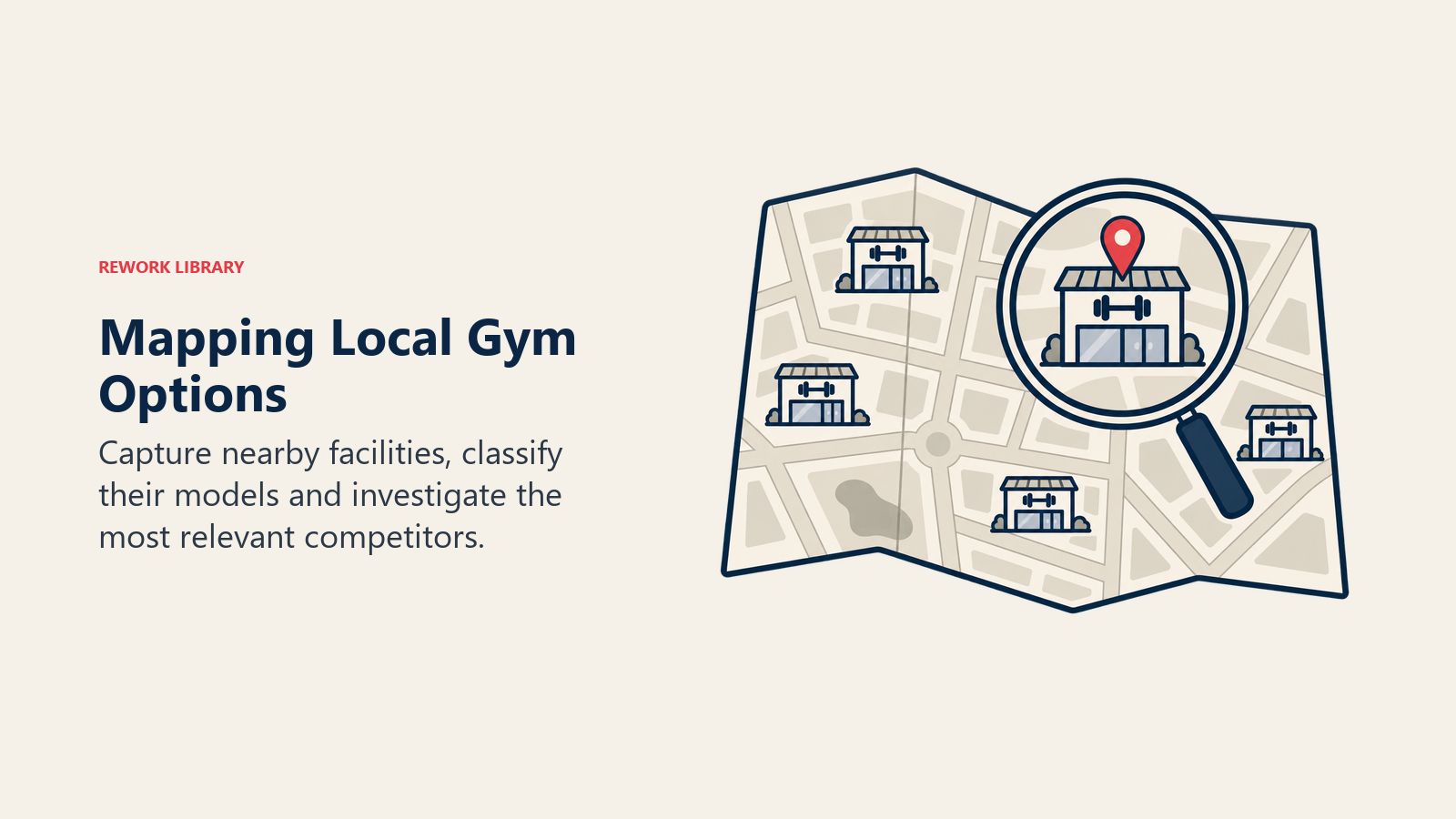
Step 1: Geographic capture. Open Google Maps and search "gym," "fitness studio," "yoga," "crossfit," "pilates," and any other relevant fitness categories within your target radius. Screenshot every result. You'll typically find 15-40 facilities depending on your market density. Add every result to a spreadsheet before filtering.
Step 2: Initial categorization. Sort results by type (big-box, boutique, specialty, studio). Flag which ones are genuine direct competitors (same price band, same target demographic, similar offering) versus indirect competitors. Note distance from your facility. Understanding the different gym business models operating in your area helps you categorize them accurately and understand how each competes differently.
Step 3: Deep dive on top 8-10 direct competitors. This is where the real work happens. For each key competitor, collect:
- Membership price points (visit their website, call if needed)
- Class schedule and programming types
- Physical size estimate and equipment visible through photos
- Review count and average star rating on Google Maps
- Number of social media followers and posting frequency
- Any promotions or offers visible on their website or social profiles
Step 4: In-person visits for top 5 competitors. Read the section on mystery shopping below.
Competitor Audit Worksheet
Use this structure for each competitor:
| Field | What to capture |
|---|---|
| Name & address | Full name, Google Maps link |
| Model type | Boutique/Big-box/Hybrid/Studio |
| Distance from you | Miles, estimated drive time |
| Membership prices | All tiers listed, including initiation fees |
| Class types | All modalities offered |
| Capacity estimate | Class sizes, total facility size |
| Staff count visible | Front desk, instructors, trainers |
| Google rating & reviews | Stars, review count, recent themes |
| Promotional offers | Current trial offers, discounts |
| Social following | Instagram, Facebook follower counts |
| Key strengths | What they do well |
| Key weaknesses | Where they fall short |
| Threat level | High/Medium/Low to your specific positioning |
The Mystery Shopper Protocol
An in-person visit tells you things no website review will reveal. Run this protocol for each of your top 5 direct competitors.
Before visiting: Create a simple prospect persona: your specific demographic, fitness goal, and budget. You're visiting as a prospective member with a genuine question (not a deceptive investigation, just a standard sales conversation from a prospect's perspective).
During the visit (15-30 minutes):
- Note the first impression: cleanliness, signage, parking availability, how easy it is to find the entrance
- Observe the front desk experience: were you greeted within 30 seconds? How was the energy?
- Ask for a tour and rate the facility condition, equipment quality, and layout
- Ask about membership options and listen for how they explain pricing and what they emphasize
- Ask what makes them different from [a competitor by name]. Their answer reveals how they see their own positioning
- Note class size in any active session you can see
- Pay attention to the member energy and demographic you observe
What to capture after leaving:
- The experience in three words
- The clearest differentiation from their sales presentation
- One thing they do noticeably better than you
- One obvious gap or weakness
- The price you were quoted and any pressure tactics used
Pay particular attention to how competitors handle their free trial and day pass offers. These reveal their conversion strategy and how confident they are in their product experience.
Identifying Service Gaps
Once your competitor map is complete, look for gaps at four levels.
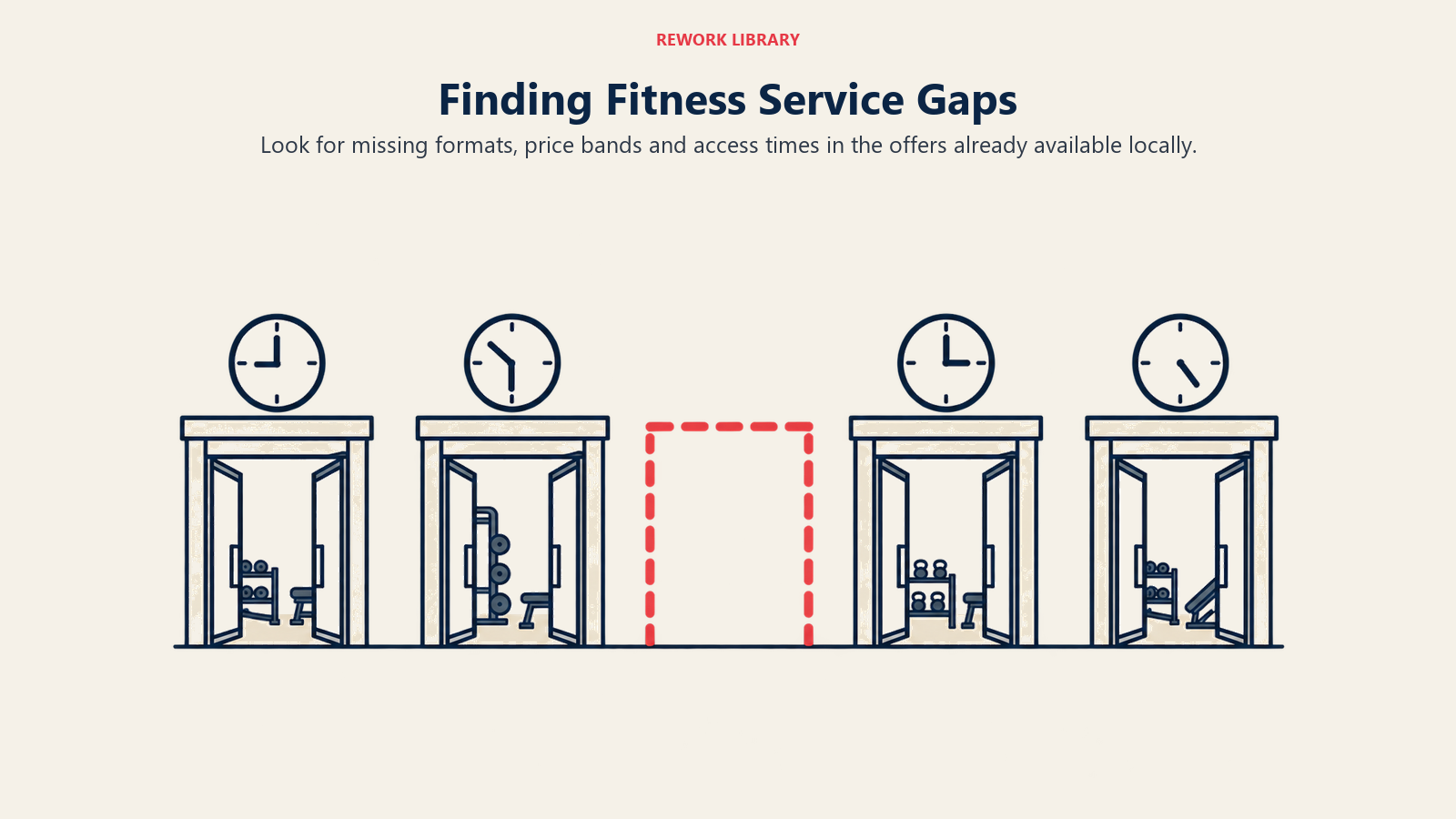
Demographic gaps: Which demographic is underserved in your market? Common opportunities include: adults 50+ who find the environment at most gyms intimidating; new mothers looking for postnatal fitness with childcare integration; serious athletes who find boutique programming too light; newcomers to fitness who feel unwelcome in performance-focused facilities.
Programming gaps: What modalities are absent or poorly represented? If your market has five yoga studios but no dedicated strength-training facility, no boxing gym, and no functional fitness studio, that's a programming gap. Map the modalities available and look for absences. Specialty fitness programs in underrepresented modalities often provide the clearest route to a defensible market position.
Price point gaps: Plot all competitor price points on a spectrum from lowest to highest. Look for price bands that are unoccupied or occupied by only one poorly-executed option. A market with three $30/month big-box gyms and two $250/month luxury boutiques might have no good option for someone willing to pay $100-$130/month for a quality mid-tier membership.
Time and access gaps: Extended hours are a genuine competitive differentiator in markets where most studios run on instructor-led schedules. 24/7 access, early morning openings (5am or earlier), or late-evening class availability can carve out a distinct position for shift workers, early risers, or night owls.
Building a Local Pricing Benchmark
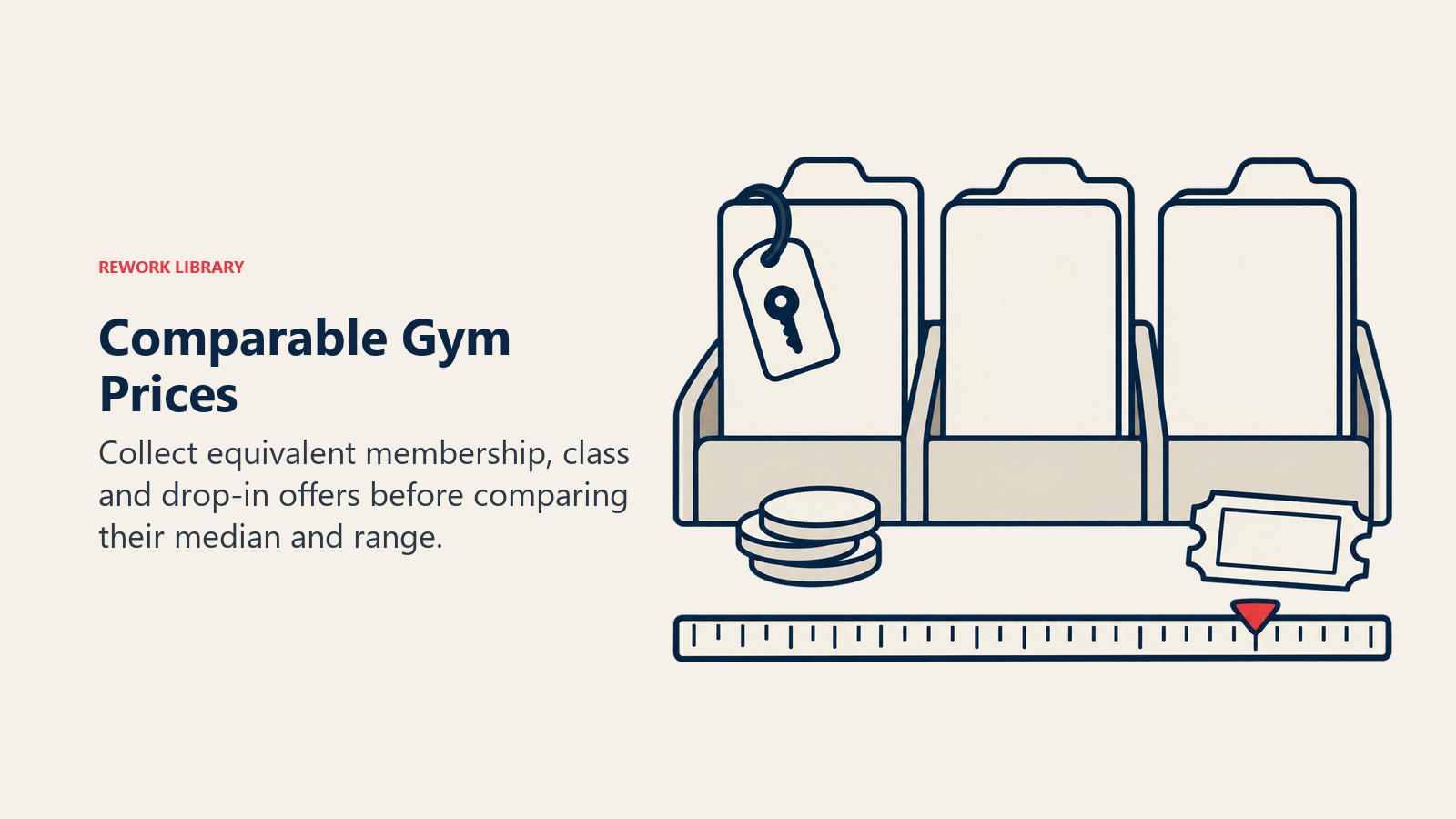
Pricing decisions made without competitive context are guesses. Build a proper pricing benchmark by collecting:
| Price category | What to collect |
|---|---|
| Base monthly membership | Standard month-to-month price |
| Annual membership | Annual contract price (per month equivalent) |
| Premium tier | Highest membership tier available |
| Class pack | 10-class or 20-class pack price |
| Day pass | Single-visit drop-in rate |
| Personal training | Per-session rate (1hr) |
| Intro offer | Free trial, discounted first month |
Calculate the median and range for each category across your 8-10 direct competitors. This gives you a market reference point for every pricing decision: new member promotions, tier restructuring, intro offers, and personal training rates all benefit from this context. Pricing psychology for fitness studios goes deeper on how to structure your own pricing once you know where the market sits.
Ongoing Competitive Intelligence
Quarterly reviews can be done efficiently with the right habits:

Set up Google Alerts for each major competitor's name. You'll get notified when they're mentioned in news, reviews, or social mentions without any active monitoring effort. The Statista health and fitness clubs industry overview aggregates publicly available market data including revenue trends, membership counts, and competitive share by operator, a useful free starting point before investing in a full IBISWorld report.
Follow competitors on social media from a personal account and review their posts monthly. Social content reveals promotions, new programming, hiring plans (frequent posting about hiring = growth), and occasionally member sentiment.
Check Google reviews quarterly. New patterns in competitor reviews (sudden complaints about staff changes, drops in ratings) can be early signals of operational problems that create switching opportunities for you.
Talk to your members. The single best source of competitive intelligence is your own member base. "What else did you consider before joining?" and "Do any of your friends go to [competitor]? What do they think?" generates real market intelligence in five-minute conversations. Structured member feedback loops build this intelligence-gathering into your regular operations rather than leaving it to chance.
Revisit price benchmarks twice a year. Fitness pricing is relatively stable year-over-year, but new entrants, facility upgrades, and competitive pressure create shifts that a twice-annual price check will catch.
Map the Battlefield Once a Quarter
Competitive analysis done quarterly instead of annually takes about four hours, not four days. You already have the base data from your initial mapping. Quarterly maintenance means checking for new entrants (Google Maps search), reviewing any significant pricing changes among top competitors, scanning recent reviews, and updating your 2x2 positioning grid.
The operators who get surprised by competitive threats are almost always ones who did good work pre-launch and then stopped looking. Markets change, new operators enter, existing facilities pivot their positioning. A business that understands its competitive environment as it changes (not as it was two years ago) is always in a stronger strategic position than one flying blind.
Learn More

Senior Operations & Growth Strategist