Gym Business Models: Boutique vs Big Box vs Hybrid
Turn this article into takeaways for your work.


Each assistant summarizes the article only for you and suggests best practices for your work.
The three main gym business models are the boutique studio, the big-box gym, and the hybrid. Boutique studios go deep on one modality at premium prices, big-box gyms win on volume and low monthly rates, and hybrids blend open-gym access with coached sessions to diversify revenue. The right choice depends on your capital, market, and target demographic.
The wrong business model can sink a gym before it ever finds its rhythm. You can have a great location, solid programming, and a motivated team, and still bleed cash for 18 months because the economics of your model don't match your market. Model selection isn't a branding decision. It's an operational and financial constraint that shapes everything downstream: your pricing, staffing ratios, marketing spend, and how long you can survive before breaking even.
Three models dominate the fitness industry right now: the boutique studio, the big-box gym, and the hybrid. Each has a fundamentally different unit economics structure. Each attracts a different demographic. And each requires a different level of capital to build and operate sustainably. Understanding these trade-offs before you sign a lease (or before you decide to pivot an existing operation) is the single most important strategic decision a gym operator makes. Before committing to any model, it's worth doing a thorough competitive analysis of your local fitness market to confirm there's demand for your chosen approach.
This guide breaks down how each model works, what it costs to run, and when to consider switching or evolving your approach.
Key Facts: Gym Business Models
- The global gym and fitness industry was valued at $96.7 billion in 2023, projected to reach $131.9 billion by 2028 (IHRSA)
- Boutique fitness studios charge an average of $30-$40 per class, compared to $30-$80/month for traditional gym memberships (Mindbody Business)
- Big-box gyms can accommodate 2,000-10,000+ members per location while boutique studios typically cap at 100-300 active members
The IHRSA 2023 Global Report provides detailed benchmarks on how each model performs financially across markets, and is the industry's primary reference for revenue and membership data.
What Distinguishes Each Gym Model
Before comparing numbers, it's worth getting precise about what actually separates these three models, because the lines blur more than most operators realize.
Boutique gyms are defined by specialization, not just size. A boutique cycling studio, a Pilates reformer space, a functional training gym with 40 members: these are boutique operations because they go deep on one modality, charge premium prices, and build identity around a specific community or methodology. The physical footprint is typically 1,500-4,000 square feet. Membership is deliberately limited. The experience is the product.
Big-box gyms are volume businesses. Think 10,000-50,000 square feet, hundreds of cardio machines, free weights, group fitness rooms, locker rooms with saunas, and membership prices that compete with streaming subscriptions. The model works on scale: low price point, high member count, and the statistical reality that most members won't show up consistently. Planet Fitness built a billion-dollar company on this premise. Its "Judgement Free Zone" positioning carved out a massive segment of cost-conscious gym-goers who had previously felt excluded from traditional facilities. The model requires significant upfront capital ($1 million to $5 million or more for a new location) but generates predictable recurring revenue if you can fill the rolls. Your membership tier design will look completely different depending on whether you run a volume or premium operation.
Hybrid gyms sit in the middle and are increasingly common as operators look for ways to diversify revenue. A hybrid might run a mid-size facility (5,000-12,000 square feet) with open gym access on a tiered membership model, plus premium small-group training, personal training packages, and occasionally retail or nutrition products. It's a more complex operation to manage, but the multiple revenue streams can smooth out the peaks and valleys that hurt pure boutique and pure big-box operators alike.
Revenue Structures: How Each Model Makes Money
Revenue structure is where the three models diverge most sharply, and where most operators underestimate their exposure.
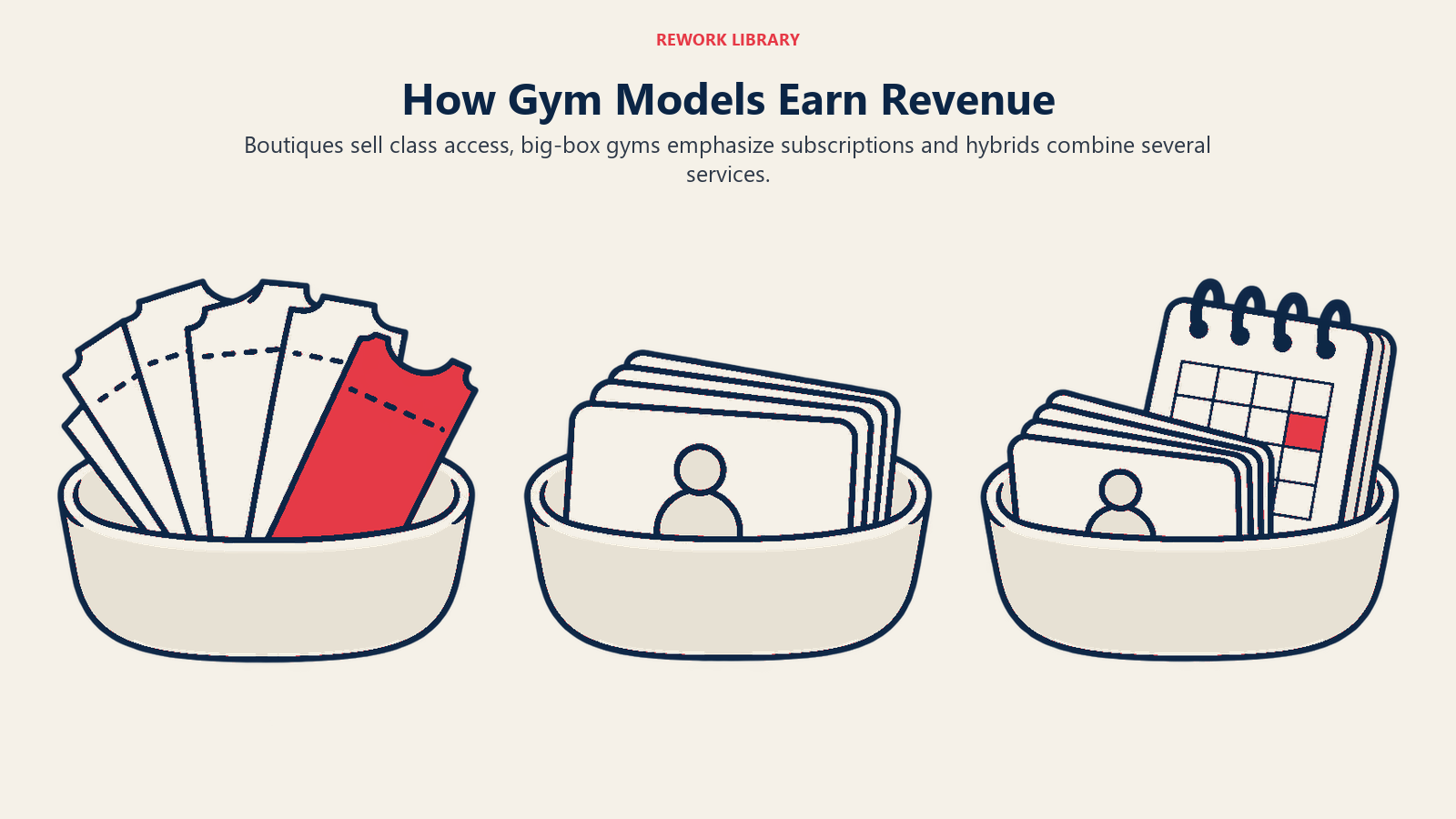
Boutique revenue is heavily class-based. Members pay for class packs or monthly unlimited memberships, and the margin per transaction is high. A reformer Pilates studio charging $35/class with 15 people in a session generates $525 in 55 minutes. If they run six sessions per day with strong utilization, the math works exceptionally well. But occupancy is everything. A half-full schedule at boutique prices doesn't produce boutique margins. Many boutique operators supplement class revenue with personal training upsells, retail (apparel, equipment accessories), and brand licensing once they've built a following.
Big-box revenue is membership-subscription driven. The business model depends on EFT (electronic funds transfer) autopay, with members on 12-month agreements or month-to-month contracts at $15-$55/month. Add-on revenue from personal training, premium locker rentals, tanning, hydro massage, and guest passes creates a secondary revenue layer. Some large operators generate 15-25% of revenue from non-membership sources. The key vulnerability: member churn in a big-box environment can be brutal because barriers to cancellation are now lower than ever, and switching costs are minimal.
Hybrid revenue deliberately mixes streams. Base memberships might run $50-$80/month for open gym access, with premium tiers at $150-$250/month that include a set number of coached sessions per week. Personal training, nutrition coaching, and ancillary services like nutrition and recovery sit on top. The advantage is that revenue diversification protects against any single stream collapsing. The challenge is operational complexity. You're essentially running two or three businesses under one roof.
Model Comparison: Key Dimensions
| Dimension | Boutique | Big Box | Hybrid |
|---|---|---|---|
| Footprint | 1,500-4,000 sq ft | 10,000-50,000 sq ft | 5,000-12,000 sq ft |
| Avg. membership price | $100-$300/month | $15-$55/month | $50-$250/month |
| Member capacity | 100-300 | 2,000-10,000+ | 400-1,500 |
| CapEx (build-out) | $150K-$600K | $1M-$5M+ | $400K-$1.2M |
| Break-even timeline | 12-24 months | 24-48 months | 18-36 months |
| Revenue per sq ft | High | Low | Medium |
| Staffing complexity | Low-Medium | High | Medium-High |
| Risk profile | Concentration risk | Market saturation risk | Execution complexity risk |
Target Demographics and Capital Requirements
Boutique studios typically attract women 25-45 with disposable income and specific fitness goals. Premium pricing isn't a deterrent for this demographic. It's a signal of quality. They're buying community and coaching alongside the workout. But this demographic is also brand-savvy and has options. If your studio doesn't deliver a consistently excellent experience, they'll leave without much friction. Understanding pricing psychology for fitness studios matters particularly here, because your price point communicates quality as much as it generates revenue.
Big-box gyms cast a wider net by design. Their primary demographic is cost-conscious adults who want access to equipment and amenities without a high monthly commitment. Planet Fitness targets the "casual gym-goer" explicitly: people who feel intimidated by hardcore gym culture. It's an enormous market segment. The challenge is that this demographic is also the least sticky. They join in January, stop coming in March, and cancel when they notice the charge in October.
Hybrid gyms tend to attract health-committed adults who want more than open gym access but don't need the full boutique experience. They're often working professionals who'll pay $120-$180/month for a combination of coached sessions and open access. This demographic has higher lifetime value than big-box members and more price stability than boutique members who might pause their membership during busy work periods.
Capital requirements vary significantly by model. A boutique studio can theoretically launch with $150,000-$300,000 if you find a second-generation space with existing flooring and basic HVAC. A big-box gym needs $1 million at minimum and realistically $2-4 million for a purpose-built location with full locker rooms and equipment. Hybrid falls in the $400,000-$1.2 million range depending on the size of the coaching component and the equipment package you're installing. Regardless of model, tracking key gym metrics from day one tells you whether your unit economics are working as intended.
Switching and Hybrid Pivots
McKinsey's research on fitness and wellness industry consolidation notes that hybrid models are gaining market share as operators seek to diversify revenue streams and serve consumers who now use a portfolio of fitness options. The most common pivot in fitness right now is boutique studios adding open gym access hours to fill off-peak time and stabilize revenue. A Pilates studio running classes 7am-12pm and 5pm-8pm sits empty for six hours daily. Adding open-access memberships at $60-$80/month fills that dead space with revenue and builds a pipeline for class conversions.
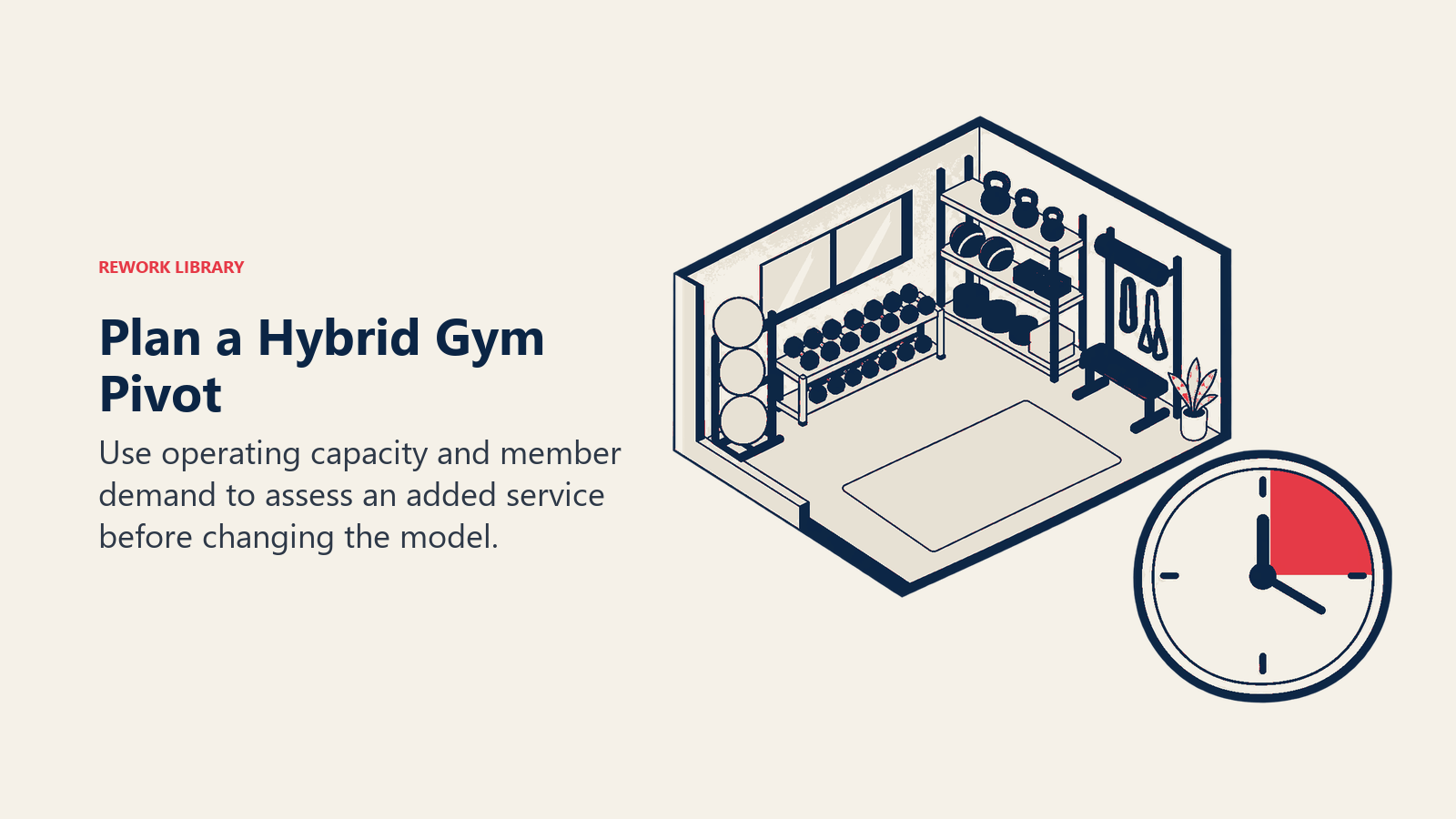
The reverse pivot (a big-box operator adding premium coaching programs) is harder but increasingly necessary as boutique studios continue taking market share from the mid-market. Traditional gyms that add a dedicated functional training zone with coached sessions three times a day are effectively building a boutique business within their footprint. These pivots often benefit from group fitness programs that can fill off-peak time without the full overhead of a dedicated instructor for every session.
Timing for pivots matters. A boutique studio that's been operating for 24+ months with strong class utilization (75%+) and a waiting list is in a solid position to introduce open gym access. A studio struggling to fill classes shouldn't pivot to open gym. Fix the core programming problem first. Similarly, a big-box operator with declining membership retention should address the retention problem before investing in premium coaching infrastructure.
Match Your Model to Your Market Before Signing
The fundamental test for model selection is market fit, not personal preference. According to IBISWorld's gym and fitness industry analysis, the U.S. market supports over 100,000 fitness businesses across all three models, with revenue concentrated among operators who have made a clear structural choice. An underserved suburban market with no premium fitness options but strong household income might support a boutique studio beautifully. A dense urban core with five cycling studios within a half-mile radius might need a hybrid approach to find white space. A mid-sized city where the biggest gym is a 20-year-old facility with dated equipment might be ripe for a well-executed big-box concept with modern amenities.
Before you commit to a model, map the competitive landscape in a two-mile radius. Count the price points available. Identify the demographics that are underserved. Then match the model to the gap, not to your personal fitness philosophy. Your market positioning strategy should emerge from this analysis, not precede it.
Break-even math should be honest. A boutique studio needs 80-120 active members paying $150+/month to cover typical operating costs. A big-box gym needs 1,200-2,000 members depending on price point and overhead. A hybrid operator needs to hit critical mass in both the base membership tier and the premium coaching program simultaneously, which is operationally harder than it sounds.
The good news is that none of these models is inherently superior. The fitness industry is large enough to support all three. The operators who succeed long-term are the ones who chose the model that fit their capital, their market, and their operational reality. Not the model they admired most at a competitor.
Learn More