Specialty Fitness Programs: Adding Yoga, CrossFit & HIIT to Your Gym - 2025 Guide
Turn this article into takeaways for your work.


Each assistant summarizes the article only for you and suggests best practices for your work.
Specialty fitness programs attract members who wouldn't otherwise walk through your front door. The dedicated yoga practitioner, the CrossFit athlete who swore off commercial gyms, the HIIT devotee who's been paying boutique-studio prices - these are entirely different buyer profiles from your standard gym membership prospect. And they'll pay premium prices for a premium experience.
But that premium pricing comes with real operational requirements. Dedicated space. Certified staff with format-specific credentials. A distinct pricing structure. And a go-to-market approach that speaks to the specialty community, not just your existing member base. Gyms that add specialty programs as schedule extras without treating them as separate business units consistently underperform. They end up with half-utilized studio space, undertrained instructors, and programs that fail to build the community that makes specialty fitness sticky.
The difference between a specialty program that becomes a revenue line and one that becomes a sunk cost is almost entirely in the planning before you open the door. Understanding how your gym's business model compares to boutique alternatives is a useful starting point for scoping which specialty formats are realistic for your facility.
Key Facts: Specialty Fitness Revenue
- Boutique fitness studios generate 2-3x the revenue per square foot of traditional gym floor space (IHRSA, 2024)
- CrossFit affiliate fees run $3,000-$4,500 annually; average CrossFit affiliate generates $200,000-$400,000 in annual revenue
- Yoga studios with a dedicated 1,200-1,500 sq ft space can achieve break-even with 35-40 active class participants per week
The Case for Specialty Programs
The financial argument for specialty programming is straightforward: premium formats command prices that general memberships don't. Statista's U.S. fitness industry data shows that specialty and boutique segments have consistently outgrown traditional gym memberships in revenue per member for the past decade.
A standard gym membership in a mid-tier market runs $30-$60 per month. A yoga studio membership in the same market runs $80-$150. A CrossFit membership runs $120-$200. A boutique HIIT membership (think F45, Orange Theory) runs $100-$180. These aren't marginal differences - they're 2-5x the revenue per member, often with better retention rates because specialty members have a stronger identity connection to their format.
Specialty programs also pull from adjacent communities that your traditional marketing doesn't reach. CrossFit athletes train at CrossFit gyms. Yoga practitioners have studio relationships. HIIT devotees are loyal to boutique brands. Adding a credible specialty program gives you access to these communities without competing on price against your own standard offering.
And for members who already belong to your gym, a specialty add-on creates an upsell that's far more appealing than personal training for many demographics. A $50/month specialty yoga add-on for an existing $45/month gym member doubles their spend and significantly increases their retention probability. Structuring these add-ons effectively is a core part of a well-designed membership tier strategy.
Certification & Compliance Requirements by Format
Yoga has the lowest barrier to entry from a brand perspective - there's no governing body or franchise fee - but the certification requirements matter significantly for insurance and member safety.
Instructors need a minimum RYT-200 (Registered Yoga Teacher), a 200-hour training from a Yoga Alliance-accredited program. Most gyms with a serious yoga program require RYT-500 for lead instructors. Prenatal yoga, restorative yoga, and therapeutic yoga require additional specialty certifications. Your gym's liability insurance may not cover yoga instruction without verified instructor credentials on file, so this isn't a documentation formality - it's an insurance requirement.
CrossFit is a franchise model. To use the CrossFit brand, you need an official affiliate license at $3,000-$4,500 per year. Lead coaches need CF-L1 certification at minimum ($1,000 for the weekend course); serious programs have CF-L2 coaches on staff. The advantage of the CrossFit brand is instant recognition and access to the global CrossFit community. The disadvantage is ongoing annual fees and compliance with CrossFit HQ brand standards.
You can run CrossFit-style programming without the affiliate license - high-intensity functional fitness classes using barbells, gymnastics, and metabolic conditioning - but you can't call it CrossFit. This works for gyms that want the programming style without the brand commitment or fee structure. Either route requires hiring instructors with the right certifications to deliver the format credibly and safely.
HIIT proprietary formats like Les Mills (BodyPump, BodyCombat) and F45 have their own licensing structures. Les Mills licenses specific class formats, requires instructor certification through their program, and charges ongoing content licensing fees for quarterly music and programming updates. F45 operates as a full franchise model with much higher entry costs ($5,000-$50,000 in franchise fees depending on territory).
Non-branded HIIT avoids licensing fees entirely and gives you programming flexibility, but requires more internal investment in class design and instructor development to maintain quality and freshness.
Space and Equipment Investment
Yoga studio requirements are more specific than most gym owners expect. The standard calculation is 21 square feet per participant on a mat - meaning a class of 20 needs at least 420 square feet of usable floor space. A studio that comfortably holds 20-24 participants with appropriate spacing typically needs 600-800 square feet.
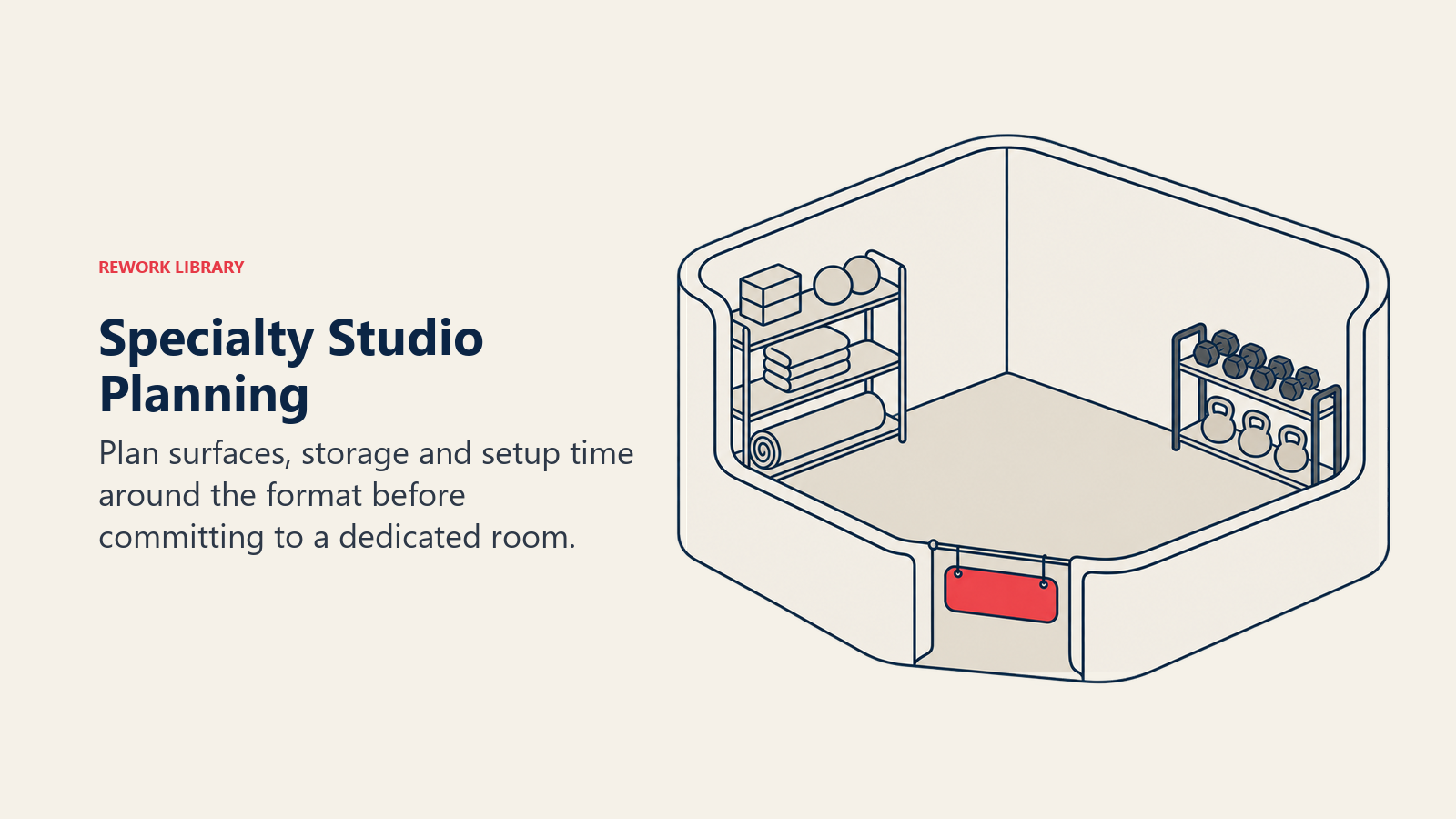
But square footage is just the start. Yoga requires hardwood, bamboo, or specialized yoga flooring (not rubber gym flooring). Acoustics matter - sound dampening to reduce echo and keep class energy contained. Climate control separate from the main gym floor (yoga practitioners want warmer temperatures than HIIT participants). Studio props (blocks, straps, bolsters, blankets) at $15-$30 per student. Total yoga studio build-out for a quality 20-person space typically runs $40,000-$80,000 depending on existing infrastructure.
CrossFit rig and flooring is a different category of investment. A quality wall-mounted or free-standing rig for 10-12 athletes runs $8,000-$20,000 from commercial suppliers like Rogue or Sorinex. Add bumper plates, barbells, kettlebells, rowing machines or assault bikes, and gymnastics equipment (pull-up bars, rings, boxes), and a proper CrossFit space for 12-15 athletes requires $25,000-$60,000 in equipment investment. The flooring itself (3/4-inch rubber for Olympic lifting) runs $3-$6 per square foot.
HIIT station configurations vary by format. A basic HIIT circuit for 20 participants using dumbbells, kettlebells, benches, and TRX can be configured for $15,000-$30,000. HIIT formats requiring stationary bikes or rowing machines push that investment significantly higher. Dedicated HIIT spaces need enough floor space per station to allow full-body movement - 50-60 square feet per active station is the minimum.
Shared-space scheduling vs purpose-built spaces is a real operational tradeoff. Yoga on the group fitness studio floor works if the surface is appropriate and you're willing to clear the space between uses. CrossFit equipment is nearly impossible to share with standard group fitness without significant setup and teardown time. The more your specialty program requires format-specific equipment or surfaces, the stronger the case for dedicated space. A thorough facility layout and zone design review should precede any specialty build-out decision.
Pricing & Revenue Modeling
The most common pricing mistake gym owners make with specialty programs is underpricing relative to the boutique market.

A typical pricing structure has three tiers:
Specialty-only membership: Access to specialty classes only, no general gym access. Price this at 60-80% of what local boutique studios charge. If yoga studios in your market charge $130/month, price specialty-only yoga membership at $80-$100. This attracts yoga practitioners who have no interest in a general gym membership.
Add-on for existing members: Access to specialty programming for existing gym members. Price this as a meaningful add-on (not a discount) - $30-$60/month depending on the format and session volume. This is pure incremental revenue from members who are already retained.
Drop-in rates: Single-class access for non-members. Price these at boutique rates: $18-$28 for yoga, $20-$30 for CrossFit, $18-$25 for boutique HIIT. Drop-in attendees are your best conversion prospects for specialty memberships. Free trial and day pass strategies can accelerate the conversion from curious visitor to committed specialty member.
Break-even modeling example: A yoga studio with $70,000 in total build-out costs, $4,000/month in instructor costs, and $1,500/month in allocated space overhead needs approximately $5,500/month in revenue to break even on operating costs (not including capital recovery). At $90/month average specialty membership, that's 62 members. A well-programmed 20-person studio running 10 classes per week at 50% average capacity serves 100 participant-sessions per week - easily enough to support 100+ active members. Break-even at this scale is typically achievable within 6-12 months of launch.
Payback period on build-out costs at $70,000 with $2,000/month net margin after operating costs is 35 months. That's a realistic timeline for a properly run specialty program - not an unreasonable investment for a revenue line that also improves member retention across the broader gym.
The Dedicated Business Unit Mindset
The specialty programs that fail most often fail for the same reason: they're treated as add-ons to the main schedule rather than distinct business operations.
A specialty program that succeeds has its own marketing identity. The yoga program has a name, visual identity, and social media presence that's somewhat separate from the main gym brand - because yoga practitioners identify with the yoga community, not with the gym brand. CrossFit athletes follow the CrossFit box, not the building that houses it. Developing this distinct identity often starts with fitness studio market positioning work that clarifies the specialty program's unique value proposition.
It has its own community development plan. What events bring specialty members together outside of class time? What communication channels serve them? What does the instructor relationship look like beyond just showing up to teach?
And it has its own performance metrics. Not just class attendance, but specialty membership count, specialty member retention rate, revenue per specialty member, and conversion rate from drop-in to membership. Without distinct measurement, specialty programs get evaluated with the same blunt instruments used for general memberships - and they look like underperformers even when they're not. Tracking these metrics consistently alongside your core gym KPIs and revenue benchmarks gives you a complete financial picture of the program's contribution.
The gym owners who build specialty programs that generate $150,000-$300,000 in annual revenue from a single 800 square foot studio share one trait: they went into the investment treating it like a business launch, with all the planning that implies. The IHRSA Global Report provides detailed benchmarking data on specialty program revenue performance that operators can use to pressure-test their own financial models before committing capital. That planning should include evaluating whether the specialty program fits within your broader gym growth stage and expansion roadmap.
Learn More

Senior Operations & Growth Strategist