Win-Back Campaigns for Cancelled Members: Re-Engagement Strategies That Work
Turn this article into takeaways for your work.


Each assistant summarizes the article only for you and suggests best practices for your work.
Every cancelled member is a warm lead. They already know your facility. They've walked through your door, used your equipment, and at some point valued what you offer enough to pay for it. They left for a reason, but most of those reasons are fixable. And the cost of re-engaging a lapsed member is a fraction of what it costs to acquire a new one from scratch.
Yet most gyms treat cancelled members as a closed file. The membership ends, the CRM record gets tagged "cancelled," and the relationship stops. Cancelled members age out of any marketing funnel and get lumped into the same bucket as cold leads who've never been to the facility. That's a significant missed revenue opportunity hiding in plain sight.
A systematic win-back program treats cancelled members as a distinct segment with specific re-engagement economics. Industry data shows that gyms running structured win-back campaigns recover 8-15% of their cancelled members annually. At $60/month average and 100 cancellations per year, that's 8-15 members recovered ($5,760-$10,800 in recovered annual recurring revenue) from a program that costs far less than equivalent new member acquisition. HBR's research on winning back lost customers confirms that lapsed customers who had a positive prior experience are among the highest-potential re-acquisition targets available. They require less education, carry less skepticism, and convert at meaningfully higher rates than cold prospects.
Key Facts: Win-Back Campaigns
- Gyms with structured win-back programs recover 8-15% of cancelled members annually (IHRSA, 2024)
- Cost per won-back member averages $20-$50 vs. $65-$150 cost per new acquisition
- Win-back conversion rates drop by approximately 50% after 90 days of cancellation. Early outreach is critical
The 30/60/90-Day Timing Framework
When you reach out to a cancelled member matters almost as much as what you say. Conversion rates decline sharply with time, but so does the member's emotional temperature. Outreach too soon feels desperate; outreach too late feels irrelevant.
0-30 days post-cancellation: Highest conversion window
Members who cancelled in the last 30 days are still warm. The decision is recent, the habit hasn't fully broken, and they may already be regretting it, especially if they cancelled on a bad day or during a stressful period. Conversion rates in this window average 12-20%. According to IHRSA's retention research, communication that is timely and personal (reaching members by name, from a staff member they recognize) doubles the likelihood of a committed response compared to generic re-engagement messages.
The tone here is empathetic, not promotional. "We noticed you cancelled and wanted to check in" outperforms "Come back for 50% off" because it doesn't immediately feel like a sales pitch. Many members at this stage will respond to a genuine check-in even without an offer attached.
31-60 days: Moderate conversion window
The habit has likely broken by now. The member may have moved on to a competitor, developed a home workout routine, or simply stopped thinking about fitness. Conversion rates drop to 7-12% in this window.
Outreach here needs to do two things: acknowledge the time that has passed without making the member feel guilty, and offer a compelling reason to reconsider. This is where a concrete offer (waived rejoining fee, discounted first month) does more work than empathy alone.
61-90 days: Lower conversion but still viable
Conversion rates average 4-8% at this stage. The member is now effectively a cold lead in emotional terms, but they still have a meaningful advantage over a new prospect: they know your facility, your staff, and your product. They don't need to be educated. They need to be reminded of what they valued and presented with a reason that the barriers have changed.
Seasonal re-engagement campaigns (January, September) often resonate strongly in this window. The combination of a new personal milestone (new year, back-to-school) and an existing familiarity with your facility creates a natural re-entry point.
Beyond 90 days: Long-lapsed segment
Conversion rates below 4%. Still worth one or two outreach attempts, particularly during seasonal windows, but this segment should not consume significant staff time. Automate the outreach and accept a low conversion rate as the baseline expectation.
Segmenting Your Cancelled Member List
Not all cancelled members should receive the same win-back approach. Segment them before designing campaigns.
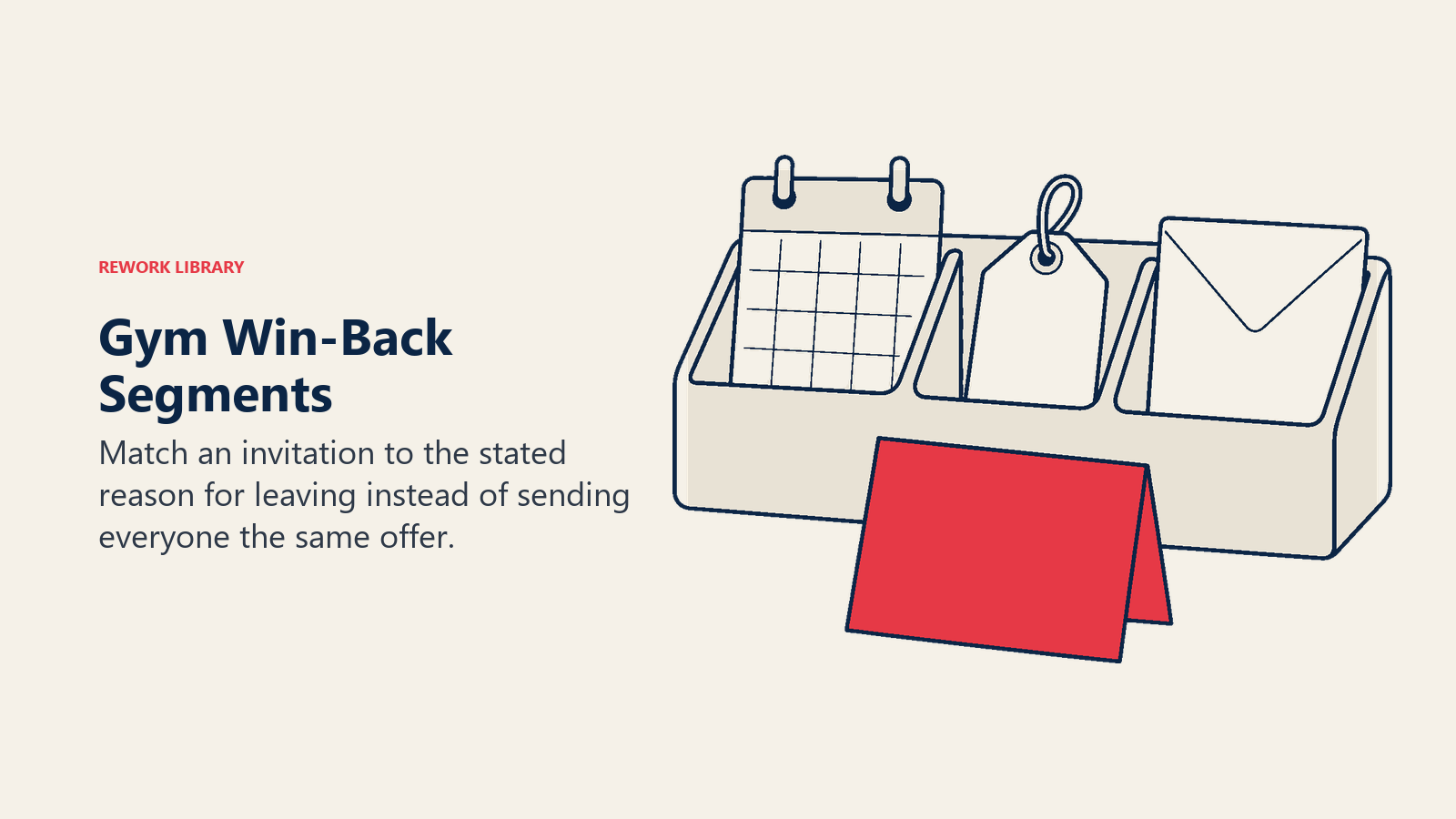
Recently cancelled (0-30 days): High-touch, personal outreach. Phone call or personal text from a staff member they knew. No immediate offer. Check in first.
Recently cancelled high-LTV members: Any member who was with you for 12+ months or paid for premium services (PT packages, premium tier) warrants a manager or owner call regardless of when they cancelled. These are relationship decisions, not marketing campaigns.
Seasonal leavers: Members who cancelled in summer and have done so before (visible in your data as "returned, then cancelled again in June") are candidates for a spring win-back campaign. They have a pattern of seasonal usage. Meet them where they are.
Price-objection cancellers: Members who cited price as their reason for leaving are candidates for a targeted offer on lower-tier memberships or a rate-lock promotion, not a full-price rejoining pitch. Review your membership tier design before reaching out, because having a clear lower-tier option ready makes this conversation much easier.
Involuntary cancellers: Members whose membership ended due to payment failure often don't realize they've been cancelled or find the rejoining process inconvenient. These are the easiest win-backs. The outreach is as simple as "Your membership lapsed due to a billing issue. Here's how to reinstate it in one step."
Offer Design: What Works and What Undermines Your Pricing
The win-back offer is where most gyms make mistakes. The instinct is to lead with the biggest discount possible. But deep discounts for lapsed members have two serious side effects: they train members to cancel and wait for a deal, and they create resentment among current members who are paying full price.
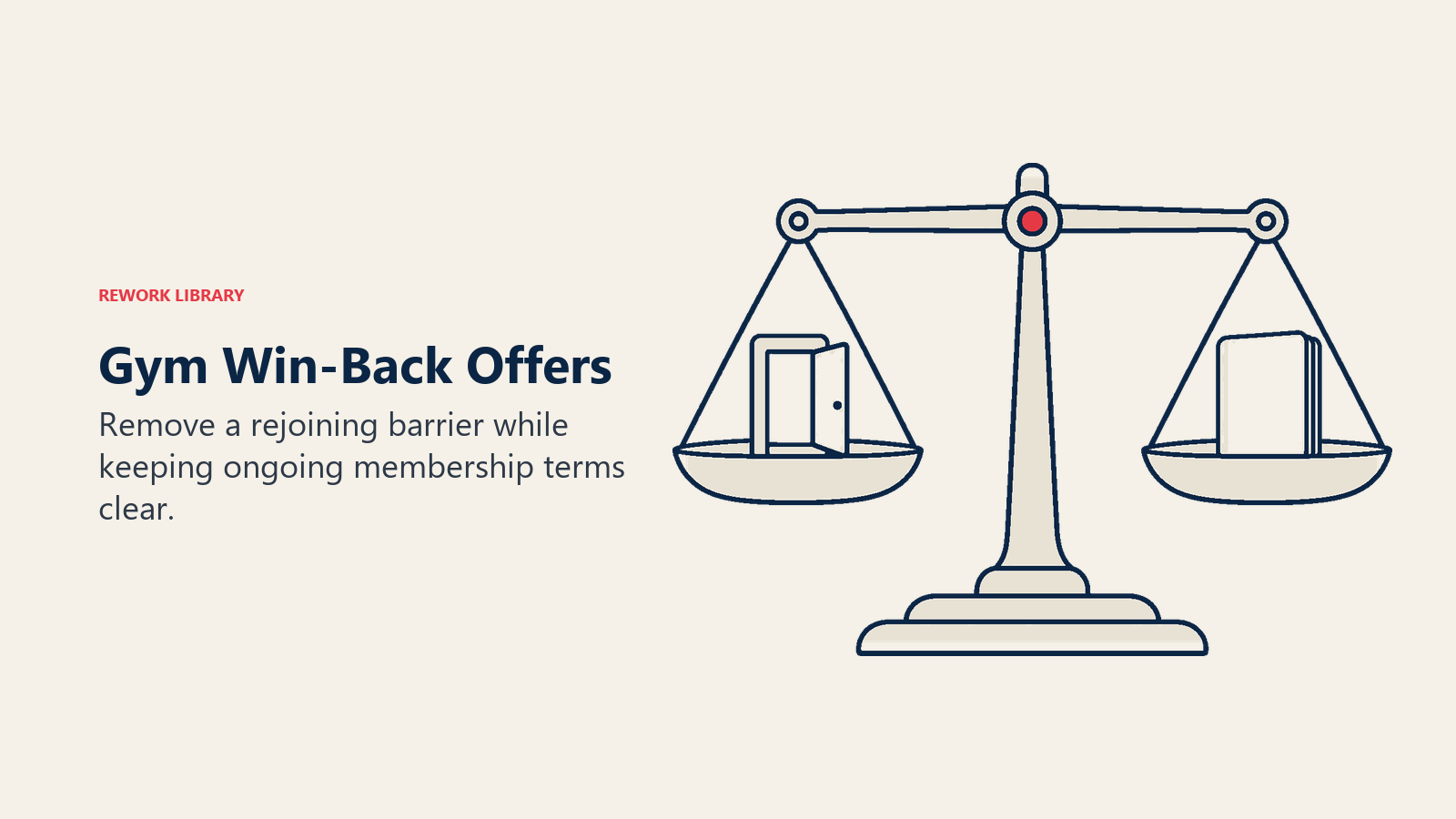
Offers that work:
- Waived rejoining fee: Most gyms charge $0-$50 to rejoin. Waiving this removes a friction point without touching your ongoing rate. Low cost, meaningful perceived value.
- Free first month: One month free on rejoining, then full price. Effective for members in the 30-60 day window who need a low-risk re-entry point.
- Rate lock: "Rejoin today and lock in your previous rate for 12 months." Particularly effective for members who left citing price concerns or who cancelled before a rate increase.
- Complimentary intro session: A free personal training session or class package. Gets them back in the building in a high-engagement format and reintroduces them to services they may not have tried before. Often converts to PT revenue. See personal training upsell strategies for how to structure this session so it naturally leads to a package conversation.
- Bonus services package: Two months of free class bookings, or a 3-session PT add-on at no cost with rejoining. Adds value without discounting the base membership.
What not to offer:
Don't offer more than 30% off the monthly rate as a permanent discount. A member who rejoins at 40% off is a member your margins can't support long-term. And when you eventually raise the price back, you'll face another cancellation.
Don't offer the same deal to all segments. A member who cancelled yesterday needs a different offer than one who cancelled eight months ago. Personalization isn't just good practice. It signals that you're treating them as an individual, not a line item. McKinsey's analysis of how personalized re-engagement campaigns outperform broadcast offers found 25–60% higher conversion rates when timing, tone, and offer were tailored to individual customer behavior. The same principle applies directly to a gym's win-back sequencing.
Messaging Sequences: Multi-Touch Win-Back
A win-back campaign isn't a single message. It's a sequence. Most lapsed members won't respond to the first outreach. Some will respond to the third. The sequence is what drives results.
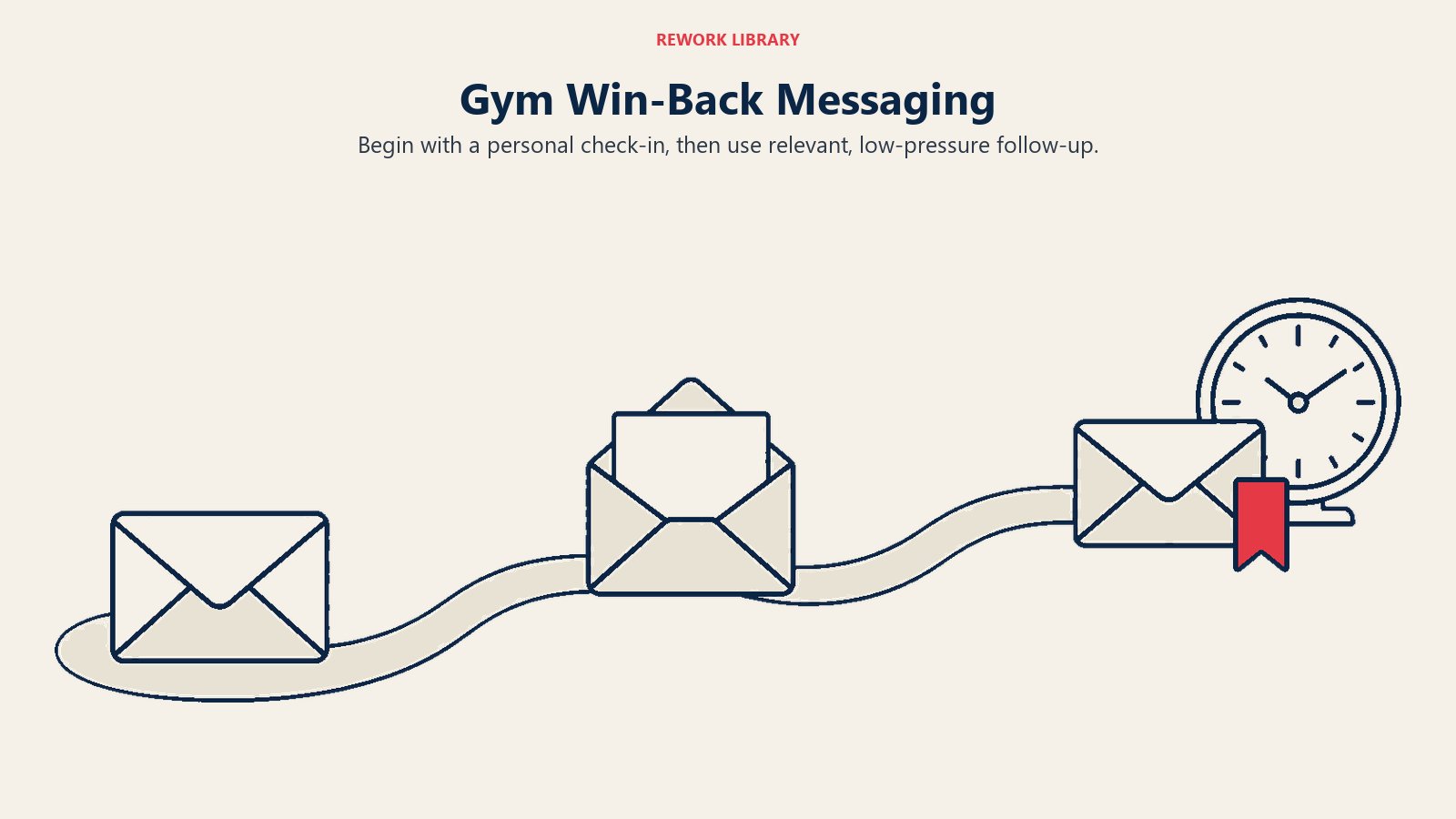
Standard win-back sequence (30-day window):
Touch 1 (Day 2 post-cancellation): Personal check-in message. Email or SMS, from a named staff member. No offer. "We noticed you cancelled and wanted to reach out personally. Is there anything we could have done differently?" This message is designed to get a response, not to make a sale.
Touch 2 (Day 7 post-cancellation): Follow up with a soft offer if no response. Acknowledge the time gap. "We understand life gets busy. If you'd like to come back, we'd love to welcome you with a free week to try things out again." One clear CTA.
Touch 3 (Day 21 post-cancellation): Specific, time-limited offer. "We're running a rejoining promotion through the end of the month. Your first month is on us, and you'd be back at your previous rate." Create mild urgency without desperation.
Touch 4 (Day 45 post-cancellation): Final check-in before moving to lower-frequency outreach. "We're making some updates to our class schedule and wanted to share them with you in case there's something that might bring you back." Informational, low-pressure.
For high-LTV members, replace touch 1 with a phone call. A manager or owner calling personally within 48 hours of a cancellation from a long-term member is a powerful signal that the relationship was valued. The new member onboarding touchpoint model is also useful here as a framework for structuring re-engagement conversations, and many of the same principles apply.
Tone guidelines:
The win-back message should be empathetic, curious, and confident, not desperate. Avoid language that signals the gym is struggling ("We miss you so much!" repeated three times) or that creates social pressure. Members who left because they felt guilt about not attending will respond badly to guilt-based win-back messaging.
"We'd love to have you back" lands better than "We really need you back." The former is an invitation; the latter is a plea.
Win-Back Success Metrics
Track win-back campaigns with the same rigor you'd apply to any acquisition program.
Conversion rate by window:
- 0-30 days: Target 12-20%
- 31-60 days: Target 7-12%
- 61-90 days: Target 4-8%
- 90+ days: Target 2-4%
If your conversion rates are below these benchmarks, diagnose the issue: is it timing (are you reaching out too late?), offer relevance (are you sending price-lock offers to members who left for reasons unrelated to price?), or message tone (does your sequence feel automated and impersonal)? Cross-referencing win-back data against your member engagement tracking records will often reveal whether at-risk signals were visible and missed before the cancellation happened.
Cost per win-back:
Calculate win-back cost by dividing total campaign costs (staff time, offer value, marketing costs) by the number of members successfully returned. Target is $20-$50 per won-back member. If your cost exceeds $80-$100, the economics are approaching new acquisition territory and you need to tighten the program.
Second-tenure retention rate:
Track whether won-back members stay. A win-back is only valuable if the member returns and remains. Members who rejoin and cancel again within 60 days are almost always returning because of the offer, not because the barriers that caused the original cancellation were addressed. If your second-tenure retention is below 50% at six months, the win-back campaign is working but the underlying retention problem isn't fixed. See the churn reduction framework for root-cause diagnosis.
When to stop the sequence:
After four touches with no response, move the member to a quarterly seasonal outreach list. Don't continue active win-back sequencing past 90 days without a response. Continued outreach to unresponsive contacts damages your email deliverability and staff morale.
Building the Win-Back Program Into Operations
The difference between a win-back campaign and a win-back program is consistency. A campaign runs once. A program runs year-round, systematically, for every cancelled member.
Assign ownership: who is responsible for running win-back outreach? In smaller gyms, this is often the owner or manager. In larger facilities, it becomes a CRM or marketing function. The key is that it's someone's explicit job, not an afterthought.
Integrate with your engagement tracking system and member feedback surveys. The member who left because of a specific complaint (logged in your exit interview data) should receive a win-back message that acknowledges that complaint was heard and addressed. "We got your feedback about the crowded morning slots and added a 6:30am class. We'd love to have you back to try it." That's personal. That converts.
A win-back program running year-round recovers 8-15% of your cancelled members without any additional marketing spend beyond staff time. For a facility cancelling 80-100 members per year, that's 6-15 recoveries per year, potentially $4,320-$10,800 in recovered annual recurring revenue. Statista's US gym membership data shows that with approximately one in four Americans now holding a gym membership, the pool of lapsed members across the industry is enormous, and operators who build systematic re-engagement programs have a compounding advantage over those who treat every cancelled member as a permanently closed file. Combined with pricing psychology that builds the right expectations upfront and membership tier design that offers appropriate downgrade paths, a win-back program is one of the highest-ROI tools in a gym operator's retention toolkit.
Learn More

Senior Operations & Growth Strategist