Virtual & Hybrid Fitness Classes: Building a Digital Revenue Stream for Your Gym
Turn this article into takeaways for your work.


Each assistant summarizes the article only for you and suggests best practices for your work.
Virtual and hybrid fitness classes are a proven gym growth lever, adding a digital revenue stream that reaches members your physical floor never could. There are three models: live streaming, on-demand libraries, and hybrid classes that broadcast an in-person session to remote participants. Built as a separate product with its own pricing and content plan, virtual fitness grows revenue without cannibalizing in-person attendance.
Virtual fitness isn't a pandemic novelty anymore - it's a permanent segment of the market. Gyms that ignore it are leaving revenue on the table and ceding members to pure-play digital competitors like Peloton, iFIT, and Apple Fitness+. But building it poorly creates cost without corresponding return. The question isn't whether to offer virtual fitness - it's how to do it in a way that adds genuine revenue rather than just adding complexity to your operations.
The numbers support the permanent shift. The global virtual fitness market reached $16.4 billion in 2023 and is projected to grow at 26% CAGR through 2030. Statista projects the Digital Fitness & Well-Being market in North America alone will reach $16.9 billion in 2024, growing at a 6.5% CAGR through 2029. More relevantly for independent gym operators, surveys consistently show that 40-50% of gym members want access to some form of digital fitness content as part of their membership. That's not a niche request - it's a mainstream expectation. Gyms that already have strong group fitness programming and trends have a natural content advantage when extending those classes to a virtual format.
But there's a right way and a wrong way to build this. The right way treats virtual fitness as a separate product line with its own pricing logic, content strategy, and audience. The wrong way treats it as a technology feature stapled to your existing membership structure. One creates a revenue stream; the other creates a support burden.
Key Facts: Virtual & Hybrid Fitness
- The global virtual fitness market was valued at $16.4 billion in 2023, growing at 26% CAGR (Grand View Research, 2024)
- Virtual-only fitness memberships typically price at 20-40% of equivalent in-person membership rates (IHRSA Digital Fitness Report, 2024)
- 73% of gyms that launched hybrid class offerings reported no meaningful reduction in in-person class attendance (Les Mills Global Research, 2024)
- On-demand content libraries with fewer than 50 videos experience 60% higher subscriber churn than libraries with 200+ videos (Mindbody Industry Report, 2024)
Streaming vs On-Demand vs Hybrid
These are three distinct product decisions, not three versions of the same thing. Each has different production requirements, audience expectations, and revenue potential. Getting clear on which model you're building is the first strategic decision.
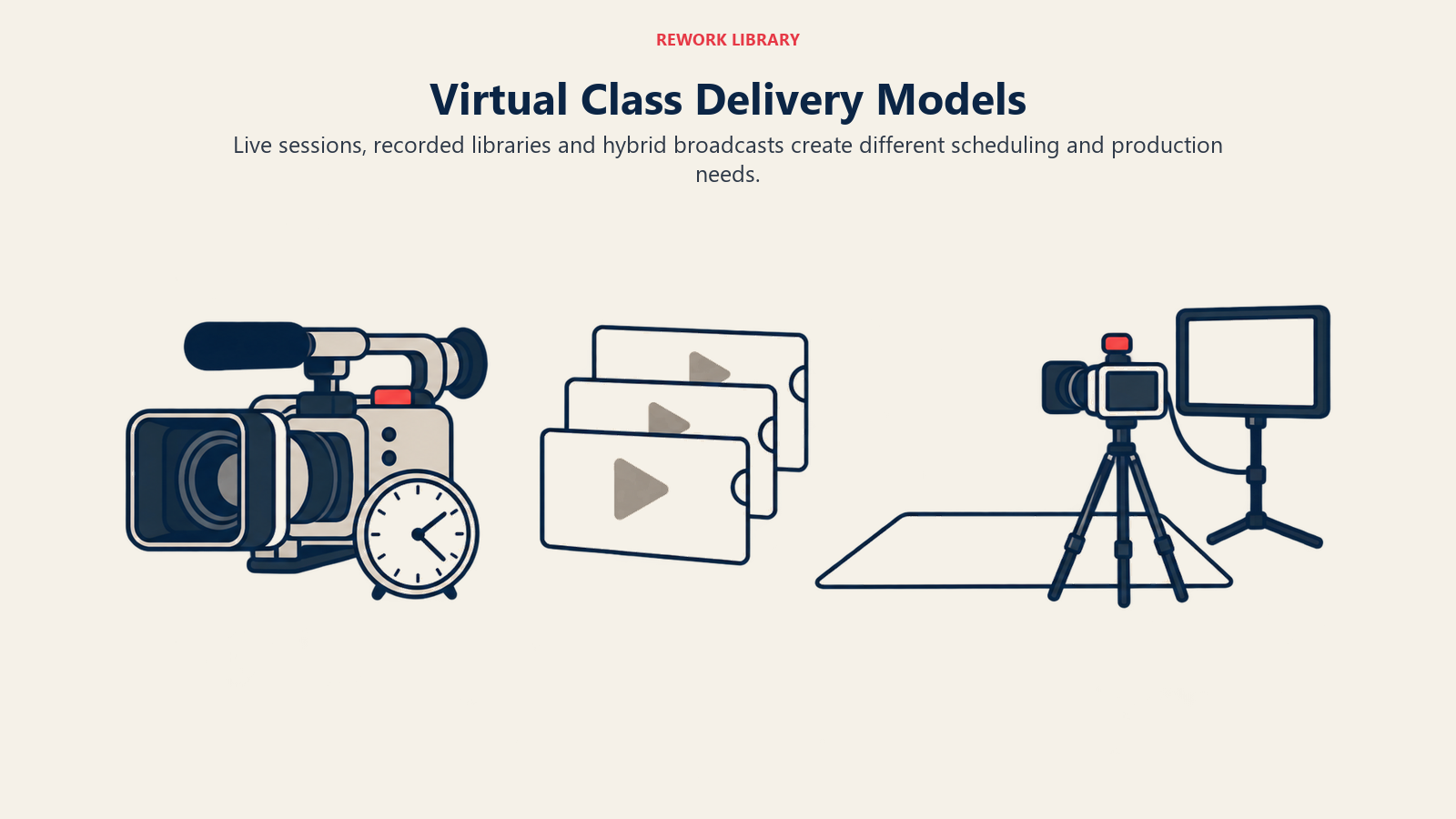
Live streaming is synchronous - instructor and members are in the same virtual room at the same time. The production bar is lower (you don't need polished editing), the community feeling is higher (members can see each other, instructors can call out names), and the scheduling structure creates appointment viewing habits that drive consistent engagement. The tradeoff is that live streaming requires scheduling discipline and a committed audience that shows up at specific times. It's most effective for formats where community and real-time instruction matter - group cycling, HIIT, boxing. Tight class schedule optimization is essential here - the timing of your live streams needs to match when your target audience is actually available.
On-demand is asynchronous - members access a library of recorded content whenever they want. This creates the most flexibility for members but requires substantial content volume to justify subscription pricing. A library of 30 workouts is interesting for a free trial. It's not enough to justify $20/month when Beachbody has 3,000 videos. The content investment for on-demand is ongoing and significant.
Hybrid classes stream an in-person class simultaneously to remote participants. This is operationally the most efficient model because you're producing content that serves two audiences from one session. But it requires technical setup (camera position that serves both in-person and remote views, audio mixing, streaming software that doesn't distract the in-person experience) and instructor training to manage both audiences at once. Done well, hybrid is the highest return-on-production model available to a gym with an active live class schedule.
For most independent gym operators, the right starting point is live streaming select classes with simultaneous recording for on-demand access later. This gives you both models from a single production setup while your on-demand library grows naturally over time.
Production Setup Requirements
The good news is that entry-level production equipment can produce a broadcast-quality gym class for under $2,000. The bad news is that setup and configuration matter as much as equipment quality, and cutting corners on audio or internet reliability will undermine the member experience regardless of camera resolution.
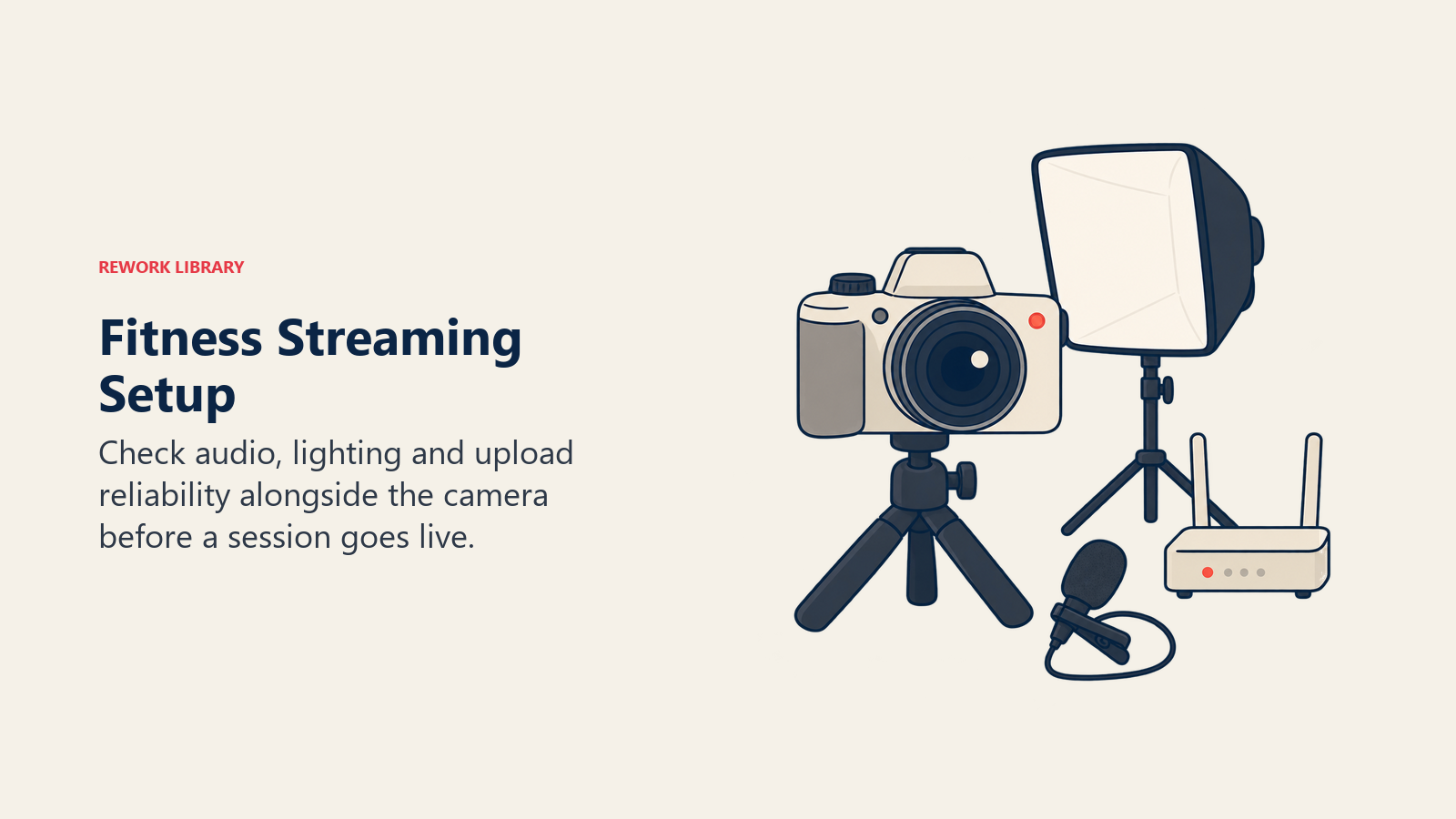
Camera: A 4K webcam ($150-300) works for a single-camera setup. A DSLR or mirrorless camera with a clean HDMI output ($400-800) produces noticeably better image quality but requires more configuration. A PTZ (pan-tilt-zoom) camera ($300-600) allows remote-controlled framing and is worth the investment if you're streaming from a fixed studio space.
Audio: This is where most first-generation gym streams fail. A lavalier microphone ($80-200) clipped to the instructor eliminates the hollow, echo-heavy audio that plagues webcam-only setups. For group fitness with music, you'll need a dedicated audio mixer that routes music and instructor mic to the stream separately, which allows you to control the music-to-voice ratio for copyright compliance.
Lighting: Fitness studios are often poorly lit for video. Soft box lights ($100-300 for a two-light setup) eliminate shadows and create professional-looking footage without requiring full studio renovation. Natural light is great when it's available but unreliable for consistent production scheduling.
Internet: Streaming 1080p video reliably requires at least 10 Mbps dedicated upload bandwidth. Most commercial internet connections support this, but verify your upload speed (not just download) and consider a dedicated connection or business-grade plan for your streaming setup. Buffering during a live class is the fastest path to subscriber churn. The IBISWorld report on Gym & Fitness Franchises in the US tracks how franchise chains have accelerated digital class offerings as a differentiator - useful context when benchmarking your own virtual investment.
Software platforms: Zoom is the default for live streaming and works adequately, but dedicated fitness platforms like Mindbody Branded App, Glofox, or ABC Trainerize offer better integration with your membership system, better copyright-compliant music libraries, and purpose-built analytics. Budget $200-800/month for a platform-level solution. Your choice here should align with the broader gym management software platform you use for memberships and scheduling - fragmented systems create friction for both members and staff.
Total startup investment for a professional entry-level streaming setup ranges from $1,500 to $4,000 in equipment, plus platform costs. A dedicated streaming studio with professional lighting, multi-camera setup, and acoustic treatment runs $8,000-15,000 for the buildout.
Pricing Virtual Memberships
Pricing is where most gyms undervalue their digital product. Virtual-only memberships at 20-40% of in-person rates are the industry benchmark, but that range is wide enough to make a significant difference in both conversion and revenue per subscriber.
Virtual-only pricing benchmarks by market:
- Budget/value market: $15-25/month for live streaming access
- Mid-market: $25-40/month for live + on-demand library
- Premium/boutique: $40-65/month for curated high-production content
Bundle pricing (physical + digital) is where the financial case gets interesting. Adding digital access to an existing in-person membership as an upgrade tier ($15-25/month premium) captures revenue from members who want flexibility without requiring a separate marketing and acquisition effort. Many gym operators find that 15-25% of their existing in-person member base will upgrade to a digital bundle once it's offered. Getting this pricing architecture right connects directly to membership tier design - the digital add-on needs to sit clearly in your tier structure with a logical price gap from the next level.
Per-class credits for on-demand content ($5-12/class) work well for casual digital users who don't want a subscription commitment. But watch the math carefully - if a member buys credits and doesn't use them, you've captured revenue but delivered no value, which isn't a retention strategy.
Corporate virtual wellness packages deserve serious consideration. A company paying $500-1,500/month for unlimited virtual class access for their employees is a B2B revenue stream with much lower acquisition cost than individual member marketing. Your existing class schedule becomes the product - and employers are increasingly receptive to flexible fitness access that doesn't require their employees to commute to a specific facility.
Content Strategy and Volume
The minimum on-demand library to justify subscription pricing is approximately 50-100 videos across a range of class types and durations. Below that threshold, subscriber churn spikes because members exhaust the content within their first few weeks.

Content refresh cadence matters as much as total volume. A library of 200 videos that hasn't been updated in six months will churn subscribers faster than a library of 80 videos updated with 10 new classes per month. Freshness signals active investment.
Organize content by duration (20, 30, 45, 60 minutes), format (strength, cardio, yoga, mobility), and difficulty level. Members selecting virtual workouts on demand need enough filtering to find what they want in under 60 seconds or they'll default to other platforms.
Instructor compensation for recorded content requires a separate conversation from live class pay. Some gyms pay a flat fee per recorded session ($50-150/class); others offer revenue share on streams (1-3% per play). There's no universal standard, but document it clearly before content production starts - retroactive compensation disputes are a real operational problem.
Content categories that perform best in on-demand fitness libraries, based on view counts: HIIT and cardio (highest demand), strength training, yoga and flexibility, beginner-specific programming (high value for new members), and mobility/recovery (lower volume but high member satisfaction scores). Beginner-specific content in particular is one of the most underused opportunities - pairing it with a thoughtful new member onboarding sequence creates a cohesive experience for people who are new to both your gym and structured training.
Addressing the Cannibalization Fear
The most common objection to virtual fitness from gym operators is: "Won't it just replace in-person attendance and undermine my membership economics?" The data consistently says no.
Virtual gym members and in-person gym members are largely different audiences. Virtual subscribers skew toward members who travel frequently, have unpredictable schedules, or live outside your geographic catchment area. They aren't choosing virtual over in-person - they're choosing virtual over not working out at all.
Among existing in-person members who also have virtual access, studies show that virtual usage supplements rather than replaces gym visits. IHRSA's research on digital engagement in health clubs consistently shows that members who engage digitally visit in-person at equal or higher rates than those who don't - virtual access expands the relationship, it doesn't replace it. Members use on-demand content for days they can't make it to a scheduled class, not as a reason to avoid coming in. In-person attendance among hybrid members is typically equal to or higher than non-digital members, because the app engagement keeps them connected to your programming. Tracking both in-person and virtual engagement in your member engagement tracking system gives you a clearer picture of true member activity across both channels.
The cannibalization risk is highest for live streamed classes running simultaneously with popular in-person classes. If your 6am HIIT class is packed and you offer live streaming at the same time, some members may choose to stream from home on days they'd otherwise attend. This is worth monitoring, but the right response is class-specific analysis rather than pulling back from virtual entirely.
Building Virtual as Its Own Product
The gyms succeeding with virtual fitness treat it as a separate product line with its own pricing logic, content calendar, and marketing approach - not a compromise version of their in-person experience. That distinction shows up in everything from how they describe it on their website to how they onboard virtual-only subscribers.
A virtual subscriber who never visits your physical facility needs a different onboarding experience than a new member who walks through your door. They need to understand the content library structure, how to find classes suited to their level, and how to contact support if something doesn't work. None of that is obvious without intentional design. A member app with strong engagement mechanics is the natural home for a virtual product - push notifications, booking, and on-demand content all live in one place.
McKinsey's wellness research finds that the US wellness market has reached $480 billion and continues growing at 5-10% annually, with digital access and personalization driving the strongest growth - a structural tailwind for gyms building credible virtual offerings. The gyms doing this well have a separate sign-up flow for virtual memberships, a dedicated email sequence for new virtual subscribers, and content specifically made for at-home workout environments (modifications for limited space, bodyweight alternatives, equipment recommendations). That level of intentionality is what separates a sustainable virtual revenue stream from a pandemic-era experiment that faded. Marketing a virtual offering also requires a distinct approach - your social media content strategy should include virtual-specific content that showcases instructors and class energy to audiences who will never walk through your door.
Frequently Asked Questions
Do virtual classes cannibalize in-person gym attendance? The data says no. Most studies show members with virtual access visit in person at equal or higher rates, and 73% of gyms that launched hybrid classes reported no meaningful drop in in-person attendance. Virtual subscribers skew toward travelers and people outside your catchment area who would otherwise not train at all.
How should I price a virtual-only membership? Virtual-only memberships typically price at 20-40% of equivalent in-person rates: roughly $15-25 a month for live streaming, $25-40 for live plus an on-demand library, and $40-65 for premium production. Adding a digital tier to existing memberships as a $15-25 upgrade captures revenue with no new acquisition cost.
What equipment do I need to start streaming classes? A professional entry-level setup runs $1,500-$4,000: a 4K webcam or PTZ camera, a lavalier mic, a soft box light kit, and at least 10 Mbps dedicated upload bandwidth. Audio and internet reliability matter more than camera resolution, since buffering and echo are the fastest path to subscriber churn.
How many videos does an on-demand library need? Plan for 50-100 videos to justify subscription pricing, organized by duration, format, and difficulty. Below that, members exhaust the content in weeks and churn. Refresh cadence matters as much as volume: a smaller library updated monthly retains better than a large one left stale.
Learn More