6 Key Business Metrics Every Gym Owner Must Track (With Formulas)
Turn this article into takeaways for your work.


Each assistant summarizes the article only for you and suggests best practices for your work.
The six key business metrics every gym owner must track are monthly recurring revenue, member lifetime value, average revenue per member, monthly attrition rate, cost per acquisition, and utilization rate. Together they explain not just what your revenue is, but why it moves, and which lever to pull first when something goes wrong.
Most gym owners know their monthly revenue. They can tell you what came in last month and whether it was up or down from the month before. But ask them why it moved (which specific member behavior drove the change) and the conversation gets vague fast. Revenue is the output. The metrics in this guide are the inputs. And managing inputs is how you actually control where your business goes.
The six metrics covered here aren't academic constructs. They're the diagnostic tools that tell you whether your business is healthy, where the problems are, and which lever to pull first. Operators who track these consistently make better decisions, respond to problems earlier, and avoid the cash flow surprises that end otherwise viable gym businesses.
The other thing these metrics do is give you a shared language with anyone you bring into the business: a potential investor, a manager you're building toward, a bank making a lending decision. A gym with clean metrics data is a more credible business than one running on gut feel and monthly bank statements. Understanding where your metrics currently stand also helps you identify which gym growth stage you're actually in, since each stage has distinct metric benchmarks.
Key Facts: Gym Business Metrics
- Gyms with formal metric tracking processes report 31% higher year-over-year revenue growth than those without (Fitness Business Pro 2024)
- The average boutique fitness studio has a member LTV of $1,800-$3,200, while big-box gyms average $400-$900 per member (IHRSA 2023)
- Industry-average monthly attrition is 3.3-4.5% for boutique studios and 4-6% for traditional gyms, and most operators underestimate their actual rate
IHRSA's Membership Attrition and Retention report establishes that the average health club has an annual attrition rate of 28.6%, the benchmark against which your monthly attrition calculations should be measured.
The Six Essential Gym Metrics
1. Monthly Recurring Revenue (MRR)
What it measures: The predictable, recurring membership income your business generates each month, excluding one-time fees, PT packages, and retail.
Why it matters: MRR is the foundation of your financial model. It's the revenue you can predict and plan around. One-time fees and add-ons are valuable but variable. MRR is what lenders, investors, and you as an operator rely on for sustainability.
Formula:
MRR = (Number of active members) × (Average monthly membership fee)
Worked example: 180 members × $120/month average membership = $21,600 MRR
Watch for: MRR that's growing in headline number but shrinking per member (a sign you're discounting to grow). Or MRR that's flat while member count grows (same issue: your average price is falling). Your membership tier design directly shapes your average membership fee, so if ARPM is drifting down, review whether your tier structure is guiding members toward appropriate price points.
2. Member Lifetime Value (LTV)
What it measures: The total revenue you expect to generate from the average member across their full tenure with your gym.
Why it matters: LTV is the single most important number for understanding what a new member is actually worth to your business. It tells you how much you can afford to spend acquiring each new member and whether your pricing model is sustainable.
Formula:
LTV = (Average Monthly Revenue Per Member) × (Average Member Lifespan in months)
Worked example: $140 ARPM × 14-month average tenure = $1,960 LTV
To find average member lifespan: Divide 1 by your monthly attrition rate. A 5% monthly attrition rate implies an average tenure of 20 months. A 7% rate implies 14 months.
Watch for: LTV that's high on paper because average tenure looks long, but which is being dragged by a small cohort of founding members who've been around for years. Segment your LTV calculation by cohort (members who joined in Q1 2024 vs Q1 2025) to see whether newer members are staying as long as early ones. Member engagement tracking at the cohort level reveals whether newer members are building the habits that predict long tenure.
3. Average Revenue Per Member (ARPM)
What it measures: The total revenue your business generates per active member each month, including membership fees and any add-on revenue.
Why it matters: ARPM tells you how effectively you're monetizing each member relationship. A gym with high ARPM is either charging more for memberships, generating significant add-on revenue (PT, nutrition, retail), or both. ARPM growth without membership price increases is a sign your value-added offerings are working.
Formula:
ARPM = Total Monthly Revenue ÷ Number of Active Members
Worked example: $32,000 total monthly revenue ÷ 210 active members = $152.38 ARPM
Watch for: ARPM significantly below your advertised membership price (signals heavy discounting). ARPM well above your membership price (positive sign: add-ons are working). Any sudden drop in ARPM without a corresponding drop in member count (you may have shifted toward a cheaper membership tier). Operators who actively develop personal training upsell programs typically see 20-40% higher ARPM than those who rely solely on membership fees.
4. Monthly Attrition Rate
What it measures: The percentage of your member base that cancels or lapses each month.
Why it matters: Attrition is the silent killer of gym businesses. A 6% monthly attrition rate sounds manageable until you realize it means you're losing 72% of your member base per year, and spending marketing dollars to replace members you should be keeping. Attrition is always worth fixing before acquisition. ACE Fitness's 2022 fitness industry trends report found that retention challenges intensified post-pandemic, with member expectations around personalization and staff engagement rising sharply.
Formula:
Monthly Attrition Rate = (Members lost in the month ÷ Members at start of month) × 100
Worked example: Lost 12 members in March, started March with 200 members. Attrition = (12 ÷ 200) × 100 = 6%
Watch for: Seasonal spikes (January joiners who leave by March is an industry-wide pattern). Cohort-based attrition (are members who joined via a certain promotion staying shorter?). Early attrition: members who leave in their first 90 days before they've established a routine are a product and onboarding problem, not just a sales problem. A structured new member onboarding process specifically targets the 0-90 day danger window where most early attrition originates.
5. Cost Per Acquisition (CPA)
What it measures: The total marketing and sales cost required to acquire one new paying member.
Why it matters: CPA tells you whether your marketing is efficient. But it only means something in relation to LTV. A $200 CPA is excellent if member LTV is $2,000. It's unsustainable if LTV is $400.
Formula:
CPA = Total Marketing & Sales Spend ÷ New Members Acquired
Worked example: $3,500 in marketing spend (ads, events, referral incentives) in March, acquired 18 new members. CPA = $3,500 ÷ 18 = $194.44
Watch for: Rising CPA over time without a corresponding rise in LTV (your marketing is becoming less efficient). CPA that varies significantly by channel (this tells you where to shift budget). CPA calculations that exclude staff time and referral incentives (these are real costs and should be included). Gym referral programs are one of the most reliable ways to reduce CPA while simultaneously improving the quality of new members.
6. Utilization Rate
What it measures: The percentage of your facility or class capacity that's actually being used relative to what's available.
Why it matters: A gym with 80 spots across five daily peak-hour classes that's running at 60% utilization has $0 in additional fixed costs to add those 32 unused spots. Utilization rate identifies whether you have a growth problem (you need more members) or a distribution problem (you have members but they're all coming at the same time).
Formula:
Utilization Rate = (Actual visits in period ÷ Maximum possible visits in period) × 100
Worked example: Your studio has 16 spots per class, 8 classes daily, 6 days/week. Maximum weekly capacity = 768 visits. Actual visits last week = 491. Utilization = (491 ÷ 768) × 100 = 63.9%
Watch for: High peak utilization (90%+) with low off-peak utilization (under 30%). This is a pricing and incentive problem, not a member count problem. Overall utilization below 50% in a studio that's losing money is a different problem from utilization below 50% in one that's profitable: the former needs more members, the latter needs better schedule optimization. Peak hour management strategies address the distribution problem directly when overall membership is adequate but timing is skewed.
Benchmark Ranges by Gym Model
| Metric | Boutique Studio | Big-Box Gym | Hybrid |
|---|---|---|---|
| Monthly attrition | 3-5% | 4-7% | 3.5-6% |
| Member LTV | $1,800-$3,200 | $400-$900 | $900-$1,800 |
| ARPM | $100-$280 | $25-$55 | $65-$180 |
| CPA | $80-$200 | $25-$80 | $50-$150 |
| Utilization rate (target) | 65-85% | 20-40%* | 50-75% |
| LTV:CPA ratio (healthy) | 10:1+ | 8:1+ | 9:1+ |
*Big-box utilization benchmarks look low because the model is built on members not showing up. The denominator (total possible visits) is enormous.
The LTV-to-CPA Ratio: The Single Most Important Health Indicator
If you track nothing else, track the ratio of member LTV to CPA. This single number tells you whether your business model is sustainable.
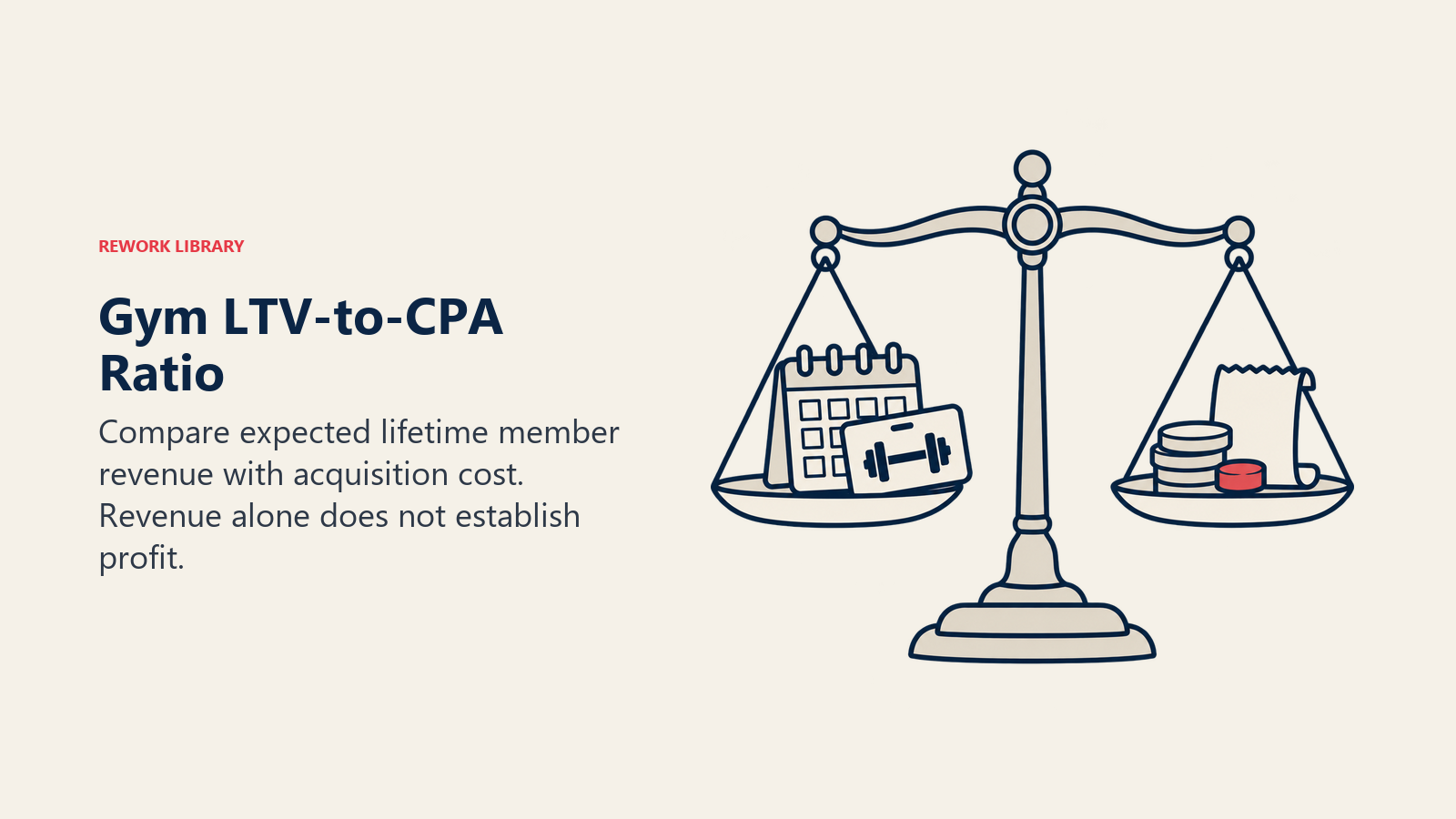
A healthy fitness business maintains an LTV:CPA ratio of at least 8:1. That means for every $1 you spend acquiring a member, you generate $8 in lifetime revenue. Below 5:1, your unit economics are under pressure. Below 3:1, you're in a loss-per-member situation that marketing spend cannot fix.
Scenario: Boutique studio with $140 ARPM, 6% monthly attrition, $160 CPA.
- Average member lifespan = 1 ÷ 0.06 = 16.7 months
- LTV = $140 × 16.7 = $2,338
- LTV:CPA = $2,338 ÷ $160 = 14.6:1 (excellent)
Red flag scenario: Same studio raises CPA to $280 through expensive paid ads while attrition rises to 8%.
- Average member lifespan = 1 ÷ 0.08 = 12.5 months
- LTV = $140 × 12.5 = $1,750
- LTV:CPA = $1,750 ÷ $280 = 6.25:1 (warning zone)
The problem in the red flag scenario isn't just the higher CPA. Rising attrition is compressing LTV at the same time marketing is becoming more expensive.
Decision Tree: Which Metric to Fix First
When things aren't going well, the instinct is to run more marketing. But marketing is rarely the first problem to fix. Use this logic:
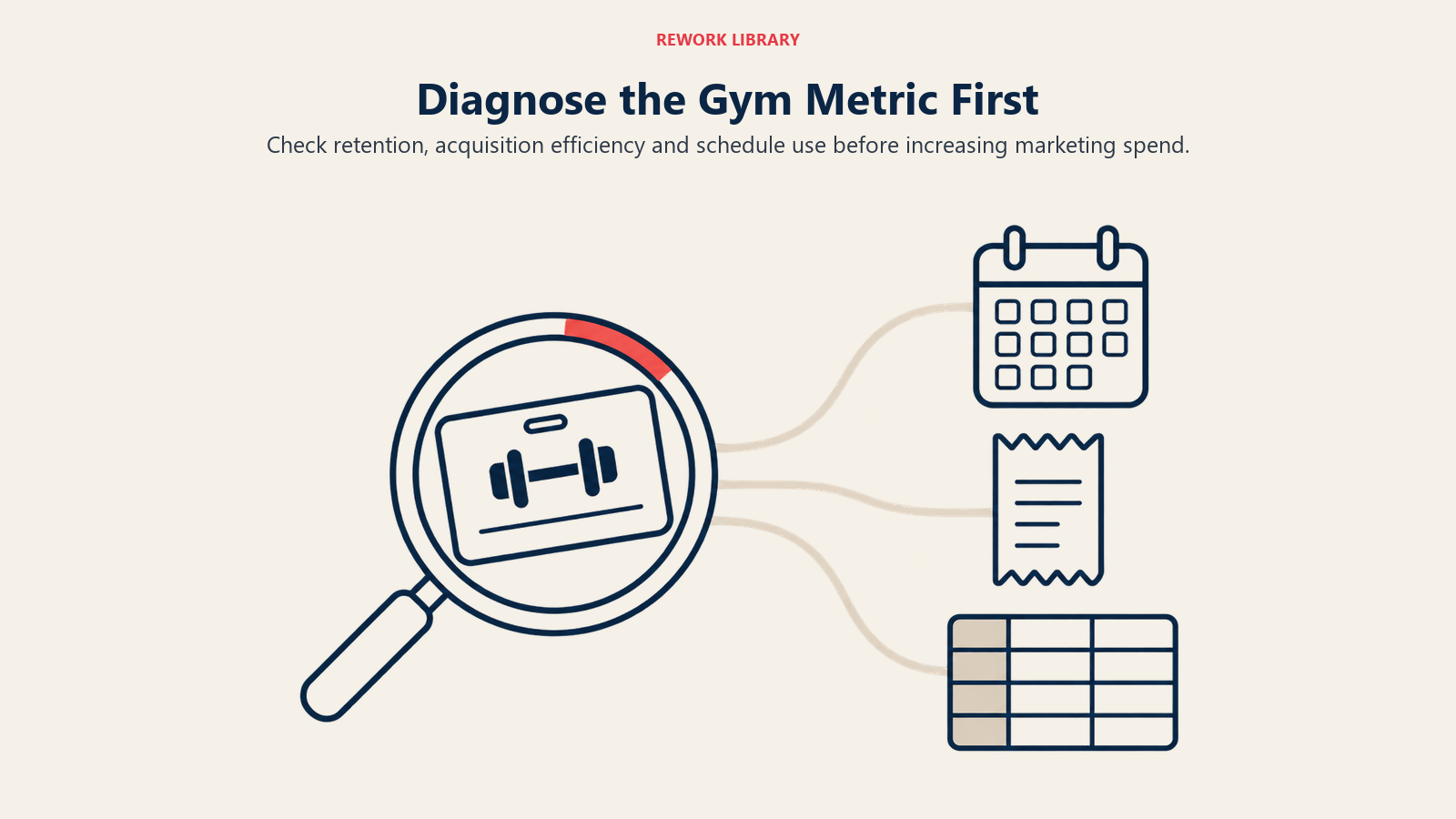
If monthly attrition is above 6%: Fix retention before any other investment. More marketing with high attrition just accelerates the churn cycle.
If attrition is below 5% but new member volume is low: Diagnose CPA and channel efficiency. You likely have a marketing reach or conversion problem.
If CPA is high but conversion rate is acceptable: Review your marketing channels. You may be overpaying for leads in saturated channels while underleveraging organic and referral.
If MRR growth is flat despite adequate new member volume: Check ARPM. You may be heavily discounting to acquire members or failing to upsell add-ons.
If utilization is low despite reasonable member count: You have a schedule distribution problem. Look at peak versus off-peak patterns and adjust incentives accordingly.
Building the Dashboard
You don't need expensive software to track these metrics. A simple spreadsheet updated weekly covers all six. The BLS Occupational Outlook Handbook for fitness trainers projects 12% employment growth through 2034, which signals rising labor costs for gym operators, another reason to track ARPM closely so you know whether your pricing keeps pace with staffing expenses.
| Column | What to enter |
|---|---|
| Date | Week ending |
| Active members | From your billing system |
| New members | Joined this period |
| Cancelled members | Left this period |
| Total revenue | From your POS/billing system |
| Marketing spend | All acquisition costs including staff time |
From these six inputs, you can calculate all six metrics automatically. The discipline isn't in the software. It's in pulling the numbers consistently every week and reviewing them with honesty. Gym management software can automate this data collection once you've outgrown manual tracking, but the habit of reviewing the numbers must come first.
Frequently Asked Questions
What are the most important business metrics for a gym? Six metrics carry the most diagnostic weight: monthly recurring revenue (MRR), member lifetime value (LTV), average revenue per member (ARPM), monthly attrition rate, cost per acquisition (CPA), and utilization rate. MRR and ARPM show how well you monetize, attrition and LTV show retention, and CPA plus utilization show efficiency.
What is the single most important gym health metric? The LTV-to-CPA ratio. It tells you whether your model is sustainable by comparing what a member is worth over their tenure to what you spend acquiring them. A healthy gym holds at least 8:1. Below 5:1 your unit economics are under pressure, and below 3:1 marketing spend cannot fix the problem.
How do you calculate gym member lifetime value? Multiply average monthly revenue per member by average member lifespan in months. To find lifespan, divide 1 by your monthly attrition rate: 5% monthly attrition implies a 20-month tenure. So a member paying $140 a month who stays 14 months has an LTV of roughly $1,960.
What is a healthy monthly attrition rate for a gym? Industry-average monthly attrition runs 3.3% to 4.5% for boutique studios and 4% to 6% for traditional gyms. Once monthly attrition climbs above 6%, fix retention before spending more on acquisition, because more marketing on a leaky base just speeds up the churn cycle.
Learn More

Senior Operations & Growth Strategist
On this page
- The Six Essential Gym Metrics
- 1. Monthly Recurring Revenue (MRR)
- 2. Member Lifetime Value (LTV)
- 3. Average Revenue Per Member (ARPM)
- 4. Monthly Attrition Rate
- 5. Cost Per Acquisition (CPA)
- 6. Utilization Rate
- Benchmark Ranges by Gym Model
- The LTV-to-CPA Ratio: The Single Most Important Health Indicator
- Decision Tree: Which Metric to Fix First
- Building the Dashboard
- Frequently Asked Questions
- Learn More