Gym Franchise Model Guide: Franchise vs Company-Owned, FDD & Franchisee Selection
Turn this article into takeaways for your work.


Each assistant summarizes the article only for you and suggests best practices for your work.
Franchising lets a successful gym concept grow without the franchisor's capital. In theory, it's an elegant model: franchisees invest their own money to open locations under your brand, you collect royalties while they do the operational work, and everyone wins as the brand grows. IBISWorld reports that gym and fitness franchises in the US generated $7.2 billion in revenue with a consistent growth trajectory - a sector large enough to demonstrate franchising viability, but fragmented enough that a well-positioned concept can still carve out meaningful territory. In practice, franchising is among the most complex growth strategies available to a gym owner, and the gap between the theory and the reality is where most franchise attempts fail.
The franchise model looks attractive on paper and is demanding in practice. It requires building a business that teaches others to operate it consistently - which means your system needs to be documented, trainable, and strong enough to survive being run by someone who isn't you. The FDD and the operations manual aren't just legal documents; they're evidence that your system exists. Gyms that franchise before their system is mature enough to be taught end up with franchisees who can't execute and a brand that gets damaged by underperforming locations. Most franchisors first test their systems through multi-location company-owned expansion - the discipline of running two or three locations builds the operational documentation that franchising requires.
Understanding both sides of the franchisee-franchisor relationship is essential before committing. The gyms that build successful franchise systems are those who approached franchising as a system-building challenge first, and a growth vehicle second.
Key Facts: Gym Franchise Economics
- FDD preparation costs range from $25,000-75,000 in legal fees before the first franchise is sold (FTC Franchise Rule, legal industry data, 2024)
- Fitness franchises typically charge royalties of 5-8% of gross revenue, plus a 1-3% national marketing fund contribution (IHRSA Franchise Report, 2024)
- Franchise system development takes 12-24 months from decision to first franchise sale for most gym concepts (Franchise Business Review, 2024)
- The top 10% of fitness franchise systems (by franchisee satisfaction) have an average of 48 hours of initial training vs 18 hours for the bottom 10% (FBR Survey, 2024)
Franchise vs Company-Owned Expansion
The fundamental choice between franchising and company-owned multi-location expansion comes down to capital, control, and growth rate. Neither is universally superior - the right answer depends on your financial position, operational maturity, and risk tolerance.
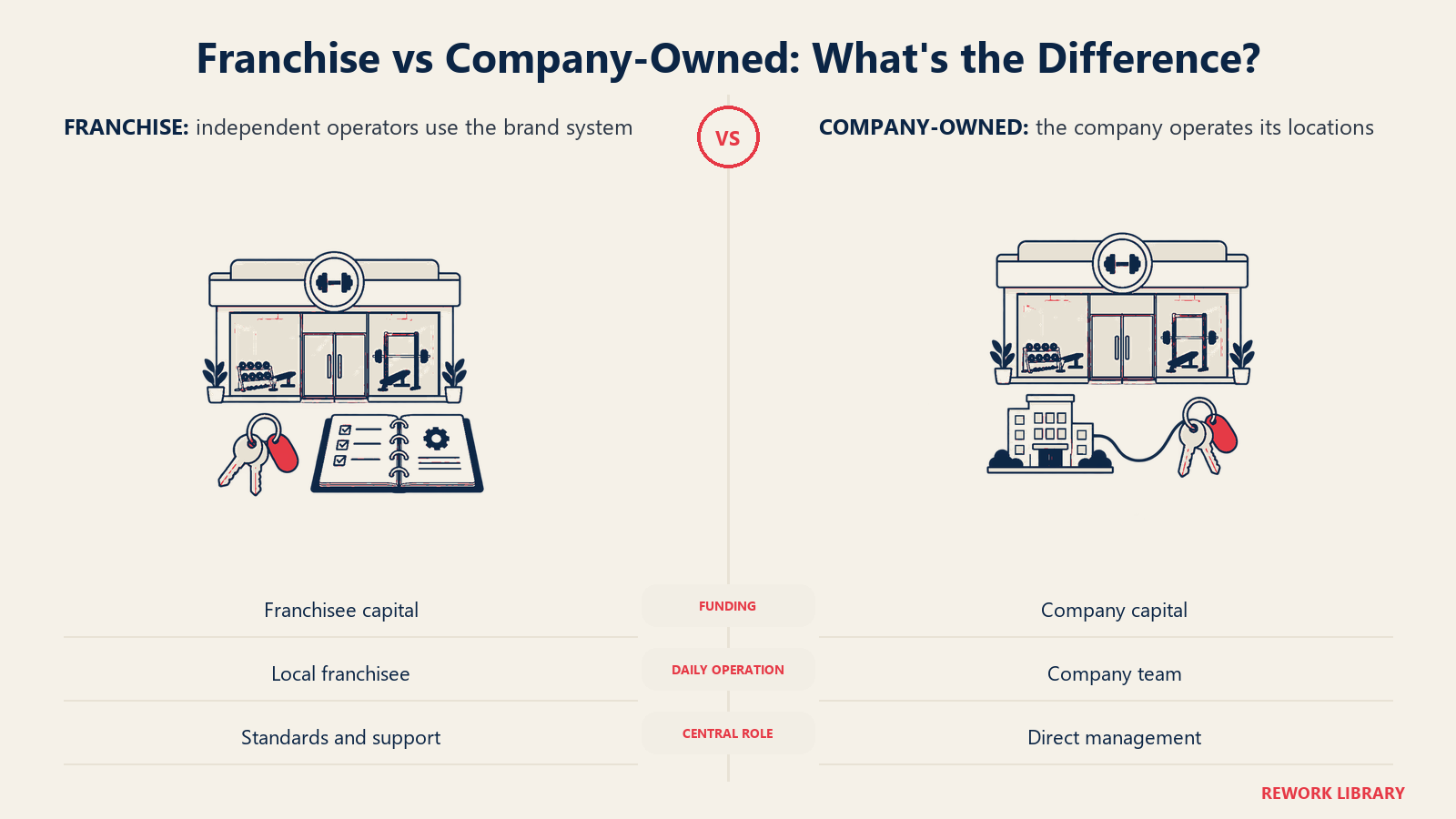
Capital efficiency: In a franchise model, the franchisee funds the build-out and equipment. You're not investing $300,000-750,000 per location; you're collecting $30,000-75,000 in initial franchise fees (which partly offsets your system development costs) and then collecting royalties from day one of operations. For gym owners without access to significant capital, franchising lets you grow a brand footprint that would be impossible to fund company-owned.
Control tradeoffs: Company-owned locations give you direct control over every hiring decision, pricing choice, and operational standard. Franchise locations are operated by independent business owners who have contractual obligations but practical autonomy. When a franchisee makes a poor hiring decision or cuts corners on facility maintenance, your brand bears the reputational cost even though you don't control that location's daily operations. This is the tradeoff that many new franchisors underestimate. Your staff management standards need to be codified clearly enough that a franchisee can hire and train to your standard without your personal involvement.
Unit economics comparison: A company-owned gym with $800,000 annual revenue and 20% EBITDA margins generates $160,000/year in profit. A franchise location with the same revenue generates royalties of $40,000-64,000/year (5-8% of revenue) for the franchisor, plus marketing fund contributions. At scale, a portfolio of 20 franchise locations generating that royalty rate produces $800,000-1,280,000 in royalty revenue annually - potentially more than the company-owned equivalent. But building that portfolio takes years and significant infrastructure investment.
Which model fits which stage: Company-owned expansion makes sense when you have capital, strong operational infrastructure, and want to maintain direct control. Franchising makes sense when your system is mature and documented, your unit economics are proven and replicable, and you have the appetite to become a franchisor rather than just a gym operator. IHRSA's health club business handbook covers the operator vs investor distinction in detail, including how franchise models change the financial reporting and capital allocation picture for club operators. These are genuinely different businesses.
The Franchise Disclosure Document
The FDD is a legally required document under the FTC Franchise Rule that must be provided to prospective franchisees at least 14 days before they sign any agreement or pay any fee. It contains 23 required items covering every material aspect of the franchise relationship.
FDD preparation costs and timeline: Expect $25,000-75,000 in legal fees to prepare an FDD for the first time, with an experienced franchise attorney who specializes in the fitness or hospitality sector. The timeline from engagement to a compliant FDD ready for presentation is typically 4-8 months. State registrations (required in the 14 registration states, including California, New York, Illinois, and others) add $5,000-15,000 and 2-4 additional months.
The items that matter most to prospective franchisees:
Item 19 (Financial Performance Representations): This is the section where franchisors can voluntarily share financial performance data from existing locations. Most prospective franchisees base their investment decision heavily on Item 19. You're not required to include financial performance data, but franchises that omit it are at a significant competitive disadvantage because sophisticated buyers will ask for it anyway.
Item 21 (Financial Statements): Audited financial statements of the franchisor for the prior three fiscal years. If you're a young company without three years of audited statements, you'll need to begin the audit process early - audited financials take 3-6 months to prepare for the first time.
Item 20 (Outlets and Franchisee Information): Lists every existing and former franchised location, including contact information for current and departed franchisees. Prospective buyers will call these people. Current franchisees who aren't satisfied are the most effective deterrent to new franchise sales.
Items that protect the franchisor: Item 9 (franchisee obligations), Item 15 (territorial exclusivity), and the franchise agreement itself (which is a disclosure exhibit) define your rights to enforce standards, terminate underperforming franchisees, and protect the system from bad actors. Item 19 financial performance representations are most credible when backed by real unit economics - which is another reason why tracking key metrics across all your locations matters long before you file your first FDD.
Building the Franchise System
An operations manual is the physical evidence that your system is teachable. It should cover every repeatable operation in enough detail that a new franchisee who follows it can produce a consistent member experience - without calling you for guidance.
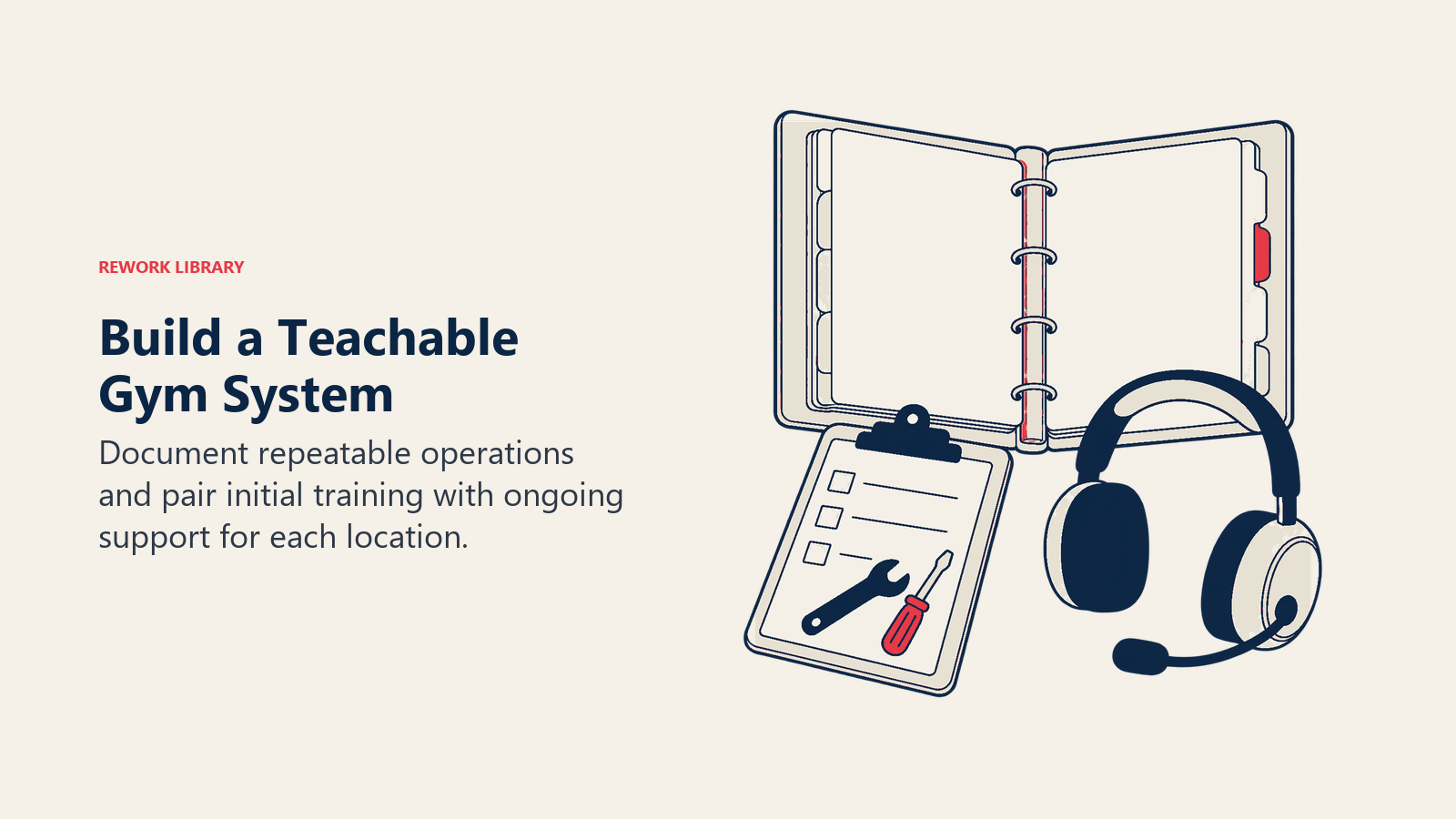
Operations manual components for a gym franchise:
- New member enrollment process (step-by-step with scripts)
- Staff hiring, screening, and onboarding process
- Class scheduling standards and instructor certification requirements
- Facility maintenance standards (equipment inspection frequency, cleaning protocols)
- Marketing and promotional guidelines (what franchisees can and can't do independently)
- Technology systems requirements (specific software platforms, POS systems)
- Brand standards (logo usage, color specifications, signage requirements, apparel guidelines)
- Complaint and conflict resolution procedures
- Financial reporting requirements and cadence
Initial training program: The benchmark for fitness franchise training is 40-80 hours, delivered partly at your flagship location ("home office training") and partly on-site during the franchisee's pre-opening period. Training should cover operations, sales, member experience, and the specific technology systems you require. Franchisees with inadequate initial training fail at higher rates - the time invested in training pays dividends in franchisee success.
Ongoing support systems: The best franchise relationships are built on ongoing support infrastructure that helps franchisees succeed, not just initial training. This includes scheduled field visits (quarterly for new franchisees, annually for established ones), a regular franchisee communication cadence (weekly ops updates, monthly performance reviews), and peer networking opportunities (annual franchise conference, franchisee advisory councils).
Technology requirements: Define your required technology stack explicitly in the franchise agreement. A common gym management software platform across all locations gives you visibility into system-wide performance data, standardizes the member experience, and simplifies training. Allowing franchisees to choose their own software creates a fragmented system that's impossible to support.
Franchisee Selection
The franchisees you sell to become your brand. A poorly selected franchisee with inadequate capital or the wrong skills will underperform, complain publicly, and potentially need to be terminated - a process that's expensive, time-consuming, and damaging to system morale.
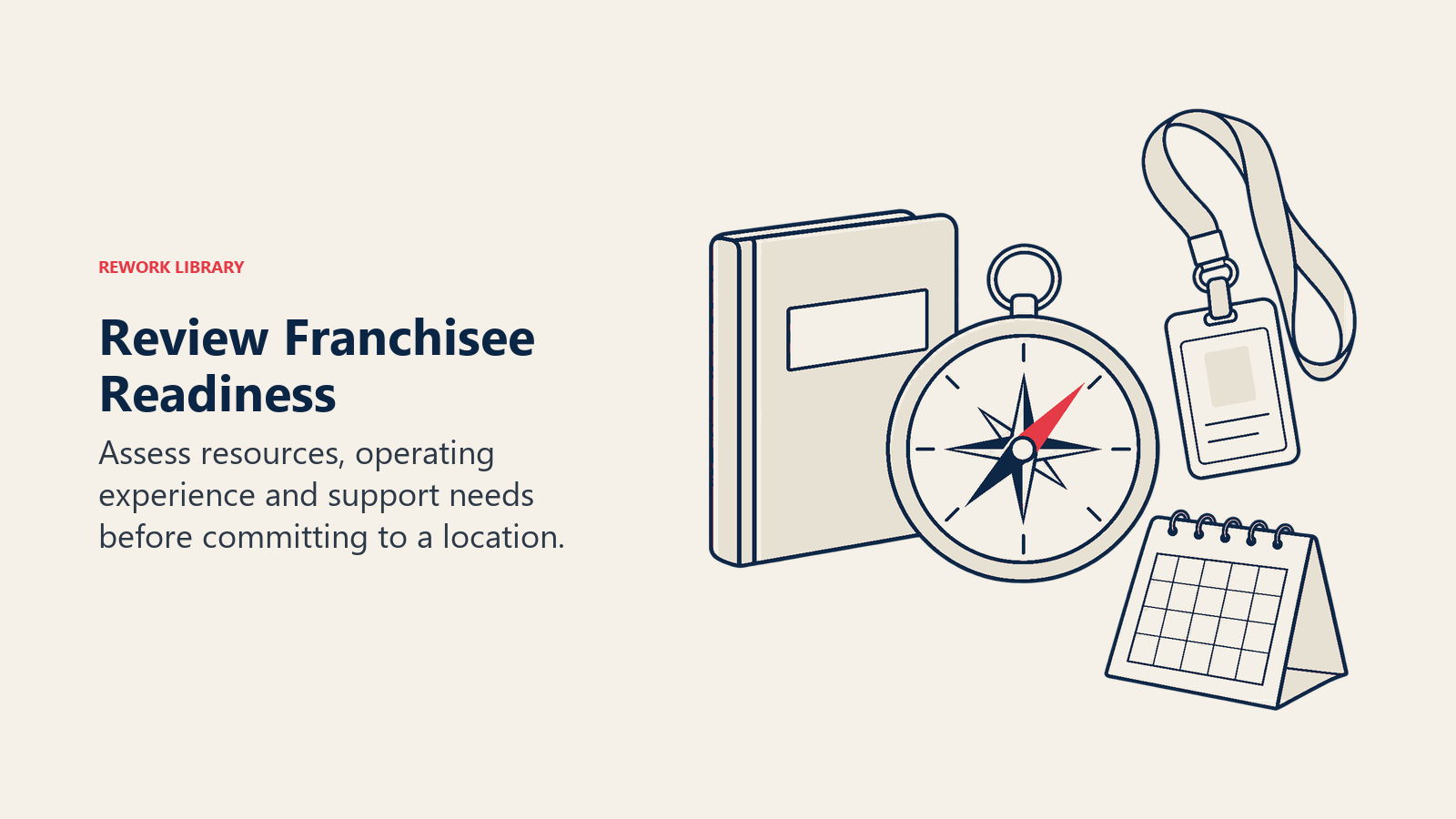
The operator vs investor debate: Fitness franchises perform better when the franchisee is actively involved in operations rather than a passive investor managing hired managers. Owner-operators who work at least part-time in their locations during the first year show 30-40% higher ramp-up success rates than absentee investors. Define your franchisee profile clearly and be willing to decline applicants who don't fit it, regardless of their financial qualifications. A franchisee's ability to execute your new member onboarding and churn reduction systems in their first year is more predictive of long-term success than their initial capital position.
Qualification criteria for a fitness franchise:
- Liquid capital: Typically 25-30% of total investment (including build-out, equipment, and working capital reserve). A $400,000 investment requires $100,000-120,000 in liquid capital.
- Net worth: 1.5-2x the total investment to ensure financial resilience during ramp-up.
- Fitness industry experience: Not always required, but operational experience in a service business is highly predictive of success.
- Management background: Experience hiring, training, and managing a team of 5-15 employees is essential.
- References: Business references and personal references that speak to character, work ethic, and management style.
Territory rights and exclusivity: Exclusive territories (where you agree not to open a company-owned or franchise location within a defined geographic area) are standard in fitness franchising. Define territories based on population counts (e.g., exclusive rights within a 3-mile radius, or exclusive rights to a territory of 75,000 people) rather than political boundaries that may not reflect your actual market. Territories that are too large limit your system growth; territories that are too small create franchisee conflict over nearby locations.
Franchisee onboarding timeline: From signing the franchise agreement to opening day, typical timelines run 6-18 months depending on the complexity of the site search, build-out, and licensing process. Provide franchisees with a week-by-week milestone calendar and dedicated support during the site selection and build-out process - these early stages are where new franchisees most need guidance and where delays most often occur.
Royalty Structure Benchmarks
Fitness franchise royalties typically run 5-8% of gross revenue. The right royalty rate depends on your support infrastructure, brand strength, and competitive market.
A 5% royalty on a $600,000 annual revenue location generates $30,000/year. Multiply across 20 locations and that's $600,000/year in royalty revenue - before marketing fund contributions and initial franchise fees. But at 20 locations, you also need a corporate team to support them: a franchise operations director, a field support team, marketing support, and technology infrastructure. The royalty revenue needs to cover that infrastructure before it generates profit.
Marketing fund contributions (typically 1-3% of gross revenue) are collected in addition to royalties and must be spent on brand marketing that benefits the system as a whole. Account for these separately from royalties - they're held in trust for franchisee benefit, not general company revenue.
Initial franchise fees range from $25,000-60,000 for fitness concepts, depending on brand strength and territory size. This fee partly offsets your system development costs (FDD preparation, operations manual, training program) and is typically non-refundable once training has been provided.
The Franchisor's Identity Shift
Franchising isn't just adding a legal structure to your existing gym business - it requires becoming a fundamentally different type of company. A franchisor is in the support and standards business, not the gym operations business. Your daily activities shift from managing members and staff to managing franchisees, supporting their operations, and protecting the brand.
Many gym operators discover they're not well-suited to the franchisor role. They built their gym because they love the fitness experience and member relationships. Managing franchisee compliance, territory disputes, and FDD renewals is a different kind of work. Be honest with yourself about whether that's the business you want to be in. An honest assessment of where you are on the gym growth stages continuum will tell you whether franchising is premature or genuinely the right next chapter.
The franchisors that succeed long-term built the support infrastructure before they sold the first franchise. They invested in the operations manual before the FDD was filed. They hired franchise support staff before they needed them. McKinsey research on wellness industry growth drivers shows that consumers increasingly choose brands with strong community and accountability structures - exactly what a well-run franchise system can deliver at scale. That investment creates a system that franchisees can succeed with - and franchisee success is the only sustainable source of system growth. Strong market positioning for your fitness brand also matters when recruiting franchisees - a brand with a clear, differentiated identity attracts better franchisee candidates than a generic gym concept with no distinct positioning.
Learn More

Senior Operations & Growth Strategist