Membership Tier Design for Gyms: Basic, Premium & VIP Structures
Turn this article into takeaways for your work.


Each assistant summarizes the article only for you and suggests best practices for your work.
Gym membership tier design is the practice of structuring your memberships into distinct levels, usually Basic, Premium, and VIP, so you capture price-sensitive prospects at the low end while raising average revenue per member at the top. A well-built three-tier structure lowers the barrier to join, creates a clear upgrade path, and improves retention because higher-tier members have more invested in the relationship.
A single membership price is a compromise that serves no one particularly well. It's too high for the prospect who just wants access and would join at $35 but balks at $65. And it's leaving money on the table from the member who'd happily pay $120 a month for personal training credits, priority booking, and a dedicated locker. If you'd only offered it.
Multi-tier membership structures solve both problems simultaneously. They lower the barrier to entry for price-sensitive prospects while creating a clear upgrade path that increases your average revenue per member over time. IHRSA's guide to gym pricing from Profiles of Success shows that multi-purpose clubs charge a median of $75/month versus $45 for fitness-only clubs, illustrating how tier design and facility positioning directly set the ceiling on what members will pay. Done right, they also improve retention, because higher-tier members have more invested in the relationship and more reasons to stay. The revenue impact becomes clear when you track key gym financial metrics like average revenue per member before and after introducing tiers.
But most gym tier designs fail because they're thrown together without a framework. Too many options, unclear differentiation, and a VIP tier that's barely distinguishable from Premium. This guide gives you the structure to build tiers that sell themselves.
Key Facts: Membership Tier Economics
- Gyms with 3-tier membership structures report 23% higher average revenue per member than single-price gyms (IHRSA, 2024)
- 35% of new members who start on Basic tiers upgrade within 6 months when a clear upgrade path exists
- VIP tier members have a 40% lower 12-month churn rate than Basic tier members
- The optimal price gap between adjacent tiers is 40 to 60%. Too small and tiers blur; too large and the jump feels prohibitive
What Membership Tiers Are Designed to Do
Before defining your tiers, get clear on what they're actually supposed to accomplish. Tiers aren't just a pricing menu. They're a revenue optimization and retention tool.
Three outcomes a well-designed tier structure produces:
First, it captures members across the willingness-to-pay spectrum. Some people will never pay $90 a month for a gym. But they will pay $40. If you don't have a $40 option, you don't get them at all. A Basic tier brings them in the door, and a portion of them will upgrade once they're committed.
Second, it increases average revenue per member without increasing member count. Moving 20% of your 400 members from a $55 Basic to a $85 Premium adds $2,400 in monthly revenue without signing a single new member. That's the math that makes tier design worth the effort.
Third, it creates differentiated retention. Higher-tier members have more invested in your gym and more features they'd lose by canceling. McKinsey's fitness consumer research found that about 50% of US gym-goers say fitness is a core part of their identity, which means higher-tier members who feel the gym reflects their identity are far less likely to cancel than those just paying for access. A VIP member with a dedicated locker, personal training credits, and priority class booking is significantly harder to lose than a Basic member who uses nothing but the treadmill. This is why tier design connects directly to gym churn reduction: the more value a member has in their tier, the more friction there is to cancel.
Building Your Three Tiers: What Goes Where
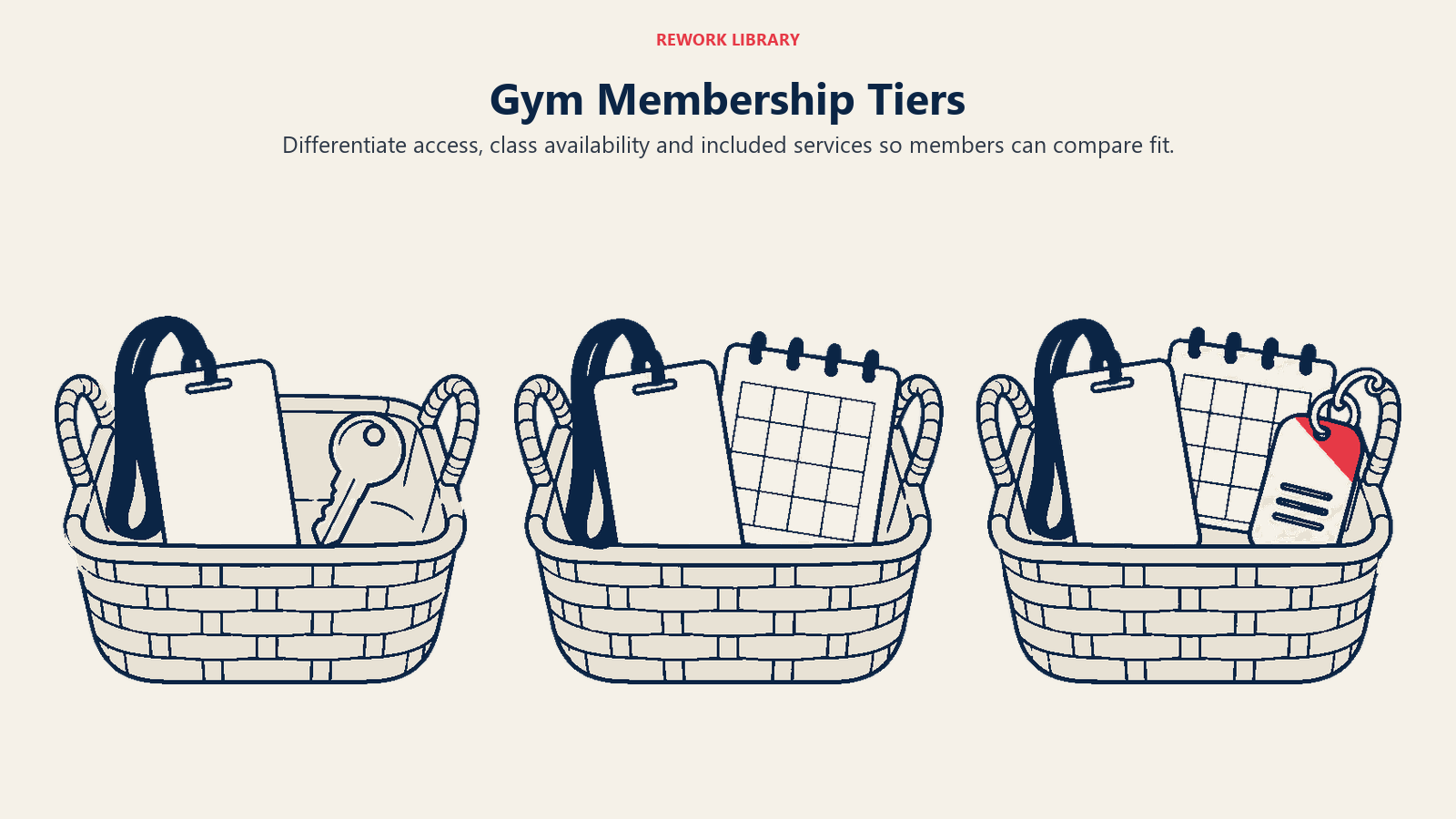
The structure below is a starting framework, not a rigid template. Adjust based on your facility's actual capabilities and your target market's expectations.
Basic Tier: Access Foundation
The Basic tier should deliver genuine value at a price point that's meaningfully lower than your competitors' standard memberships. It's not a stripped-down version of your product. It's a real offer for a real segment.
What to include:
- Unlimited gym access during standard hours (or off-peak, if you're differentiating by time)
- Access to cardio equipment, free weights, resistance machines
- 2 to 4 group class credits per month (or none, if classes are a Premium differentiator)
- Basic locker room access (day-use lockers only)
- Member app access and booking for available equipment
What to exclude:
- Dedicated locker
- Unlimited group classes
- Personal training credits
- Guest passes
- Priority booking
- Premium services (towels, nutrition consultations)
Typical price range: 40 to 55% of your market's standard membership rate. If everyone else charges $60, your Basic should land at $35 to $40.
Premium Tier: The Core Offer
Premium is where most of your members should live. It's your primary product: the offer that delivers a complete gym experience at a price that reflects its value. In a well-designed tier structure, 50 to 60% of your membership should be at this level.
What to include:
- All Basic benefits
- Unlimited group classes (or a generous credit: 12 to 16 per month)
- 2 guest passes per month
- 1 personal training assessment or session per quarter
- Discounted personal training rates (10 to 15% below standard)
- Towel service or premium locker room access
- Priority booking for popular classes (24 hours in advance vs 12 for Basic)
Typical price range: 40 to 60% more than Basic. If Basic is $40, Premium is $65 to $70.
VIP Tier: The White Glove Experience
VIP exists to serve your highest-value members and generate your highest margin revenue. It should feel genuinely exclusive, not just "more stuff," but a different experience in the gym. If your VIP members don't feel meaningfully different from Premium members in their day-to-day experience, the tier will fail. The personal training upsell pathway is often the most compelling VIP differentiator, because it ties the higher price directly to a tangible, measurable service.
What to include:
- All Premium benefits
- Unlimited personal training sessions (one model) OR 4 PT sessions per month included
- Dedicated locker (assigned, not day-use)
- Exclusive VIP-only hours or areas if your facility allows
- Monthly nutrition check-in or body composition assessment
- Priority booking opens 48 to 72 hours in advance
- Complimentary guest day passes (4 to 6 per month)
- Concierge service: equipment reservations, recovery room booking, expert programming
- Recognition: name on a member wall, birthday acknowledgment, milestone rewards
Typical price range: 60 to 80% more than Premium. If Premium is $65, VIP is $100 to $120.
Pricing Psychology Across Tiers
The price gaps between tiers aren't arbitrary. They directly affect how members perceive value and make upgrade decisions.
The anchor effect: When a prospect sees your tier menu, their reference point becomes the first price they see. Present VIP first. $120 looks large initially, but it makes $65 look like a bargain by comparison, even though $65 is your actual target price for most new members. This is anchoring working in your favor. The full mechanics of how anchoring and decoy pricing interact in membership sales are covered in pricing psychology for fitness studios.
Price gap ratios: The gap between Basic and Premium should be large enough to create genuine differentiation but not so large that it feels like a different product category. A 40 to 60% premium on the next tier is the sweet spot. If Basic is $40 and Premium is $65, that's a 63% premium (acceptable). If Basic is $40 and Premium is $90, that's a 125% premium, and the jump feels too large for a single step up. Many members will stay on Basic rather than commit to the gap.
The decoy tier: In a three-tier structure, your middle tier (Premium) is the target, the one you want most members to choose. Design the Basic and VIP tiers to make Premium look like the obvious choice. Basic should feel meaningfully limited (not a bad deal, but clearly incomplete). VIP should feel aspirational but not irrational ("I'd love that, but I don't need all that right now"). Premium becomes the rational choice in the middle.
Annual vs monthly presentation: Always show monthly rates, but offer annual pricing as a line item below. "Or pay $700/year and save $80" gives the price-sensitive member a way to commit that feels like a win. Annual members have 45% lower churn, so the discount is worth it for the retention benefit alone. The Statista overview of health and fitness club statistics gives you broader market context on pricing norms across club types, useful when calibrating where your tier prices sit against the competitive landscape.
Upgrade Paths and Upsell Triggers
A tier structure without upgrade triggers is just a menu. The revenue gains come from systematically moving members up the tier ladder at the right moments.

Trigger 1: Class credits exhausted: If a Basic member uses all 4 of their monthly class credits by week 3, they get an automated message: "Looks like you've loved your classes this month. You've used all 4 credits. Premium members get unlimited classes. Want to upgrade?" This is a zero-pressure upsell at a moment of demonstrated demand.
Trigger 2: 90-day review: At 90 days, invite every Basic and Premium member to a "membership review," a brief call or in-person check-in. Review their attendance patterns, ask about their goals, and present the next tier as a logical fit. "Based on how often you're coming in and the classes you're taking, Premium would actually save you money on PT sessions." This is a consultative upgrade, not a sales push. Attendance patterns visible in your member engagement tracking data make these conversations much more precise.
Trigger 3: Life changes: New Year, post-summer return, post-injury recovery, post-baby fitness restart. These are all high-motivation moments when members are open to investing more in their health. A well-timed "upgrade your plan" message around these life events converts at 2 to 3x the rate of a generic upsell email.
Trigger 4: Service usage patterns: Members who regularly attend classes but are on Basic, or who book PT sessions frequently outside their tier's included credits, are upgrade candidates. Your gym management software should flag these patterns monthly so you can reach out personally.
Common Tier Design Mistakes
Mistake 1: Too many tiers. Four or five tiers overwhelm prospects. Three is the maximum. If you have more options to offer, bundle them as add-ons rather than separate tiers.
Mistake 2: Unclear differentiation. If the only difference between Basic and Premium is two extra class credits, prospects can't justify the price gap. Each tier needs at least three meaningful, tangible differentiators.
Mistake 3: A VIP tier that isn't actually special. If your VIP members don't feel different in the gym, they'll downgrade. Dedicated lockers, exclusive hours, personal trainer relationships, and recognition aren't optional in a VIP tier. They're the product.
Mistake 4: Showing all tiers before establishing value. Don't open a membership consultation with the tier menu. Spend 5 minutes understanding the prospect's goals and usage patterns first. Then present the tier that fits them. They're more likely to upgrade when the recommendation is personalized.
Mistake 5: Not reviewing tier performance quarterly. Which tier are most new members choosing? What's the upgrade rate from Basic to Premium at 6 months? What's the VIP churn rate? These numbers tell you whether your tier design is working or needs adjustment. Your tier structure also needs to account for whether you use contracts or month-to-month billing, since commitment terms affect how members perceive tier value.
The Self-Selling Tier Structure
When your tiers are designed correctly, members upgrade without being pushed. The Basic member who uses 8 classes in a month despite having only 4 credits will ask about upgrading before you have to ask them. The Premium member whose personal training usage is high will look at VIP and do the math themselves.
Good tier design creates that natural pull. The goal isn't to sell people on tiers. It's to make the right tier obvious for each member at each stage of their gym relationship. IHRSA's research on member engagement driving retention consistently shows that the frequency of member interactions with the facility is the strongest predictor of staying, and higher tiers, with more included services, naturally increase that frequency. That's the design challenge, and it's worth solving. Average revenue per member is your most powerful lever for gym profitability, and tier design is how you move that number without adding a single member. For households joining together, family and group membership plans add another dimension to the tier decision that's worth planning for.
Learn More