Contract vs Month-to-Month Gym Memberships: Pros, Cons & What Works
Turn this article into takeaways for your work.


Each assistant summarizes the article only for you and suggests best practices for your work.
Contracts guarantee revenue but can poison your brand in a market where consumers expect flexibility. Month-to-month billing gives prospects what they want but can create a churn problem that keeps you perpetually filling a leaking bucket. Statista's data on gym membership contract duration in the US shows how member preferences around commitment terms have shifted, giving you a realistic picture of what your market expects before you set policy. The right answer isn't always obvious, and the wrong choice can cost you years of recovery time.
This isn't a philosophical debate. It's a business model decision with real financial, retention, and legal consequences. And it depends far more on your market and your gym's stage of growth than on your personal preference for predictability. Understanding your gym's growth stage helps clarify which model fits your current situation.
This guide walks through the honest tradeoffs between contracts and month-to-month billing, with actual numbers so you can model the impact on your own P&L.
Key Facts: Membership Commitment and Retention
- Annual contract members have 55% lower churn in months 2-6 versus month-to-month members (IHRSA Membership Report, 2024)
- But 38% of consumers say they've actively avoided signing up for a gym because of mandatory contract requirements (Statista, 2024)
- Hybrid models (month-to-month with a contract option at a discount) increase total member count by 18% on average vs contract-only gyms
- Early termination fee collections average 43% of fees assessed. Most members who want to leave just disappear
What Each Model Means in Practice
Before comparing them, let's be precise about what these models actually involve operationally.
Annual and term contracts require members to commit to a specific membership duration (typically 6 or 12 months) with a legal obligation to pay even if they stop using the gym. Key elements: a signed agreement, auto-renewal provisions, an early termination fee (ETF) for members who cancel before the contract ends, and billing that continues regardless of usage. Members can't simply stop paying. Stopping payment creates a collections situation.
Month-to-month memberships have no fixed commitment period. Members pay each month (typically via recurring auto-draft) and can cancel with proper notice, usually 30 days. There's no ETF, no legal obligation beyond the current billing period, and no collections risk for lapsed members. Members can stop at any time. The commitment model you choose also affects how you structure your membership tier design, since annual commitment discounts only work as a meaningful lever on month-to-month pricing.
Hybrid models offer both options simultaneously, typically with a price differential. Example: $55/month on month-to-month, or $45/month on an annual commitment paid monthly. The member chooses their preference at sign-up. This is the most common structure at independent gyms that have been operating for more than 5 years.
Financial Impact Comparison
Let's model these three approaches with a mid-sized gym of 400 members to show the real numbers.

Scenario: 400 members at $60/month average
Contract-only gym:
- MRR: $24,000 (predictable, barring contract breaches)
- Average annual churn rate: 20% (contracts suppress churn)
- Members lost per year: 80
- ETF collected (43% of 80 members x average $150 ETF): $5,160
- Revenue stability: Very high, cash flow predictable 12 months out
- New member acquisition pressure: Moderate (only replacing 80/year)
- Risk: Consumer complaints, difficulty attracting trial-hesitant prospects
Month-to-month-only gym:
- MRR: $24,000 (same current base)
- Average annual churn rate: 35 to 45% (higher without commitment friction)
- Members lost per year: 140 to 180
- ETF collected: $0
- Revenue stability: Moderate, MRR can swing 10 to 15% quarter-to-quarter
- New member acquisition pressure: High (replacing 140-180/year)
- Risk: Requires stronger acquisition machine and engagement program to maintain MRR
Hybrid gym (60% annual, 40% month-to-month):
- MRR from annual members: $16,200 (240 members x $67.50 avg, blend of rates)
- MRR from M2M members: $9,600 (160 members x $60)
- Total MRR: $25,800 (slightly higher due to M2M price premium)
- Blended annual churn: 28%
- Members lost per year: 112
- Revenue stability: High for contract cohort, moderate for M2M cohort
- Risk: More complex to administer, requires clear communication on rate differences
The hybrid model often outperforms both extremes on total revenue and member count because it doesn't exclude either prospect type at sign-up.
Retention Impact: What the Research Shows
The relationship between contract length and churn is well established in fitness research, but it's more nuanced than "contracts reduce churn."
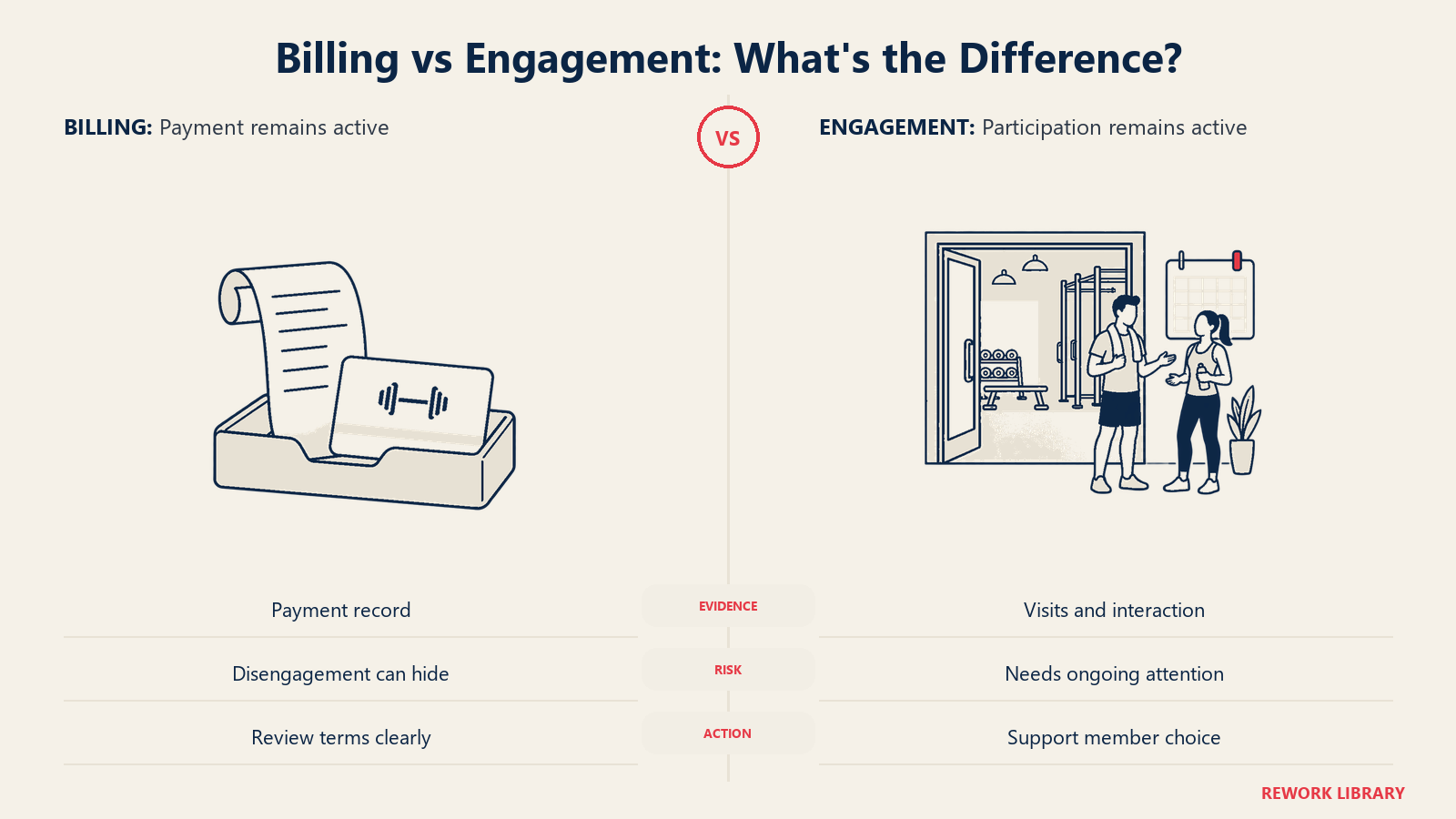
Contracts don't actually make members stay. They create financial friction that prevents members from leaving easily. That's not the same thing as retention. A contracted member who stopped coming to the gym three months ago but is still paying is not a retained member. They're a paying non-member who's going to generate negative word-of-mouth when they finally do cancel.
The real retention benefit of contracts comes from the commitment effect: members who sign a contract have self-identified as serious about their fitness goals, and that psychological commitment correlates with higher early engagement. IHRSA's research on how gyms are using member data to increase retention found that every two staff interactions per month with a member results in an extra visit the following month, a reminder that commitment terms are only one lever, and engagement programs are just as important. Annual contract members are 35% more likely to attend in months 2 through 4 than month-to-month members, which is exactly when the "new gym" motivation tends to fade. A structured new member onboarding program reinforces this early engagement regardless of commitment model.
Month-to-month members need different retention interventions. Without the contract holding them, engagement programming, personal outreach, and community-building are the primary retention mechanisms. Gyms that rely on month-to-month billing and don't invest in engagement programs consistently struggle with 40%+ annual churn. The most effective engagement tools are covered in gym churn reduction strategies.
The bottom line on retention: contracts buy you time with disengaged members. Engagement programs keep members engaged. The best gyms do both.
Churn comparison by model: | Model | Month 1-3 Churn | Month 4-6 Churn | Month 7-12 Churn | Annual Churn | |---|---|---|---|---| | 12-month contract | 3% | 4% | 13% (post-contract) | 20% | | 6-month contract | 5% | 6% | 24% (post-contract) | 35% | | Month-to-month | 8% | 12% | 15% | 35-45% | | Hybrid (60/40) | 5% | 7% | 16% | 28% |
Note: The post-contract surge in annual contract gyms is the most dangerous pattern. Members who were locked in often leave in clusters at renewal time. This is why renewal management in months 10 through 11 is critical for contract-heavy gyms. A proactive member win-back campaign can recover some of those departing members before the contract technically expires.
Legal Considerations
This is the area where most gym operators are most unprepared. Membership contracts have significant legal requirements that vary by jurisdiction, and violations can result in regulatory action, fines, or private lawsuits.

Key contract clauses every gym agreement needs:
Clear cancellation policy: How many days notice is required, what the process is, and what happens to prepaid amounts. Ambiguous cancellation language is the most common source of consumer complaints and chargebacks.
Auto-renewal disclosure: Most jurisdictions require explicit, prominently displayed notice that the membership will automatically renew unless canceled. "Buried in the terms" doesn't satisfy this requirement. The disclosure must be conspicuous: typically bolded, in larger font, and above the signature line.
Early termination fee clarity: The ETF amount, how it's calculated, and the circumstances under which it applies must be clearly stated. ETFs that aren't explicitly disclosed before signing are typically unenforceable.
Cooling-off period: Many states and countries require a 3 to 5 business day period during which a new member can cancel without penalty. California, New York, and several European countries have strict cooling-off requirements. Know your jurisdiction's rules.
Medical cancellation provisions: Most jurisdictions require gyms to allow contract cancellation without ETF for documented medical conditions that prevent gym use. Your contract must include this provision.
Legal checklist for contract language:
- Cancellation method and notice period: clearly stated
- Auto-renewal disclosure: prominently displayed above signature
- ETF amount: clearly quantified, not vague
- Cooling-off period: compliant with local law
- Medical cancellation clause: included
- Freeze/pause provisions: defined (how long, how many per year)
- Dispute resolution process: defined
If your current membership agreement hasn't been reviewed by an attorney familiar with consumer protection law in your jurisdiction, that's a risk that costs $300 to $500 to fix and potentially thousands to resolve after the fact.
Market Context: When Each Model Works
Contracts work best in:
- Niche or specialty studios (CrossFit, martial arts, specialized programming) where the perceived value of the expertise justifies a commitment
- Markets where competitors use contracts and consumer expectations are aligned accordingly
- Gyms in growth markets where demand exceeds supply and members are willing to commit
- New gym openings that need predictable revenue to hit break-even projections
A fitness competitive analysis of your local market reveals whether your competitors use contracts, which directly affects what your prospects expect at sign-up.
Month-to-month works best in:
- Commoditized fitness markets (large urban areas with many options) where contract requirements are a competitive disadvantage
- Gyms competing against national chains that offer no-commitment memberships
- Boutique studios with high brand loyalty, where the community is the retention mechanism, not the contract
- Markets where consumers are skeptical of gyms following negative industry experiences (this is common in post-COVID fitness markets)
Hybrid models work best in:
- Established gyms with a mix of loyal long-term members and price-sensitive new prospects
- Gyms with strong occupancy who don't need to use price as the primary acquisition lever
- Markets where both types of buyers exist in meaningful proportions
- Operators who want to maximize total member count without sacrificing revenue predictability
The honest question to ask yourself: what would you choose if you were a prospect in your market? If you'd reject a contract at your gym, your competitors' potential members probably would too.
The Real Cost of Getting This Wrong
Operators underestimate two things simultaneously: the real cost of churn in month-to-month gyms, and the real cost of cancellation friction in contract-heavy gyms.
The churn cost in M2M gyms: if you're replacing 40% of your membership annually, and your average customer acquisition cost is $80, you're spending $12,800 per year just to stay flat at 400 members. McKinsey's fitness industry consolidation research highlights that building strong loyalty and referral programs is now table stakes for independent gyms competing against well-capitalized chains, which makes the choice between contract and M2M models a competitive positioning decision, not just an administrative one. Add the cost of the gap period when those slots are empty, and your actual churn cost is significantly higher. Month-to-month gyms need a stronger acquisition machine and engagement program to compensate. Tracking the actual cost of churn against your key gym metrics gives you the numbers to make this decision rationally rather than emotionally.
The cancellation friction cost in contract gyms: when a member has a negative experience trying to cancel, they tell people. Yelp reviews, Google reviews, and word-of-mouth work against you for years after a contentious cancellation dispute. One aggressive collections attempt for a $150 ETF can cost you 10 prospective members who read the review and chose a competitor. That's $6,000 to $10,000 in lifetime value lost for a $150 "win."
The right model is the one that matches your market's expectations, your operational capabilities, and your stage of growth, not the one that makes you feel most financially secure on paper.
Learn More