Personal Training Upsell Strategies: Converting Members Into PT Clients
Turn this article into takeaways for your work.


Each assistant summarizes the article only for you and suggests best practices for your work.
A personal training upsell turns general gym members into paying PT clients through defined touchpoints rather than chance floor conversations. The core funnel is a complimentary intro session built on the member's stated goals, tiered packages that lower the entry barrier, and consultative conversion that solves a problem the member already named. Done right, it can lift PT penetration from 5 to 12 percent and add six figures in annual revenue with no new members.
Personal training is the highest-margin revenue line in most gyms. The labor cost is predictable, the pricing is premium, and PT clients retain at dramatically higher rates than general membership holders, because they have ongoing accountability relationships, structured progress, and a real investment in the outcome. A member paying $60/month for a gym membership can justify cancelling on a bad week. A member who's three sessions into a 20-session PT package thinks twice.
Yet most gyms leave PT revenue almost entirely to individual trainer relationships. A member asks a trainer a question on the floor. The trainer hands them a business card. Maybe something happens, maybe it doesn't. This approach produces whatever PT revenue individual trainers generate through their personal networks, which varies enormously and is entirely outside management's control.
A structured PT upsell program changes this. It creates defined touchpoints where PT is introduced, a natural funnel from general membership to paying PT client, and clear incentive structures that motivate staff without creating a high-pressure culture. Gyms that build this properly can convert 10-15% of their membership base to some form of personal training, and those members generate 2-3x the revenue and stay 40% longer than non-PT members. IBISWorld's analysis of the personal training industry projects the sector to grow at an 8.2% CAGR to $11.9 billion, driven in large part by fitness facilities expanding in-house PT offerings rather than relying on independent trainers.
Key Facts: Personal Training Economics
- PT clients have an average tenure 40-60% longer than non-PT members (IHRSA, 2024)
- Gyms that convert 10-15% of membership to PT generate 30-45% of total revenue from this segment alone
- The average gym's PT conversion rate without a structured program: 4-6%; with a structured program: 12-18%
The Intro Session Funnel
The entry point to personal training is the complimentary intro session: a 30-minute fitness assessment and goal-setting conversation that introduces the PT experience without the commitment of purchasing a package. This session serves multiple purposes: it delivers immediate value to the member, it gives the trainer visibility into the member's goals and gaps, and it creates a natural moment to present a PT recommendation.
Structuring the 30-minute intro session:
Minutes 1-10: Goal conversation. "Tell me what you're working toward and what's held you back before." Listen more than you talk. Take notes. The data from this conversation is the foundation of your PT proposal. ACE's Integrated Fitness Training model is built around exactly this principle: personalized programming grounded in the client's stated goals, movement patterns, and history produces both better results and stronger retention than generic protocol-based training.
Minutes 11-20: Movement assessment or demo workout. A brief functional movement screen (overhead squat, hip hinge, push assessment) takes less than 10 minutes and gives you specific, personalized feedback to deliver. Alternatively, run them through a short sample workout that demonstrates what a real session feels like.
Minutes 21-28: Findings and recommendation. Deliver three specific observations from the assessment ("I noticed you're compensating on the left side in your squat, which is likely causing your lower back discomfort") and tie them directly to the goals they stated. This is where the relevance of PT becomes concrete.
Minutes 28-30: Natural proposal moment. "Based on what you've told me and what I've seen, here's what I'd recommend for your first eight weeks..." Present the program recommendation as a natural conclusion to the conversation, not as a sales close. The proposal comes from the assessment data, not from a script.
Who should offer intro sessions:
New member orientation is the primary trigger. Every new member should be invited to a complimentary intro session within their first 7 days. But intro sessions should also be available at the day-14 and day-30 onboarding touchpoints for members who haven't engaged. See the new member onboarding guide for the touchpoint schedule this integrates with.
Conversion rate expectation: A well-structured intro session converts to a PT package at 25-40% when the session quality is high and the recommendation is specific. A generic "here are our PT packages" presentation converts at 8-12%. ACE Fitness research on PT business ROI confirms that session quality and client goal alignment are the primary drivers of package conversion, not promotional pricing or sales pressure.
PT Package Design
The packages you offer determine your conversion rate as much as your sales process. Most gyms offer two options: expensive unlimited monthly PT and a high per-session drop-in rate. This binary creates a barrier to entry for members who want PT but aren't ready to commit at premium price points.
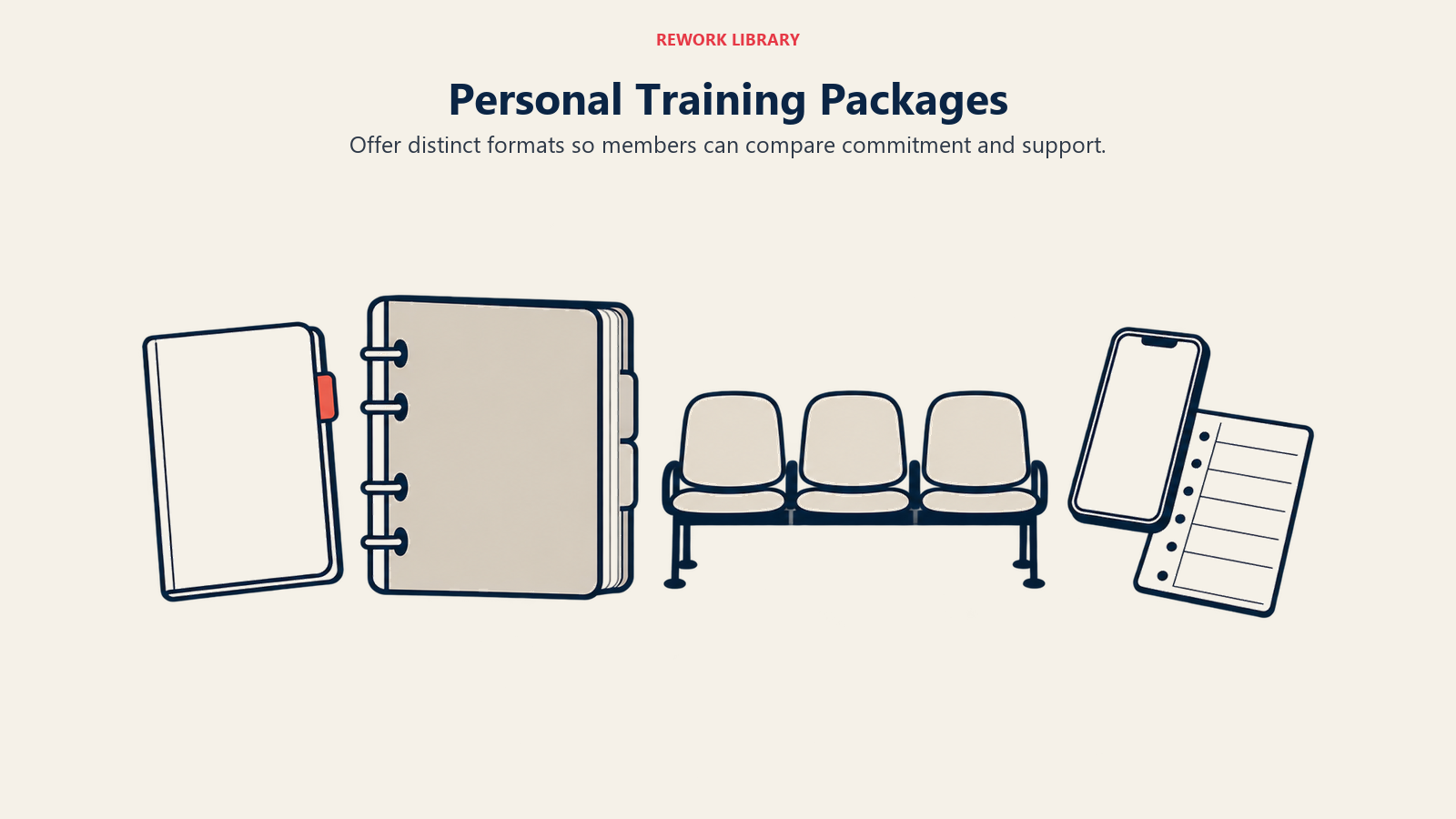
Package tiers to consider:
Starter packages (8-12 sessions): Designed for members who want to try PT without a large upfront commitment. Typically priced at a 10-15% discount vs. single-session rate. Attracts members who need a lower-risk entry point. Converts to larger packages at 50-60% when the initial package delivers clear results. Understanding pricing psychology for fitness studios helps you anchor these entry packages in a way that makes the full package feel like the obvious upgrade.
Standard packages (20-24 sessions): The core PT product for committed clients. Sufficient volume to show meaningful progress and establish a training habit. Typically priced at 15-20% discount vs. single-session. Most PT programs are built around this tier.
Small group training (2-4 people): The highest-volume, highest-accessibility product in your PT lineup. Pairs 2-4 members with similar goals and fitness levels for semi-private sessions at 40-60% of individual PT rate. This is the bridge product that converts price-sensitive members and creates community within the PT program. A member who won't pay $80/session for one-on-one PT will often pay $45/session for a group of three with a trainer they trust.
Hybrid packages: Monthly PT sessions combined with an app-based programming subscription between visits. The member works out on their own 2-3 days per week using a trainer-designed program and meets with the trainer 2-4 times per month. This model serves members who want ongoing guidance but not weekly sessions, and creates recurring revenue between in-person blocks.
Pricing considerations:
Session rates should reflect your market positioning and overhead. For boutique studios in urban markets, individual PT rates of $80-$120/session are standard. For mid-market gyms in suburban locations, $50-$80/session is typical. Small group training at 40-55% of individual rates creates the volume tier.
Don't discount starter packages too aggressively. Members who buy a highly discounted intro package often price-anchor to that rate and resist transitioning to full-price packages. Modest discounts (10-15%) reward commitment without creating pricing problems downstream.
Conversion Tactics That Don't Create a Pushy Culture
The most common reason gym operators avoid structured PT upsell programs is the fear of creating a high-pressure sales environment that alienates members. This fear is legitimate. Aggressive PT sales is one of the most common complaints in gym reviews. But the solution isn't to avoid upselling. It's to design an upsell process that feels consultative rather than transactional.

Goal-setting data as the upsell driver:
The best PT conversion conversations happen when the trainer has specific goal data from a prior conversation. A trainer who says "I heard from Marcus that you mentioned wanting to get stronger for your ski trip in March. I put together a quick 10-week program that would get you there" is not selling. They're solving a problem the member already told someone they had. The consent to be helped was given at sign-up.
This is why the goal-setting conversation at orientation is so important. Document member goals. Make them accessible to the PT team. Use them as the basis for every PT recommendation. The member doesn't experience a sales pitch. They experience someone paying attention.
Staff incentive structures:
Commission-based PT referral bonuses work but create the pushy culture problem if poorly designed. The cleanest incentive structure: a flat referral fee paid to the staff member (front desk, floor staff, or trainer) who generates the PT intro session booking, not the PT sale itself. This incentivizes the behavior (intro session booking) that leads to conversion without putting sales pressure on the interaction.
Trainers themselves should receive a competitive base wage plus commission on package sales within their client roster. Avoid incentive structures that pay trainers only on new sales, as these create churn within the PT client base as trainers over-acquire and under-retain. For guidance on building the right compensation model, see fitness instructor hiring and retention which covers both trainer pay structures and long-term staff retention.
New member orientation as the primary touchpoint:
Every new member who receives a structured onboarding conversation has PT relevance established from day one. The goal-setting conversation includes goals that PT can directly address. The first 30 days include a natural intro session invitation. The day-30 progress check-in is an appropriate moment to revisit PT if usage and goals warrant it.
This sequenced approach converts at higher rates than cold floor approaches because the relationship and the goal data already exist before the PT conversation starts. Members who've had three structured touchpoints with staff before the PT conversation feel known, not sold to.
Retention Within PT
Acquiring a PT client is the easier half of the problem. Retaining them through a full package and transitioning them to a renewal requires active management.
Why PT clients churn:
The most common PT churn causes are: perceived plateau (not seeing enough progress relative to cost), scheduling friction (sessions that are hard to book or frequently rescheduled), and life disruption (travel, work demands, injury). Price is rarely the primary reason for mid-package PT cancellation if the value is visible.
Progress milestone celebrations:
Make member progress explicit and visible. A member who's been training for 10 weeks may not notice their own improvement as clearly as someone seeing them from the outside. The trainer's job includes regular progress snapshots: "Remember in week one when you couldn't hit a proper goblet squat? Look at your form now." These moments rebuild motivation during the mid-package plateau that most clients experience around weeks 4-6. Publicly recognizing milestones in your community building channels extends their motivational impact beyond the individual client and can nudge other members toward considering PT themselves.
Transitioning from intensive to maintenance:
Not every PT client needs or can sustain a 2-4 sessions per week program indefinitely. Design maintenance programs (1 session per week, or bi-weekly check-ins with independent programming between visits) that keep the relationship active at lower cost. A client who drops from 3 sessions per week to 1 is not a churn. They're a maintained relationship that may return to higher intensity. A client who cancels entirely and is not offered a maintenance path is a lost revenue stream.
Handling cancellations within PT contracts:
When a client within an active PT contract requests a pause or cancellation, treat it as a churn signal requiring the same urgency as a membership cancellation. Understand the reason (injury gets a recovery plan and a return timeline; schedule conflict gets a flexible rescheduling policy; motivation dip gets a goal reset conversation). Don't accept the pause without a concrete return plan if you can avoid it.
PT client retention connects directly to class schedule optimization. PT clients who also attend group classes retain significantly longer than those who only do individual sessions. Building group class attendance into PT programming (as warm-up or supplementary training) cross-sells both products and creates deeper facility integration.
The Revenue Math of PT Conversion
A gym with 400 members and a 5% PT penetration rate has 20 PT clients. At $70/session average, 2 sessions per week, and 40 active weeks per year, those 20 clients generate $112,000 in annual PT revenue.
Lifting PT penetration to 12% (48 PT clients) at the same economics generates $268,800 in annual PT revenue, a $156,800 increase without adding a single new member. Statista data on personal training revenue shares shows that at dedicated PT gyms, personal training accounts for 57% of total revenue, demonstrating the ceiling available to operators who build genuine PT conversion infrastructure rather than leaving it to chance floor interactions.
The membership tier upgrade path in membership tier design and the instructor recruitment and retention approach in instructor hiring and retention both influence your PT capacity and ceiling. Build those correctly and PT upsell becomes the revenue multiplier that makes the entire member acquisition investment pay off at a fundamentally different level.
A gym that converts just 10-15% of its membership to some form of personal training doesn't just generate more revenue per member. It creates members who are more accountable, more engaged, more connected to your facility, and dramatically harder to lose. That's the full business case for treating PT upsell as a systematic program rather than an individual hustle.
Frequently Asked Questions about Personal Training Upsell
What is a personal training upsell?
It is a structured program that converts general gym members into paying PT clients through planned touchpoints, such as a complimentary intro session, goal-based recommendations, and tiered packages. It replaces ad-hoc trainer hustle with a repeatable funnel that management can measure and improve.
What is a good PT conversion rate?
Without a structured program, most gyms convert 4 to 6 percent of members to personal training. With a structured program built on quality intro sessions and goal alignment, 12 to 18 percent is achievable. A well-run intro session itself can convert 25 to 40 percent of attendees to a package.
How do you upsell PT without being pushy?
Anchor every recommendation in goal data the member already shared at onboarding, so the conversation solves a stated problem rather than pitching a product. Pay staff a flat fee for booking intro sessions rather than for closing sales, which rewards the helpful behavior without creating sales pressure.
How much revenue can PT conversion add?
A 400-member gym at 5 percent PT penetration earns roughly $112,000 a year from PT at typical rates. Lifting penetration to 12 percent raises that to about $268,800, a $156,800 increase with no new members, because PT clients pay premium rates and retain far longer.
Learn More

Senior Operations & Growth Strategist