Member Feedback Loops & Surveys: How Gyms Turn Opinions Into Retention
Turn this article into takeaways for your work.


Each assistant summarizes the article only for you and suggests best practices for your work.
Most gyms lose members without ever knowing why. The member doesn't file a complaint, doesn't argue with the front desk, doesn't send a passive-aggressive email. They just stop coming. A few weeks pass. The credit card charge fails. By then, the opportunity to intervene is gone.
The silent cancellation is the hardest kind to prevent, and the most common. Industry data suggests that fewer than 4% of dissatisfied gym members ever voice a complaint to management. The other 96% either leave quietly or tell their friends instead of you. If you're relying on member complaints to identify problems in your facility, you're working with 4% of the signal. This dynamic is well-documented in service business research, HBR's work on reducing customer defections notes that most customers who leave never signal their intent, which means the absence of complaints is not evidence of satisfaction.
A structured feedback loop is the early warning system that captures the other 96%. It surfaces dissatisfaction while members are still showing up, while the issues are still fixable, and while the relationship is still intact. Gyms that treat feedback as a continuous operational input (not an annual survey exercise) retain more members and spend less re-acquiring lost ones.
Key Facts: Member Feedback in Fitness
- Only 4% of dissatisfied customers complain directly; the rest leave silently (Service Profit Chain, Lee & Heskett)
- Gyms with formal NPS programs report 15-25% higher 12-month retention vs. those without (IHRSA, 2024)
- Members who receive a visible response to their feedback are 2.5x more likely to remain members vs. those whose feedback was ignored
Designing Your Feedback Channels
A single feedback channel misses too many members. Different people give feedback in different ways, at different times, and in different contexts. An effective feedback system uses multiple channels with a defined purpose for each.
NPS surveys (Net Promoter Score)
NPS is the cleanest benchmark metric for member satisfaction. The question is simple: "On a scale of 0-10, how likely are you to recommend this gym to a friend or colleague?" The score is calculated as: % Promoters (9-10) minus % Detractors (0-6). IHRSA and The Retention People partnered to establish the North American health club NPS benchmark at 39, based on responses from over 321,000 members, giving gym operators a credible external reference point for evaluating their own scores.
Industry benchmarks for fitness:
- Below 20: Below average (significant dissatisfaction or indifference)
- 20-40: Average fitness business NPS range
- 40-60: Good (above-average satisfaction and loyalty)
- Above 60: Excellent (strong community and advocacy)
Run NPS quarterly for the full membership base. The trend matters more than any single score. A gym at NPS 35 that has risen from 22 over six months is in a better position than one that's been stuck at 40 for three years. HBR's analysis of how to improve your NPS emphasizes that consistent follow-up and visible action on feedback is the single most reliable driver of score improvement over time, which is exactly why the "closing the loop" step matters as much as the survey itself.
Send NPS surveys via email, 30-60 days after join date for new members, and at quarterly intervals for the general membership. Keep the email subject line honest: "Quick question about your experience at [Gym Name]." Response rates drop when survey emails look like marketing.
Pulse surveys
A pulse survey is 1-3 questions sent more frequently (monthly or bi-weekly) to catch in-the-moment sentiment. Sample pulse questions:
- "How satisfied are you with the class schedule this month? (1-5)"
- "Has any staff member gone above and beyond for you recently? (Yes/No + optional name)"
- "Is there one thing we could change to improve your experience? (Open text)"
Pulse surveys work best via SMS for gym members, with response rates averaging 20-35% vs. 8-15% for email. Keep them genuinely brief; a "quick survey" that takes four minutes will tank your response rate after the first send. If your pulse data reveals consistent dissatisfaction with class availability, cross-reference with your class schedule optimization data before making schedule changes.
Post-class check-ins
A verbal or digital prompt immediately after a class is the most timely feedback mechanism available. The experience is still fresh. The emotional state is positive (post-workout endorphins help). And the instructor who just ran the class can receive direct, immediate signal.
Paper slips in class leave 30-second post-class rating slots on a simple scale work for analog gyms. For digital-native studios, a check-in app or QR code posted in the room allows a 10-second tap rating with an optional comment field.
Physical suggestion boxes
Underestimated and underused. A physical suggestion box near the front desk, emptied and reviewed weekly, captures the members who won't fill out a survey but will write a note. The anonymity of a paper note reduces social friction and sometimes surfaces more honest feedback than a digital form. Don't ignore them.
Exit interviews for cancelled members
The exit interview is the highest-signal feedback source you have, and the least used. When a member submits a cancellation request, trigger an immediate personal outreach, not an automated email. A phone call or personal text from a staff member works best.
The goal isn't to save them (though that's a secondary benefit). The primary goal is to understand the real cancellation reason. Ask: "I saw you're cancelling. Would you be open to a quick 5-minute call? We want to understand what we could have done better." Most members who've already decided to leave will be honest in this context.
Log every exit interview response. Over 90 days, patterns will emerge that your standard surveys won't capture.
Survey Design That Gets Responses
A feedback system is only as good as the responses it collects. Low response rates produce biased data: you hear only from your most satisfied and most frustrated members, missing the majority in the middle.
Benchmark response rates for fitness:
- Email NPS surveys: 8-15% (higher for highly engaged members)
- SMS pulse surveys: 20-35%
- Post-class paper surveys: 30-50% (when actively distributed)
- In-app prompts: 15-25%
What improves response rates:
Keep surveys short. Three questions at most for pulse surveys. Five to seven for quarterly NPS. Every additional question drops response rate by approximately 10-15%.
Send from a real person's name. "From: Marcus, City Gym Manager" outperforms "From: City Gym Team" by 15-25% in open rates. Members respond to people they recognize, not brands.
Time it right. Email surveys sent Tuesday through Thursday between 10am and 2pm consistently outperform weekend and evening sends for gym members. SMS works better in the early evening, when members are often more relaxed and responsive.
Avoid leading questions. "How much did you love your experience?" is not a survey question. "How would you rate your overall experience?" is. The framing of a question shapes the answer you get.
Offer a low-friction incentive where appropriate. A monthly prize draw (e.g. "Complete this survey to enter a draw for a free month") can lift response rates by 20-30% without distorting results. Don't offer rewards per response, as it attracts non-thoughtful submissions.
Closing the Loop: Acting on Feedback
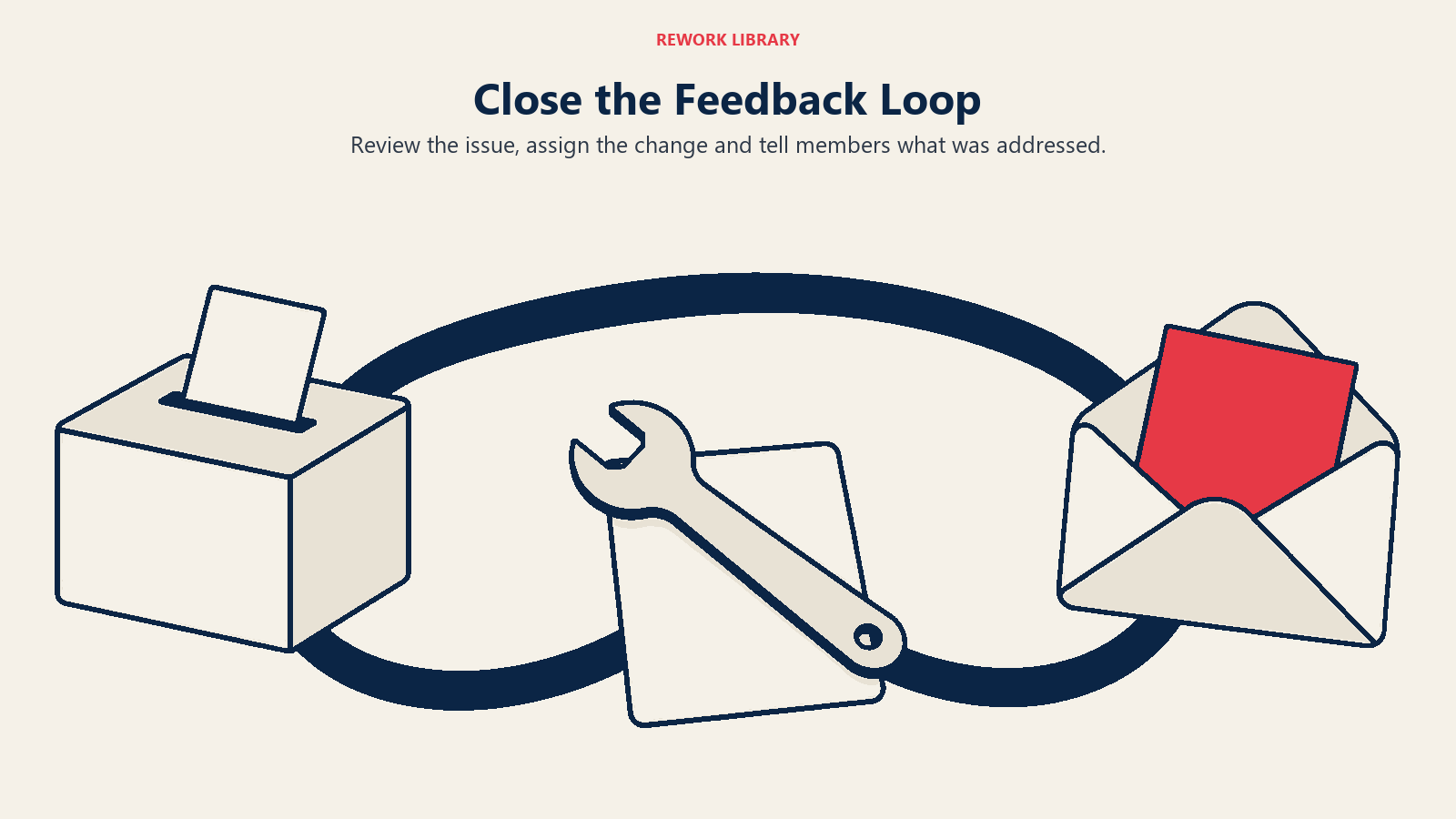
The feedback loop isn't closed until three things happen: the feedback is reviewed, the issue is addressed, and the member knows their feedback was heard. Most gyms do the first but not the third.
Building a feedback review cadence:
Weekly review (15 minutes): Pulse survey results, new post-class feedback, suggestion box submissions. Look for anything that needs a same-week response. Assign action items with owner and due date.
Monthly review (30 minutes): NPS score update and trend analysis. Exit interview summaries. Any patterns emerging across multiple feedback channels? What's one change to make this month based on feedback?
Quarterly review (60 minutes): Full NPS analysis, cohort comparison, year-over-year sentiment trends. Present to ownership with a summary of changes made in response to feedback and their measured outcomes.
Triaging issues by severity and frequency:
Not all feedback requires the same response. A framework:
| Severity | Frequency | Response |
|---|---|---|
| High | High (5+ mentions) | Immediate operational change, communicate to all members |
| High | Low (1-2 mentions) | Investigate individually, respond to member directly |
| Low | High (5+ mentions) | Schedule improvement, communicate timeline to members |
| Low | Low (1-2 mentions) | Log and monitor for recurrence |
Communicating changes back to members:
This is where most feedback systems fail. Members submit feedback, nothing visibly changes, and they conclude that the survey was performative. Close the loop explicitly: a monthly "You asked, we listened" post in your community channel or a brief announcement at the start of classes ("We got feedback that the Saturday schedule was too crowded, so we're adding a 9am class starting next month") converts feedback contributors into advocates. Publishing these updates through your community building channels gives them maximum visibility and reinforces the culture of transparency.
Members who see their feedback result in visible change are 2.5x more likely to remain members. That's not just a retention number. It's proof that the loop is working.
Measuring Feedback ROI
Feedback programs should be accountable to the same business outcomes as any other retention investment.
Correlating NPS with retention: Run a quarterly analysis matching NPS score from 90 days prior to current-period retention rates for the same member cohort. In most gyms, a 10-point NPS improvement correlates with a 5-8% improvement in 6-month retention. This gives you a dollar value to put on feedback program investment. For further context on using NPS effectively without over-relying on it, HBR's Net Promoter 3.0 framework is worth reading, it covers how to pair NPS with earned growth metrics to get a complete picture of member loyalty.
Tracking member sentiment over time: Build a simple sentiment dashboard that plots monthly NPS scores, top positive feedback themes, and top negative feedback themes. Present alongside your engagement tracking metrics and MRR in your monthly ownership report.
Connecting feedback to staff performance: Include member feedback scores in instructor and front-desk staff performance reviews. Not as a punitive tool, but as a development input. An instructor who consistently receives high post-class ratings in Q1 but sees declining ratings in Q3 needs a conversation, not a warning. This aligns with the performance review framework in instructor hiring and retention, where member satisfaction scores feed directly into development planning.
The Feedback Flywheel
Here's what a mature feedback program looks like in practice: members submit feedback regularly because they trust it leads to changes. Changes get made and communicated. Members notice and submit more feedback. Staff take pride in acting on it. The cycle becomes self-reinforcing.
Reaching this state requires 6-12 months of consistent execution: asking for feedback, acting on it, and communicating the results, every month without exception. It's not complex. But it requires discipline that most gym operators underestimate.
Pair your feedback program with a structured churn reduction framework and new member onboarding that builds the relationship before the feedback request arrives. Members who feel known and valued give more honest feedback and are more likely to flag concerns before they cancel.
For members who have already cancelled, the win-back campaign playbook includes how to use exit interview data to personalize re-engagement messaging. And for the community context that makes feedback feel safe to give, see community building in fitness studios.
The gyms that grow consistently aren't the ones that avoid getting feedback about their problems. They're the ones that hear about problems first and fix them fast.
Learn More

Senior Operations & Growth Strategist