Gym Management Software Guide: Platform Comparison & Selection Framework - 2025
Turn this article into takeaways for your work.


Each assistant summarizes the article only for you and suggests best practices for your work.
The right gym management platform is the operational spine of a modern fitness business. It handles the billing that keeps cash flow predictable, the scheduling that drives class attendance, the access control that manages who's actually in your facility, and the reporting that tells you whether the business is healthy before the problems become crises. Statista's digital fitness market forecast projects the global digital fitness and well-being sector to reach $65 billion in 2025, with gym management software platforms sitting at the core of how fitness businesses operationalize that digital infrastructure. Done well, it runs quietly in the background while your team focuses on members.
The wrong platform is a different experience. Manual workarounds for things the system should handle automatically. Billing errors that require staff time to resolve and create member friction. Reporting that requires exporting to spreadsheets before it's usable. And a staff that spends more time managing the software than using it. These aren't hypothetical problems - they're the day-to-day reality at gyms that chose their platform based on initial price rather than total operational fit.
Software selection for a gym is a 3-5 year commitment in most cases. The switching costs - data migration, staff retraining, member communication, potential billing disruptions during transition - make a poor selection genuinely painful to undo. That switching cost is exactly why investing significant evaluation time upfront is justified, even when the initial pricing differences between platforms seem minor. Your platform choice also directly affects your ability to track the key gym metrics that predict business health.
Key Facts: Gym Software Market
- 67% of gym operators who switch platforms report that they underestimated migration complexity (Club Industry Tech Survey, 2024)
- Gyms using integrated management platforms (billing + scheduling + access control in one system) average 18% lower administrative overhead vs those using separate point solutions
- Average migration timeline from old platform to full go-live on new platform: 8-14 weeks for gyms with 300+ active members
Essential Features vs Nice-to-Have
Not every feature on a platform demo is a feature you'll use. The evaluation trap is getting impressed by capabilities you won't implement in the first two years and missing limitations in the core functions you'll use every day.
Core requirements - non-negotiable for any gym above 100 members:
Membership management: the ability to create, modify, freeze, and cancel memberships with clear status tracking. Payment processing: automated recurring billing with clear failure handling, retry logic, and dunning communication (automated emails to members with failed payments). Class scheduling: a calendar interface that members can access from a web browser and ideally a mobile app, with the ability to book, cancel, and waitlist. Access control integration: the ability to connect door readers, turnstile systems, or front desk check-in workflows so access is contingent on active membership status. Basic reporting: at minimum, active member count, monthly revenue, check-in volume, and class attendance.
Secondary features - important for most gyms but not day-one requirements:
Mobile app (branded or white-label) for member booking and account management. Marketing automation: automated email sequences for new members, win-back campaigns for lapsed members, birthday messages. Advanced reporting dashboards with churn rate, LTV, and revenue trend data. Personal training management: package sales, session booking, and trainer-specific scheduling. Waitlist management with automated promotion when spots open. For gyms building out member app engagement programs, native mobile functionality is a core requirement rather than a nice-to-have.
Advanced features - relevant for larger gyms and multi-location operations:
Multi-location support: the ability to manage multiple facilities from a single account with location-specific reporting. Inventory management for retail or supplement sales. Payroll integration for staff hour tracking. Custom API access for building your own integrations or connecting to proprietary systems. Corporate membership management for employer-sponsored programs.
The evaluation principle: Identify which tier each feature request falls into before your demo sessions. Ask specifically about the core requirements - how the platform handles billing failures, what the access control integration options are, how reporting is structured. Platform sales teams will naturally lead with impressive advanced features. Your job is to evaluate the unsexy core functions that you'll rely on daily.
Platform Comparison: Leading Options in 2025
Mindbody is the largest platform by market share in the boutique fitness space. Strengths: extensive integration ecosystem (connects with almost every major marketing, accounting, and access control system), large user community (plenty of third-party consultants and resources), and strong class-based scheduling. Weaknesses: interface that many staff find dated and unintuitive, pricing that escalates significantly with member count, and customer support that struggles with response time at the support tier most independent gyms can afford. Best fit: boutique studios and gyms with heavy class-based programming who need broad integration capability. Pricing: $130-$500+/month depending on member count and feature tier.
GloFox positions as the modern alternative to Mindbody, with a cleaner interface and a reputation for better customer support. Strengths: user-friendly interface that reduces staff training time, solid mobile app, and proactive onboarding support. Weaknesses: integration ecosystem smaller than Mindbody, reporting less sophisticated for advanced analytics needs, and multi-location functionality less mature. Best fit: boutique studios and growing independent gyms that prioritize ease of use and support quality. Pricing: $110-$300/month flat, not per-member.
ClubReady targets mid-to-large commercial gyms and multi-location operators. Strengths: reliable billing and collections features, strong multi-location management, and sophisticated member journey automation. Weaknesses: higher learning curve, minimum contract terms, and implementation costs that make it less accessible for smaller gyms. Best fit: gyms with 500+ members, franchise models, and multi-location operations needing centralized control. Pricing: custom, typically $400-$1,200+/month.
ABC Fitness Solutions (formerly ABC Financial) is one of the oldest platforms in commercial fitness, with particular strength in billing and payment processing reliability. Strengths: proven billing engine, strong large-gym references, and reliable access control integrations. Weaknesses: interface is dated, mobile app lags competitors, and smaller gyms often find the platform over-engineered for their needs. Best fit: large commercial gyms (1,000+ members) where billing reliability and access control robustness are the primary requirements. Pricing: custom enterprise pricing.
Zen Planner serves a niche particularly well: CrossFit affiliates and martial arts gyms with complex programming and athlete-management needs. Strengths: athlete management features, workout tracking integration, and a pricing model that's accessible for smaller gyms. Weaknesses: less polished consumer-facing interface, limited marketing automation. Best fit: CrossFit boxes, martial arts gyms, and other community-focused fitness operations. Pricing: $117-$348/month. Gyms running CrossFit or HIIT specialty programs should weight Zen Planner's athlete management features more heavily in their evaluation.
The IBISWorld gym industry analysis notes that technology adoption, including integrated management platforms, is increasingly cited as a factor separating high-margin club operators from those with thin operating margins, as automation reduces administrative overhead.
Pricing model comparison: Per-member pricing (Mindbody-style) costs more as you grow but keeps initial costs low. Flat monthly pricing (GloFox-style) is more predictable and becomes cost-advantageous above certain member thresholds. Revenue share models (some newer platforms take 1-2% of processed revenue) align vendor incentives with gym growth but can become expensive at scale. Calculate your projected monthly cost at your current size, at 1.5x your current size, and at 2x - the platform that's cheapest today may not be the cheapest in two years.
Integration Requirements
A gym management platform that doesn't talk to your other systems creates manual data transfer work that staff will eventually stop doing - and the data quality problems that follow.
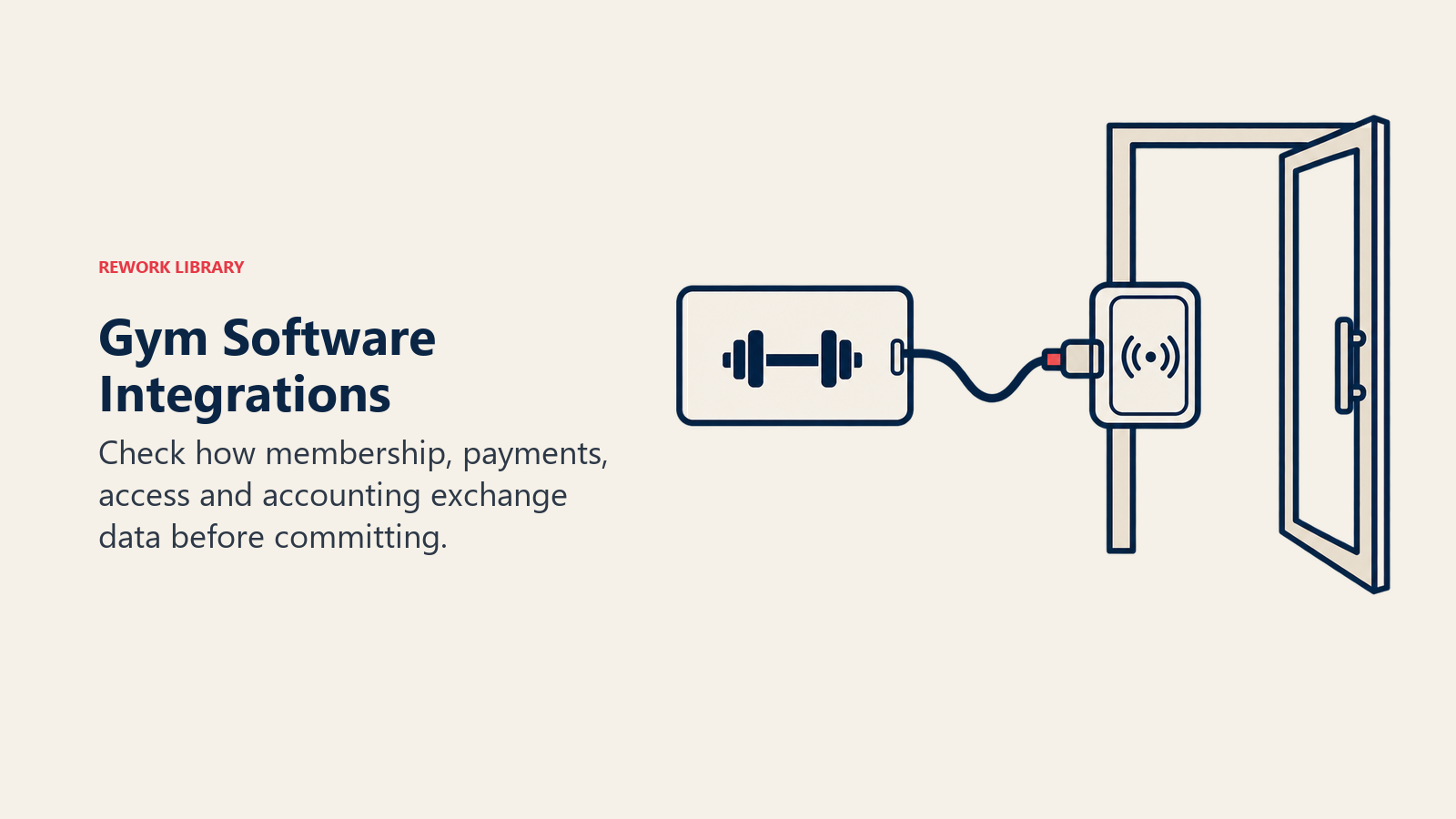
Payment processor compatibility is the most critical integration. Some platforms require you to use their proprietary payment processing (at rates that may be higher than your current processor). Others integrate with Stripe, Square, or major payment processors at competitive rates. Know what rates you're paying and what the platform's payment processing options are before committing.
Access control system integration determines whether your platform-based membership data automatically controls physical access. The IHRSA research on technology-driven retention makes a direct link between integrated digital systems, particularly check-in tracking and member engagement data, and measurable improvements in member retention rates. A member whose membership lapses should automatically lose key fob access without manual staff intervention. Platforms vary significantly in their native access control integrations - some work seamlessly with Salto, Brivo, or ButterflyMX; others require middleware. If you're installing new access control, choose a system that your platform natively supports. This integration also provides the check-in timestamp data you need for peak hour analysis and demand planning.
Marketing tool connections: Email marketing (Mailchimp, Klaviyo, ActiveCampaign) and SMS tools should receive member data automatically without manual CSV exports. Look for native integrations or Zapier compatibility as minimum standards.
Accounting software sync: QuickBooks Online integration is table stakes for any platform serving independent gyms. Verify that the sync covers revenue, refunds, and member payment status - not just top-line revenue totals.
API availability: If you have any proprietary systems, custom reporting needs, or specific integration requirements not covered by native connections, API access becomes essential. Ask specifically whether API access is included in your plan tier or requires an enterprise upgrade.
Migration Planning
Platform migration is where most gym software projects go wrong, not in the selection phase. Migrations fail because of underestimated complexity, rushed timelines, and inadequate testing before the cutover.
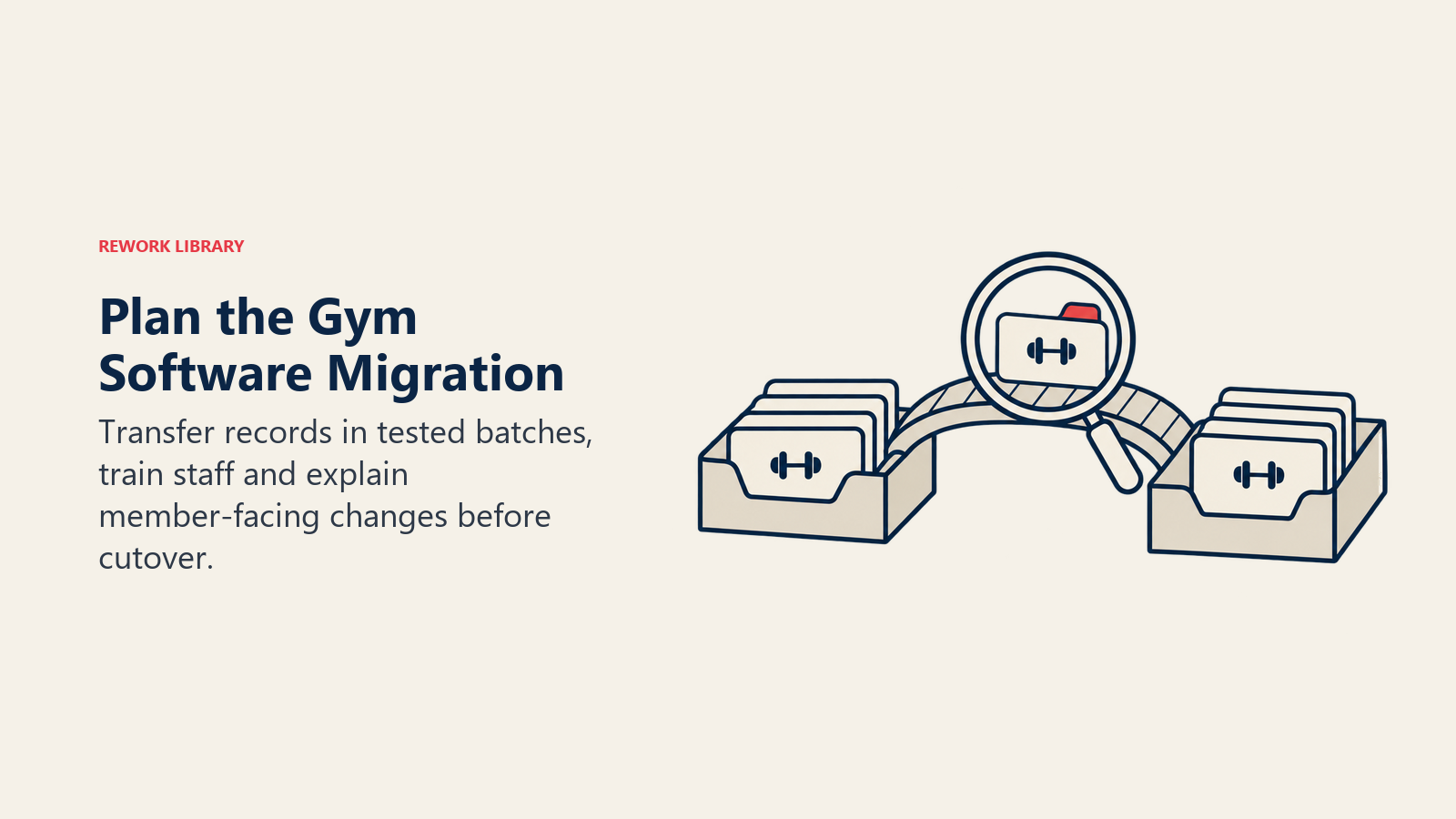
Data migration checklist: Active member records (membership tier, billing information, payment method on file), historical member data (former members you may want to re-engage), class attendance history (needed for instructor performance and format planning), outstanding packages and prepaid sessions that must transfer, billing schedules and draft dates, and access control credentials.
Parallel running period: Before cutting over fully to the new platform, run both systems simultaneously for 2-4 weeks. New sign-ups go into the new system; existing members run in the old system until manually migrated in batches. This catches data migration errors before they affect billing and access. Parallel running is the most important risk-reduction step in migration and the most commonly skipped.
Staff training requirements: Every staff member who touches the platform needs hands-on training before go-live, not just a demonstration. Build a training plan that includes: basic member management (checking status, processing payments, handling freezes), class scheduling and booking management, and report access for the metrics their role requires. Plan for 4-8 hours of training per front desk staff member, not 30 minutes. Integrating software training into your overall staff onboarding process ensures it's treated as a core competency, not an afterthought.
Communicating changes to members: Members don't care about your platform migration - they care whether their billing works and whether they can book classes. Communication should focus on member-facing changes: new app to download, new login credentials, any changed booking interfaces. Send communication 3-4 weeks before go-live, again at 1 week, and have staff ready for increased inbound questions during the first two weeks post-migration.
Timeline expectations: For gyms with under 200 members and simple data migration, 4-6 weeks from contract signing to full go-live is achievable. For gyms with 300-500+ members, complex billing histories, or legacy data challenges, plan for 10-14 weeks. Rushing the timeline is the most reliable predictor of post-migration billing errors.
The gym operators who handle software selection and migration well share one trait: they treat it as the significant operational project it actually is, with a project owner, a timeline, clear milestones, and testing protocols before cutover. The ones who struggle treat it as a software purchase - sign the contract, get the login, and figure it out as they go. For gyms evaluating software as part of a broader technology upgrade, consider how wearable device and fitness tracker integration will factor into your member experience requirements.
Learn More

Senior Operations & Growth Strategist