Member App Engagement Strategies: Driving Retention Through Digital Touchpoints
Turn this article into takeaways for your work.


Each assistant summarizes the article only for you and suggests best practices for your work.
A member app that gets deleted within 30 days is a sunk cost. An app that becomes part of a member's weekly fitness routine is one of the most powerful retention tools available - the digital equivalent of having a personal trainer check in every day. The difference between those two outcomes isn't the app itself. It's how deliberately you design the engagement mechanics around it.
Most gyms treat their member app as a booking tool. That's a waste. When built around retention behavior, an app creates daily touchpoints with members whether they're in your facility or not. It tracks progress, celebrates milestones, connects community, and reminds members why they pay you every month. The gym with the best app retention doesn't necessarily have the best facility - but it wins on churn. Understanding your key gym metrics like MRR and member LTV is the foundation for measuring whether those digital touchpoints are translating into real revenue.
The data supports this. Fitness apps with DAU/MAU ratios (daily active users divided by monthly active users) above 20% show meaningfully higher gym visit frequency than those below 10%. Members who log workouts in-app visit 23% more often than those who don't. These aren't coincidences - they're the behavioral outcomes of good engagement design. IHRSA research confirms that technology-driven engagement keeps members coming back more frequently and drives deeper brand connection with the club.
Key Facts: Member App Engagement
- Fitness apps with DAU/MAU ratios above 20% correlate with gym visit frequency increases of 15-25% (Gympass research, 2024)
- Members who use a gym app for class booking churn at rates 30% lower than those who book at the front desk (ABC Fitness data, 2024)
- Push notification opt-out rates average 40% industry-wide when notifications exceed 3 per week (Braze mobile engagement report, 2024)
- Gamification features increase app session length by an average of 22% across fitness platforms (Appsflyer, 2024)
Feature Priority by Retention Impact
Not all app features are equal. Some directly drive retention; others are nice-to-have additions that cost development time without moving the needle. Here's how to think about sequencing.
Class booking is the highest-retention feature you can build. When members book through the app rather than calling the front desk or walking in, you capture intent. You can send reminders. You enforce cancellation policies automatically. You reduce no-shows. You track attendance patterns that tell you who's at churn risk before they cancel. Pairing this booking data with a structured new member onboarding process dramatically improves the odds that first-timers become regulars.
Get booking right before anything else. That means one-tap rebooking for recurring classes, saved preferences so a member's favorite Monday 6am slot is easy to re-reserve, and real-time availability so members don't book only to find class is full. Waitlist functionality with push notification alerts when spots open is a direct retention mechanism - it creates urgency and habit.
Workout logging and progress tracking are the next tier of retention impact. Members who log workouts in your app are investing in a relationship with your platform, not just your facility. Every logged session is a data point that makes leaving harder - their history lives in your ecosystem. For strength-focused members, logging personal records and tracking weight progression over months creates genuine attachment. This data also feeds directly into member engagement tracking and metrics, giving you early warning when a member's activity starts to drop off.
Community features matter more at the boutique level than the large-box level, but they matter everywhere. In-app messaging between members, a community feed showing who attended what class, instructor updates and programming notes - these extend the social value of membership beyond the physical visit. And social connection is one of the top three retention drivers in fitness.
Nutrition logging and live on-demand content are valuable but secondary. Don't build a nutrition tracker when your booking flow still has friction. Sequence features by their retention impact, not by how impressive they look in marketing materials.
Push Notification Strategy
Push notifications are your most direct line to a member's attention - and the easiest way to lose it. The average gym member who allows notifications tolerates about two per week before they start tuning them out or disabling them entirely.
The 40% industry-average opt-out rate for over-communication isn't an accident. It's what happens when gyms treat push notifications as a broadcast channel rather than a behavior change tool. Every notification you send should have a clear behavioral purpose. IHRSA notes that new member emails alone carry a 59% open rate compared to 15% for generic communications - the same personalization logic applies to push notifications.
Booking reminders are the highest-value notification type. A "your class starts in 2 hours" reminder reduces no-shows by 15-25% depending on class type and membership tier. These get clicked because they're relevant and timely - the member already has intent; you're just reducing friction.
Class availability alerts for waitlisted members have near-perfect engagement. "A spot just opened in Tuesday's HIIT class - tap to claim" is as close to guaranteed-click as push notifications get. Build urgency with a countdown (spots claimed within 15 minutes on average), and you've got a notification members appreciate rather than resent.
Milestone celebrations are underused. When a member hits 50 visits, completes a 30-day streak, or logs their first 100kg deadlift, a personal-feeling congratulation notification reinforces their progress and your role in it. These notifications have open rates above 60% in well-designed fitness apps.
Re-engagement notifications are for members who've gone silent. "We haven't seen you in 12 days - your Thursday class is almost full, book your spot" combines guilt and urgency without being manipulative. Set these to trigger automatically based on absence thresholds, not manual staff review. For members who have truly gone dark, automated notifications are the first line of defense, but a full member win-back campaign covers the members who don't respond to digital prompts alone.
Personalization matters more than volume. A notification that references the specific class a member attends, their streak count, or their progress toward a goal performs 3-4x better than generic broadcast messages. Start with basic behavioral segmentation - attendance frequency, class type preference, time of day patterns - and refine from there.
A/B test notification copy on timing and language. "Your class is tomorrow" vs "Don't lose your streak - class tomorrow at 7am" will produce different results for different member segments. Test one variable at a time and measure click-through rate and downstream attendance.
Class Booking Optimization
Booking friction is churn risk. Every extra tap between "I want to go to Thursday's class" and "confirmed" is a moment where a member might decide not to bother. Your booking flow should be fast enough that it's easier to book than not to.
One-tap booking for recurring class preferences is the gold standard. If a member attends the same yoga class every Tuesday morning, they should be able to enable auto-booking with a single notification confirmation. Some gyms have reduced no-shows by 35% simply by introducing this feature for their most regular attendees.
Cancellation policy enforcement through the app serves multiple purposes. It protects your class capacity (catching members who'd otherwise ghost), it trains members to commit to bookings they intend to keep, and it funds itself through late cancellation fees. A $10 late cancellation fee applied consistently generates revenue while changing behavior. But it only works if the policy is enforced automatically through the app - manual enforcement creates inconsistency and staff awkwardness.
Waitlist mechanics create urgency that's good for both the member and the facility. A well-designed waitlist shows members their position, estimates their probability of getting in based on historical patterns, and alerts them immediately when a spot opens. This keeps members engaged with your schedule even when their preferred class is full - and often converts a frustrated "class full" moment into a booking.
Gamification and Progress Tracking
Gamification in fitness apps works because fitness is inherently measurable, and humans respond to visible progress and social comparison. The key is designing mechanics that motivate without alienating members who aren't competitive by nature.
Streak mechanics are the most powerful retention tool in mobile fitness. A member on a 45-day check-in streak thinks twice before canceling - not because of the financial cost, but because of the psychological cost of breaking the streak. Design streak mechanics around visit frequency rather than daily activity (a "visited 3x this week" streak is more sustainable than a "visited every day" streak for most gym members).
Milestone badges at meaningful checkpoints (first class, 10th visit, 3-month membership, 100 workouts) create shared language and celebration moments. Display these on member profiles and in community feeds where they can be acknowledged by others. The social dimension is what makes badges meaningful rather than just a counter. If your gym integrates with wearable devices, these milestones can also pull in heart rate and effort data - see the wearable integration for gyms guide for how leaderboard design intersects with device ecosystems.
Leaderboards require careful design. An effort-based leaderboard - ranking members by heart rate zones achieved or workout points earned based on relative effort - is far more inclusive than a performance-based leaderboard that only rewards the fittest members. Opt-in design is non-negotiable; forced leaderboard visibility will cause some members to disengage entirely. But for members who opt in, competitive mechanics can increase class attendance frequency by 15-20%.
Progress tracking features - body weight trends, strength progression charts, cardio improvement metrics - create the most durable attachment to your app because they accumulate value over time. A member who has 18 months of strength progression logged in your app is not switching gyms lightly. That history is a retention asset.
Sharing mechanics let members post workout summaries, milestone achievements, or class completions to social media. This serves double duty as member satisfaction signal and organic marketing. Design sharing templates that look good natively on Instagram Stories and TikTok - your members doing the work for you. A deliberate social media content strategy for fitness studios amplifies this further by creating a consistent brand backdrop that makes member-generated content more recognizable.
App Adoption as an Onboarding Priority
App engagement doesn't happen automatically. It requires deliberate onboarding steps that turn app download into app habit during the first 30 days - the highest-risk window for cancellation.
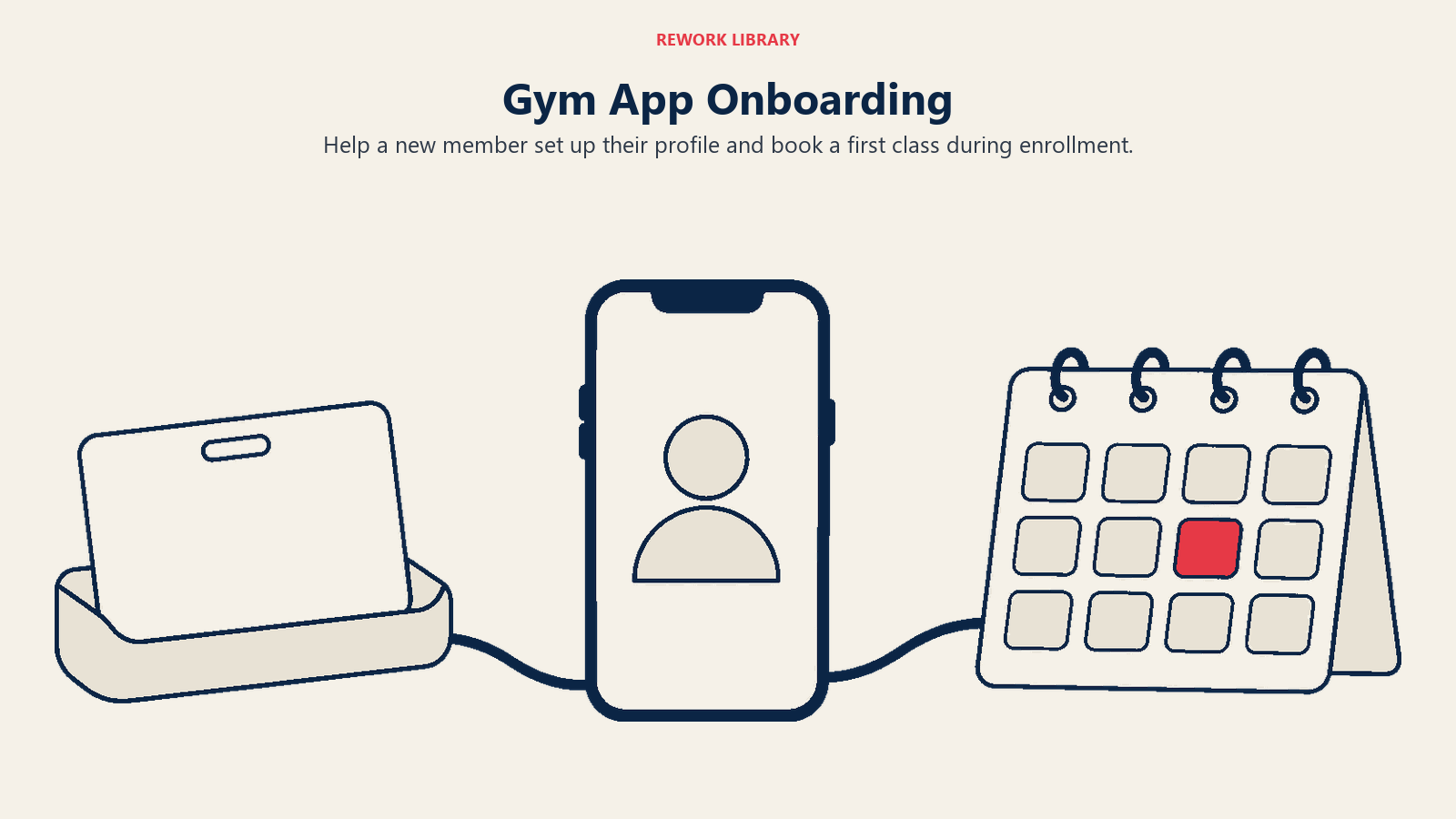
At sign-up, don't just mention the app - make app setup part of the membership enrollment process. Staff should walk new members through downloading, creating their profile, and booking their first class before they leave the facility. Better yet, integrate app setup into your digital onboarding flow so it happens before the member even visits. The gym management software you choose will determine how tightly your app experience integrates with check-ins, billing, and class booking from day one.
Set milestones for new member app behavior: first class booked in-app, first workout logged, first community connection made. Track completion rates for each milestone and use push notifications to prompt incomplete steps. The members who complete all three within 14 days show dramatically lower 90-day churn rates than those who don't engage with the app at all.
Measure app engagement the same way you measure attendance and revenue. DAU/MAU ratio, push notification opt-in rate, booking completion rate, feature adoption by cohort - these metrics tell you whether your app is functioning as a retention tool or just as an icon on members' phones.
The App as a Retention Investment
App engagement is a proxy for gym engagement. Members who use the app consistently visit more often, cancel less, and refer more frequently. The correlation is strong enough that app engagement metrics belong on your weekly operations dashboard alongside attendance and MRR. McKinsey's analysis of fitness consumers confirms that digital engagement and personalization are now among the top factors driving consumer loyalty in wellness - gyms that build this into their app experience gain a structural retention advantage. Pairing app data with a systematic approach to reducing gym member churn gives you both the early warning signals and the playbooks to act on them.
The financial case is straightforward. If improving app engagement from 15% to 25% DAU/MAU reduces monthly churn by 1 percentage point, and your average member LTV is $800, the value per 100 members is $800 in preserved revenue every month. That math justifies significant investment in notification strategy, feature development, and onboarding optimization.
But the non-financial case is equally important: a great app makes your gym feel like a community, not just a facility. Members who feel connected to your brand through digital touchpoints are harder to poach by a competitor offering a lower price or shinier equipment. The app is where that connection gets built between visits. Many gyms extend that connection further by offering virtual and hybrid fitness classes through the same app, creating a digital membership layer that keeps members engaged even when they can't come in person.
Learn More