Peak Hour Management & Capacity Planning for Gyms - 2025 Guide
Turn this article into takeaways for your work.


Each assistant summarizes the article only for you and suggests best practices for your work.
Peak hour management is the operational practice of distributing gym demand across the day so crowded windows feel less congested without adding floor space. Most gyms have excess capacity for roughly 60% of operating hours, so the fix is shifting demand through pricing, programming, and check-in data, not expansion.
Overcrowding during peak hours is one of the top three reasons members cancel their gym memberships. IHRSA's member retention research consistently identifies facility experience, including crowding perception, as a primary driver of cancellation decisions, alongside price sensitivity and lack of use. It shows up in surveys as "the gym is too crowded" or "I can never get the equipment I want," but those are symptoms. The real problem is that most gym operators have accepted peak congestion as an unavoidable fact of the fitness business rather than a solvable operational problem.
But here's what the data actually shows: most gyms have excess capacity for 60% of their operating hours. The 5:30-8am window, the 12-1pm lunch block, and the 5-7:30pm evening peak represent roughly 5-6 hours of high demand out of a 16-18 hour operating day. For the other 10-12 hours, equipment sits underutilized while members who attended during peak hours have already cancelled because of the crowding experience.
The opportunity isn't more space. It's better demand distribution. And the tools to accomplish it - pricing incentives, programming anchors, and data-driven scheduling - cost a fraction of what a facility expansion would require. Start by auditing whether the issue is truly capacity or a facility layout problem that's creating cluster zones in an otherwise adequate space.
Key Facts: Peak Hour Impact on Retention
- 41% of gym member cancellations cite "overcrowding at peak times" as a primary or contributing reason (IHRSA Consumer Report, 2024)
- Gyms with off-peak membership tiers report 23% higher overall utilization and 8% lower churn vs those without
- Average gym utilization during off-peak hours (9am-4pm weekdays) is 28% of peak hour capacity
Understanding Your Peak Pattern
Before you can manage peak demand, you need to understand it precisely. Most gym operators have a general sense of when they're busy, but "busy" is a perception. Managing peak hours requires data.
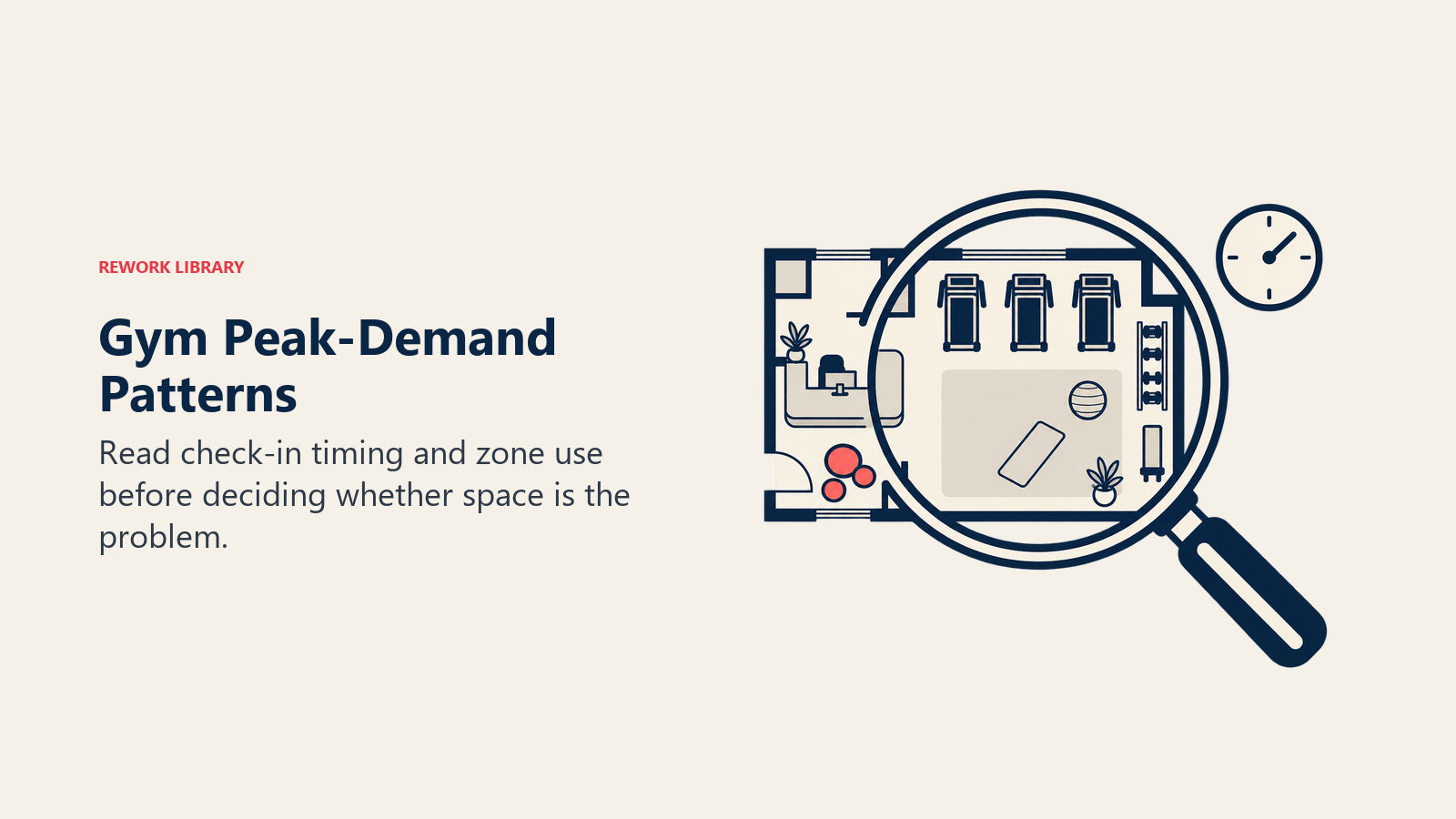
Access control data is your baseline tool. Every gym with electronic key fob or card access has check-in data by timestamp. Pull monthly access reports and sort by hour of day for each day of the week. Build a heat map: day of week across the top, hour of day down the side, with check-in volume in each cell. This typically takes 30 minutes in a spreadsheet and reveals patterns that are more nuanced than the general "mornings and evenings are busy" assumption most operators work from.
What you'll likely find: Tuesday through Thursday evenings are your highest-demand windows. Monday evenings are high but not peak (people over-commit to fitness goals on Mondays and follow through inconsistently). Saturday mornings are high but compressed into a shorter window. Sunday is often your lowest-demand day, and the midday period on weekdays is consistently underutilized across most gym types. Your gym management software's reporting tools should surface this data automatically without requiring manual spreadsheet work.
Distinguishing true peaks from perceived peaks. Your data may show that your highest check-in hour has 78 members while your facility comfortably handles 100. The crowding perception isn't from headcount - it's from clustering. Members congregate in the free weight area, the most popular cardio equipment, and the zone nearest the entrance. Other areas of the gym sit at 30% utilization simultaneously. This is a flow problem, not a capacity problem, and it has different solutions.
Seasonal peak shifts need advance planning. January produces check-in volumes 40-60% above December baseline at most gyms. Statista's U.S. gym membership data documents the long-term trend of membership growth that underlies peak hour pressure, more members in the same physical space means the operational systems that worked at lower membership counts need revisiting as the gym grows. This spike is predictable, which means staffing adjustments, equipment sanitization protocols, and floor management procedures should be documented and ready before January 1st rather than improvised when the rush arrives. Post-summer return peaks (September) and pre-summer motivation peaks (April-May) are secondary but worth planning for. January surges also create an opportunity for new member onboarding systems that convert seasonal joiners into long-term members.
Off-Peak Incentives: Shifting Demand Through Pricing and Programming
The most cost-effective capacity management strategy is reducing peak demand rather than expanding peak capacity.
Off-peak membership tiers price-differentiate access by time window. A gym charging $50/month for standard access might offer an off-peak membership (access only from 9am-4pm on weekdays and after 8pm evenings) at $30-$35/month. This tier serves a specific population: stay-at-home parents, retirees, shift workers, remote professionals, and students - all of whom can be flexible about timing in exchange for a price break.
The arithmetic is favorable: a member paying $35/month who attends during off-peak hours contributes $35 toward fixed costs with zero additional stress on peak capacity. Compared to the alternative (not attracting them at all, or worse, having them join and cancel because of peak crowding), off-peak pricing creates a genuine win for both parties.
Programming anchors at off-peak times create behavioral habits that reduce peak demand. A popular instructor's 10am Tuesday class builds a loyal attendee base that has a reason to be at the gym at 10am rather than 6pm. Senior fitness classes at 9am and 10am serve a demographic that's both retention-valuable and naturally flexible with timing. Corporate wellness programming at 12pm pulls office workers out of the evening peak. Building off-peak class quality requires the same attention to group fitness programming trends that drives evening class attendance.
The key is that the off-peak programming has to be genuinely good, not a dumping ground for less popular instructors and less-desired formats. Members who are being asked to shift their schedule are making a real accommodation - they deserve a quality experience in exchange.
Communicating off-peak value without devaluing peak access. The messaging risk with off-peak pricing is inadvertently signaling that peak access is only for members paying the premium price. Frame off-peak tiers as a value option for members who have scheduling flexibility, not as a lesser tier. "Our off-peak members get a quieter, less crowded workout experience - it's a better workout for many people who prefer that environment" is more effective than "come during off-peak to avoid the crowds," which implies peak hours are a negative.
Capacity Tracking & Limits
Member-to-equipment ratios by zone establish what "at capacity" actually means for different areas of your facility. Standard benchmarks: one treadmill per 25-35 active members is the traditional rule of thumb, but this varies significantly by member usage patterns (members who do 60-minute cardio sessions create more capacity pressure than those doing 20-minute finishers). Squat racks and power cages: one per 80-120 active members in strength-focused gyms, where demand for these specific pieces of equipment is the primary bottleneck during peak hours.
Maximum safe capacity calculations matter both operationally and legally. Many jurisdictions have occupancy limits for fitness facilities. Even where they don't, fire code occupancy limits apply. Know your legal maximum and build your operational maximum at 75-80% of that figure - this gives you buffer and ensures the experience stays positive before you hit the regulatory limit.
Reservation systems for high-demand equipment are increasingly standard in larger gyms. Squat rack reservations (15-minute slots, booked via gym app or front desk) prevent the frustrating experience of members camping equipment while others wait. Class-style reservation for popular cardio equipment (treadmill time slots during peak hours) may seem excessive, but at facilities where specific cardio equipment is consistently unavailable during peaks, it's a meaningful quality-of-life improvement.
Drop-in vs reservation for group fitness has direct capacity implications. Drop-in class models create unpredictable capacity utilization - a class that typically draws 12 might draw 20 during peak weeks, exceeding safe studio limits. Reservation-required models give you accurate capacity data and eliminate the experience of members arriving for a class they can't get into. The tradeoff is slightly reduced spontaneous attendance, which is typically worth the reliability gain. Your member app engagement strategy directly affects how reliably members use digital reservation tools rather than showing up unbooked.
Digital waitlist tools integrated with your gym management software serve two functions: managing demand for specific equipment or classes, and creating data on latent demand. A waitlist for a Tuesday 6pm cycling class that consistently has 8 people on it is telling you to add a second session. A waitlist for squat rack slots during the 5-6pm window tells you to either add capacity or implement a stronger rotation policy.
Staffing for Peak Hours
Peak hour staffing is often under-planned relative to the actual demand management role staff play during congested periods.
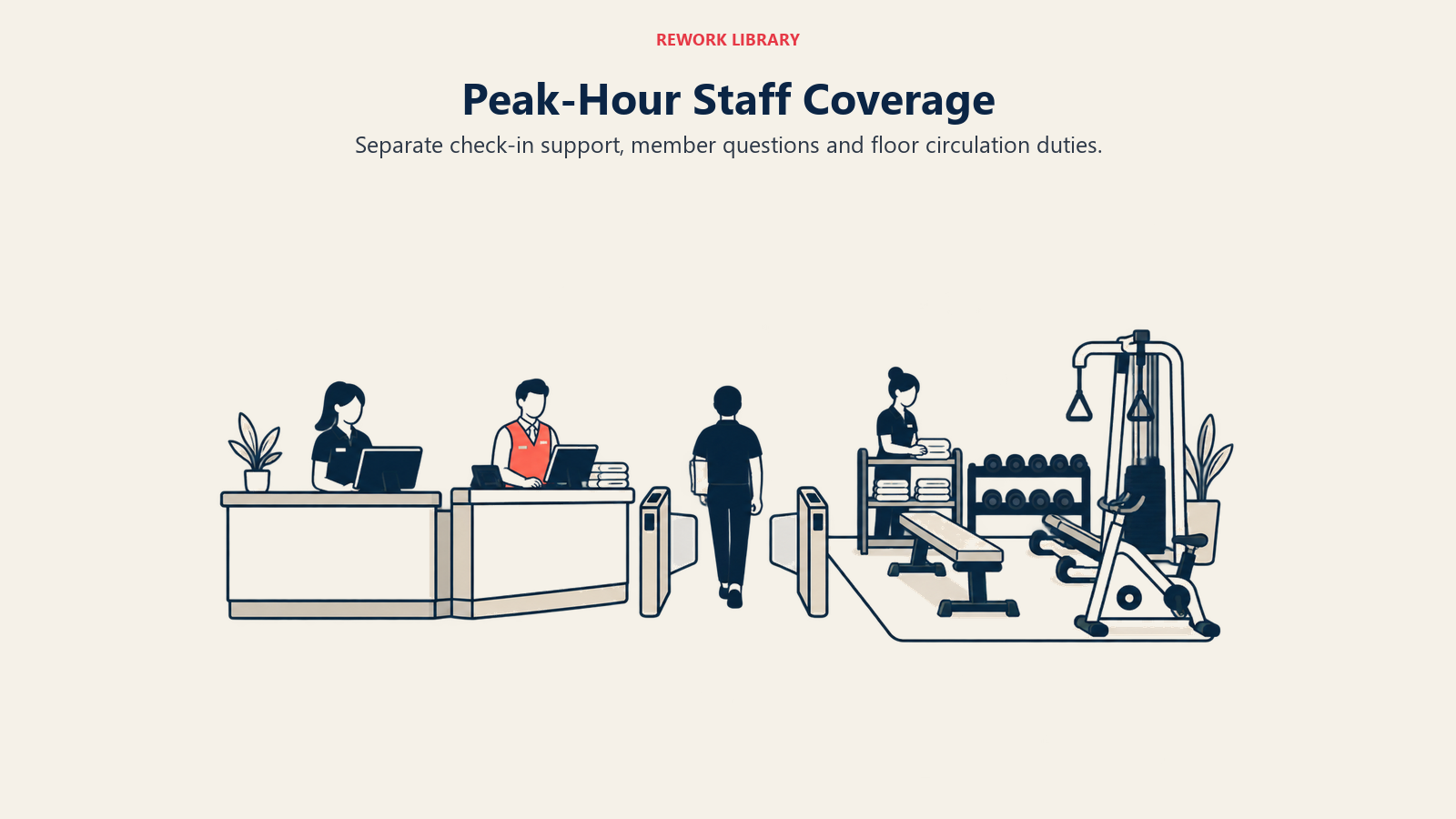
Minimum staff coverage during peak: A gym with 80-100 members in the facility during peak hours needs at minimum two front desk staff (one dedicated to check-in flow, one available for questions and conversations), two floor staff (one per primary zone during peak), and a manager or lead on duty with authority to handle any situation without escalation delay.
Floor staff roles during congested periods extend beyond equipment assistance. During peak hours, floor staff are crowd flow managers as much as fitness assistants. Watching for equipment clustering and directing members toward available alternatives. Maintaining cleaning cadence on high-touch surfaces without creating obstacles in traffic paths. Proactively greeting members who appear to be waiting or searching for equipment - that interaction either solves their problem or at least communicates that the gym cares about their experience. This proactive floor presence is one of the core behaviors covered in gym staff management training.
Front desk capacity for check-in bottlenecks. The check-in queue is a visible frustration multiplier. A member who waits 90 seconds to check in starts their workout already irritated. Two solutions reduce this: self-service check-in kiosks or app-based check-in that bypasses the desk entirely for standard members, and staffing two check-in positions simultaneously during the first 30 minutes of peak hour rushes rather than waiting until the line forms.
Equipment sanitization workflows at peak. Members notice when sanitizing wipe dispensers are empty and equipment surfaces aren't being cleaned. During peak hours, designate floor staff cleaning rotation explicitly: a circuit of high-touch surfaces every 20-30 minutes rather than reactive cleaning only. This visible cleanliness maintenance is a member satisfaction signal that's disproportionately important during crowded periods when members are watching each other more closely.
The IBISWorld gym industry analysis highlights that member experience quality, including facility congestion, is a core competitive differentiator as the U.S. fitness club market continues its recovery and expansion past $47 billion in annual revenue.
The most effective capacity management strategy combines real-time data, pricing incentives, and targeted programming to create a gym experience that feels uncrowded across more hours of the day - not just during the brief windows that happen naturally. That combination costs less than $5 per square foot to implement and generates returns in reduced churn that pay back the investment within 6-12 months at most gyms. Tracking churn improvements against these investments requires consistent member engagement and retention metrics that show whether the needle is actually moving.
Frequently Asked Questions about Peak Hour Management for Gyms
What are gym peak hours?
Most gyms see three demand spikes: the 5:30 to 8am morning block, the 12 to 1pm lunch window, and the 5 to 7:30pm evening peak. Tuesday through Thursday evenings are usually the single busiest window. That is roughly 5 to 6 high-demand hours inside a 16 to 18 hour operating day.
How do you reduce gym overcrowding without expanding the facility?
Shift demand instead of adding space. Off-peak membership tiers, off-peak class programming, and equipment reservation systems pull members into underused hours. These cost a fraction of a buildout and address the clustering that drives the crowding perception.
Is gym crowding a capacity problem or a flow problem?
Often it is flow, not capacity. A gym at 78 check-ins against a 100-person comfortable limit can still feel packed because members cluster in the free-weight area and the most popular cardio machines while other zones sit at 30% use. Fix the layout and rotation before adding equipment.
What is an off-peak membership tier?
It is a lower-priced plan that grants access only during low-demand windows, such as 9am to 4pm weekdays and after 8pm. A $30 to $35 tier against a $50 standard plan serves shift workers, retirees, parents, and remote staff who trade timing flexibility for a price break, without adding pressure to peak hours.
Learn More

Senior Operations & Growth Strategist