Facility Layout Optimization for Gyms: Traffic Flow, Zone Design & Expansion Planning - 2025 Guide
Turn this article into takeaways for your work.


Each assistant summarizes the article only for you and suggests best practices for your work.
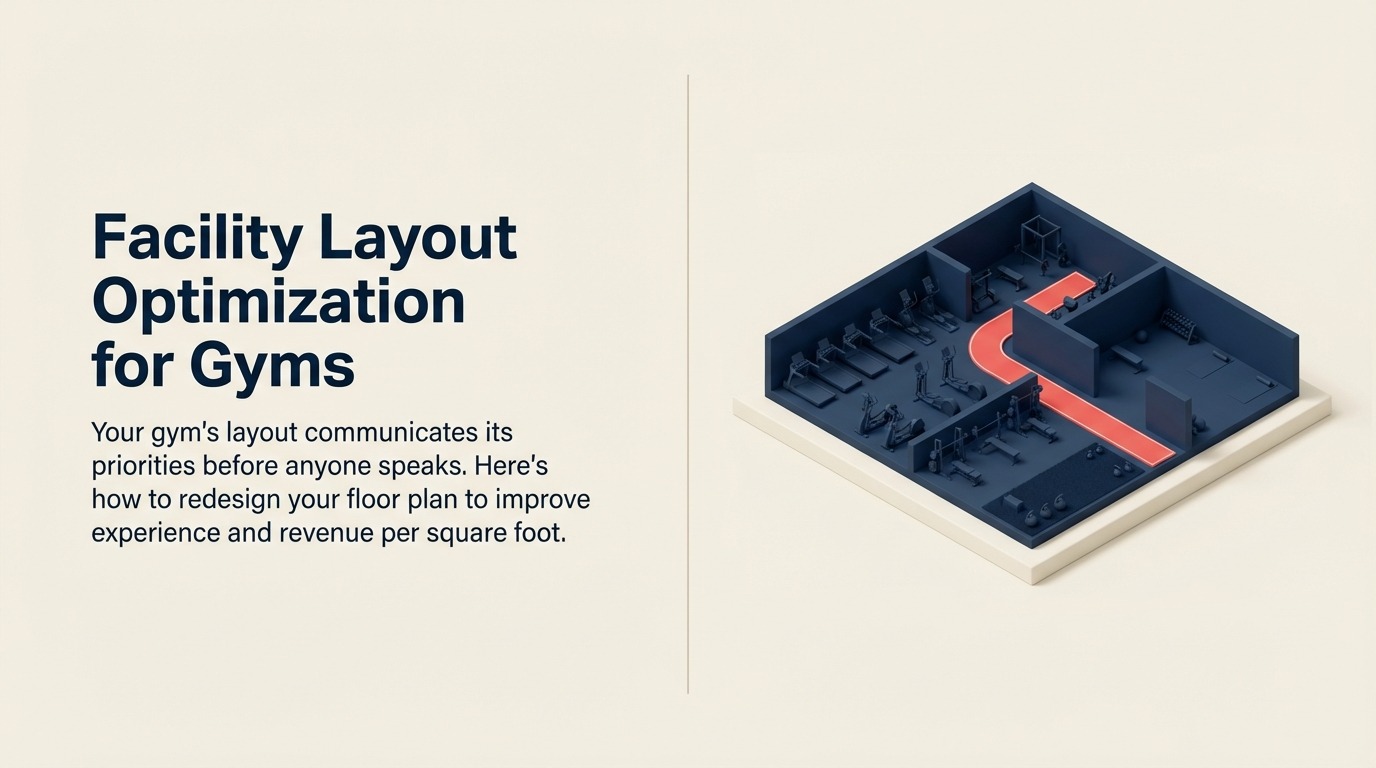
Gym layout optimization is the practice of arranging zones, equipment, and traffic paths so the same square footage drives more member satisfaction and revenue. Strong floor plans put high-value areas like personal training and group studios in plain sight, ease peak-hour flow, and lift revenue per square foot, all without adding a single new member. Below are the traffic-flow, zone-design, and expansion frameworks that make it work.
The layout of a gym communicates its priorities before a single word is spoken. A facility where the cardio machines face a wall of mirrors sends a different message than one where they face windows overlooking a city street. A strength zone where free weights and machines are crammed together without clear sightlines says something different than a deliberately zoned floor with logical progression and visual breathing room. Members form impressions in the first 30 seconds of entering a space, and those impressions influence whether they feel comfortable returning.
But layout isn't just about aesthetics. Poor traffic flow creates crowding frustration at peak hours that shows up in churn data months later. Misplaced zones reduce class visibility and personal training conversion. Revenue-generating areas (personal training zones, specialty studios, retail) placed in low-traffic locations underperform not because the service is poor but because the facility design doesn't drive foot traffic past them.
A well-designed floor plan is a revenue tool. And unlike marketing campaigns or new programming, a layout optimization is a one-time investment that produces ongoing returns. IHRSA's industry reporting documents how facility differentiation, including layout and zone design, has become a primary competitive factor as the market splits between budget and premium segments. It's also one of the most impactful steps you can take before launching any new specialty fitness program, since dedicated studio space is the foundation of a successful specialty offering.
Key Facts: Gym Layout & Revenue
- Gyms that redesign their floor plan to improve traffic flow report 12-18% increases in personal training conversion within 6 months (IHRSA Operations Report, 2024)
- Revenue per square foot at boutique studios averages $95-$140/sq ft annually vs $22-$45/sq ft at traditional gyms - primarily due to space utilization and zone design
- 68% of member complaints about peak hours relate to perceived crowding, not actual equipment unavailability
Traffic Flow Principles
Traffic flow design starts with the entrance, because every member path begins there.
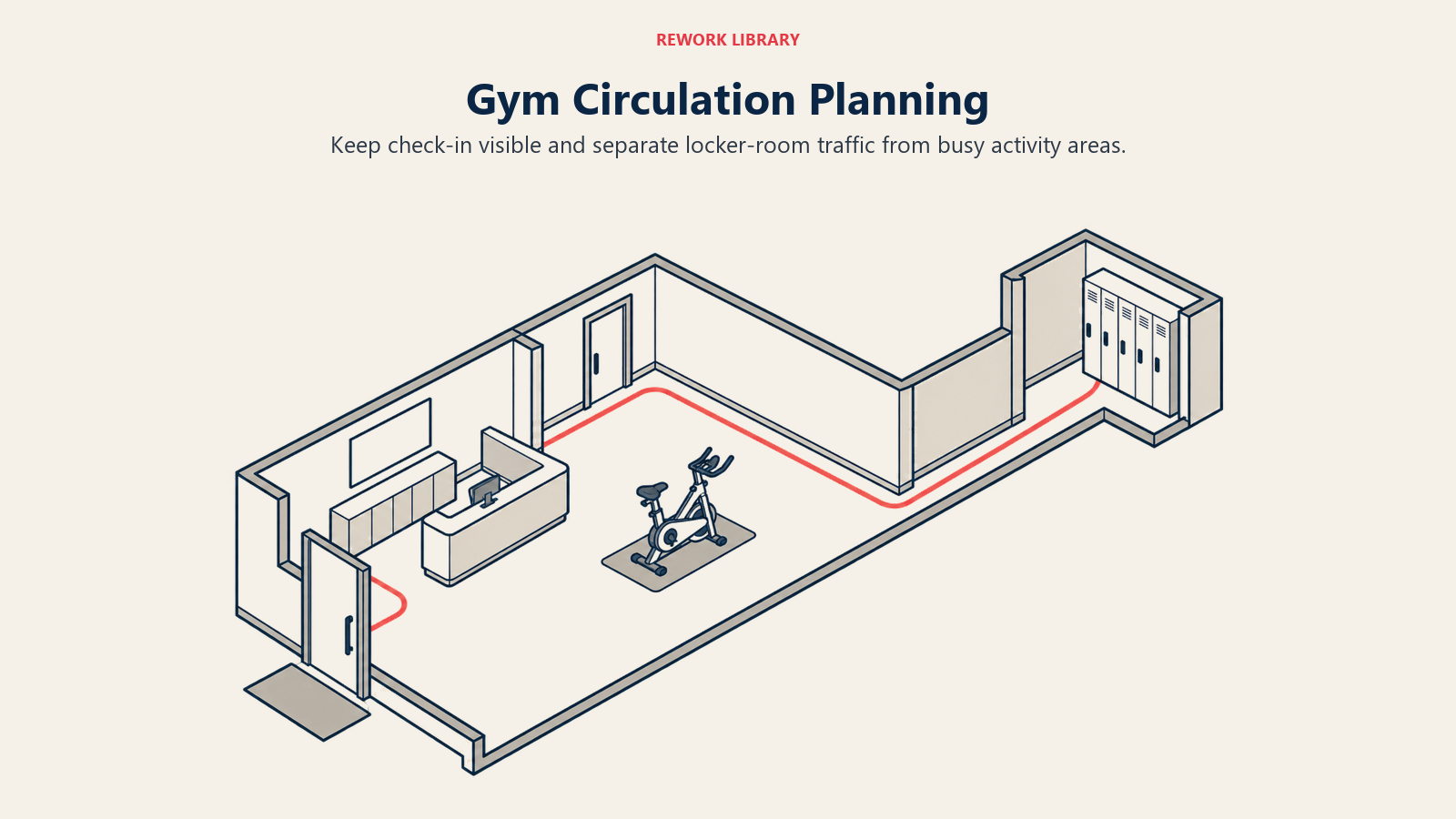
Entry and check-in zone design sets the first impression and determines queue behavior. The check-in desk should be visible immediately from the entrance - members who have to search for check-in are already frustrated. The zone between the entrance and the desk should be clear enough to handle simultaneous arrivals during peak check-in moments (5-8 members arriving within the same few minutes) without creating a bottleneck that blocks the entrance. A minimum 8-10 feet of clear space between the door and the check-in counter is the standard for gyms processing 100+ check-ins per peak hour.
Natural traffic paths from entrance to primary zones should require minimal wayfinding. Members should be able to see the cardio zone, the strength zone, and group fitness studio access from within 20 feet of the entrance. Gyms where the primary zones are visible and clearly differentiated from entry require no signage to direct members - the sight lines do the work. Gyms that require directional signs to navigate to basic areas have a floor plan that's working against them.
Sight lines to high-value areas are a design tool, not an afterthought. If your personal training zone is visible from the cardio area, members on treadmills watch PT sessions for 20-40 minutes and develop a subconscious familiarity with personal training before anyone has to sell them on it. If your group fitness studio has a glass wall visible from the main floor, members see full classes in session - the best possible social proof for class programming. Put revenue-generating activities where members who haven't bought them yet will see them. This visibility also reinforces personal training upsell conversions by normalizing PT activity as part of the everyday gym experience.
Locker room placement has a disproportionate impact on floor circulation. Locker rooms placed in a location that requires members to walk through the main floor create cross-traffic that congests the most active zones during peak hours. Locker rooms positioned with their own access corridor or placed at the periphery of the facility reduce the constant back-and-forth traffic that contributes to peak hour congestion perception.
Zone Design: Principles and Tradeoffs
Dedicated zones vs open floor plans is the first design decision with significant downstream implications. This choice also shapes how you handle equipment lifecycle and replacement planning, since zone-specific flooring types constrain future equipment decisions.
Open floor plans give maximum flexibility for reconfiguring the gym as programming evolves. They work well for small gyms (under 5,000 sq ft) where space constraints make zone boundaries impractical. The downside: open floor plans feel chaotic at peak hours, make it harder for members to establish territory (the subconscious sense of "my space" that builds gym habit), and reduce the acoustic privacy that certain formats (stretching, functional training) benefit from.
Dedicated zones - physically differentiated by flooring type, visual barriers, or deliberate equipment placement - give members a coherent sense of where different activities belong. They reduce perceived crowding by distributing the population across distinct areas rather than concentrating everyone on a single open floor. The downside is reduced flexibility: once flooring types are installed and equipment is placed with zone definition in mind, reconfiguration is expensive.
Cardio zone placement and design: Cardio equipment benefits from exterior walls with windows where possible - natural light and an outside view are among the most consistent factors in member satisfaction with cardio zones. If exterior windows aren't available, screens on each unit become more important. Cardio zones need more ventilation than strength zones because of the sustained aerobic effort happening there. Temperature differential of 2-4 degrees cooler than strength areas is often reported as ideal by members. Standard spacing: 24-30 inches between cardio units for member comfort; the 18-inch minimum is acceptable for code but creates a cramped feel that members notice.
Strength zone organization is where many gym layouts fail through insufficient segmentation. A strength zone that mixes free weights (barbells, dumbbells), selectorized machines, and functional training equipment (cables, suspension trainers, turf) without clear internal organization creates congestion and conflict between users doing incompatible activities. Best practice: a dedicated free weight area with adequate space per barbell platform (minimum 8x8 feet per platform), selectorized machines arranged in a logical circuit progression (push/pull/lower body groupings), and functional training elements positioned adjacent to but visually distinct from static machine work.
Stretching and cool-down areas: These are consistently underspaced in commercial gyms, and consistently mentioned in member satisfaction data as inadequate. The NSCA Professional Standards and Guidelines specify minimum space requirements per user for different activity zones, a useful external standard when designing or auditing zone layouts for safety and liability compliance. A dedicated stretching area (yoga mats, foam rollers, stretching equipment) positioned away from the high-energy strength and cardio zones serves multiple member populations: post-workout recovery, members who arrive early or stay late to stretch, and members who prefer low-intensity workouts. Minimum allocation: 200-300 square feet for gyms up to 10,000 sq ft. These recovery zones also tie naturally to ancillary services like nutrition and recovery programs that can generate additional revenue from the same space.
Square footage allocation benchmarks by gym type: Traditional commercial gym (10,000-15,000 sq ft): cardio 30-35%, strength 30-35%, group fitness 15-20%, functional training 10-15%, stretching/recovery 5-8%, locker/bathroom 15-20%. Boutique fitness studio (2,000-4,000 sq ft): studio space 55-65%, changing/bathroom 20-25%, reception 10-15%. These are starting points, not constraints - your specific programming mix should drive allocation.
Peak Hour Congestion Management
Peak hour congestion is primarily a perception problem before it's a capacity problem. Members experience "overcrowding" at utilization rates that, by the numbers, have adequate equipment availability. The experience of crowding is driven by visual density, wait times for specific equipment, and acoustic noise - not just the ratio of members to machines.

Identifying bottleneck zones through observation: Spend three consecutive peak hours observing your floor without interacting with members. Where are wait times happening? Where do members stand, scan, and look frustrated before walking to a different zone? Where does equipment sit idle despite overall crowding perception? The answers reveal whether you have an actual capacity problem or a distribution problem - members clustering in certain zones while equivalent equipment in other zones sits unused. A full demand analysis using the approach from the peak hour management guide will give you the data to distinguish between layout problems and genuine capacity constraints.
Heat mapping with access data: If your gym management software tracks member entry times and class bookings, you can build a rudimentary heat map of when different zones are most stressed. Time-stamped floor staff reports (noting which zones required attention at what times during peak hours) create a data picture that informs equipment placement decisions.
Equipment density calculations: The minimum comfortable space per user in active zones is 35-50 square feet (beyond the equipment footprint itself). A 3,000 square foot strength zone at 50 sq ft per user can comfortably accommodate 60 simultaneous users. If your peak hour strength zone exceeds 60 active users, you have an actual capacity issue. If it's at 40 users but feels overcrowded, you have a layout issue - equipment placement is creating cluster zones while other areas stay clear.
Staggered programming starts: Group fitness class schedules that all begin and end at the same times create simultaneous mass movement through the facility. Staggering class starts by 15-20 minutes distributes entry and exit flow across a longer window, reducing the lobby and corridor congestion that creates peak hour frustration independent of floor capacity. This scheduling approach is detailed further in the class schedule optimization guide.
Expansion Planning
Utilization rate thresholds for expansion triggers: Before pursuing physical expansion, establish utilization benchmarks that justify the capital and operational investment. Common triggers: sustained peak hour utilization above 85% for 12+ consecutive weeks, average daily check-ins exceeding 65% of theoretical maximum capacity for 3+ months, and member satisfaction scores on facility crowding declining for two consecutive quarterly surveys. One bad January doesn't justify a lease expansion. A sustained trend across multiple metrics does.
Common expansion approaches: Adjacent space acquisition (leasing the neighboring unit in a strip mall) is the lowest-disruption approach but requires lease availability and landlord cooperation. Mezzanine additions above existing cardio or strength zones can add 20-30% of floor space in high-ceiling facilities for $150-$250 per square foot - lower than ground-floor construction but requiring structural engineering. Parking lot conversion (enclosed fitness space in a parking structure or surface lot) is viable in owned property situations but requires zoning approval and significant construction cost.
Sequencing renovations to maintain operations: Avoid shutting down zones entirely during renovation. Sequence construction to maintain minimum capacity in affected zones: complete new zones before demolishing old ones, schedule highest-impact construction phases during low-season periods (late summer for many markets), and communicate the timeline and end-state to members proactively to manage frustration during the disruption period.
Phased build-outs for capital management: Rather than committing to a full expansion upfront, design expansion in phases that can be paused if business conditions change. Phase 1 might be adding specialty studio space; Phase 2 adds a dedicated functional training area; Phase 3 expands locker room capacity. Each phase delivers standalone value and represents a natural decision point to continue or pause based on financial performance.
Statista's health and fitness club statistics show that boutique fitness studios, which typically operate with purpose-designed zones in smaller footprints, generate significantly higher revenue per square foot than traditional multi-purpose gyms, a data point worth keeping in mind when deciding how aggressively to invest in zone differentiation.
Layout optimization is one of the highest-leverage, lowest-cost improvements available to most gyms. The same square footage, reorganized thoughtfully, can meaningfully improve member experience, reduce perceived crowding, increase personal training conversion, and improve revenue per square foot - without adding a single new member. That's the kind of return that makes layout review worth doing before the next membership drive. If your analysis shows you genuinely need more space rather than better use of existing space, the multi-location gym expansion guide covers the financial and operational considerations for physical growth.
Frequently Asked Questions about Gym Layout Optimization
What is gym layout optimization?
It is the deliberate design of a gym's zones, equipment placement, and traffic paths to improve member experience and revenue per square foot. Good layout makes high-value areas visible, reduces peak-hour crowding, and guides members past services like personal training without any signage doing the work.
How do you reduce peak-hour crowding in a gym?
Most peak-hour crowding is a perception and distribution problem, not a true capacity problem. Observe where members cluster and wait, redistribute equipment across distinct zones, allow 35 to 50 square feet per active user, and stagger group-class start times by 15 to 20 minutes to spread lobby and corridor traffic.
How much space should each gym zone get?
For a 10,000 to 15,000 square foot commercial gym, a common starting split is cardio 30 to 35 percent, strength 30 to 35 percent, group fitness 15 to 20 percent, functional training 10 to 15 percent, stretching and recovery 5 to 8 percent, and locker and bathroom 15 to 20 percent. Adjust to your programming mix.
When should a gym consider expanding its space?
Use sustained signals, not one busy month. Common triggers are peak-hour utilization above 85 percent for 12 or more consecutive weeks, average daily check-ins above 65 percent of capacity for three or more months, and falling crowding-satisfaction scores across two quarterly surveys.
Learn More

Senior Operations & Growth Strategist