Multi-Location Gym Expansion Strategy: Site Selection, Management & Financial Modeling
Turn this article into takeaways for your work.


Each assistant summarizes the article only for you and suggests best practices for your work.
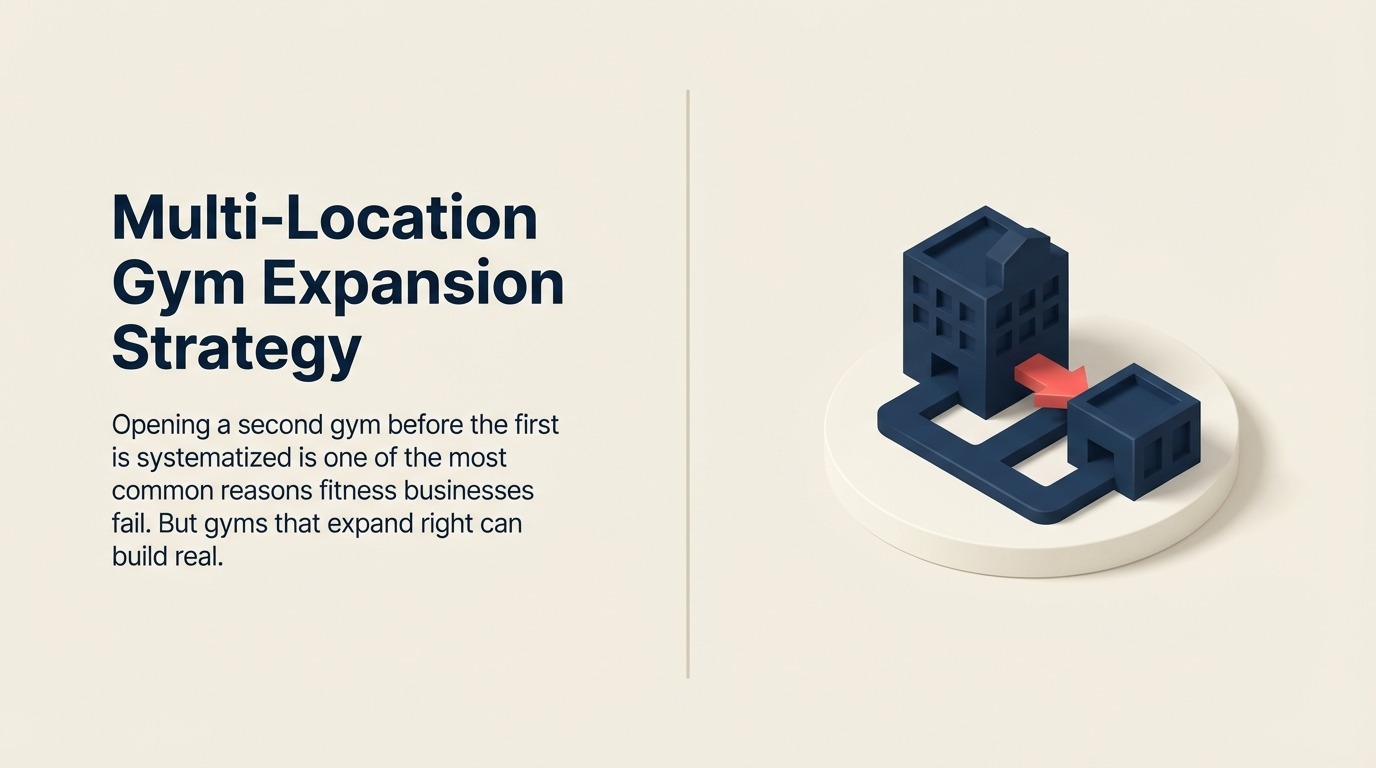
Opening a second gym location before the first one is systematized is one of the most common reasons fitness businesses fail. The owner who successfully built their first gym through force of personality, direct oversight, and intimate knowledge of every operational detail discovers that none of those things scale. The second location opens, the founder splits their attention, and both locations suffer.
But gyms that expand with the right operational foundation and financial model can compound their revenue and build genuine enterprise value. A three-location gym operation with proven systems, capable site managers, and predictable unit economics is worth fundamentally more than a single-location gym with the same total revenue. IBISWorld reports the US gym and health fitness club industry reached a market size of $44.8 billion in 2024, with over 107,000 locations operating nationwide - a fragmented market where scaled regional operators have meaningful competitive advantages over single-location independents. The multiple applies when buyers see a system, not a solo operator. Before deciding on expansion, it's worth revisiting your gym business model - boutique, big-box, and hybrid gyms have very different expansion economics, and the optimal path for each differs significantly.
The framework for successful multi-location expansion is straightforward: solve operations before you scale, not after. Treat your first location as the prototype for a system that others can run. When that system is documented, proven, and profitable without requiring your daily presence, you're ready to expand.
Key Facts: Multi-Location Gym Expansion
- Second gym locations take an average of 12-18 months to reach profitability from opening (IHRSA Facility Report, 2024)
- Build-out costs for a mid-size (5,000-15,000 sq ft) gym range from $50-150 per square foot depending on market and finish level (Club Industry, 2024)
- Gyms with documented SOPs sell at 1.5-2x higher multiples than operationally informal gyms of equivalent revenue (M&A data, 2024)
- 68% of gym operators who expanded to a second location cited "insufficient working capital during ramp-up" as their primary financial challenge (IHRSA Survey, 2024)
Expansion Readiness Assessment
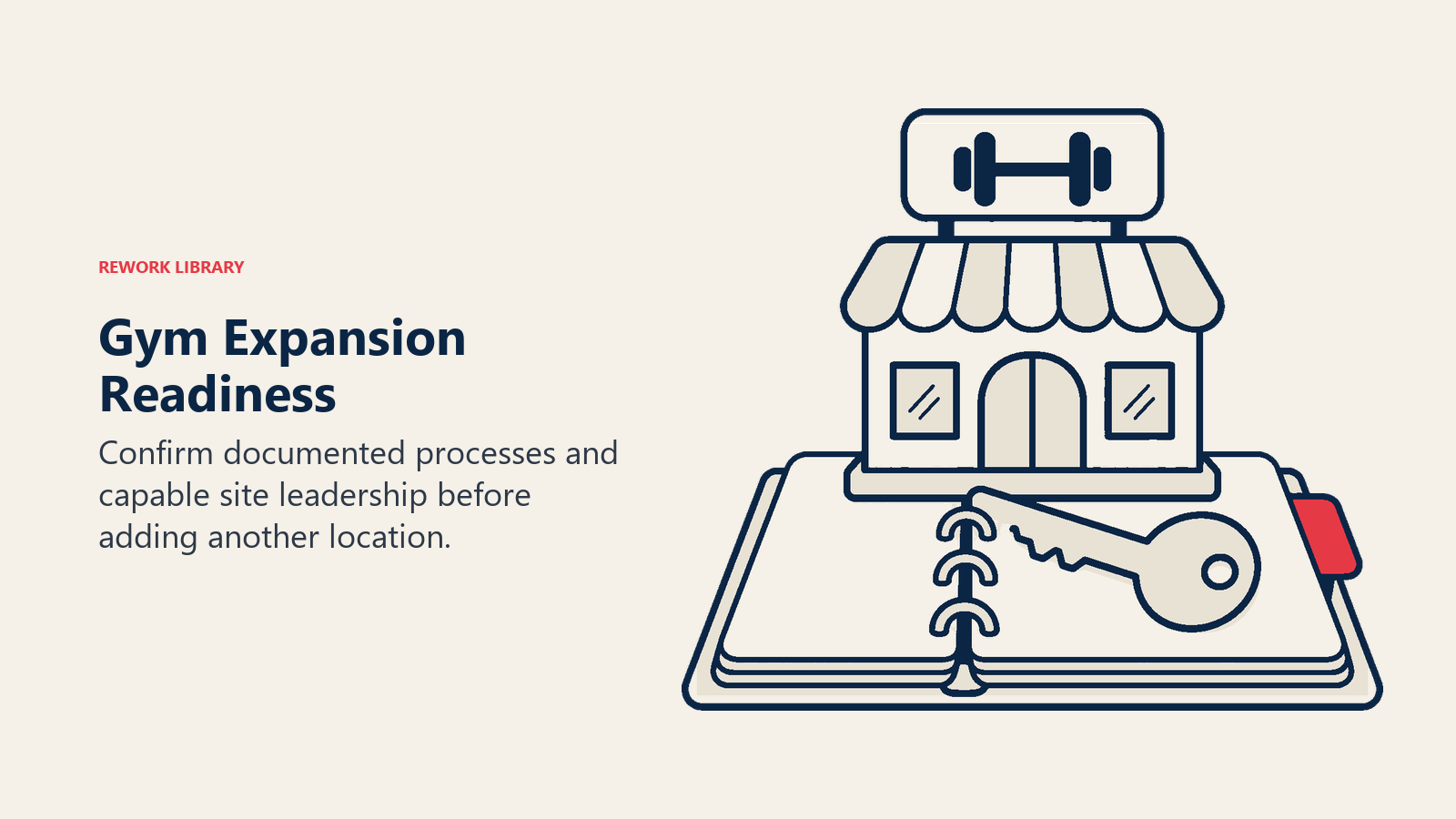
Before evaluating sites or modeling financials, assess honestly whether your first location is ready to serve as the foundation for a system. These are the operational prerequisites:
Stable, growing MRR: Your first location should have at least 24 consecutive months of profitability and stable or growing month-over-month membership revenue. If your MRR is flat or declining, that's an operations and retention problem that a second location won't fix - it will amplify. Review your key gym metrics - MRR trend, churn rate, and member LTV - before making any expansion decision; these numbers tell you whether growth is coming from a strong foundation or a fragile one.
Documented processes: Every repeatable operation - new member onboarding, staff scheduling, cleaning protocols, equipment maintenance, sales scripts, cancellation handling - should be written down and trainable without your personal involvement. If your operation runs on institutional knowledge that lives only in your head, you can't replicate it.
Strong management team: You need at least one person capable of running the first location independently while you focus on the second. This might be an existing general manager you've developed or an external hire. But if your first location requires your presence to function, expansion will pull you in two directions and both will suffer.
Reserve capital: Opening a second gym requires capital beyond the build-out costs. You need 6-12 months of operating expenses in reserve to cover the ramp-up period before the new location reaches break-even. Undersized reserves are the most common cause of expansion failure.
Healthy unit economics: Understand your first location's revenue per member, gross margin, and customer acquisition cost. If these metrics aren't healthy at location one, they won't magically improve at location two.
Expansion readiness scorecard:
| Category | Not Ready | Getting There | Ready |
|---|---|---|---|
| MRR stability | Declining | Flat | Growing 6+ months |
| SOPs documented | Informal | Partially | Fully documented |
| Management depth | Owner-dependent | One manager | Proven GM |
| Reserve capital | Under 3 months | 3-6 months | 6-12+ months |
| Months profitable | Under 12 | 12-24 | 24+ |
Site Selection Framework
Site selection is the decision with the longest-lasting consequences. A bad location with great operations still fails. A great location with mediocre operations will survive and improve. Pick the site carefully.
Demographic analysis starts with your target member profile: age range, income level, lifestyle indicators. Your existing membership is the best data source for this. What zip codes do your current members come from? Map them and you'll see the geographic concentration that defines your market. A second location should target a similar demographic profile in a geographically distinct area.
Population density thresholds matter. A boutique fitness studio needs 50,000-100,000 people within a 3-mile radius to generate a viable member base. A large-format gym can serve a wider radius (5-7 miles) but needs higher population density to compensate for lower average membership price. Research daytime vs residential population separately - a location in a commercial district may have 20,000 daily workers and only 5,000 residential population, which affects your class schedule timing and peak hours.
Competition mapping within a 3-mile radius tells you what share you're targeting and what positioning gaps exist. A market with five budget gyms and no boutique fitness studios is a different opportunity than a market with three boutique studios and no budget options. Identify what's not there, not just what is. A fitness competitive analysis of each candidate market - examining competitor pricing, programming, and positioning - is a worthwhile investment before signing a lease.
Lease terms are where experienced gym operators often leave money on the table. McKinsey's analysis of wellness market growth confirms that consumers are increasingly prioritizing fitness as a core lifestyle investment, which strengthens the tenant positioning of well-run gyms when negotiating with landlords in mixed-use and retail developments. Key negotiation points:
- Tenant improvement allowance (TI): $30-60/sq ft is typical for retail, and gyms often qualify for higher TI based on long lease terms and creditworthy tenants
- Free rent during build-out: 3-6 months is standard; push for the longer end
- Lease length: 10-year terms with renewal options provide security while keeping you from being locked out of renegotiation
- Personal guarantee limitation: Negotiate time limits on personal guarantees (e.g., guarantee personal liability only for the first 24-36 months)
- Co-tenancy provisions: If you're in a retail center, specify what types of neighbors are acceptable
Cannibalization risk from proximity to your existing location is real but often overstated. Members generally don't switch between your own locations - they use whichever one is most convenient for them. The risk is highest for drive-time proximity under 10 minutes. For locations 15+ minutes apart, cannibalization is typically under 5% of membership.
Management Structure
The organizational question of how to manage a second location is the one most gym operators underestimate. "I'll keep a close eye on it" is not a management structure.
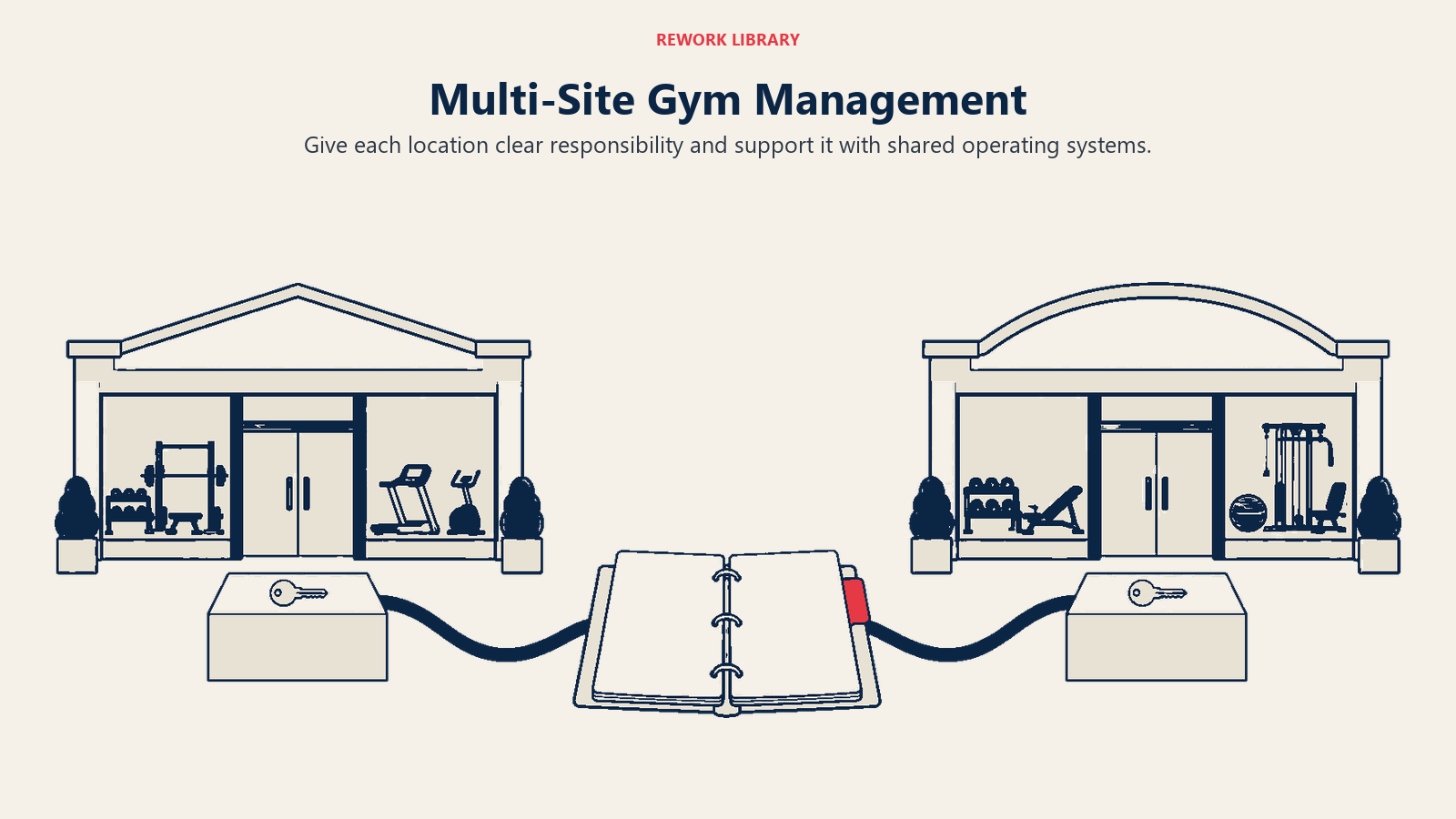
Option 1: Dedicated site manager with area oversight. Each location has its own general manager, and you (the owner) function as an area director managing both GMs. This requires promoting or hiring a capable GM for each location and investing in management development. It's the right structure for gyms with $500K+ annual revenue per location.
Option 2: Remote management with strong systems. You continue managing both locations directly using technology (gym management software, security cameras, remote access to POS and attendance data) and visit each location weekly. This works for owner-operators with strong systems and a small team but creates single points of failure - if you're unavailable, operations suffer.
Option 3: Promote from within. The best general managers often come from your existing team: front desk leads, trainers, or operations coordinators who've grown into leadership. They know your culture, your members, and your systems. Promoting from within is often faster and cheaper than external hiring and has higher retention rates because the internal hire already has community investment in your brand.
The management transition every first-time multi-location operator needs to make is from being the best operator in the gym to being the system designer and coach who enables others to operate it. That's a different skill set and often requires deliberate development.
Technology systems for remote oversight: A modern gym management software platform (Mindbody, Glofox, ClubReady) gives you real-time visibility into membership numbers, check-ins, class bookings, and revenue across locations from a single dashboard. Security camera systems with remote access let you monitor front desk behavior and facility cleanliness. Staff scheduling software creates accountability without requiring your physical presence.
Financial Modeling
The financial model for a new gym location needs to account for four distinct phases: pre-opening (expenses with no revenue), ramp-up (revenue growing but below break-even), stabilization (approaching break-even), and maturity (full profitability).
Build-out cost ranges by gym type:
- Boutique fitness studio (1,500-3,000 sq ft): $80,000-250,000 all-in
- Mid-size gym (5,000-10,000 sq ft): $300,000-750,000
- Large-format gym (15,000-30,000 sq ft): $800,000-2,500,000
These ranges vary significantly by market (construction costs in Manhattan vs a mid-sized Midwestern city differ by 40-60%), tenant improvement allowance (higher TI lowers your out-of-pocket), and finish level (a boutique studio with premium finishes costs meaningfully more per square foot than a utilitarian training space).
Ramp-up timeline expectations: Most gym locations require 6-18 months from opening to reach break-even, depending on gym type, local market awareness, and pre-sale effectiveness. A pre-sale campaign (selling founding member packages before doors open) can dramatically shorten the ramp period by establishing MRR before the first operating day. Target pre-selling 100-200 founding memberships before opening; this provides working capital and proves market demand before you're on the hook for full operating expenses. Your pricing psychology matters here - founding member pricing needs to feel like a genuine opportunity without setting a rate floor that hurts your long-term margin.
Working capital requirements: Budget for 6 months of full operating expenses as a reserve fund separate from your build-out budget. If your second location has $30,000/month in operating expenses, that's $180,000 in working capital reserve needed before you open. This is the number that kills underfunded expansion - the location opens, members trickle in during ramp-up, but the operating expenses don't wait.
Debt vs equity for expansion: Most gym expansions are funded through a combination of SBA loans (7(a) or 504 programs for owner-occupied or tenant-improved commercial space), equipment financing, and retained earnings from the first location. IHRSA's member resources include an operator and investor guide to gyms and fitness centers covering financing structures and build-out benchmarks used by operators across market segments. Equity partners (investors who take an ownership stake) make sense for gyms pursuing rapid multi-location expansion, but diluting ownership on a single-location expansion is usually suboptimal. Know what you're giving up before bringing in outside capital.
Portfolio-level cash flow modeling: A second location in ramp-up typically draws cash from your first location. Model this explicitly. If your first location generates $15,000/month in free cash flow and your second location requires $12,000/month in deficit funding during ramp-up, your net portfolio position is $3,000/month positive - tight but manageable. If your second location requires $20,000/month in deficit funding, you're drawing from reserves every month, which has a time limit.
The Second Location as a Systems Test
The most useful mindset for a second gym location is treating it as a proof of concept for your systems, not just a bigger version of what you've already built. Everything that required your personal judgment at location one - hiring decisions, pricing decisions, scheduling decisions, member conflict resolution - needs to become a systematized process by location two. Strong staff management practices become the backbone of this - without documented hiring, training, and performance standards, each location develops its own culture that eventually diverges from your brand.
The operators who scale to three, five, and ten locations are those who learned from location two what their systems could and couldn't handle. They fixed the gaps, documented the solutions, and entered location three with a more mature operational model. Scaling is iterative, and the second location is where the most important iteration happens. For operators who want to grow brand footprint without funding every location themselves, the gym franchise model is the natural next consideration - it uses the same systems-first discipline but recruits franchisees to deploy the capital.
Learn More

Senior Operations & Growth Strategist