New Member Onboarding for Gyms: The First 30 Days That Determine Retention

Turn this article into takeaways for your work.


Each assistant summarizes the article only for you and suggests best practices for your work.
Day 14 is when most gyms lose new members. The novelty of joining has worn off. The habit hasn't formed yet. The member hasn't made a single friend at the facility. And nobody from your team has called to check in. So they stop showing up (quietly, without drama) and you don't notice until month two when the credit card charge fails.
The good news is this failure mode is entirely predictable. And because it's predictable, it's preventable. A structured 30-day onboarding program costs almost nothing to run, requires no special software, and can be the single highest-ROI retention investment your gym makes. Most operators skip it because they think onboarding is administrative: a tour, a key fob, a waiver signature. It isn't. Onboarding is your primary retention intervention.
Research from the fitness industry consistently shows that members who complete a structured onboarding sequence in their first 30 days are 3 to 4 times more likely to still be members at month 12. That's not a marginal improvement. That's the difference between a gym that grows and one that runs an expensive acquisition treadmill, replacing departed members as fast as it signs new ones. The IHRSA Member Retention Report documents the direct correlation between early visit frequency and long-term membership survival across thousands of health clubs.
Key Facts: New Member Retention
- Members who visit at least 4 times in their first month are 65% more likely to remain active at 12 months (IHRSA, 2024)
- The average gym loses 30-50% of new members within the first 90 days of joining
- New members who receive a personal goal-setting conversation in week one report 40% higher satisfaction scores at day 30
What Onboarding Actually Means
A lot of gym operators confuse onboarding with orientation. Orientation is the 20-minute walkthrough on day one: here's the locker room, here's the free weights, here's how to book a class. That's necessary but not sufficient.
Onboarding is the full 30-day experience you design to move someone from "person who just paid for a membership" to "person who has built a habit and made a connection here." It covers four distinct phases: the first visit experience, the first two weeks of habit formation, the first social connections, and the month-one progress check. Before designing this sequence, it helps to know what gym membership tiers a new member signed up for, since the onboarding experience may differ by commitment level.
Each phase has specific objectives. The first visit needs to deliver a win: the member should leave feeling capable and welcomed, not overwhelmed. Weeks two and three need to address the "this is harder than I thought" dip that causes 60% of early cancellations. Week four needs to lock in the habit with a progress conversation that makes the next 30 days feel achievable.
Skip any of these phases and you've got a gap where members fall through.
Designing the First Visit
The first visit sets the entire emotional frame for the membership. Get it wrong and you spend the next 30 days trying to fix a first impression. Get it right and the member arrives for their second visit already expecting to succeed.
What to cover in orientation:
Walk the facility with the member, not just ahead of them. Point out equipment they'll actually use based on what they told you in the sign-up conversation. If they mentioned wanting to lose weight, spend more time in the cardio zone and functional training area. If they said "get stronger," put the free weights front and center.
Introduce them by name to at least two staff members. This sounds basic. Most gyms skip it. Members who know staff names by name are far less likely to feel anonymous, and anonymity is the precursor to cancellation.
Run a 10-minute goal-setting conversation. Not a sales pitch. An actual conversation about what they want to achieve, by when, and what's stopped them before. This conversation does two things: it gives your staff a retention hook (you can reference these goals in every future check-in), and it creates accountability that the member has opted into.
Book their second visit before they leave. This is the single most important thing you can do on day one. A member who schedules their next session before walking out the door shows up for that session 78% of the time. One who leaves without booking shows up about 40% of the time. This kind of structured goal-setting and early accountability mirrors the ACE Integrated Fitness Training model, which places collaborative goal-setting and rapport development at the core of any successful client relationship.
The Goal-Setting Conversation
Goal-setting at a gym often gets reduced to "what do you want to accomplish?" followed by a vague answer and a nod. That's not goal-setting. That's small talk.
A structured goal-setting conversation takes 10 minutes and follows this sequence:
What do you want to achieve? Let them answer fully. Don't interrupt with suggestions.
What does success look like in 90 days? Push for specifics. "Feel better" isn't a goal. "Drop 10 pounds and be able to run a 5K without stopping" is a goal.
What's worked before, and what hasn't? This surfaces the patterns that caused previous fitness attempts to fail. If they mention they always quit when work gets busy, you now know their primary churn risk.
What would make this time different? This is where accountability lives. If they say "having someone check in with me," you've just given yourself permission to run a structured check-in program without it feeling like surveillance.
What's the best class or service we have for where you're starting? Translate their goals into a specific program recommendation. If you have a beginner strength class on Tuesday mornings, recommend it by name and book it before they leave.
Document this conversation. Keep it accessible so any staff member can reference it in future interactions. The goal-setting conversation is worthless if only one person knows what was said.
The 30-Day Check-In Schedule
Three touchpoints determine whether your onboarding actually works: day 3, day 14, and day 30.
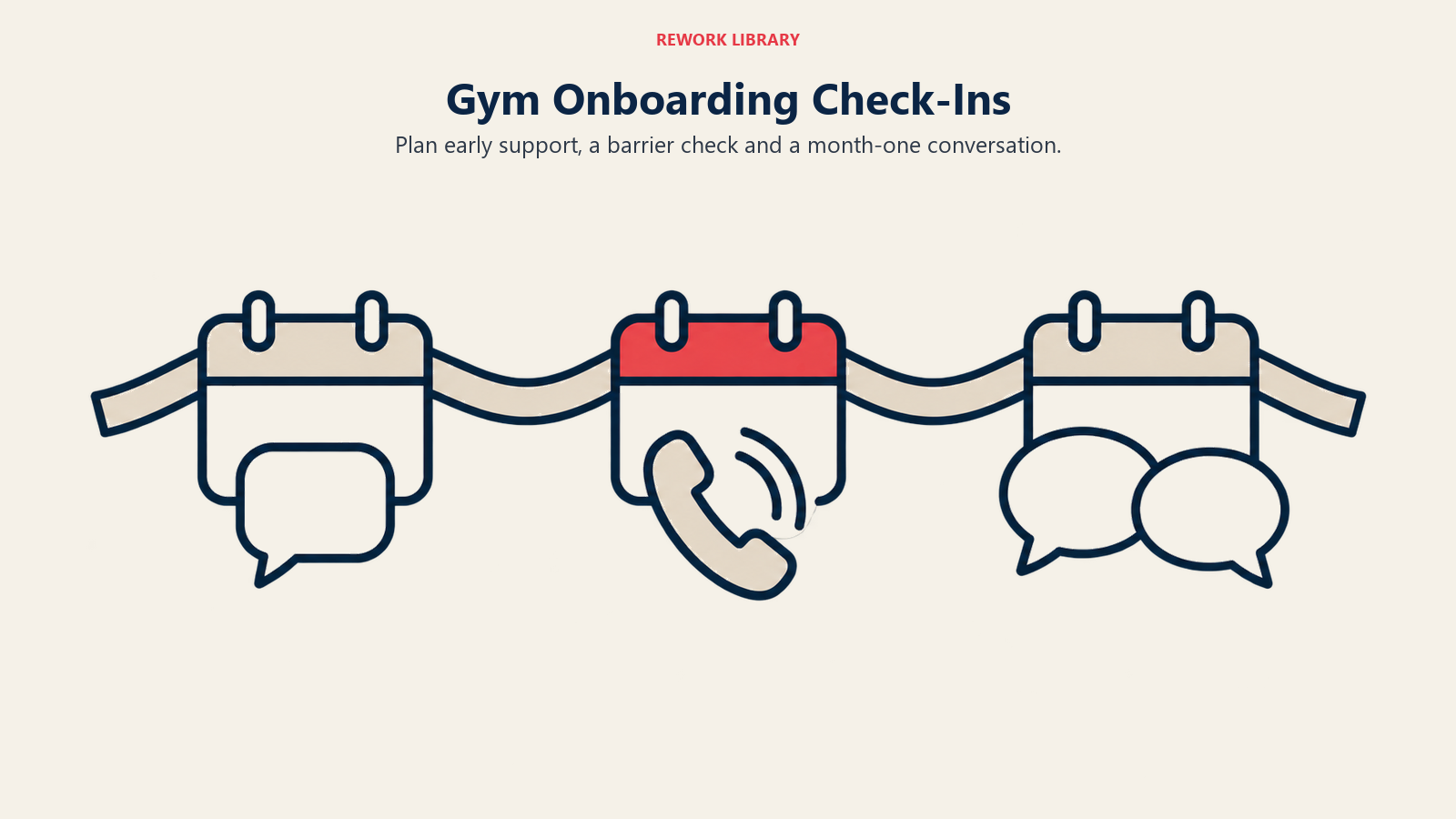
Day 3 check-in
This is a warmth call, not a sales call. The message is simple: "Hey, just wanted to check how your first session went and make sure you have everything you need." Duration: under two minutes. Purpose: eliminate the "nobody cares if I show up" feeling that causes early ghosting.
Text message works fine for day 3. Keep it personal ("Hi Sarah, it's Marcus from City Gym, just checking in after your first session") rather than automated. Members can tell the difference.
Day 14 check-in
Day 14 is the critical intervention point. This is when novelty has faded and habit hasn't formed. This check-in should be a brief phone call, not a text. Ask three questions: How many times have you been in? Have you tried any of the classes yet? Is there anything that's been a barrier to getting in?
If the member has visited fewer than 3 times in the first two weeks, they're at high risk. Don't panic, but do escalate. Offer a free short personal training session or a class introduction with a staff guide. The goal is to get them back in the building.
Day 30 progress check-in
This is a scheduled conversation, ideally in person. Pull up their goal-setting notes from day one. Review what they said they wanted to achieve in 90 days and map the first month's progress against it. Even small wins are worth celebrating. "You've been in 8 times this month, that's a real consistency win."
This is also the appropriate moment to introduce relevant upsells if the member's goals warrant it. If they mentioned wanting faster results and they're consistently showing up, a personal training introduction isn't a hard sell. It's a logical next step. See how personal training upsell programs can layer naturally onto the onboarding sequence.
Early Warning Signals
The members most likely to cancel in months two through four almost always show warning signs in weeks two and three. These signals are easy to catch if you're looking.
Visit frequency drop. A member who came in three times in week one and once in week two is on a downward trajectory. Your management software should flag anyone whose weekly visits drop by more than 50% compared to their first week. If it doesn't have this feature, build a simple manual tracking sheet.
No class participation by day 14. Members who only use the gym floor and never attend a class or use any group programming have no social connection to the facility. They're paying for equipment access, which is the weakest possible reason to stay. If a member hasn't tried a class by day 14, personally invite them to a specific class at a specific time.
No staff interaction. If a member walks in, works out, and walks out without speaking to a single staff member for multiple consecutive visits, they're functionally invisible. These members cancel without warning because no one in the gym knows them well enough to notice. Good gym staff management practices address this directly by training front desk teams to initiate conversation with every member by name.
No response to day 14 check-in. A member who doesn't respond to your day 14 outreach is telling you something. Escalate immediately. Try a different channel (call if you texted, text if you called) and consider a "we miss you" offer within 72 hours of non-response.
Building the Onboarding into Operations
The mistake most gyms make is treating onboarding as an individual staff responsibility rather than a system. When it depends on a specific person remembering to call, it doesn't happen consistently. Build the triggers into your operations so no member falls through.

Assign clear ownership: who runs the day-one orientation, who sends the day-3 message, who does the day-14 call, who conducts the day-30 review. These can be different people. What matters is that the handoff is explicit, not assumed.
Use your management software to set automated alerts. Most platforms (Mindbody, GymMaster, Club OS) can flag members who haven't visited in seven days or whose visit frequency has dropped. Pair those alerts with a defined response protocol.
Train all front desk staff on the goal-setting conversation. It shouldn't require a manager or a personal trainer to have this discussion. Any team member should be able to run a competent 10-minute goal conversation with a new member.
For a broader view of how to catch at-risk members before they cancel, pair onboarding with a formal member engagement tracking system. And if you want to understand the full retention framework this onboarding feeds into, see the gym churn reduction framework.
Making Onboarding Scale
Small gyms can run manual onboarding with a spreadsheet and a phone. Larger facilities need automation to be consistent. Either way, the sequence is the same.
For gyms with fewer than 300 members, a simple Google Sheet with new member names, join dates, and three check boxes for each touchpoint (day 3, day 14, day 30) is enough to track compliance. Assign one staff member as the onboarding coordinator and review the sheet weekly.
For larger gyms, integrate onboarding triggers into your CRM or gym management platform. Day-3 messages can be automated with a personal tone ("Hi [first name]" from a real staff name, not "Gym Team"). Day-14 calls should remain manual, because automation here signals to the member that they're not known.
If you're using free trial or day pass programs as a front-end to your membership, start the onboarding sequence the moment they convert to a paid membership, not when the trial ends.
The Onboarding Payoff
Every dollar and hour you invest in the first 30 days pays compounding returns. A member retained for 24 months instead of 6 generates roughly four times the lifetime revenue. The cost of delivering a structured onboarding program is minimal: a few phone calls, a goal sheet, and disciplined follow-through.
Compare that to what you spend acquiring a new member: digital ads, referral bonuses, free month offers. The math isn't close. Harvard Business Review research on the value of keeping the right customers confirms that increasing retention rates by just 5% increases profits by 25% to 95%, and acquisition costs 5x more than retention. Onboarding is the cheapest retention program you'll ever run. It just requires the discipline to do it every time, for every new member, without exceptions.
Members with social connections inside your gym cancel at dramatically lower rates than members who come alone and leave without talking to anyone. IHRSA research on member engagement shows that members who exercise in groups face a 56% higher cancellation risk when they don't, and that nearly 70% of members who made friends through their club become active promoters of the facility. Build in introductions, recommend classes with strong community cultures, and read the community building guide for programming frameworks that accelerate connection.
The first 30 days aren't a grace period. They're the most important 30 days of the entire membership. Design them accordingly.
Learn More