Gym Growth Stages: From Pre-Launch to Multi-Location Scale
Turn this article into takeaways for your work.


Each assistant summarizes the article only for you and suggests best practices for your work.
Solving the wrong problem for your stage is the fastest way to burn cash and lose momentum in the gym business. Watch an operator hire a full-time operations manager when they have 60 members. Watch another build a custom app during their first six months because a competitor has one. Watch a third location open before the first has hit positive cash flow. All of these are stage mismatch mistakes: applying resources and strategies that belong in a later stage to a business that hasn't earned the right to go there yet.
The gym business has five distinct growth stages, each with its own set of critical problems to solve, resources to deploy, and metrics to hit before moving forward. The operators who grow sustainably understand which stage they're in and resist the pressure (from investors, from peers, from their own ambition) to skip ahead. Stage clarity is one of the most underused levers in fitness business management.
This guide gives you the full map.
Key Facts: Gym Business Growth
- Only 36% of new gyms survive their first five years, with most failures occurring in the first 24 months (IHRSA Industry Data)
- Gyms that reach 200+ members in their first year have a 68% higher chance of still operating at year five (Fitness Business Pro 2023)
- The average gym takes 18-36 months to reach consistent monthly profitability, depending on model and market
The IHRSA Global Report provides the industry's most comprehensive benchmarking data on revenue milestones, membership thresholds, and profitability timelines across gym types, useful context when setting stage-specific targets.
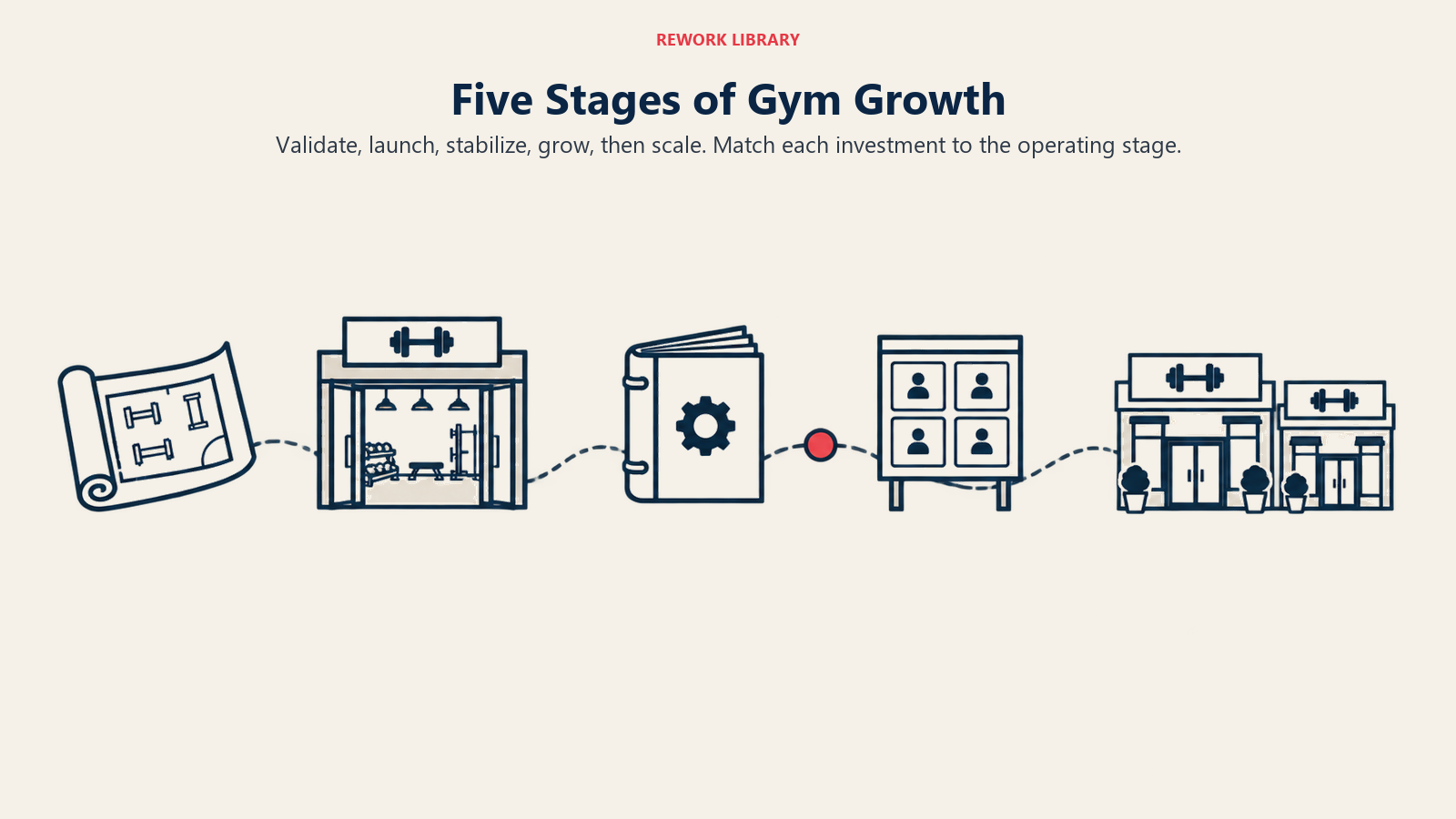
The Five Stages of Gym Growth
Stage 1: Pre-Launch (Months -6 to 0)
The pre-launch stage is everything that happens before you open your doors. Most operators underinvest in this stage because they're anxious to start generating revenue. That urgency is understandable and often fatal.
The critical work at pre-launch is concept validation, location selection, licensing and permitting, and founding member sales. Founding member campaigns (preselling memberships at a discount before opening) serve two purposes: they generate immediate cash flow that offsets fit-out costs, and they test whether your concept actually has demand in your specific market. A studio that sells 80 founding memberships before opening has strong market validation. One that sells 15 probably has a positioning or marketing problem that needs solving before day one. Your market positioning strategy should be locked before you run any pre-launch campaigns, since founding members are your clearest early signal of whether your positioning resonates.
Location selection deserves more rigor than most operators apply. Proximity to your target demographic is the primary criterion, but foot traffic patterns, parking availability, visibility from the street, and the terms of your lease all compound into a decision that will constrain your business for years. Operators who rush location due to excitement about a space they fell in love with frequently regret it.
Pre-launch priorities: Concept validation, founding member campaign, location secured, legal entity formed, key hire (if any), licensing and permits, equipment ordered
Stage gate to launch: 40+ founding members sold, lease signed, all permits in place
Stage 2: Launch (Months 0-6)
The launch stage is operationally chaotic for almost everyone. You're running a new business, training staff, onboarding members, discovering that your scheduling software doesn't integrate with your payment processor, and simultaneously trying to generate marketing momentum. The goal of this stage isn't growth. It's operational stability.
The critical metrics at launch are minimum viable membership (the number of members required to cover monthly operating costs) and early retention. You should know your minimum viable membership number before you open: take your monthly fixed costs (rent, utilities, insurance, debt service, any staff) and divide by your average monthly revenue per member. That's your floor. Getting there within six months is the launch stage objective. Tracking your key gym metrics from the start, MRR, attrition rate, and CPA, gives you the diagnostic data to catch problems before they compound.
Early retention is worth obsessing over at this stage because churn compounds. A gym that loses 8% of members per month loses nearly 60% of its member base per year. IHRSA's research on member retention and engagement confirms that gyms with structured early-engagement processes see measurably lower 90-day attrition than those relying on passive member experience. At launch, when your total member count is low, each cancellation is visible and painful. Build personal relationships. Call every new member after their first week. Fix operational friction before it becomes a retention problem. A structured new member onboarding process is one of the highest-ROI investments you can make in the first six months.
Launch priorities: Hit minimum viable membership, operational stability, early retention focus, member feedback loops, team process documentation
Stage gate to stabilization: Minimum viable membership achieved for 2+ consecutive months, monthly attrition below 6%, core team stable
Stage 3: Stabilization (Months 6-18)
Stabilization is where most gyms spend longer than they expect. This is both normal and healthy. The stabilization stage is about building the foundations that make everything that comes later possible: consistent revenue, member experience quality, and the first signs of organic referral growth.
The primary work of stabilization is churn reduction. Many operators in this stage are still in net-growth mode, adding more new members than they're losing, and they mistake this for health. But if you're adding 30 new members a month and losing 25, you're on a treadmill, not a growth trajectory. Fixing the leaky bucket (member retention) is always higher ROI than accelerating the inflow (new member marketing) at this stage. A systematic gym churn reduction approach typically involves early intervention at the 30- and 60-day marks, when members are most likely to quietly disengage.
Programming quality and consistency also solidifies during stabilization. Early-stage gyms often have variable class quality because instructors are still finding their feet, schedules aren't perfectly optimized for demand, and member experience depends too heavily on the owner's personal involvement. Stabilization is when you build the systems and quality standards that make the member experience consistent regardless of which team member is delivering it.
Stabilization priorities: Reduce monthly attrition below 4%, build referral engine, systematize programming, reduce owner dependency, optimize schedule utilization
Stage gate to growth: Revenue growing consistently month-over-month for 6+ months, attrition below 4%, referral accounts for 25%+ of new members
Stage 4: Growth (Months 18-36)
By the growth stage, you know your business works. You have stable revenue, manageable churn, and a team that can operate without your constant presence. Now the question shifts from "can this survive?" to "how fast and in what direction should this grow?"
Growth stage work is about maximizing what you've built. This means increasing capacity utilization (getting more revenue from your existing footprint before you expand it), scaling the marketing that's already working, and beginning to build the management layer that allows the business to run without you in every key decision.
Capacity utilization is the most underutilized growth lever in fitness. Before you invest in a second location or a bigger space, ask whether you're getting maximum revenue from your current one. Peak-hour classes at 90% utilization are money in the bank. Off-peak slots at 20% utilization are wasted capacity. Class schedule optimization and pricing incentives for off-peak attendance, along with corporate wellness partnerships that fill midday slots, are all growth stage moves that compound your return on existing fixed costs.
Growth priorities: Maximize utilization, scale proven marketing channels, build management team, systematize hiring and training, explore secondary revenue streams
Stage gate to scaling: Consistently above 70% capacity utilization, team can operate without owner in day-to-day, positive cash flow for 12+ months, expansion capital available
Stage 5: Scaling (Year 3+)
Scaling means different things for different operators. For most, it's a second location. For some, it's a gym franchise model. For others, it's vertical expansion: adding digital products, certifications, or equipment retail. The form matters less than the readiness. IBISWorld's gym franchises industry analysis notes that franchised gym concepts have grown faster than independent operators over the past decade, largely because the scaling infrastructure is pre-built, a model worth studying even if you're not pursuing a formal franchise path.
The biggest scaling mistake in fitness is opening a second location before the first is truly systematized. If your first location still needs the owner present to maintain quality, opening a second location doesn't multiply your business. It divides your attention. You need documented processes, capable managers, and the financial reserves to sustain a new location through its own pre-profitability period (typically 12-24 months) before you pull the trigger. Multi-location gym expansion requires that location one runs well without you, otherwise you're scaling problems, not success.
At the scaling stage, the problems you're solving are organizational: building leadership capability below the founder level, creating training systems that work without your direct involvement, and developing the financial sophistication to manage multiple profit centers simultaneously. It's a different kind of business than a single-location gym, and operators who treat it as just "more of the same" consistently underperform.
Scaling priorities: Systematize location one fully, identify second location, secure expansion capital, hire general manager, develop training and culture documentation
Stage-by-Stage Reference Table
| Stage | Timeline | Team Size | Key Metric | Common Mistake | Priority |
|---|---|---|---|---|---|
| Pre-Launch | -6 to 0 months | 1-2 | Founding members sold | Skipping validation | Founding member campaign |
| Launch | 0-6 months | 2-5 | Monthly attrition | Prioritizing growth over retention | Operational stability |
| Stabilization | 6-18 months | 3-8 | Referral rate | Building before fixing churn | Retention systems |
| Growth | 18-36 months | 5-15 | Capacity utilization | Opening second location too early | Revenue per sq ft |
| Scaling | 3+ years | 10-50+ | Revenue per location | Owner dependency in location 1 | Systematization |
Stage Mismatch Mistakes to Avoid
The most common mismatch errors, in order of frequency:
Hiring a full-time operations manager at launch. You don't need an operations manager when you're figuring out basic operational stability. You need the owner doing everything and learning from direct experience what needs to be systematized later.
Building a custom app during stabilization. Apps are scaling-stage investments that make sense when you have 500+ members and need to systematize engagement at scale. During stabilization, you need personal relationships, not technology. Member app engagement tools are most valuable once you've already solved the underlying retention problem they're meant to support.
Running aggressive paid advertising during pre-launch. Paid ads in pre-launch, before you have any idea what your conversion messaging should be and before your operations are stable enough to handle inbound volume, generate leads you can't convert and burn cash you need for operations.
Opening a second location during growth stage. If your first location isn't yet at 70%+ utilization and isn't cash flow positive for at least 12 months, a second location is a distraction from the problems that still need solving at location one.
Self-Diagnostic Checklist
Use these questions to identify your current stage honestly:
- Are you hitting minimum viable membership? (If no: Launch)
- Is monthly attrition above 5%? (If yes: Stabilization)
- Is referral accounting for less than 20% of new members? (If yes: Stabilization)
- Is capacity utilization below 60%? (If yes: Growth, not Scaling)
- Does the business require your daily involvement to function? (If yes: Growth, not Scaling)
- Do you have 12+ months of positive cash flow? (If no: Growth)
Know Your Stage and Resist the Pressure to Skip Ahead
Stage clarity won't make you a great operator. But stage confusion will reliably make you a struggling one. The pressure to skip ahead (to grow faster, to open the second location, to build the tech stack) is constant in this industry. Competitors make announcements. Investors ask about expansion timelines. Your own ambition pulls toward the next milestone.
But the gym operators who build durable, profitable businesses almost always did it by staying longer in each stage than felt comfortable, solving the problems that stage presented fully, and only moving forward when the metrics genuinely supported it. Stage discipline is competitive advantage. Not many operators have it.
Learn More

Senior Operations & Growth Strategist
On this page
- The Five Stages of Gym Growth
- Stage 1: Pre-Launch (Months -6 to 0)
- Stage 2: Launch (Months 0-6)
- Stage 3: Stabilization (Months 6-18)
- Stage 4: Growth (Months 18-36)
- Stage 5: Scaling (Year 3+)
- Stage-by-Stage Reference Table
- Stage Mismatch Mistakes to Avoid
- Self-Diagnostic Checklist
- Know Your Stage and Resist the Pressure to Skip Ahead
- Learn More