Community Building in Fitness Studios: Challenges, Social Groups & Member Culture
Turn this article into takeaways for your work.


Each assistant summarizes the article only for you and suggests best practices for your work.
A member who comes to your gym three times a week for the equipment will leave the moment a competitor opens closer to their office. A member who comes twice a week because their Tuesday morning crew is there will stay through a rent increase, a facility renovation, and two competing gyms opening on the same block. That's the practical difference between a transactional member and a community member, and the gap in retention rates between them is not subtle.
Research from the fitness industry consistently shows that members with at least one social connection inside a gym cancel at 5 times lower rates than isolated members. Community isn't a feel-good program. It's the single most durable retention lever available to any fitness facility. IHRSA's research on member loyalty found that nearly 70% of health club members who made new friends through their club identified as active promoters of the facility, turning community investment directly into referral value.
But community doesn't build itself. Members don't naturally introduce themselves while staring at a wall on the elliptical. Instructors who are rushed between classes can't spontaneously create culture. Community requires deliberate design: programming that creates interaction, infrastructure that sustains it, and a staff culture that models it. This guide covers what actually works.
Key Facts: Community & Retention
- Members with 2+ social connections at their gym retain at 4.7x the rate of members with no connections (IHRSA, 2023)
- Group fitness participants churn at 30-40% lower rates than gym-floor-only members
- Studios running at least one community event per month report 18% higher annual retention vs. those running none
What Real Community Looks Like (and What It Isn't)
Before designing community programs, it helps to be clear about what you're actually trying to build.
Real community in a fitness studio looks like this: members know each other's names, ask about each other's progress, show up on days when they're not sure they want to work out because they don't want to let their group down. It's self-reinforcing. The people are the reason to come.
Fake community looks like this: a Facebook group with 300 members, three active posters, and content that's mostly promotional. A whiteboard with monthly member photos. A "community wall" that nobody reads. These things signal that you care about community without actually building it.
The difference is interaction. Real community is built through repeated, low-stakes interactions between members. Your job as a gym operator is to design programming and environments that make those interactions happen naturally and frequently.
Fitness Challenges as Community Builders
A well-designed fitness challenge is the fastest community-building tool available to most studios. Done right, it creates a shared goal, a reason to show up consistently, accountability between participants, and a natural ending point that creates a collective experience.
Challenge design template:
- Duration: 21-30 days is the sweet spot. Long enough to create habit, short enough to maintain urgency.
- Scope: Simple and measurable. "30 classes in 30 days," "100,000 steps per week," or "complete all 5 strength benchmarks" outperforms vague transformation goals.
- Teams vs. individual: Team-based formats generate dramatically more social connection. Assign members to teams of 3-5, mix experience levels intentionally, and create a leaderboard. Individual challenges create competition; team challenges create relationships. The ACE Group Fitness Instructor certification program specifically trains instructors to build class environments that recognize participants and sustain high engagement, the same social energy that makes team challenges produce lasting connections.
- Tracking: Public tracking is essential. A physical whiteboard in the gym works better than a digital-only leaderboard for in-person connection: members physically gather around it, have conversations, celebrate wins.
- Prizes: Keep prizes modest and experience-focused. A free month of membership, a branded gear pack, or a guest pass bundle works better than cash. The real prize is the recognition and the experience.
Run the challenge announcement in person if possible. An all-hands at a popular class time builds anticipation better than an email. Assign a challenge coordinator (usually a motivated front-desk staff member or a participating instructor) to keep energy high in weeks two and three, when motivation typically dips. A well-timed challenge also benefits from class schedule optimization, scheduling challenge-aligned classes at peak attendance windows maximizes participation and social energy.
Social Events Beyond the Workout
Community expands when members interact outside of training context. A member who has only ever seen another member at the gym sees them as a gym acquaintance. A member who has shared a post-class coffee or run a 5K with another member sees them as a friend. That distinction matters for retention.
Social event formats that work:
- Nutrition workshops: Partner with a local nutritionist for a 60-minute workshop open to members. Provide food. These generate high attendance and a built-in conversation starter.
- Social runs: A monthly 5K run departing from the gym, followed by coffee or breakfast nearby. Low cost, high social density. Works especially well for cardio-focused member segments.
- Post-class rituals: The most sustainable social events are the ones that happen automatically every week, not the ones you plan months in advance. A coffee cart after Saturday morning class, or a member-organized brunch that you support with a venue recommendation, creates a recurring touchpoint.
- Fitness goal milestone celebrations: A member hits their 100th class or their first pull-up. Acknowledge it publicly. Put it on the whiteboard. Take a photo and ask if they want it shared. These moments cost nothing and create enormous goodwill.
- Community partner events: Partnering with a local restaurant for a healthy dinner event, or a local outdoor equipment shop for a gear demo, expands the community beyond the facility walls and adds value without adding overhead.
The frequency question: one social event per month is the minimum. Two is better. Beyond that, you risk over-programming and staff burnout. Quality and consistency matter more than frequency.
Digital Community Infrastructure
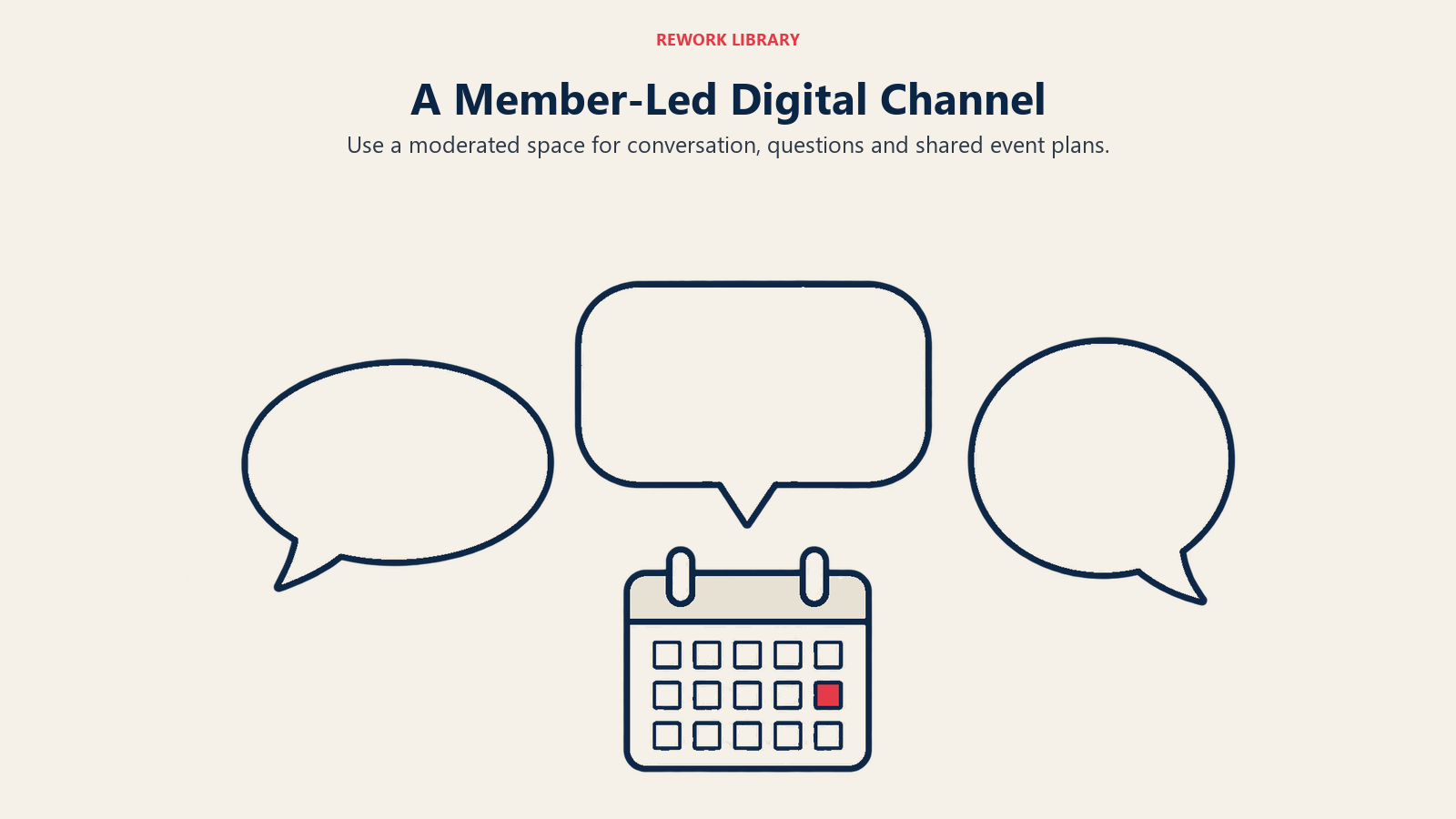
A digital community channel extends your community beyond the four walls of your facility. Done well, it gives members a way to stay connected between visits, celebrate each other's wins, and keep the gym present in their minds on rest days. Done poorly, it becomes another channel you have to manage that nobody uses.
Platform selection:
- WhatsApp groups work best for high-engagement communities under 100 members. Low friction, personal feel, good for real-time coordination. Risk: can feel overwhelming if not moderated.
- Facebook groups offer better organization and reach for larger communities. Easier to search and reference past content. Works better for events and announcements than real-time interaction.
- Slack channels are gaining traction in studios with a more professional or tech-forward membership base. Allows topic organization (separate channels for nutrition, challenges, member wins, class updates).
Content that drives engagement:
- Member milestone celebrations (first pull-up, 100th class, PR lifted)
- Instructor tips and mini-tutorials posted weekly
- Challenge leaderboard updates
- Upcoming event reminders with personal sign-up links
- Poll questions that drive participation ("What class would you add to the schedule?")
Content that kills engagement:
- Promotional posts more than 20% of the time
- Staff-only posting with no member-generated content
- Automated posts that feel like marketing emails
- Content that could be just as easily emailed (no interactivity)
Appoint a community manager (can be part-time or shared among staff) who is responsible for seeding conversation and responding quickly to member posts. A community channel where staff take more than 24 hours to engage looks abandoned even with active member posting. The member app engagement strategies guide covers how to extend your digital community through a branded app, which gives members a more integrated alternative to third-party social platforms.
Buddy Systems and Accountability Pairing
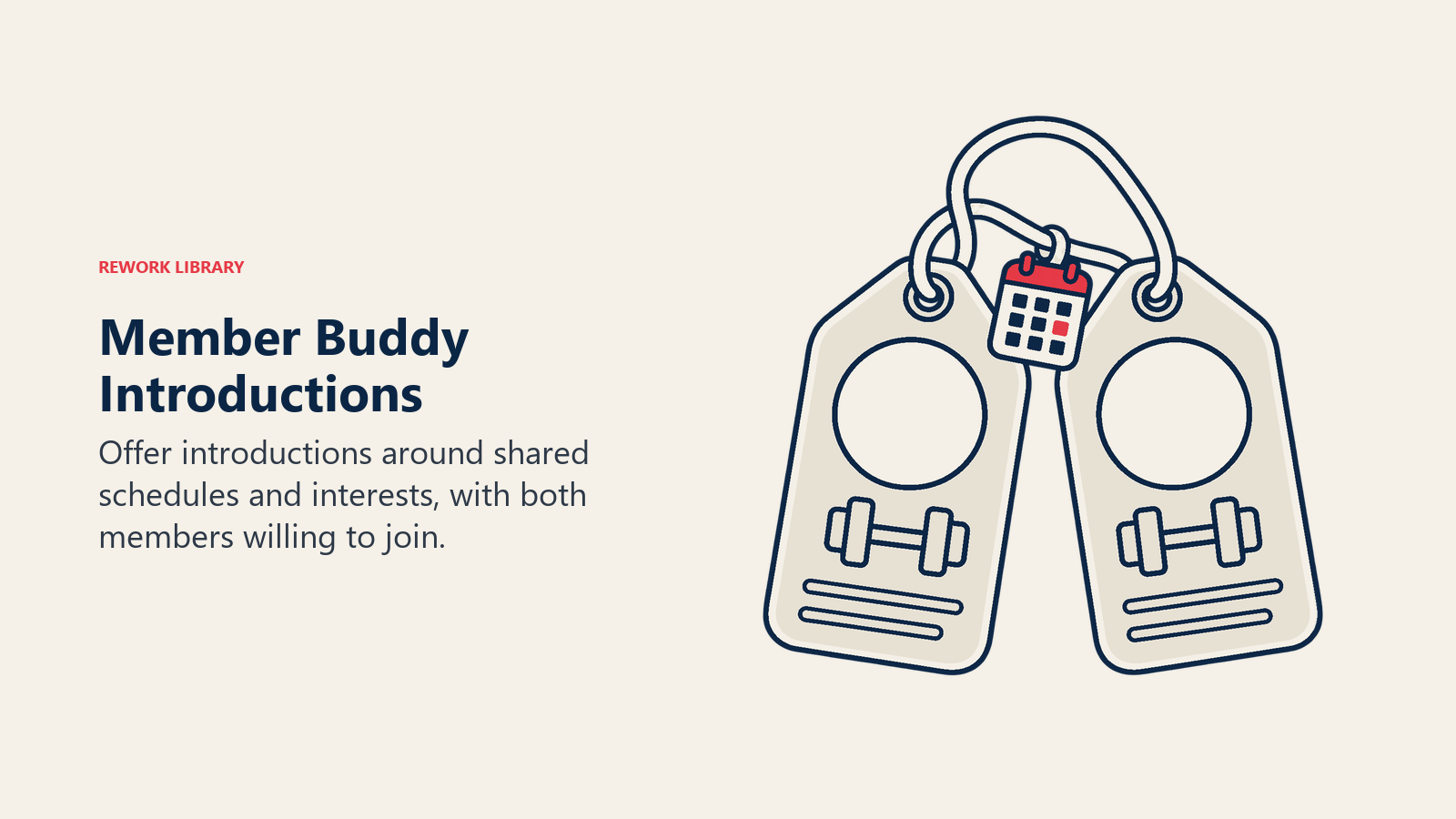
The buddy system is one of the highest-leverage community tools available at the new member stage, when the risk of social isolation (and therefore cancellation) is highest.
Pairing protocol:
At the day-14 touchpoint in your new member onboarding program, identify any new member who hasn't attended a class or made a visible social connection. Pair them with an existing member of similar fitness level, schedule, and goals.
The pairing shouldn't feel clinical. A simple introduction works: "Hey, I want to introduce you to Marcus. He's been with us for eight months, comes in Tuesday/Thursday mornings, and has similar strength goals. I think you'd get along." Send Marcus a brief heads-up message first, letting him know you'd like to introduce a new member and that he'd be doing the gym a real favor.
Formal "ambassador programs" work well in studios with a strong community culture: identify 10-15 long-term members who are naturally social and enthusiastic, give them a title and a small perk (priority class booking, branded item), and ask them to introduce themselves to one new member per month. Many will do this naturally anyway. The formalization just channels it.
Accountability partner pairing:
Beyond new member onboarding, accountability pairings work well for challenge programs. Pair members with similar goals and have them check in with each other weekly via your community channel. The accountability relationship alone increases challenge completion rates by 30-40%.
Staff Role in Community Culture
Here's the part most gym operators underestimate: you can design all the community programming in the world, and if your staff doesn't model community behavior, it won't stick.
Community culture starts at the front desk. A front desk team that knows member names, asks about their progress, and makes everyone feel recognized on arrival sets the tone for how members treat each other. A front desk team that stares at a screen while processing check-ins communicates that this is a transactional facility.
Staff community culture checklist:
- Front desk staff can name at least 80% of members who walk in on any given day
- Instructors have brief conversations with participants before and after every class (not just during)
- Staff publicly celebrate member milestones (PRs, attendance records, goal completions)
- Staff participate in community events, not just staff them
- New member introductions are staff-initiated, not left to chance
- Staff know and reference member goals in passing conversations ("How's the marathon training going?")
These behaviors can be trained and measured. Include community interaction quality in your staff performance reviews. Ask members for feedback on whether they feel known at your facility. This question, added to your member feedback surveys, is one of the highest-signal retention indicators available.
The Retention Math of Community Investment
A 30-day fitness challenge costs roughly $500-$1,500 to run depending on prizes and marketing. If it improves 12-month retention by 5 percentage points for the 40 members who participate, and those members were paying $60/month on a 14-month average tenure, the retention value is: 40 members × 5% improvement × $60 × 14 months = $1,680 in preserved revenue. That's before accounting for the referrals community members generate. The US gym and fitness club industry on IBISWorld shows the sector generating over $45 billion annually, with community-driven boutique studios growing faster than commodity gyms, a structural proof point that the social investment pays off at the market level too.
Community investment pays for itself. The challenge is that the ROI isn't always immediately visible in the way that an advertising campaign is. You need engagement tracking data to connect community participation to retention outcomes and make the business case to ownership.
For the full churn reduction framework that community building supports, and for the referral programs that community members tend to drive, see the linked articles. And to understand what community events like open houses can do for acquisition alongside retention, see community events and open houses.
You can't force community. But you can design conditions where it develops naturally, and the retention math makes it worth designing carefully. McKinsey's work on what turns customers into fans identifies community and shared identity as among the most powerful loyalty levers available, and unlike points programs or discounts, they're extremely difficult for competitors to replicate.
Learn More

Senior Operations & Growth Strategist