Member Engagement Tracking for Gyms: Visit Frequency, Scoring & Early Warnings
Turn this article into takeaways for your work.


Each assistant summarizes the article only for you and suggests best practices for your work.
The member who cancels next month already stopped caring six weeks ago. You just weren't watching. They cut their weekly visits from three to one, stopped attending Tuesday spin, and haven't responded to the last two promotional emails. Every one of those signals was visible in your data. But without a system designed to surface them, they disappeared into the noise.
Most gyms track membership counts and monthly revenue. Fewer track engagement in any systematic way. The ones that do catch cancellations before they happen, not after. That's the difference between a reactive retention strategy (win-back campaigns, last-minute save offers) and a proactive one (catching the behavioral shift at week four and intervening before the decision is made).
Engagement tracking isn't complicated. You don't need advanced analytics software or a data science team. You need a defined set of metrics, a simple scoring model, and a clear protocol for what to do when a member's score drops. This guide gives you all three.
Why Visit Frequency Alone Is Not Enough
Visit frequency is the most obvious engagement metric and the one every gym management platform reports. But it tells an incomplete story.
A member who visits twice a week but uses nothing but the treadmill, has no instructor relationships, and has never attended a class is far more vulnerable than a member who visits once a week but is deeply embedded in a Monday morning bootcamp community. The twice-a-week treadmill member is paying for a commodity: access to cardio equipment. The moment a competitor opens closer to their office or drops their price, they're gone.
The once-a-week community member has social capital in your gym. They know three other members by name. They'd feel guilty bailing on the bootcamp crew. That connection is stickier than any loyalty point program you'll ever run.
So visit frequency matters, but it's a surface-level signal. A complete engagement picture combines frequency with class participation, social indicators, and service usage. That's what an engagement score does.
Building an Engagement Scoring System
An engagement score is a single number between 0 and 100 that represents how connected a member is to your gym. High scores predict retention. Low scores predict cancellation. The goal is to spot declining scores early enough to intervene before the decision is made.
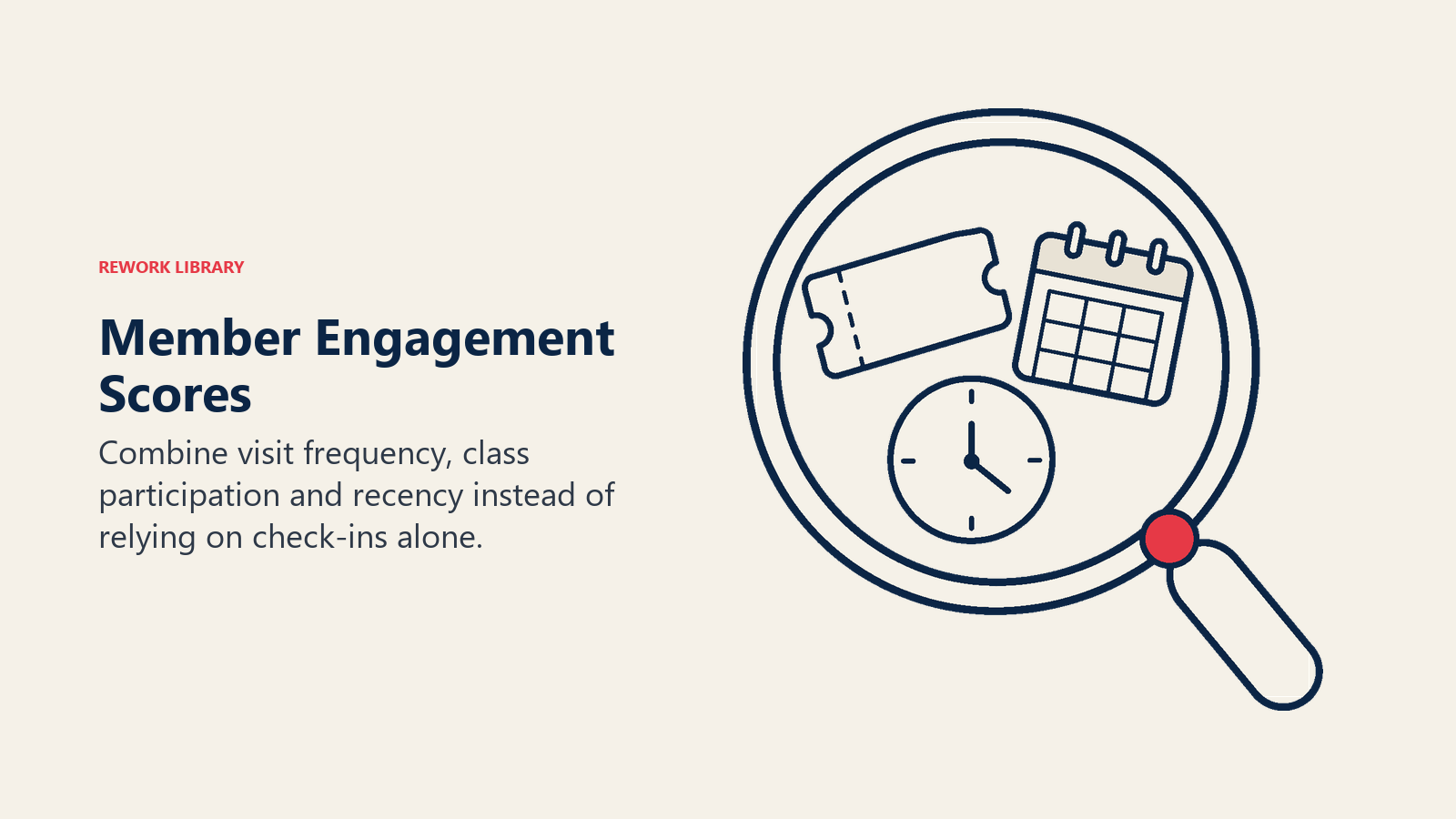
Here's a practical weighted scoring model for a standard gym:
| Input | Weight | What to Measure |
|---|---|---|
| Visit frequency (last 30 days) | 40% | Number of check-ins in the past 30 days |
| Class or group session attendance | 25% | Any group fitness class, PT session, or structured program |
| Recency | 20% | Days since last visit (0 points if >21 days) |
| App or digital engagement | 10% | Bookings, check-ins, profile activity |
| Referral activity | 5% | Any referral in the past 90 days |
Scoring visit frequency (40 points max):
- 8+ visits in 30 days: 40 points
- 5-7 visits: 30 points
- 3-4 visits: 20 points
- 1-2 visits: 10 points
- 0 visits: 0 points
Scoring class attendance (25 points max):
- 4+ group sessions in 30 days: 25 points
- 2-3 sessions: 18 points
- 1 session: 10 points
- 0 sessions: 0 points
Scoring recency (20 points max):
- Visited in the last 7 days: 20 points
- Visited in the last 14 days: 12 points
- Visited in the last 21 days: 5 points
- Last visit over 21 days ago: 0 points
Digital and referral scores follow similar tiered logic. The exact weights can be calibrated to your gym's data over time. If class attendance is a stronger predictor of retention in your facility than app engagement, adjust accordingly. But start with this framework and refine once you have 90 days of baseline data.
Segmenting Members by Engagement Level
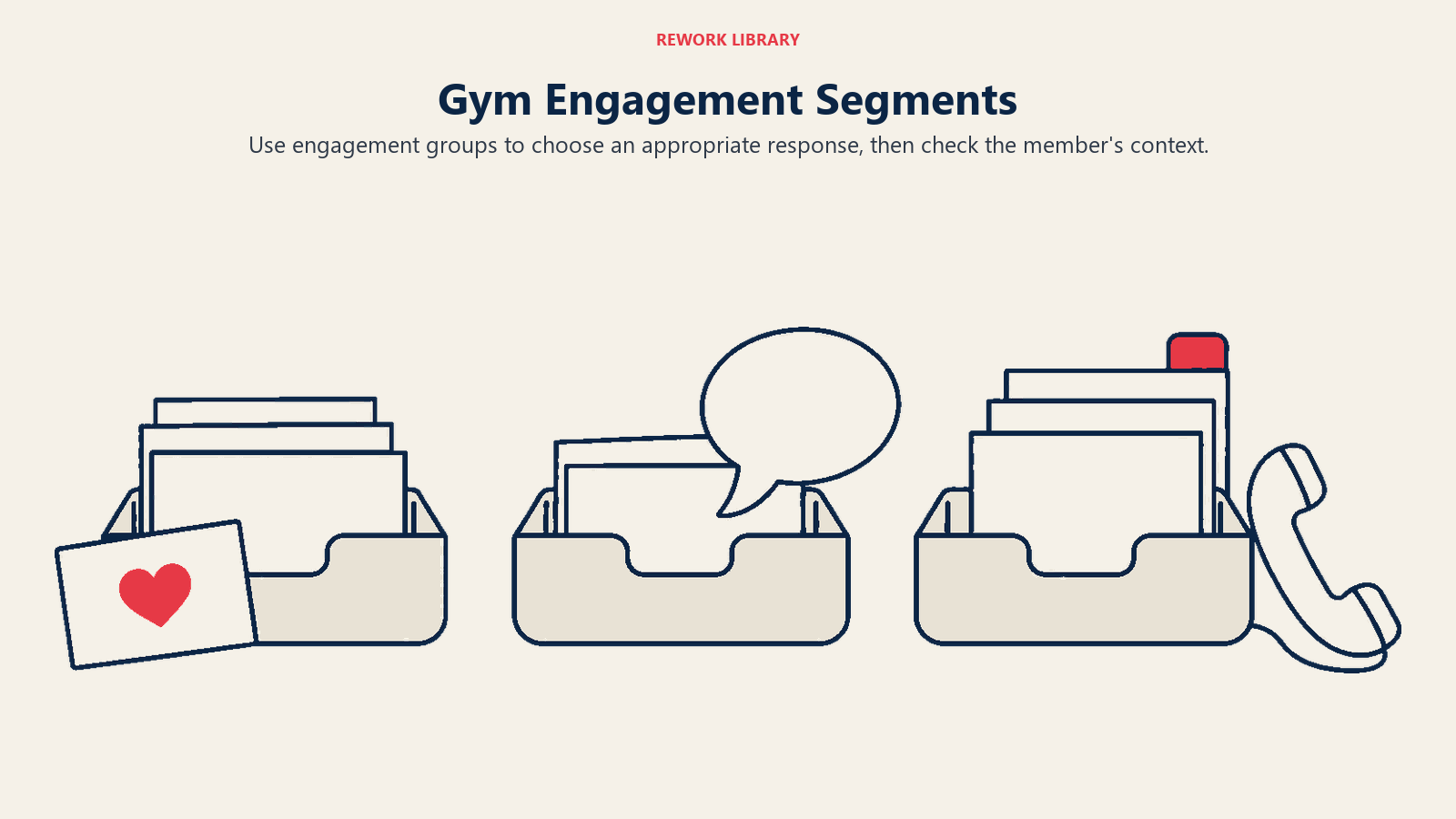
Once you have scores, segment your membership into three groups. Each segment needs a different response protocol.
High engagement (score 70-100): Active members
These are your most valuable members. They visit regularly, attend classes, and are likely already referring others. Don't ignore them because they're low-risk. They're also your best referral source and the most likely candidates for upsell programs like personal training packages. High-engagement members are also the most responsive to gym referral programs, they have the social capital and the motivation to bring in people they know.
Your job with this segment is appreciation and deepening the relationship: priority booking for popular classes, early access to new programs, recognition in community channels.
Medium engagement (score 40-69): At-risk members
This is where your retention team should focus most of its energy. These members are showing up, but not consistently. They may have skipped a week due to travel, gotten busy at work, or lost motivation after an initial burst of enthusiasm. Some will recover naturally. Others are on a slow slide toward cancellation.
Intervention at this level is lightweight: a check-in message, a class recommendation, a "haven't seen you in a while" text from a staff member they know. The goal is to interrupt the disengagement pattern before it becomes a habit.
Low engagement (score 0-39): Pre-cancellation zone
A member in this range has effectively already decided to cancel. They just haven't clicked the button yet. Standard marketing messages don't work here. You need direct, personal outreach with a specific reason to come back. This might be a complimentary personal training session, an invitation to a new class format launching next week, or an offer to pause rather than cancel if the issue is financial.
The faster you move once a member drops into this range, the higher your save rate. Waiting until they submit a cancellation request leaves you arguing with a decision that's already made.
Intervention Triggers by Engagement Segment
Knowing a member's engagement score is worthless without a clear protocol for what to do with it.

When a high-engagement member drops 15+ points in 30 days: Check for a reason before reaching out. Did they recently move? Have billing issues? If no obvious cause, send a personal message (text or email, not automated) from a staff member they know. Acknowledge the change without making them feel monitored.
When a medium-engagement member misses 10+ days: Automated message day 10, personal follow-up call day 14 if no response. Don't lead with an offer. Lead with genuine check-in. "Hey Sarah, haven't seen you in class recently, just wanted to make sure everything's okay." Offers come only after you understand why they're absent.
When any member drops to low engagement for two consecutive weeks: Escalate to a save protocol. Direct phone call from a manager or owner. Acknowledge specifically what you've noticed ("I see you haven't been in since the 4th") and ask an open question about what's going on. Have a menu of save options ready but don't lead with them. Listen first. If they're unresponsive to save attempts, move them into your member win-back sequence post-cancellation.
Early Warning Checklist
Use this checklist weekly to scan for at-risk members before scores reach the danger zone:
- Any member with zero visits in the past 10 days who averaged 3+ visits per week previously
- Any member whose last 30-day visit count is less than half their previous 30-day count
- Any new member (0-60 days) who has visited fewer than 3 times in their first 14 days
- Any member who has not attended a class in 30 days who previously attended regularly
- Any member with two failed payment attempts in the past cycle
- Any member who hasn't opened your last 3 emails (digital disengagement precedes physical disengagement)
This checklist takes about 10 minutes to run in most gym management platforms. Add it to someone's Monday morning routine and it becomes a weekly retention audit that costs you nothing but time. Pair this with a structured new member onboarding program to catch high-risk members before their engagement even starts to drop.
Tracking Infrastructure: What You Need
You don't need enterprise software to run an engagement tracking system. What you need depends on your gym's scale and existing tools.
Tracking in gym management software
Mindbody, GymMaster, Pike13, and Club OS all have built-in attendance reporting. Most allow you to set automated alerts for members who haven't checked in within a defined window. Configure these alerts first. They're the lowest-effort early warning system you can build.
In Mindbody: Reports > Client Retention Report gives you visit frequency trends. Set a saved search for "clients with 0 visits in the last 14 days" and run it every Monday morning.
In GymMaster: The Member Health Dashboard displays visit frequency by segment. You can export at-risk lists directly to your outreach queue.
In Pike13: Client reports allow custom filters by last visit date and class attendance. Build a saved view for your at-risk segment.
Manual tracking in a spreadsheet
For gyms with under 200 members, a Google Sheet works fine. Structure it with one row per member and the following columns: Name, Join Date, Last Visit Date, Visits (Last 30 Days), Class Attended (Last 30 Days), Engagement Score, Segment, Last Outreach Date, Notes.
Update it weekly by pulling your attendance report from your management platform. The scoring can be calculated with simple formulas. The manual review step is actually an advantage: it forces a staff member to look at every member's status once a week, which catches nuances that automated systems miss.
This connects directly to your member feedback loop, where survey data can inform and refine your engagement scoring model over time. For the full churn reduction framework that this tracking system feeds into, see gym churn reduction strategies.
Reporting Engagement to Ownership
Engagement data is most valuable when it shows up in the same report as financial data. A gym that ties engagement scores to revenue can make the business case for retention investment clearly. The US gym and health fitness club industry is expected to generate $47.1 billion in revenue in 2026, and operators who treat engagement data as a strategic input, not just an operational metric, are best positioned to capture a growing share of that market.

Monthly engagement report structure:
- Average engagement score across membership (target: 65+)
- Percentage of members in high/medium/low segments (target: <15% in low)
- Month-over-month movement (how many members improved vs declined)
- Intervention outcomes (outreach sent, responses received, saves confirmed)
- Projected churn risk (members in low segment × average cancellation probability)
Present this alongside your key gym metrics (MRR, member LTV, and churn rate) so ownership can see the direct connection between engagement activity and revenue preservation.
The gym management software comparison in the gym management software guide can help you evaluate which platforms give you the cleanest engagement data extraction.
Engagement Tracking as an Action System
Here's the framing that matters: an engagement score is not a reporting tool. It's a daily action list for your retention team. McKinsey research on customer loyalty programs reinforces that the highest-retention brands use behavioral data to trigger timely, personalized outreach, not broad campaigns, and that this approach consistently outperforms generic re-engagement efforts.
Every member in the low-engagement segment is a task. Every declining medium-engagement member is a follow-up. The score itself means nothing if it doesn't translate into a phone call made, a class recommendation sent, or a save offer extended.
The gyms that build real retention advantages don't just track engagement. They build a culture where every staff member treats a low score the same way a sales team treats an expiring opportunity. With urgency, with a clear process, and with a bias toward doing something before it's too late.
Learn More

Senior Operations & Growth Strategist
On this page
- Why Visit Frequency Alone Is Not Enough
- Building an Engagement Scoring System
- Segmenting Members by Engagement Level
- Intervention Triggers by Engagement Segment
- Early Warning Checklist
- Tracking Infrastructure: What You Need
- Reporting Engagement to Ownership
- Engagement Tracking as an Action System
- Learn More