Social Media Ads for Fitness Studios: Facebook, Instagram & Beyond
Turn this article into takeaways for your work.


Each assistant summarizes the article only for you and suggests best practices for your work.
Most gym ads waste money targeting people who already have memberships somewhere else. Facebook and Instagram's fitness interest audience is enormous, but a huge chunk of it is already committed to a gym, a boutique studio, or a home workout program they love. Broad targeting against "people interested in fitness" in a 10-mile radius sounds right but performs terribly because you're showing ads to your competitors' happiest members. They won't switch just because they saw your ad.
The operators who run profitable paid social campaigns for fitness businesses are the ones who've learned to find the thin slice of the population that's actually in market: people who've recently started searching fitness topics, who've visited competitor websites, who've moved to a new area, or who match the behavioral profile of someone about to start (or restart) a gym membership. It's a smaller audience than you think, and it requires more targeting precision than most gym owners apply.
This guide covers the full paid social cycle for fitness studios: who to target, what creative actually converts, how to structure your budget, and the single metric that determines whether your campaigns are working. Paid social works best as part of a broader acquisition system. The local marketing foundations of search presence and community visibility provide the organic baseline that makes paid campaigns more efficient.
Key Facts: Fitness Studio Paid Social
- The average cost per gym membership lead on Facebook/Instagram ranges from $12-$45 depending on market, creative quality, and targeting precision (WordStream 2024)
- Fitness ad click-through rates average 1.01% on Facebook, but higher quality creative and tighter targeting consistently achieves 2-4x the industry average (Hootsuite)
- Video ads generate 3x more leads than static image ads for local fitness businesses, according to Meta's own data for the health & fitness category
Statista's social media advertising CTR data shows that average click-through rates across social platforms sit below 1%, which underscores why fitness ads that blend into the feed perform so poorly and why creative quality matters more than budget size.
How Paid Social Works for Local Fitness Businesses
Before building a single campaign, understand the unique dynamics of local fitness advertising.
Geographic radius is the first constraint. Your ads should only run within a realistic travel radius: the distance your actual members realistically drive or commute to reach you. For most urban studios, that's 3-5 miles. For suburban facilities with parking, it might extend to 8-10 miles. Broad geographic targeting kills CPA by putting your ads in front of people who will never actually visit, regardless of how interested they are in fitness.
Intent signals distinguish cold audiences from warm ones. Someone who visited your website last week is in a completely different mental state than someone who's never heard of you. Facebook and Instagram's advertising platform lets you target by behavior, not just demographics, and behavioral targeting is where the unit economics of fitness ads start to work.
Creative fatigue cycles fast in fitness. Fitness is a visually saturated category on social media. People scroll past generic gym photos without registering them consciously. Your creative needs to interrupt the pattern (real people, real transformations, real class energy) or it disappears into the background. The lifespan of a fitness ad creative on Instagram is roughly 2-3 weeks before frequency kills the click-through rate. A strong social media content strategy for fitness keeps your organic feed active and feeds a steady pipeline of authentic content that can be repurposed for ads.
Facebook and Instagram remain the dominant platforms for local fitness advertising, primarily because of the sophistication of their geographic and behavioral targeting. Meta's tools for local service businesses (including radius targeting and lookalike audience construction from your own customer data) are more mature than any competing platform. IHRSA's guide on building your fitness business's social media muscle provides practical guidance on how health clubs can align organic and paid social strategies to drive measurable member acquisition results. TikTok is worth testing for studios targeting the 18-28 demographic and those with strong short-form video content. YouTube pre-roll can work for driving brand awareness before class previews or transformation content. But for most local studios, start with Meta and earn the right to diversify later.
Audience Targeting Strategy
Audience targeting is where most gym campaigns leave money behind. Here's the order in which to build your audiences, from highest intent to lowest.
Tier 1: Retargeting (highest intent):
Retargeting website visitors is the highest-ROI targeting available. Someone who visited your pricing page or your free trial page already knows you exist and has expressed interest. They need a gentle nudge and a specific offer, not an introductory brand message. Install the Meta Pixel on your website before running any campaigns. Without it, you can't retarget your own web traffic.
For retargeting, run a specific offer ad (free trial, discounted first month) to anyone who visited your website in the last 30 days. Keep this audience small but feed it consistently by driving traffic through other means. Your retargeting offer should align with your free trial and day pass strategy: if the offer in the ad doesn't match what prospects find when they click through, conversion drops sharply.
Tier 2: Lookalike audiences:
Upload your current member contact list (with consent, in compliance with GDPR/privacy regulations) to Meta's Ads Manager. Meta will find people within your geographic radius who share behavioral characteristics with your existing members. A 1-3% lookalike from a member list of 200+ people is a reliable source of qualified new prospects. These are people who look like your best members. They just haven't heard of you yet.
Tier 3: Interest and behavioral targeting:
For cold audiences with no prior relationship to your business, combine:
- Geographic radius targeting (your specific catchment area)
- Recent life events (new to area, recently moved; Meta has this data from Instagram activity patterns)
- Behavioral signals (health and wellness app users, active fitness app users)
- Interest layers (specific to your modality: yoga, CrossFit, strength training, HIIT, not just "fitness")
Avoid stacking too many interest layers on a small geographic radius or you'll shrink your audience too small to generate any delivery. A cold audience of 50,000-200,000 people within your radius is generally workable.
Tier 4: Custom event-based audiences:
If you run in-person events or free trials, create a custom audience of people who engaged with your event invitations or RSVPs. These are warm prospects who know your brand and have shown behavioral intent. Community events and open houses are particularly valuable for building this event-engaged audience in markets where you're still building brand recognition.
Creative That Converts
Fitness is one of the most visually competitive categories on social media. The creative that performs worst is also the most common: stock photos of athletes in professional studio lighting, generic "Get Fit This Year" headlines, and bright orange call-to-action buttons. This creative looks like every other gym ad on the platform because it is every other gym ad.
What actually works:
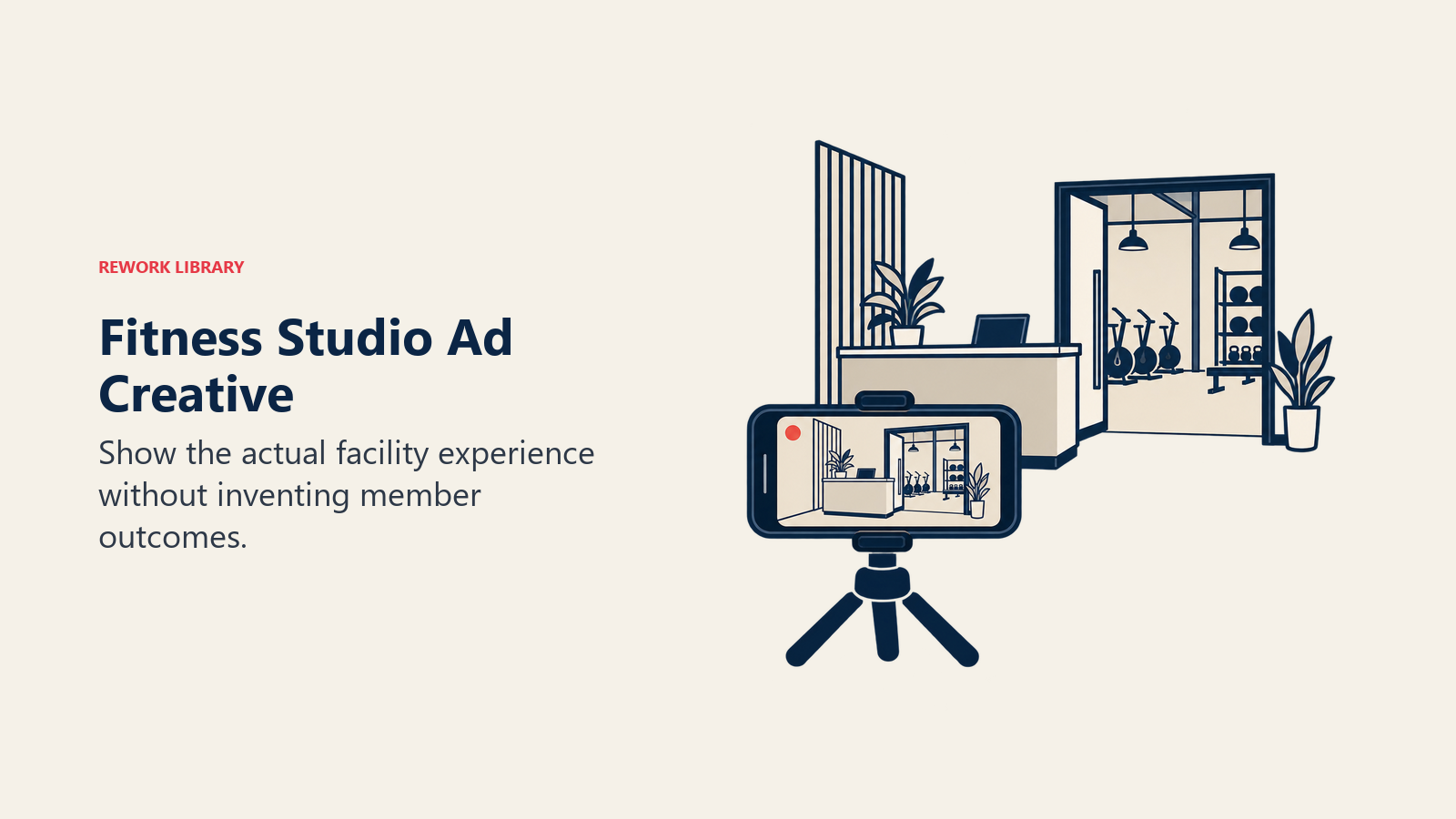
Class preview video (15-30 seconds): A genuine clip of one of your actual classes: the energy, the coaching, the community interaction. No professional production needed. Shot on a phone with decent lighting, showing real people having a real experience. This is the highest-performing creative format for most boutique and hybrid studios. It answers the question "what would it actually feel like to be there?" before the prospect has to commit to visiting.
Transformation story (static or carousel): A before-and-after or a member-written testimonial with a real photo. Not stock imagery. Not a vague "I feel so much better!" quote. Specific: "I've lost 18 pounds in 4 months, my back pain is gone, and I haven't missed a Wednesday class since September" ([Name], member since March 2024). The specificity is what makes it credible. ACE Fitness's guide on running successful fitness business promotions reinforces that the most effective fitness promotions lead with member outcomes, not facility features. That principle applies directly to social ad creative.
Coach or founder video (authentic, 30-60 seconds): A personal, direct-to-camera video from your head coach or owner explaining who the studio is for and what makes it different. This humanizes the brand and builds immediate trust. People join gyms because of people, and showing the person behind the programming is an underused creative approach.
Limited-time offer with deadline: Clear, specific, urgent. "14-Day Free Trial. Available for New Members Only. Offer Ends [Date]." The deadline needs to be real (don't run a "limited time offer" for six months straight; people notice). The specificity of the offer reduces friction significantly versus a vague "contact us to learn more."
What doesn't work:
Generic stock photography. Headline copy that starts with "Are you ready to transform your life?" Ads that show only the equipment rather than the community. Ads that feel like they could have been made by any gym in any city.
Campaign Structure
Organize Meta campaigns across three distinct objectives:
| Campaign Type | Objective | Audience | Budget % |
|---|---|---|---|
| Retargeting | Conversions (trial sign-up) | Website visitors (30 days) | 20-25% |
| Lookalike conversion | Conversions (trial sign-up) | 1-3% lookalike from member list | 40-50% |
| Cold prospecting | Lead generation or Traffic | Interest + behavioral | 25-40% |
At each campaign level, run 2-3 different ad creative options. Let them run for at least 7 days before making judgments on performance. The algorithm needs time to find the right audience within each targeting set.
Budget and Bidding
Starting budgets by goal:
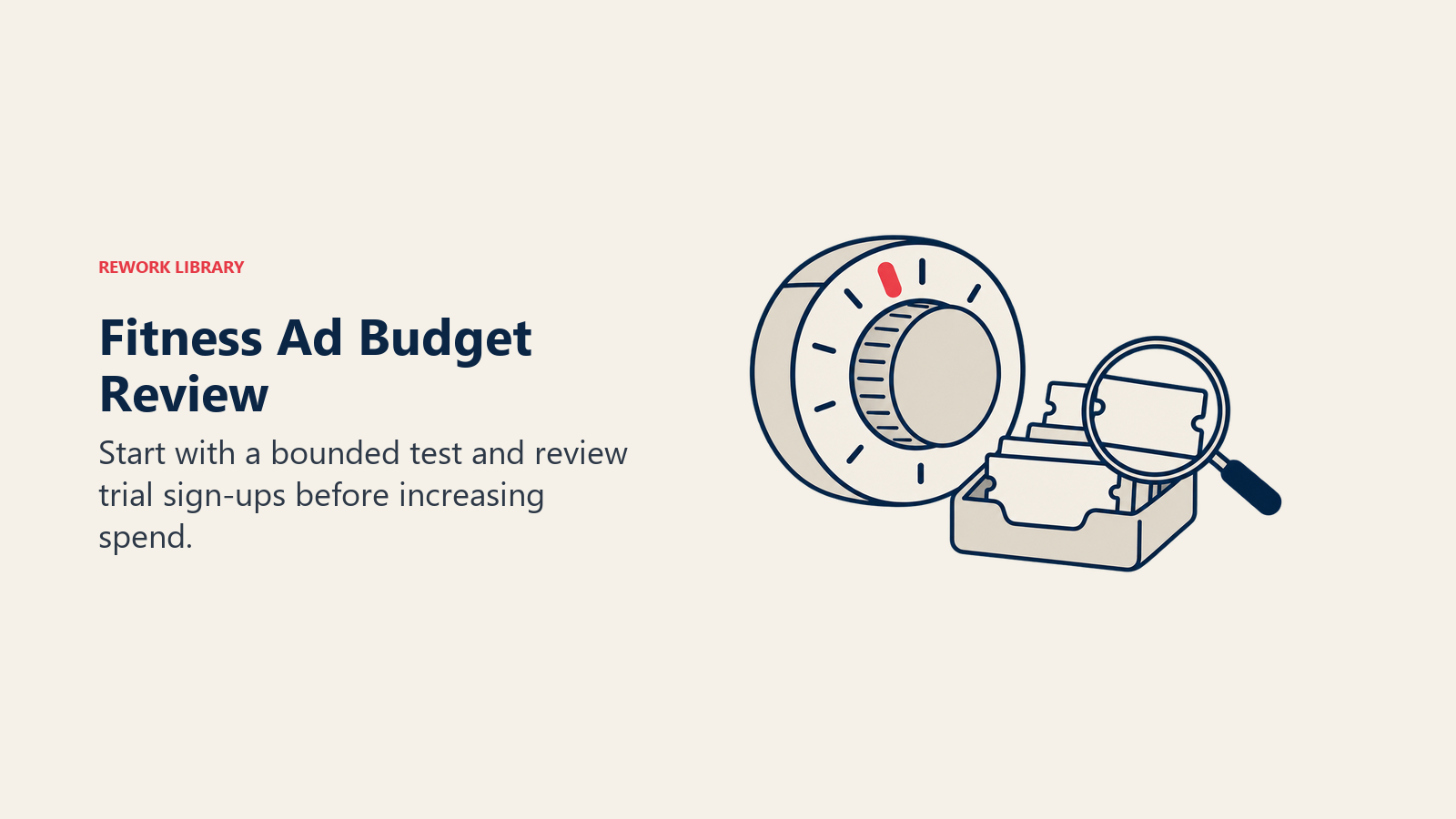
A new campaign with no existing data should start conservatively to gather information before scaling. Recommended starting budgets:
- Retargeting: $5-$15/day (small audience, high intent)
- Lookalike campaigns: $15-$30/day
- Cold prospecting: $20-$40/day
Total starting budget: $40-$85/day ($1,200-$2,550/month). This generates enough data within 30 days to identify what's working and what to scale.
What to optimize for: Use Conversions objective if you have a landing page with a clear action (trial sign-up, contact form) and the Meta Pixel installed. Use Lead Generation objective if you don't have a well-converting landing page yet. Meta's native lead forms have lower friction and can generate leads more cheaply in early campaigns.
Scaling winners: When an ad set is generating trial sign-ups at or below your target CPA, scale by increasing budget by 20-30% every 3-5 days. Dramatic budget increases (doubling overnight) reset the algorithm's optimization and often degrade performance. Gradual scaling preserves the performance momentum.
Conversion Tracking Setup
This is the step most gym operators skip, and it's the reason they can't tell whether their ads are actually working.
Meta Pixel installation: The Pixel is a small snippet of code installed on your website that fires when someone takes an action (visits a page, fills out a form, clicks a button). Install it on your website and verify it's working using the Meta Pixel Helper browser extension before running any campaigns. Without the Pixel, you're tracking clicks, not conversions.
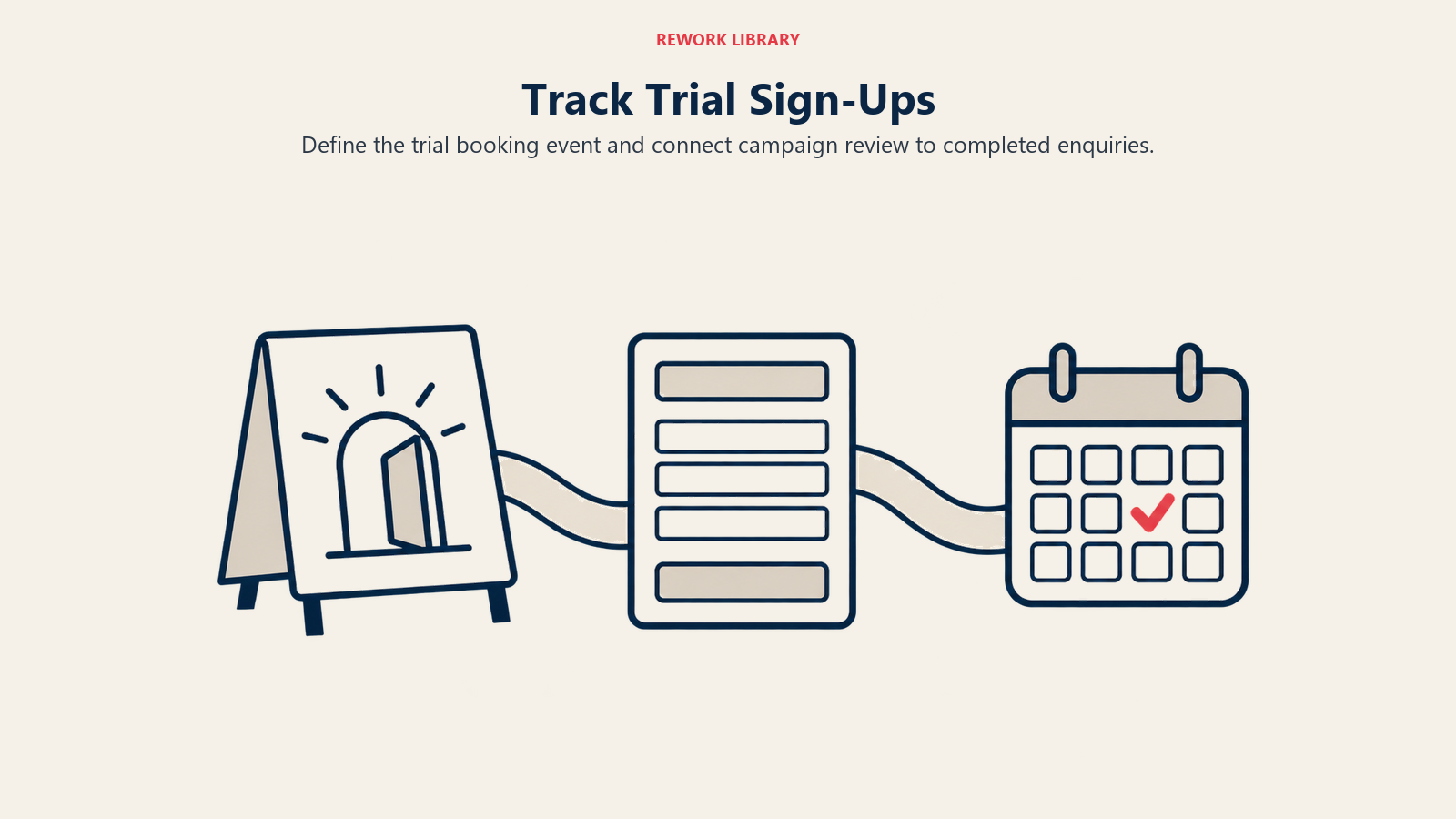
Define your conversion event: For most gyms, the primary conversion event should be trial sign-up (someone completing a form to book a free trial or day pass). Secondary events might include landing page views and phone call clicks. Configure these in Meta Events Manager.
Lead form vs. landing page: Meta's native lead forms (which appear inside the Facebook or Instagram app, without the prospect leaving the platform) typically generate more leads at lower cost than sending traffic to an external landing page. The downside: lead quality can be lower because the friction of completing the form is reduced. Test both for your specific market, but start with native lead forms if you don't have a high-converting landing page already.
The only metric that matters: Cost per trial sign-up. Not impressions, not clicks, not reach. Every campaign decision (which creative to scale, which audience to cut, how much to spend) should reference this number. A $500/month campaign that generates 10 trial sign-ups at $50 CPA is worth more than a $2,000/month campaign that generates 50 clicks but 4 actual trials. Your key gym metrics framework should incorporate paid social CPA as one of the channel-specific inputs to your overall acquisition analysis.
Know Your Break-Even CPA
Before running any campaign, calculate the maximum you can profitably pay for a trial sign-up.
Your trial conversion rate (what percentage of trial visitors convert to paid members) combined with member LTV tells you the revenue value of a successful trial. If your trial converts at 30% and your member LTV is $1,800, one successful trial sign-up is worth $540 in expected revenue.
Your maximum profitable CPA for a trial sign-up is therefore $540 × 0.30 = $162 (the value of the member × the probability of conversion). Most well-run campaigns should run well below this ceiling.
But your trial-to-membership conversion rate matters as much as your CPA. A campaign generating trial sign-ups at $30 CPA with a 10% conversion rate is worse economics than one generating trials at $60 CPA with a 40% conversion rate. Track the full funnel, not just the first click. Pairing well-targeted paid social with a gym referral program lowers your blended CPA significantly, since referrals acquired through member networks cost a fraction of what paid campaigns charge per lead.
Learn More
