Market Positioning for Fitness Studios: Niche, Luxury, and Accessible Strategies
Turn this article into takeaways for your work.


Each assistant summarizes the article only for you and suggests best practices for your work.
Most fitness studios fail not because of bad programming. They fail because they look, sound, and price exactly like five other studios within two miles. Walk into three boutique gyms in any mid-size city and you'll find the same exposed brick aesthetic, the same "community over competition" tagline, and membership rates within $10 of each other. When prospects can't tell you apart, they default to whichever studio is closest or cheapest. Neither is a winning position.
Positioning is the specific combination of who you serve, what problem you solve, and how you're different from everything else available in your market. It's not your logo or your color palette. It's the answer to a prospect's unspoken question: "Why should I choose you instead of the gym down the street?" If you can't answer that in one sentence, you don't have a position. You have a facility. Your positioning decision also determines which gym business model will sustain your financials, because model and position have to align.
The good news is that most local fitness markets have untapped positioning opportunities. Operators who invest real time in positioning before they invest in marketing consistently outperform those who build beautiful facilities and then wonder why foot traffic is soft.
Key Facts: Fitness Studio Market Positioning
- 62% of gym members say "proximity" is the top reason they chose their gym, but 41% say they'd travel further for a studio with a specialization they can't find nearby (IHRSA 2023)
- Studios with a defined niche positioning report 23% lower member churn than generalist competitors, according to Mindbody's 2024 fitness industry report
- The average fitness consumer belongs to 1.8 fitness memberships simultaneously. Niche studios often become someone's "second membership" rather than competing head-on with a primary gym
According to McKinsey's sweating for the fitness consumer report, 84% of U.S. consumers say wellness is a top priority, but they're increasingly fragmented across gyms, apps, and boutique studios, which makes clear positioning more important, not less.
What Market Positioning Means in Fitness
Positioning in fitness isn't just about branding. It's about making a real, operational choice about who you're for and who you're not for. That second part (who you're not for) is what most operators get wrong. They want to serve everyone because excluding anyone feels like leaving money on the table. But when you try to be everything to everyone, your marketing is vague, your programming is generic, and your members don't feel like they belong to anything special.
The clearest framework for fitness positioning sits on two axes: the specificity of your offering (generalist to specialist) and your price signal (accessible to premium). Every studio lands somewhere on this grid, whether they planned it or not.
Niche positioning means going deep on a specific modality, demographic, or outcome rather than offering broad fitness access. A strength training gym that serves competitive powerlifters. A prenatal and postnatal fitness studio. A yoga studio that only teaches Ashtanga. A high-intensity functional training studio for first responders. The niche creates natural self-selection. Your ideal member finds you because you speak directly to their specific need, not because you're the closest option. Specialty fitness programs are the programming layer that makes niche positioning tangible, they're what you deliver on the positioning promise.
Luxury positioning isn't just about charging more. It's about creating an environment, experience, and level of service that justifies a significant price premium and attracts members who prioritize quality over cost. Luxury studios typically operate in 4,000-8,000 square foot spaces with high-end equipment, private showers, premium towel service, and small class caps (12 people maximum). The experience has to match the price signal or members leave quickly.
Accessible positioning is a deliberate choice to compete on value and convenience rather than premium experience. This isn't the same as being cheap. It means removing friction for price-sensitive but health-motivated members. Extended hours, simplified membership options, no contracts, and clean but functional facilities. The operators who do this well don't apologize for not being boutique. They own the accessible position confidently. IBISWorld's U.S. gym and fitness industry report tracks how value-positioned operators have maintained consistent market share even as boutique concepts expanded.
Brand Differentiation Tactics
Once you've chosen a positioning direction, you need to express it consistently across every touchpoint a prospect encounters before joining.

Naming and identity: A studio named "Peak Performance Functional Training" is making a very different claim than "Studio Bloom" or "Iron District." Your name should signal the positioning immediately, even before someone reads your website. Generic names like "FitLife" or "[City Name] Fitness" fight an uphill battle because they communicate nothing about what makes you different.
Instructor personality and methodology: The fastest-growing studios in the boutique space almost always have a signature coach whose personality, credentials, or teaching style attracts a specific community. This isn't about ego. It's about giving prospective members someone to connect with before they walk through the door. A Brazilian jiu-jitsu world champion running strength classes, a former physical therapist who coaches injury-resilient training, a coach who built their own 50-pound weight loss story: these are positioning stories that competitors can't replicate. Strong fitness instructor hiring and retention becomes critical once your positioning depends on specific coaching personalities.
Signature methodology: Studios that name and systemize their training approach create something competitors can't simply copy. It doesn't need to be original. It needs to be yours. A "60-Day Reset" program with a defined protocol, a "Foundations to Functional" beginner pathway, or a weekly programming structure built around periodization principles all create recognizable distinctives. Members can describe what you do to a friend in a way that makes sense.
Visual identity and language: Your visual identity should make the positioning obvious without requiring explanation. A premium studio should look premium: not just clean, but deliberate. Typography, photography, the language you use in your class descriptions: all of it either reinforces the position or undermines it. If you're charging $200/month, your Instagram feed shouldn't look like it was shot on a 2018 iPhone by a front desk employee between check-ins. Your social media content strategy is one of the primary ways prospects evaluate your positioning before they ever walk in.
Competitor Mapping: The 2x2 Positioning Grid
Before you finalize your position, map where your local competitors actually sit. Most operators do this informally. They visit a couple of competing studios and look at their price points. That's not enough. You need a systematic view of the full competitive landscape. A formal competitive analysis for fitness facilities covers the full process, but the 2x2 grid below is the core output you need.
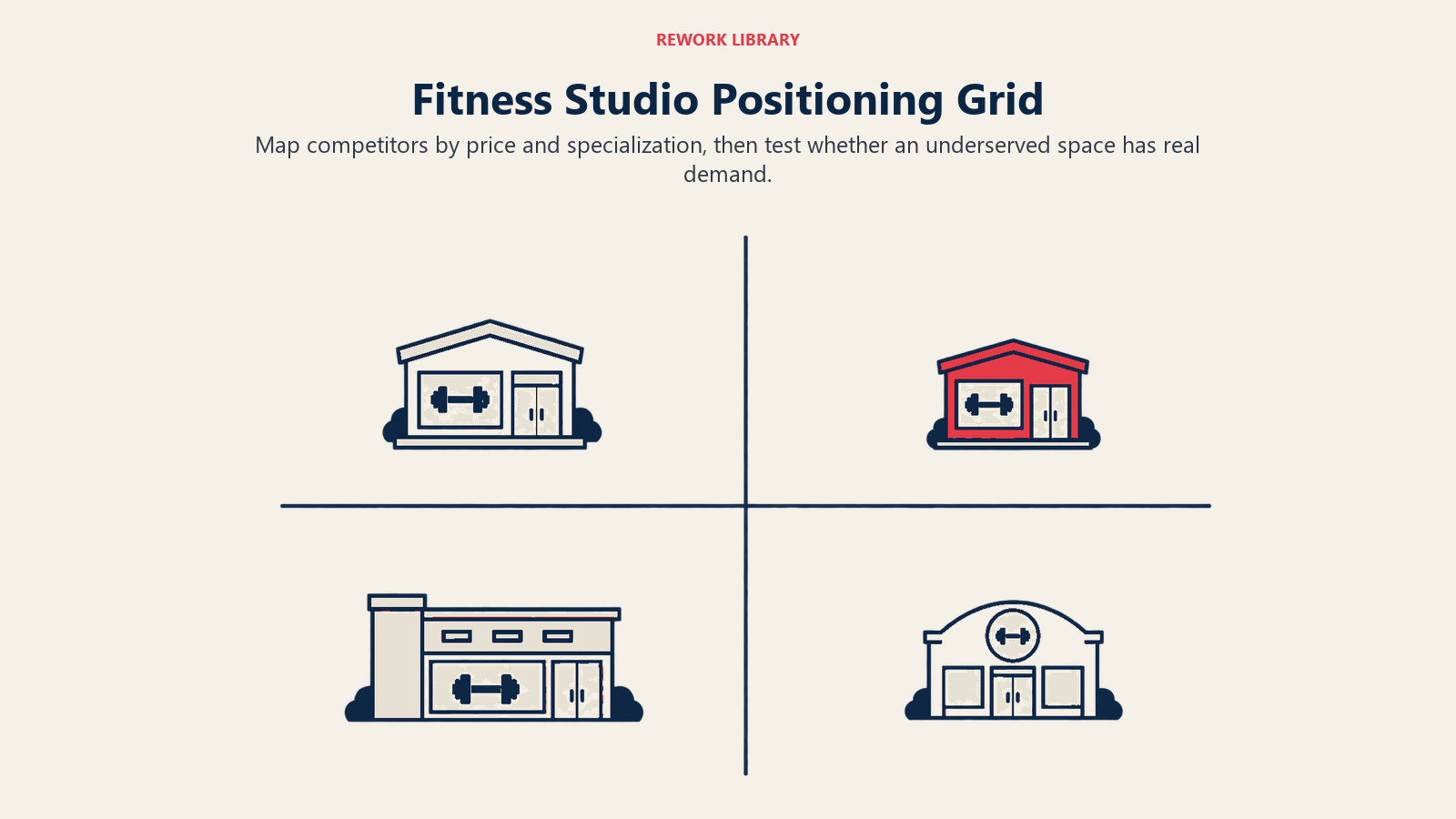
Build a simple 2x2 grid with two axes: price point (low to high) on the horizontal axis, and specialization (generalist to specialist) on the vertical axis. Plot every competitor within a reasonable travel radius: typically 3-5 miles in urban environments, 8-10 miles in suburban markets.
What you're looking for is white space: a quadrant that's underpopulated relative to the demand signals you're seeing. A market with four mid-price generalist gyms and no premium specialists might support a luxury boutique. A market with two expensive boutiques and nothing affordable for early-stage fitness enthusiasts might support an accessible, community-focused gym at a $60-$80/month price point.
| Quadrant | Position | Description |
|---|---|---|
| High price, High specialization | Luxury niche | Premium, specialized, small class sizes |
| High price, Low specialization | Luxury generalist | Full-service premium club |
| Low price, High specialization | Accessible niche | Specialist programming, value pricing |
| Low price, Low specialization | Accessible generalist | Traditional gym, volume model |
The goal isn't to find a quadrant with zero competitors, because that might mean there's no demand, not just no competition. Look for quadrants where demand exists but supply is limited or poorly executed.
Real Positioning Case Studies
The prenatal specialist: A trainer with six years of prenatal fitness certification launches a studio that exclusively serves pregnant women and new mothers, running classes from the first trimester through 12 months postpartum. No general population programming at all. It sounds like a narrow niche, but in a market of 50,000+ women in the 28-40 age bracket, the addressable audience is meaningful. She charges $175/month, has a 3-month waiting list, and gets referrals from every OB practice in town because she's the only dedicated option.
The corporate wellness pivot: A mid-size gym struggling with traditional membership growth signs 12 corporate wellness partnerships with local employers, offering subsidized membership rates in exchange for payroll deduction. They position as the "workplace wellness partner" rather than competing for retail gym traffic. Corporate partnerships generate $18,000/month in guaranteed revenue before a single walk-in joins.
The recovery-focused studio: A licensed physical therapist opens a small group training studio explicitly positioned for injury-resilient training and active recovery. They charge $220/month, cap classes at 8 people, and partner with two orthopedic practices for post-rehab referrals. It's technically a gym, but it competes against physical therapy practices as much as it competes against other gyms.
Testing and Refining Your Position
Positioning isn't a one-time decision made at launch. It's something you observe and adjust over the first 12-18 months based on real market signals.
Early signals your positioning is working: your members describe your studio accurately to friends without prompting. Your conversion rate from first visit to membership is above 35%. You're getting organic referrals from healthcare providers or complementary businesses. New members mention "I was looking specifically for something like this" during their intake conversation. A well-designed free trial and day pass strategy accelerates this feedback loop by giving you dozens of first-impression conversations per month.
Early signals your positioning needs adjustment: you're competing almost entirely on price. Members join but don't invite friends. You're attracting a different demographic than you intended. Your marketing messages feel interchangeable with competitors' messages. You're discounting to close sales more than once a month.
The adjustment process is iterative. If you positioned as a luxury strength studio but you're attracting general fitness members looking for open gym access, you have a mismatch between your marketing messaging and your actual programming. You either need to sharpen the programming to match the luxury positioning or acknowledge that the market is pulling you toward a different position.
A Clear Position Makes Every Marketing Dollar Work Harder
The operators who struggle with marketing almost always have a positioning problem underneath. When your position is vague, your ads have to work much harder to differentiate you. When your position is clear, your marketing can be specific, and specific marketing attracts better-qualified leads.
A studio with a clear niche positioning can say, in a Facebook ad: "Finally, a strength training gym in [City] designed specifically for women over 40. No ego, no intimidation, just results." That ad will generate fewer clicks than a generic "Join Now, First Month Free!" promotion, but the leads will be far more qualified and far more likely to stay. The NSCA's guide on leveraging industry market research for fitness studios outlines how operators can use third-party data to validate their positioning before committing marketing spend. Local marketing strategies for gyms become significantly more effective when your positioning gives them something genuinely distinctive to communicate.
Run the positioning exercise before you finalize your marketing budget. It'll make every dollar you spend on Google ads, social media, and community events more effective because you'll know exactly who you're trying to reach and what you're offering that they can't get elsewhere.
Learn More

Senior Operations & Growth Strategist