Your First RevOps Hire: Role Profile, Skills, and Interview Signals
Your first RevOps hire will shape how the company thinks about revenue operations for years.
Hire too narrow, and RevOps becomes a CRM admin queue. Hire too analytical, and the company gets better reports without better process. Hire too senior, and you may get strategy language without hands-on operating work.
The first RevOps hire should be a systems-minded operator: someone who can map the revenue process, fix handoffs, govern data, build usable dashboards, and earn trust across marketing, sales, customer success, and finance.
This hire should not be treated as "the person who cleans Salesforce." They are the first owner of the revenue operating system.
Forrester's RevOps organizational design research emphasizes that revenue operations brings together work across commercial functions. Your first hire needs to operate across those boundaries, even if the team is still small.
Gartner's guidance on reducing revenue enablement complexity makes a similar point from a different angle: sales and revenue teams create too many disconnected initiatives when no one manages the operating model. The first RevOps hire should reduce that complexity, not add another layer of internal process.
Key operating facts
- The first RevOps hire is usually not a pure analyst, CRM admin, or sales ops specialist. The role needs enough systems skill to build, enough process skill to simplify, and enough influence to change behavior across teams.
- Hiring too late creates cleanup work. Hiring too early without a mandate creates a ticket queue. The timing works when the company has repeatable revenue motion, visible handoff pain, and leaders willing to let one person govern shared rules.
- The hire should inherit a written mandate, even if it is short. A clear RevOps charter protects the role from becoming "whoever fixes the report this week."
- The first 90 days should start with inspection. A practical revenue process audit gives the hire evidence before they change fields, workflows, dashboards, or meeting rhythms.
What the first hire owns
The first RevOps hire should own:
- Revenue lifecycle definitions
- Lead routing and handoff rules
- CRM hygiene and field governance
- Core revenue dashboards
- Forecast data quality
- Closed-won handoff process
- Revenue operating cadence
- RevOps roadmap
They should not be expected to solve every system problem alone. But they should know how to prioritize the operating problems that matter.
Turn this article into takeaways for your work.


Each assistant summarizes the article only for you and suggests best practices for your work.
The job is not to own every commercial outcome. It is to own the operating conditions that make those outcomes easier to manage. That distinction matters because the first hire will be pulled into every problem that touches revenue data. A campaign underperforms, sales asks for a new dashboard. A forecast misses, finance asks for stricter fields. A customer churns, CS asks for new handoff requirements. Each request may be reasonable, but not every request should become a RevOps priority.
A strong first hire converts those requests into operating questions:
| Request | Better operating question |
|---|---|
| "Build a dashboard for MQL quality" | Which lifecycle definition or rejection reason is missing? |
| "Make this CRM field required" | Which decision breaks if the field is empty? |
| "Automate this handoff" | Is the handoff rule clear enough to automate safely? |
| "Fix forecast accuracy" | Which stage, close-date, or commit rule is not being inspected? |
| "Clean the CRM" | Which data defects create revenue or customer risk? |
This is why the first hire should be close to the operating cadence, not buried inside a support queue. They need to hear the real debates in forecast calls, campaign reviews, renewal reviews, and finance planning. The work is partly technical, but the diagnosis is organizational.
What they should not own alone
The first RevOps hire should not own company revenue strategy, sales coaching, marketing channel strategy, customer success delivery, or finance planning.
They should support those functions by making the operating system reliable. Functional leaders still own performance in their lanes.
This distinction prevents a common hiring mistake: expecting RevOps to fix every revenue outcome without giving it authority over the shared system.
The safest framing is: functional leaders own performance, RevOps owns shared operating quality. Sales still owns selling. Marketing still owns demand. CS still owns customer outcomes. Finance still owns planning. RevOps makes the definitions, data, handoffs, rules, and inspection rhythm consistent enough that those leaders can manage the same revenue system.
If this boundary is unclear, the first hire gets blamed for outcomes they cannot control. If the boundary is too narrow, they become a systems helper with no authority. The right middle ground should be written before the role is opened.
Skills to look for
The strongest candidates can explain how a lead becomes revenue in operational detail.
| Skill | Why it matters |
|---|---|
| Process design | RevOps fixes workflows, not only reports |
| CRM fluency | The CRM is usually the operating core |
| Data judgment | The hire must know which fields and metrics matter |
| Cross-functional trust | RevOps works only if teams accept governance |
| Executive communication | Leaders need clear tradeoffs and operating narrative |
| Bias to simplification | Early RevOps should reduce complexity, not add it |
They should also be comfortable saying no. A first RevOps hire will receive many requests for fields, reports, views, automations, and imports. If they say yes to everything, they become a ticket queue. If they say no without context, they lose trust. The skill is explaining the operating tradeoff.
Role profile
A practical first RevOps role profile looks like this:
Mission: Build and maintain the operating system that makes revenue measurable and predictable across marketing, sales, customer success, finance, and systems.
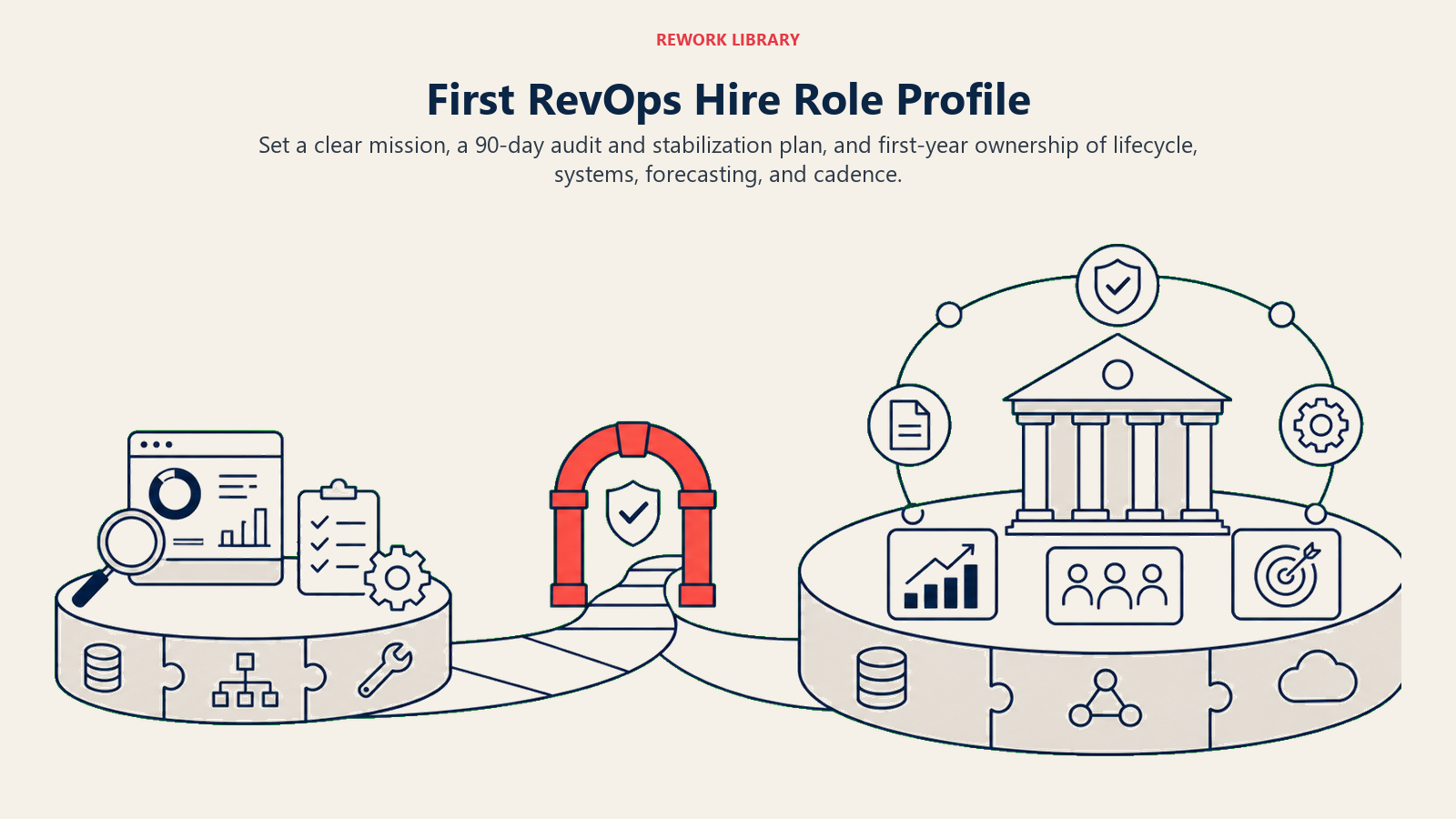
First 90 days:
- Audit the revenue lifecycle.
- Identify broken handoffs.
- Baseline CRM data quality.
- Document source-of-truth rules.
- Stabilize the highest-risk workflow.
- Build a small trusted dashboard.
- Draft the RevOps charter.
First year:
- Standardize lifecycle definitions.
- Govern CRM fields and system changes.
- Improve forecast data quality.
- Build revenue cadence.
- Connect customer success data into revenue reporting.
- Reduce manual reporting work.
See First 90 Days in RevOps for the onboarding plan.
Choose the level by operating risk
The first RevOps hire can be a manager, director, or senior individual contributor. The title matters less than the operating risk they must carry.
Use this simple test:
| Current company reality | Better first hire profile |
|---|---|
| CRM is messy, but leaders agree on the motion | Hands-on RevOps Manager or senior IC |
| Marketing, sales, and CS disagree on lifecycle definitions | Director-level operator with cross-functional authority |
| Multiple systems, complex attribution, and finance reporting gaps | Director or head of RevOps with strong data governance |
| Enterprise sales motion with heavy forecast pressure | Forecast and pipeline governance specialist who can influence sales leadership |
| Product-led or high-volume inbound motion | Systems-minded operator with routing, lifecycle, and automation depth |
| Company already has sales ops and marketing ops | RevOps leader who can design the broader RevOps team structure |
Early companies often over-hire for seniority and under-hire for build ability. A first RevOps hire who wants a team, clean data, and a large transformation budget may not be useful in the first six months. The early job usually includes ugly work: mapping fields, inspecting records, rewriting lifecycle definitions, sitting with managers, removing duplicate reports, and saying no to low-value requests.
But under-hiring is also risky. If the person cannot challenge functional leaders, they will struggle to govern shared definitions. The right candidate needs enough authority to disagree with a VP of Sales about opportunity criteria or a marketing leader about MQL definitions without turning the conversation political.
In practice, the strongest first hires tend to be builders with director-level judgment, even if their title is manager. They can configure a workflow, but they can also explain why the workflow should not exist yet.
Interview questions
Ask:
- Walk me through how you would audit our lead-to-revenue process in your first 30 days.
- How would you decide whether a CRM field should be required?
- What makes a forecast unreliable?
- How would you handle marketing and sales disagreeing on MQL quality?
- What dashboards would you build first, and what would you refuse to build?
- Tell me about a time you changed a process people were used to.
Good answers are concrete. Weak answers stay at the level of "alignment", "visibility", and "better reporting."
What strong answers sound like
For the audit question, a strong candidate describes records, not only interviews. They would inspect recent leads, opportunities, closed-won deals, and renewal-risk accounts. They would compare system data with what teams say.
For the required-field question, a strong candidate ties fields to decisions: routing, qualification, forecast, handoff, compliance, or delivery. They do not make fields required just because someone wants a report.
For the forecast question, a strong candidate mentions stage criteria, close-date hygiene, manager inspection, commit rules, and data completeness. They do not blame only rep optimism.
For the dashboard question, a strong candidate starts small: pipeline, conversion, forecast, retention, data quality. They also name dashboards they would refuse until definitions are clear.
Common hiring mistakes
Hiring only a CRM admin. Admin skills are useful, but the first RevOps hire must define process and governance, not only configure fields.
Hiring only an analyst. Analysis identifies issues. RevOps also changes the system so the issue does not recur.
Hiring too senior for the work. A first RevOps hire usually needs to build, clean, document, and lead working sessions. If the candidate only wants to manage a team, timing may be wrong.
Giving no authority. A first hire cannot own data quality if every field change requires political negotiation.
Hiding the mess. Candidates need to know the real state of the CRM, reporting, and handoffs. A sanitized interview process leads to mismatched expectations.
Scorecard for the first hire
Use a scorecard instead of relying on general confidence.
| Area | Strong signal | Weak signal |
|---|---|---|
| Process thinking | Maps handoffs and failure points | Talks mainly about dashboards |
| Systems judgment | Understands fields, workflows, integrations | Focuses only on one tool |
| Data quality | Knows governance and adoption tradeoffs | Assumes cleanup solves the issue |
| Communication | Explains tradeoffs clearly | Uses vague alignment language |
| Prioritization | Separates urgent breakage from roadmap work | Accepts every request |
| Cross-functional trust | Understands marketing, sales, CS, and finance needs | Speaks only from one functional view |
The scorecard should match your current bottleneck. If the main issue is forecast trust, weight forecast and finance alignment more heavily. If the main issue is lead leakage, weight lifecycle and handoff process more heavily.
Decision rights to define before hiring
Many first RevOps hires fail because the company never defines what they can decide.
Before opening the role, decide who has final authority over:
| Decision | Recommended owner |
|---|---|
| Lifecycle stage definitions | RevOps with revenue leadership approval |
| CRM field creation and retirement | RevOps with systems owner |
| Required fields | RevOps with functional owner and finance input when needed |
| Lead routing rules | RevOps with marketing and sales leadership |
| Opportunity stage exit criteria | Sales leadership with RevOps governance |
| Forecast category definitions | Sales and finance with RevOps governance |
| Closed-won handoff requirements | Sales and CS with RevOps governance |
| Dashboard source of truth | RevOps with finance for executive metrics |
These do not need to be heavy committees. They need to be explicit. A lightweight RevOps RACI is enough to prevent surprise vetoes after the hire starts changing the system.
Decision rights also protect speed. If every small change requires a leadership meeting, RevOps becomes slow and political. If RevOps can change anything without consultation, teams lose trust. The role needs a clear lane: minor field help text, dashboard cleanup, and report retirement can often be handled by RevOps directly. Changes to qualification, forecast, billing, customer handoff, or executive reporting need named stakeholders.
This is a good interview topic. Ask the candidate where they would want authority and where they would want approval. Strong candidates do not ask for unchecked control. They ask for a governance model that lets them move quickly on low-risk work and slow down on high-risk definitions.
Practical interview exercise
The best interview exercise is not a generic case study. Give the candidate a small version of your real operating mess.
For example:
Here are five recent leads, four opportunities, one closed-won deal, and one renewal-risk account. The records are incomplete. Tell us what you would inspect, what you would ask each team, and what you would fix first.
The point is not to test whether they know your CRM perfectly. The point is to see how they think.
Strong candidates will separate symptoms from causes. They might notice that lead source is inconsistent, that rejected leads have no reason code, that late-stage opportunities lack next steps, or that the closed-won record does not explain the promised implementation scope. Then they will decide which issue matters first.
Weak candidates usually jump to dashboard ideas before understanding the workflow. They may recommend required fields everywhere, automation everywhere, or a full CRM redesign. That sounds active, but it often creates more friction before the company knows what problem it is solving.
A second useful exercise is a tradeoff conversation:
Sales wants a required field for competitor. Marketing wants a required field for campaign theme. CS wants a required field for onboarding risk. The reps are already complaining that the CRM takes too long. What do you do?
A strong answer ties each field to a decision. If the field changes routing, forecast, qualification, handoff, compliance, or customer delivery, it has a stronger case. If it only supports a low-use report, it can probably wait.
First hire onboarding plan
Do not onboard the first RevOps hire by handing them a backlog of tickets. That trains the company to treat RevOps as support.
A better onboarding plan starts with access, context, and decision rights:
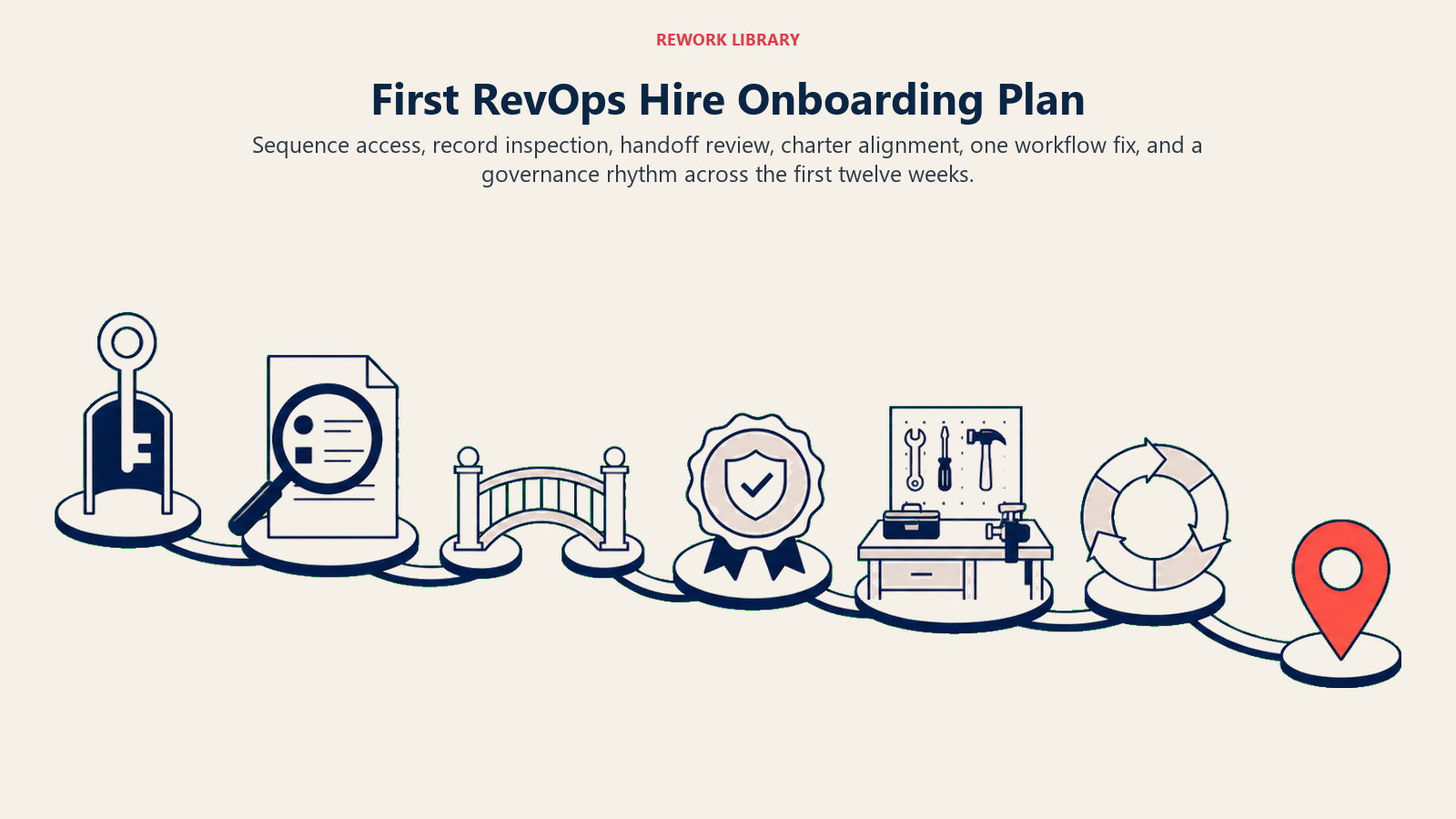
| Week | Focus | Output |
|---|---|---|
| 1 | Learn the revenue motion | Interview map and system access checklist |
| 2 | Inspect records and reports | Lifecycle risk notes and dashboard trust audit |
| 3 | Review handoffs | Lead, opportunity, and closed-won failure points |
| 4 | Align with leaders | Draft RevOps charter and top five priorities |
| 5 to 8 | Fix the first workflow | One measurable operating improvement |
| 9 to 12 | Build cadence | RevOps roadmap and monthly governance rhythm |
The first hire should have direct time with marketing, sales, CS, finance, and systems. They should also sit in real operating meetings: forecast calls, pipeline reviews, campaign reviews, renewal reviews, and leadership meetings where revenue data is debated.
That exposure matters because RevOps cannot be designed from the ticket queue. It has to be designed from how work actually moves.
One useful practice is to give the new hire a "shadow ledger" for the first month. Every time a leader asks for a report, every time a rep complains about a field, every time finance rebuilds a number, and every time CS says deal context is missing, the new hire records the operating reason. By the end of the month, the company can see the pattern behind the requests.
That ledger often becomes the first roadmap. It shows which issues are one-off cleanup tasks and which ones are system problems. A one-off missing field may not need a new process. A repeated missing field across closed-won deals probably needs stage criteria, required handoff data, manager inspection, and dashboard visibility.
The onboarding plan should end with a decision meeting. The first hire presents the top operating risks, the first workflow to fix, the requests they will pause, and the governance rhythm they need. That meeting is where leadership proves whether RevOps has a mandate or only a title.
The first roadmap should be boring
The first roadmap should not be a giant transformation deck. It should be a short operating plan that removes the biggest sources of confusion.
A useful first roadmap usually has four lanes:
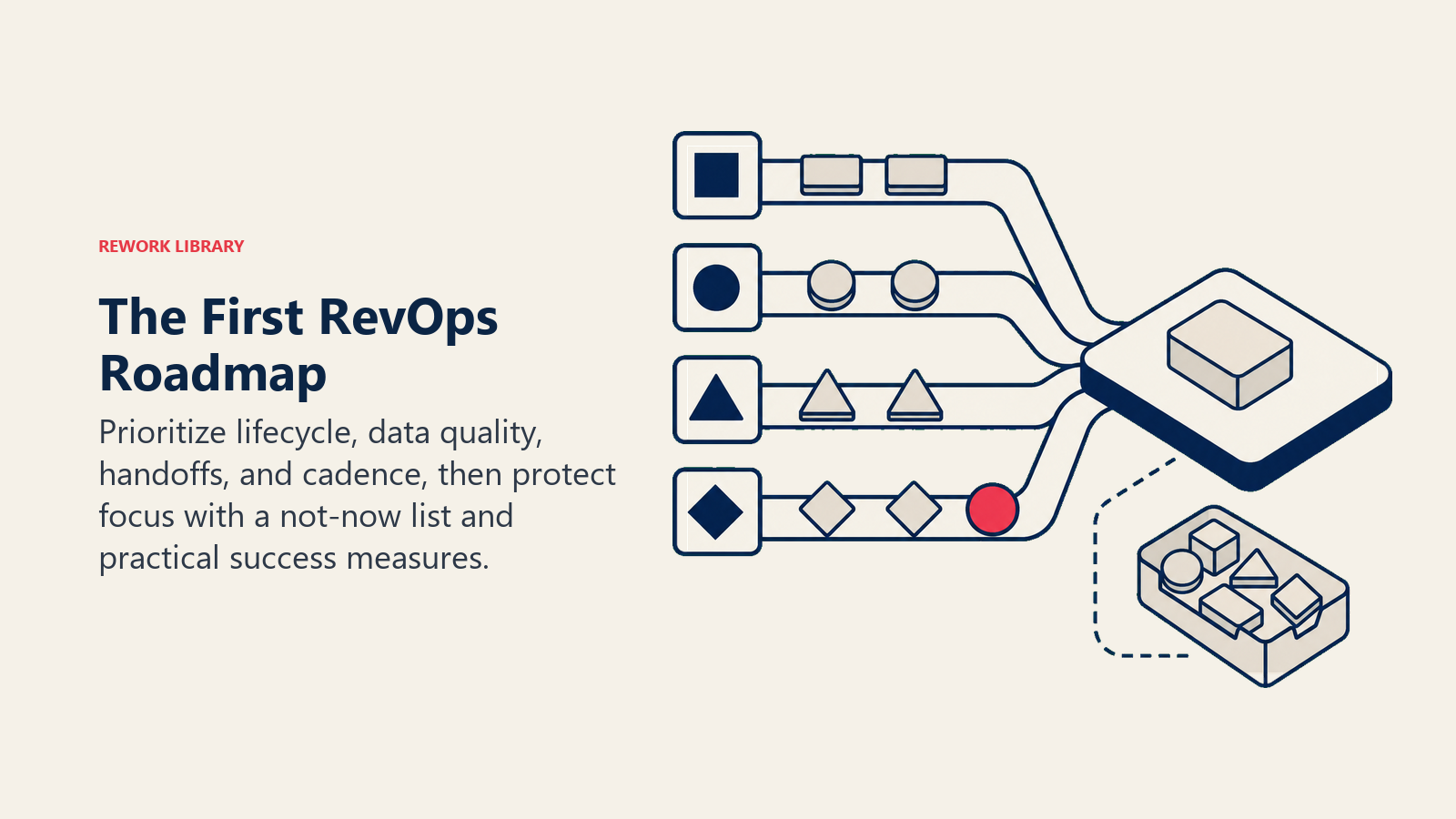
| Lane | Example first work |
|---|---|
| Lifecycle | Rewrite lead, MQL, SQL, opportunity, closed-won, renewal, and expansion definitions |
| Data quality | Fix required fields, duplicate rules, source fields, ownership, and field retirement |
| Handoffs | Stabilize lead routing, sales acceptance, closed-won handoff, and renewal risk escalation |
| Cadence | Clean up pipeline review, forecast call, handoff review, and data quality review |
The roadmap should include a "not now" list. This is where many first hires earn trust. They explain why a new BI migration, full CRM rebuild, advanced attribution model, or AI automation layer may need to wait until definitions and data are stable. Saying "not yet" is different from saying no. It keeps the company from stacking complex work on top of weak foundations.
The first roadmap should also include success measures. Good measures are practical:
- Fewer unworked leads past SLA
- Higher handoff completeness
- Lower duplicate rate
- Clearer forecast category usage
- Fewer conflicting executive reports
- Higher manager trust in pipeline views
- Faster answer to common revenue questions
Avoid measuring the first hire only by backlog closed. Ticket volume can make RevOps look productive while the operating system stays fragile. Measure whether the highest-risk workflows become easier to run.
Red flags
Watch for these candidate signals:
- They describe RevOps mainly as reporting.
- They blame data quality only on reps.
- They want to redesign the CRM before learning the process.
- They cannot explain how marketing, sales, CS, and finance use the same data differently.
- They avoid conflict around governance.
- They use broad alignment language but cannot name operating artifacts.
- They treat tool expertise as a substitute for process judgment.
Also watch for a company-side red flag: hiring RevOps without giving the role authority.
If every lifecycle definition, field change, routing rule, and dashboard decision can be overridden by the loudest stakeholder, the first hire will not succeed. A RevOps hire needs executive backing for governance. Without it, they become the person who documents confusion.
Compensation and level
The right level depends on scope.
A RevOps Manager can work if the company needs hands-on ownership and the executive team can provide decision support.
A Director of RevOps is better if the role needs to push across multiple functional leaders, govern systems, and build a multi-quarter roadmap.
A VP RevOps is usually too early unless the company already has multiple ops specialists or significant revenue complexity.
Do not use title inflation to compensate for lack of authority. A Director title without decision rights will still fail.
When in doubt, choose the level that can do the work in front of the company. A practical RevOps Manager with good judgment can create more value than a senior leader who expects a team, a clean system, and a strategic planning seat on day one.
First-hire scorecard
Use a scorecard before choosing the first RevOps hire profile.
| Need | Better profile |
|---|---|
| CRM, routing, and workflow reliability | Systems-capable operator |
| Funnel and forecast diagnosis | Analyst with operating judgment |
| Cross-functional handoff design | Process-oriented RevOps lead |
| Finance and planning trust | RevOps leader with forecasting experience |
| Too many ungoverned requests | Operator with charter and intake discipline |
The first hire should match the current operating bottleneck. A brilliant analyst will struggle if the real problem is process ownership. A systems admin will struggle if the real problem is executive decision rights.
Frequently Asked Questions about Your First RevOps Hire
What title should the first RevOps hire have?
For most growth-stage companies, Revenue Operations Manager or Director of Revenue Operations works better than VP unless the company already has a team to manage.
Should they know Salesforce or HubSpot?
They should know your CRM well enough to govern it. But do not make tool expertise the only hiring filter.
Should the first hire come from Sales Ops?
They can, as long as they understand marketing, CS, finance, and cross-functional data governance.
What should the first hire deliver in 90 days?
A lifecycle audit, handoff risk list, data quality baseline, dashboard trust audit, RevOps charter draft, and first operating roadmap.
Learn more

Principal Solution Architect
On this page
- What the first hire owns
- What they should not own alone
- Skills to look for
- Role profile
- Choose the level by operating risk
- Interview questions
- What strong answers sound like
- Common hiring mistakes
- Scorecard for the first hire
- Decision rights to define before hiring
- Practical interview exercise
- First hire onboarding plan
- The first roadmap should be boring
- Red flags
- Compensation and level
- First-hire scorecard
- Learn more