Deal Health Scoring: How RevOps Flags Pipeline Risk
Deal health scoring helps teams spot pipeline risk before a forecast miss.
The score should not replace manager judgment. It should focus attention on deals that need inspection.
Gartner's forecast confidence research is relevant because deal risk often becomes visible before the forecast miss, but teams need a system to notice it. McKinsey's sales productivity research also supports using management focus and clear operating signals to improve productivity.
Key operating facts
- Deal health scoring should prioritize manager inspection. It should not replace judgment or automatically decide forecast category.
- Useful scores combine timing, activity, buyer coverage, stage evidence, risk, close-date movement, and next-step quality.
- A simple transparent score is usually better than a complex black box if managers cannot explain why a deal is flagged.
- RevOps should review score accuracy after the period closes and adjust signals that create noise or miss real risk.
Common inputs
| Signal | Risk pattern |
|---|---|
| Stage age | Deal stuck too long |
| No next meeting | Momentum is weak |
| Close date pushed | Timing risk |
| Single-threaded | Buyer coverage risk |
| Missing decision criteria | Qualification risk |
| Low activity | Engagement risk |
| No mutual plan | Commit risk |
Use scoring to support Pipeline Inspection Cadence, not to automate forecast calls blindly.
What deal health scoring is for
Deal health scoring is a prioritization tool.
It helps managers decide where to inspect. It helps RevOps find pipeline patterns. It helps sales leaders see risk earlier. It should not claim to know the future with false precision.
A good score answers:
- Which deals need manager attention?
- Which risks are visible in the data?
- Which stage rules may be weak?
- Which reps need coaching?
- Which forecast categories need review?
- Which process issues repeat across many deals?
The goal is not to create a perfect number. The goal is to improve inspection quality.
Score design principles
Use a score that managers can understand.
| Principle | Why it matters |
|---|---|
| Separate signal from judgment | The score should flag risk, not decide the forecast |
| Show reasons | Managers need to know why a deal was flagged |
| Weight by materiality | Large current-period deals deserve more attention |
| Avoid false precision | A red, yellow, green model may be enough |
| Review outcomes | Scores should improve after comparing to actual slips and wins |
For example, a deal might be flagged red because it is in commit, has no next meeting, has moved close date twice, and has no economic buyer identified. That is useful because the manager can inspect specific evidence. A score of 63 without explanation is less useful, even if the model is mathematically more complex.
Simple score design
Start with green, yellow, and red.
| Health | Meaning | Action |
|---|---|---|
| Green | No visible risk based on current rules | Continue normal inspection |
| Yellow | One or more risk signals need review | Manager inspects and records action |
| Red | Material risk threatens timing or quality | Manager and leader review before forecast |
This is easier to trust than a score of 73. A 73 looks precise, but the underlying data may not support that precision.
Risk signal examples
Useful risk signals:
- Stage age exceeds threshold
- No next meeting
- Close date moved more than once
- Close date in the past
- No economic buyer
- No decision process
- No legal or procurement status
- No mutual plan for complex deal
- Amount changed late
- Forecast category changed late
- No activity in recent days
- Single contact on large opportunity
- Customer health risk for expansion or renewal
Each signal should have a clear reason and a suggested inspection question.
Weighting the score
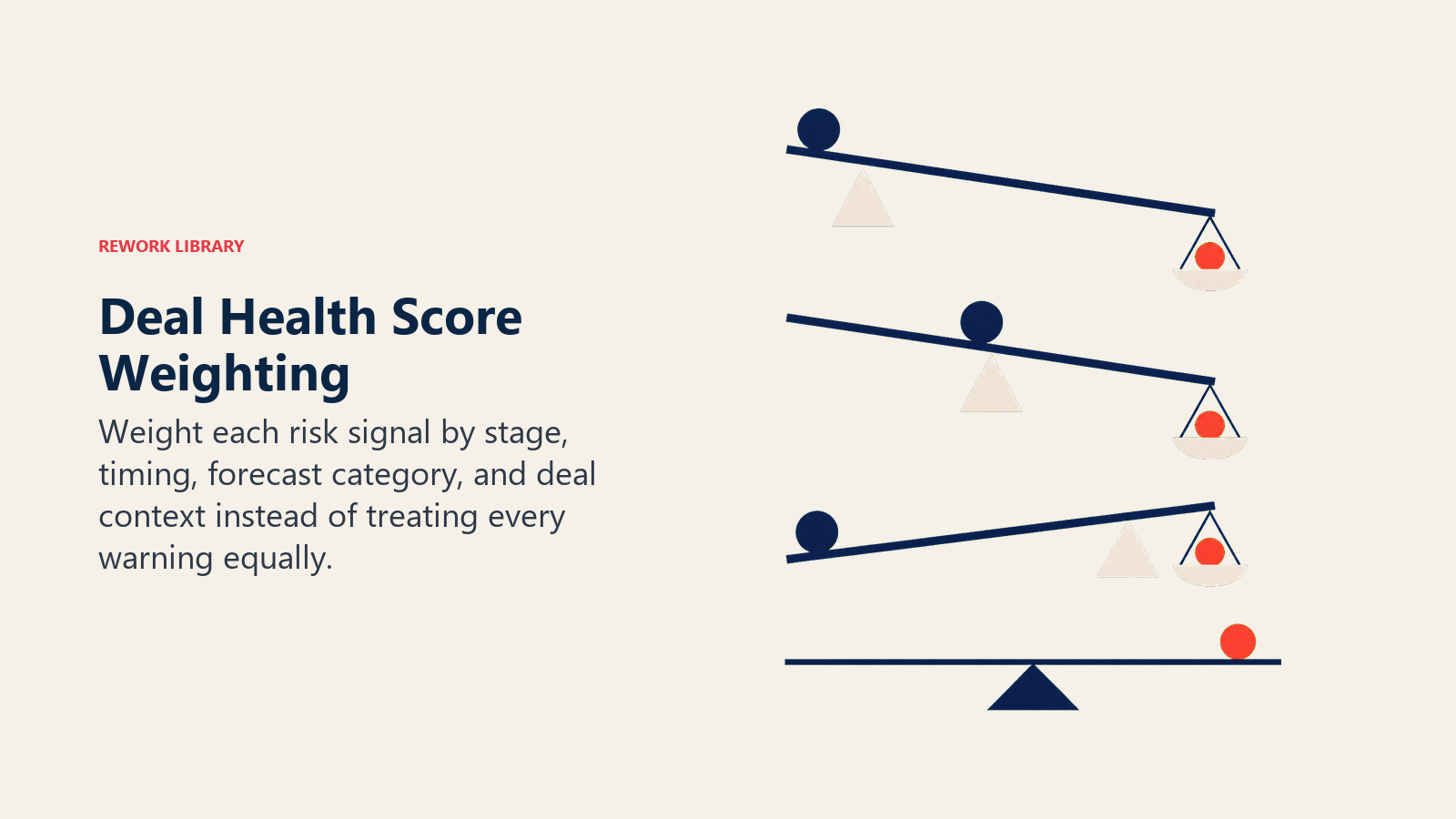
Not every signal should carry the same weight.
A missing next step in an early-stage deal may be a small risk. A missing next step in a commit deal closing this month is a large risk. A close-date push in discovery may be normal. A close-date push after legal review may be a forecast issue.
Turn this article into takeaways for your work.


Each assistant summarizes the article only for you and suggests best practices for your work.
RevOps should weight signals by:
- Stage
- Forecast category
- Deal amount
- Close period
- Segment
- Sales motion
- New business vs renewal
- Strategic account status
The first model can be simple. The important part is to make the weighting explainable.
Deal health and commit
Deal health scoring should support Commit Criteria.
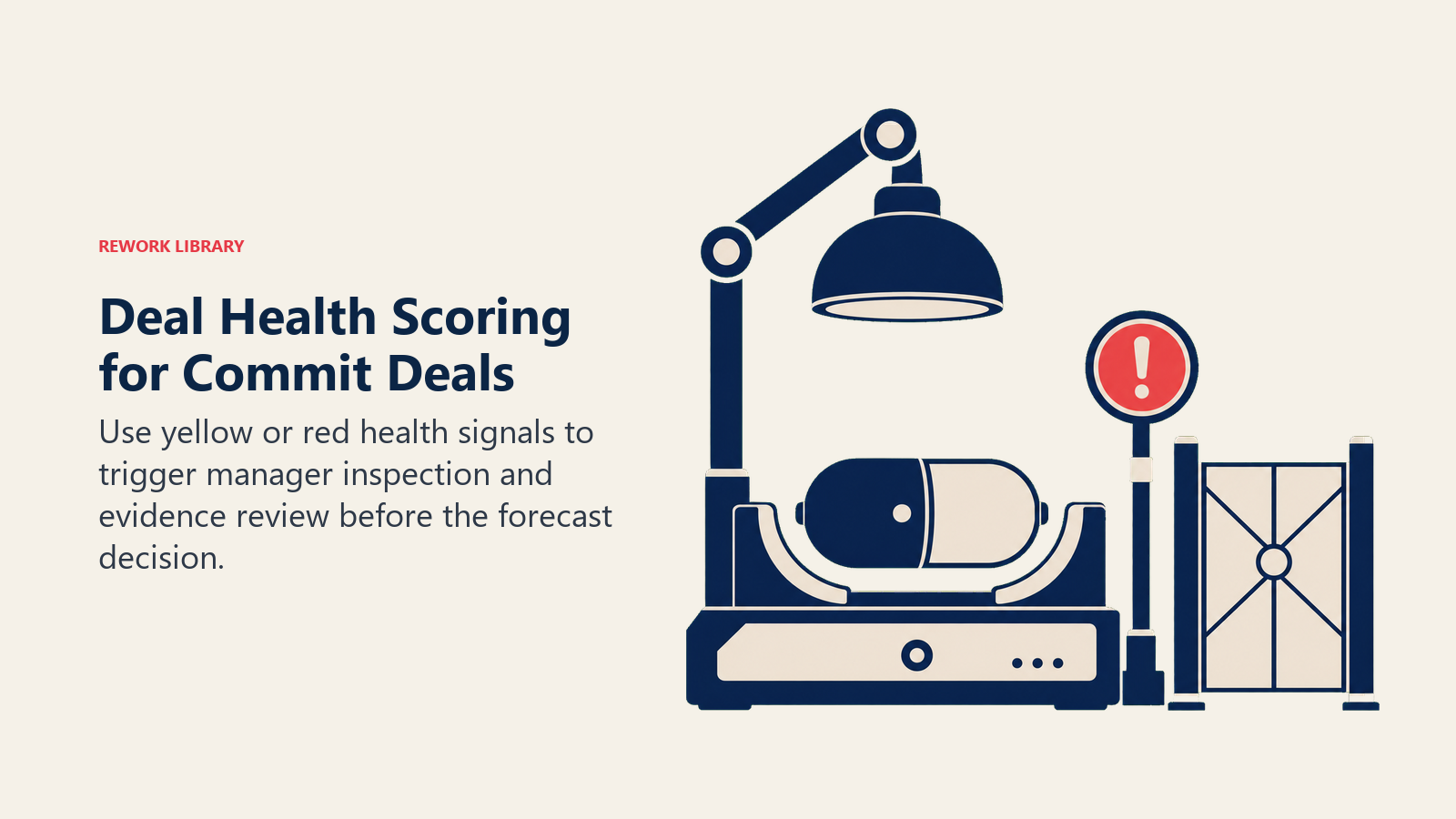
If a deal is in commit and the health score is yellow or red, the manager should inspect the evidence before the forecast call. The deal may still remain in commit, but the risk should be visible.
Examples:
- Commit deal with no procurement status: inspect buyer process.
- Commit deal with close date pushed twice: inspect timing evidence.
- Commit deal with one contact: inspect buyer coverage.
- Commit expansion with weak product adoption: inspect value proof.
The score should not remove the deal automatically. It should force a better conversation.
How to use the score
Keep the first version simple. Use green, yellow, and red rather than a false-precision score out of 100. A red deal should trigger inspection, not automatic removal from forecast. A green deal should still need manager judgment before commit.
The best operating habit is trend review. If a deal moves from green to yellow because the close date pushed and no next meeting exists, the manager has a specific coaching question. If many deals in the same segment turn yellow for the same reason, RevOps has a process problem to investigate.
Manager workflow
A practical manager workflow:
- Review yellow and red deals before pipeline inspection.
- Ask the inspection question tied to each signal.
- Decide whether the deal needs action, category change, or no change.
- Record the action owner.
- Review changes before the forecast call.
This keeps scoring connected to coaching.
RevOps workflow
RevOps should maintain the scoring model:
- Define signals.
- Set thresholds.
- Review false positives.
- Review missed risks.
- Tune by segment.
- Document rule changes.
- Train managers on interpretation.
- Report trends to leadership.
If managers ignore the score, RevOps should not simply add more alerts. It should ask whether the signals are useful, explainable, and tied to real decisions.
Data requirements
Deal health scoring depends on data quality.
Useful fields include:
- Stage
- Forecast category
- Close date
- Last activity
- Next meeting
- Next step
- Deal amount
- Decision process
- Economic buyer
- Procurement status
- Legal status
- Mutual plan
- Customer health for existing accounts
If these fields are missing or unreliable, start with fewer signals. A simple model based on stage age, next step, close-date movement, and activity can still create value.
AI and deal health
AI can help detect patterns humans miss, but AI should not be the first step.
Start with transparent rules. Then consider AI for:
- Summarizing account activity
- Detecting risk language in notes
- Comparing similar historical deals
- Flagging missing buyer roles
- Suggesting next inspection questions
- Identifying renewal or expansion risk
Keep humans in charge of forecast decisions. AI output should be logged and reviewed, especially when it affects forecast, prioritization, or customer treatment.
Common mistakes
Score replaces judgment. Managers stop inspecting.
Too many signals. The model becomes noisy.
No explanation. Reps do not know what to fix.
Same thresholds for every motion. Enterprise and transactional deals behave differently.
No feedback loop. False positives and missed risks never improve the model.
Score is hidden from reps. Coaching opportunity is lost.
Health score dashboard
A useful dashboard shows:
- Health by forecast category
- Red and yellow commit deals
- Health by manager
- Health by segment
- Top risk signals
- Health trend over time
- Deals that moved from green to red
- Deals that closed despite red signals
- Deals that slipped with prior yellow or red signals
The dashboard should help leaders inspect where risk is concentrated.
Readiness checklist
Before rollout:
- Risk signals are defined.
- Thresholds are written.
- Data fields are reliable enough.
- Managers understand interpretation.
- Actions are tied to score states.
- Forecast call handoff is clear.
- False positive review is scheduled.
- Reps can see what to fix.
What the checklist should prove
Deal health scoring is useful when it improves inspection. If it creates arguments about the score instead of better action on risky deals, simplify the model until managers trust it.
Example scoring model
A first version can use rule bands:
| Signal | Yellow | Red |
|---|---|---|
| Stage age | Above normal threshold | Twice normal threshold |
| Next step | Vague next step | No next step |
| Close date | Moved once | Moved more than once |
| Activity | Low recent activity | No recent activity |
| Buyer coverage | One active contact | No economic buyer |
| Commit evidence | One missing field | Multiple missing fields |
The model should show the reason behind the color. A rep should be able to see why a deal is yellow and what action would improve it.
False positives and missed risks
Every scoring model will be wrong sometimes.
False positives are deals marked risky that still close smoothly. Missed risks are deals marked healthy that slip or lose. RevOps should review both.
Questions:
- Did the signal threshold create noise?
- Did the model miss an important field?
- Did the manager override the score correctly?
- Did reps update fields late?
- Did the customer behave differently from historical patterns?
- Should this motion use different rules?
This feedback loop keeps the model credible.
Rollout plan
Roll out deal health scoring in stages.
First, run the model in shadow mode. Show managers the signals, but do not change forecast rules yet. Second, compare scores to actual deal outcomes. Third, tune thresholds. Fourth, add the score to pipeline inspection. Fifth, include red commit deals in the forecast packet.
Shadow mode helps managers trust the model before it affects behavior.
Rep experience
Reps should not experience deal health scoring as a mysterious penalty.
They should see:
- Current health state
- Reasons for the state
- Suggested actions
- Manager review status
- Whether the score affects forecast review
If the score is transparent, reps can improve deal quality. If the score is hidden, they may treat it as an unfair inspection tool.
Governance
Deal health scoring needs governance because it can affect prioritization and forecast judgment.
Governance should define:
- Who can change rules
- How rule changes are documented
- How often thresholds are reviewed
- Who can override a score
- How overrides are tracked
- Which fields feed the model
- How data quality issues are handled
This is especially important if AI is added later. A model that affects revenue decisions should have an audit trail.
Deal health by customer lifecycle
Use different signals across the lifecycle.
New business health may focus on buyer coverage, decision process, activity, and procurement. Expansion health may focus on adoption, stakeholder support, product fit, and commercial scope. Renewal health may focus on usage, support issues, sponsor strength, and renewal date.
One generic score can be useful for early rollout, but lifecycle-specific scoring becomes more accurate as the company matures.
Examples by motion
Enterprise example: a deal has strong activity, but no economic buyer and no procurement path. The score should flag buyer coverage and process risk even if the rep is busy.
Commercial example: a deal is in proposal stage with no next meeting and a close date this month. The score should flag timing risk and missing momentum.
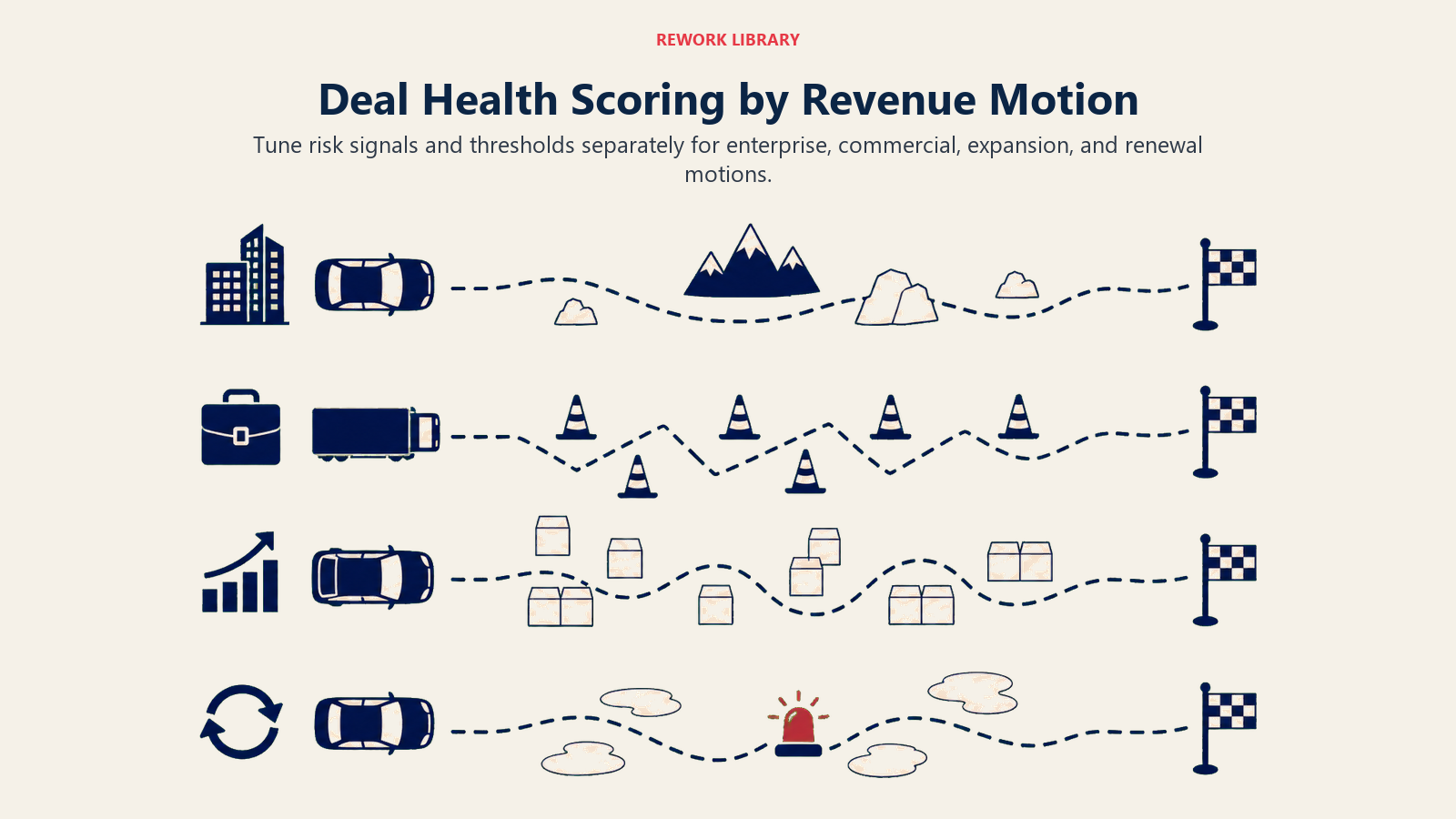
Expansion example: an account has an open upsell opportunity, but product adoption has fallen for the main user group. The score should flag customer health risk before the forecast assumes expansion.
Renewal example: contract timing looks normal, but the executive sponsor left and support issues increased. The score should flag relationship and satisfaction risk.
Minimum viable score
Start with a small model:
- Stage age
- Next step
- Close-date movement
- Recent activity
- Forecast category
- Deal amount
That model can prioritize manager attention without requiring a large data science project. Add buyer-role coverage, legal status, procurement status, customer health, and AI signals after the core fields are trusted.
Operating cadence
Review deal health weekly for current-period pipeline and monthly for trends.
Weekly review should focus on red and yellow deals that affect forecast. Monthly review should inspect recurring risk signals by segment, manager, source, and stage. Quarterly review should decide whether scoring rules need to change.
The score should become part of pipeline inspection, not another dashboard that sits outside the operating rhythm.
Adoption tips
To improve adoption:
- Show the reason behind every score.
- Let managers override with reason.
- Review false positives openly.
- Keep the first version simple.
- Tie scores to coaching questions.
- Avoid using the score as a punishment metric.
Trust is the product. Without trust, the score will be ignored.
Quality bar
A good health score should be explainable in one sentence.
For example: "This deal is yellow because it is in commit, the close date moved twice, and there is no next meeting." That sentence gives the manager a coaching path. If the score cannot explain itself, simplify it.
Review the score after each period close. Missed risks and false alarms are both learning inputs.
The model should become more useful over time. If it does not, reduce the signals and rebuild trust.
Simple trusted scoring beats complex ignored scoring.
The best review compares score history with actual outcomes. Deals that slipped, closed, or were lost should teach the team which signals predicted risk and which signals only created noise.
Manager response by risk type
A health score becomes useful when each risk type has a response.
| Risk type | What it usually means | Manager response |
|---|---|---|
| No next customer action | Deal has interest but no buyer commitment | Require a dated buyer-owned next step |
| Stage aging | Deal is sitting longer than normal for its motion | Inspect blocker, stakeholder gap, or stage accuracy |
| Missing economic buyer | Champion may not control budget or decision | Plan executive access or downgrade confidence |
| Close date pushed | Timing is less real than forecast suggests | Review buyer event, procurement path, and commit status |
| No mutual plan | Seller owns the plan but buyer has not agreed | Build or reset the plan with buyer actions |
| Weak business problem | Discovery is shallow or value is unclear | Return to problem, impact, and success criteria |
| Procurement unknown | Commercial path is not visible | Identify process, owner, timeline, and required steps |
| Post-sale risk | Deal may close but create onboarding or churn risk | Add CS or implementation review before commit |
This table keeps the score from becoming a passive warning. Each signal should tell the manager what to inspect next.
Deal health review packet
For important deals, RevOps can help managers review a small packet:
- Health score and trend.
- Signals driving the score.
- Last customer action.
- Next buyer-owned action.
- Missing required evidence.
- Forecast category and commit criteria.
- Post-sale risk if the deal closes.
- Manager decision after review.
The packet should not replace coaching. It should give the coach better evidence.
Frequently Asked Questions about Deal Health Scoring
Who owns deal health scoring?
RevOps owns the model and reporting. Sales managers own interpretation and action.
Should deal health be AI-driven?
It can be, but start with transparent rules. Add AI after the underlying data is reliable.
Learn more

Principal Solution Architect
On this page
- Common inputs
- What deal health scoring is for
- Score design principles
- Simple score design
- Risk signal examples
- Weighting the score
- Deal health and commit
- How to use the score
- Manager workflow
- RevOps workflow
- Data requirements
- AI and deal health
- Common mistakes
- Health score dashboard
- Readiness checklist
- What the checklist should prove
- Example scoring model
- False positives and missed risks
- Rollout plan
- Rep experience
- Governance
- Deal health by customer lifecycle
- Examples by motion
- Minimum viable score
- Operating cadence
- Adoption tips
- Quality bar
- Manager response by risk type
- Deal health review packet
- Learn more