Stage Exit Criteria: How RevOps Prevents Vague Funnel Movement
Stage exit criteria define what must be true before a record moves forward.
Without exit criteria, stages become subjective. One rep creates an opportunity after a first call. Another waits for budget confirmation. A manager moves deals into commit because the relationship feels strong. Customer success flags renewal risk only after the customer complains. Forecast quality suffers because the stage no longer represents evidence.
A stage should move because evidence changed, not because someone feels optimistic.
Stage exit criteria are how RevOps turns funnel stages from labels into operating standards.
Gartner's forecast confidence research is a useful reminder that weak opportunity data and subjective judgment damage forecast trust. McKinsey's sales productivity research also points to the value of targeted guidance in sales execution. Stage exit criteria are that guidance written into the operating system.
Key operating facts
- Exit criteria define what evidence is required before a record leaves a stage.
- Strong criteria make funnel conversion, stage aging, and forecast reporting more trustworthy.
- Not every criterion should become a required field.
- Managers are the main enforcement layer for judgment-heavy criteria.
- Criteria changes should be dated and communicated because they affect trend reporting.
Why exit criteria matter
Exit criteria create shared evidence.
They help managers answer:
- Should this lead move to sales?
- Should this SQL become an opportunity?
- Should this opportunity move to proposal?
- Should this deal enter commit?
- Should this customer be flagged as renewal risk?
- Should this account become an expansion opportunity?
Without criteria, the answer depends on who is looking. That makes conversion, stage aging, and forecast reports hard to trust.
Exit criteria also protect teams from stage inflation. If records move forward too easily, pipeline looks healthier than it is. If records stay too long because criteria are unclear, managers cannot tell whether the process is blocked or the data is stale.
Entry vs exit criteria
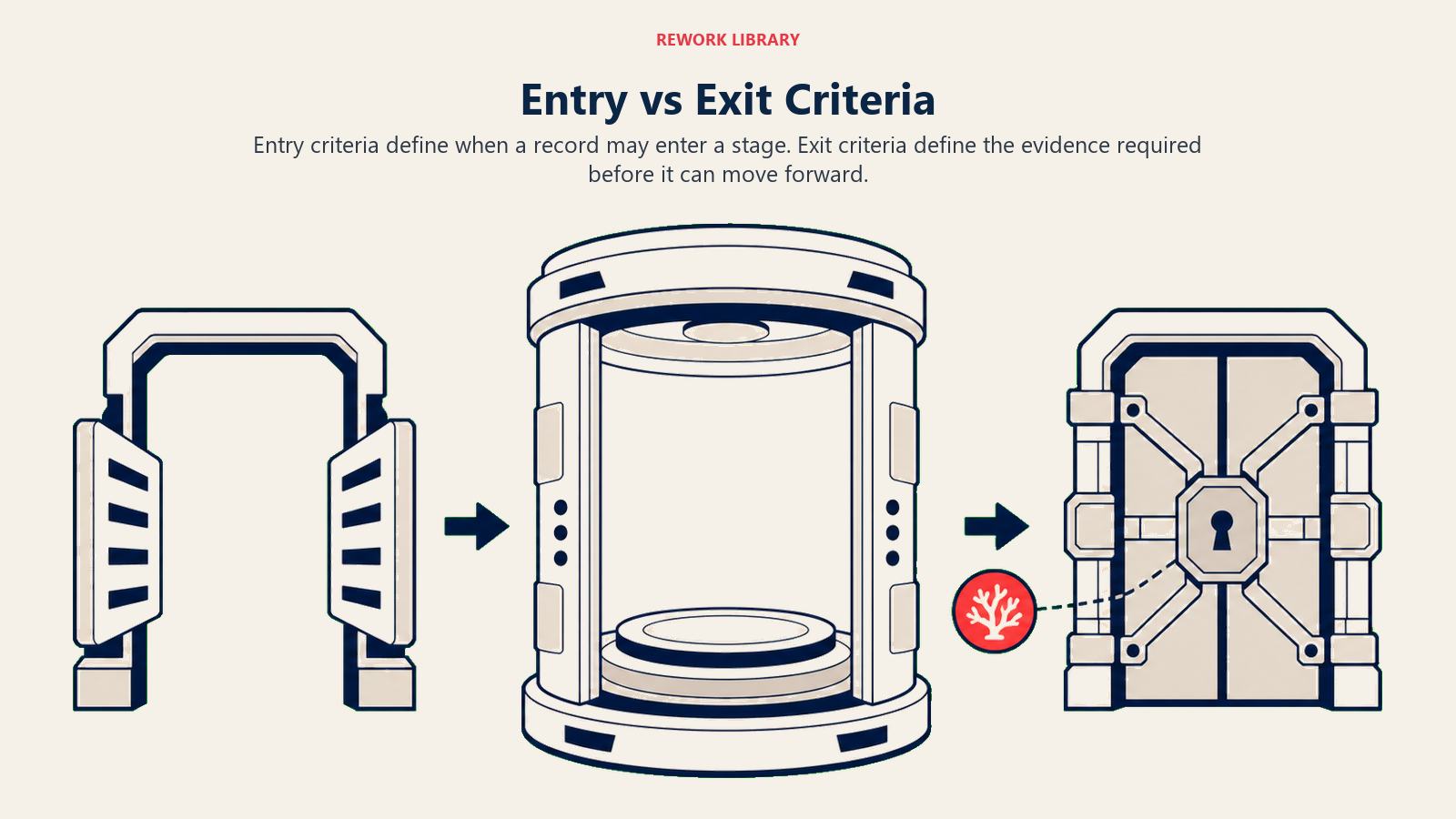
Entry criteria and exit criteria are different.
Entry criteria define when a record can enter a stage. Exit criteria define what must happen before it leaves.
Turn this article into takeaways for your work.


Each assistant summarizes the article only for you and suggests best practices for your work.
Example:
| Stage | Entry criteria | Exit criteria |
|---|---|---|
| Discovery | Business problem and buyer contact exist | Pain, impact, stakeholders, process, and next step are confirmed |
| Solution fit | Buyer agrees to explore approach | Proposed solution is tied to value and buying process |
| Commercial review | Scope and value are active | Pricing, procurement, legal, and approval path are understood |
| Commit | Deal has credible close path | Mutual plan, risks, and final approvals support close date |
Both matter. But exit criteria are often more important because they prevent premature movement.
What good criteria include
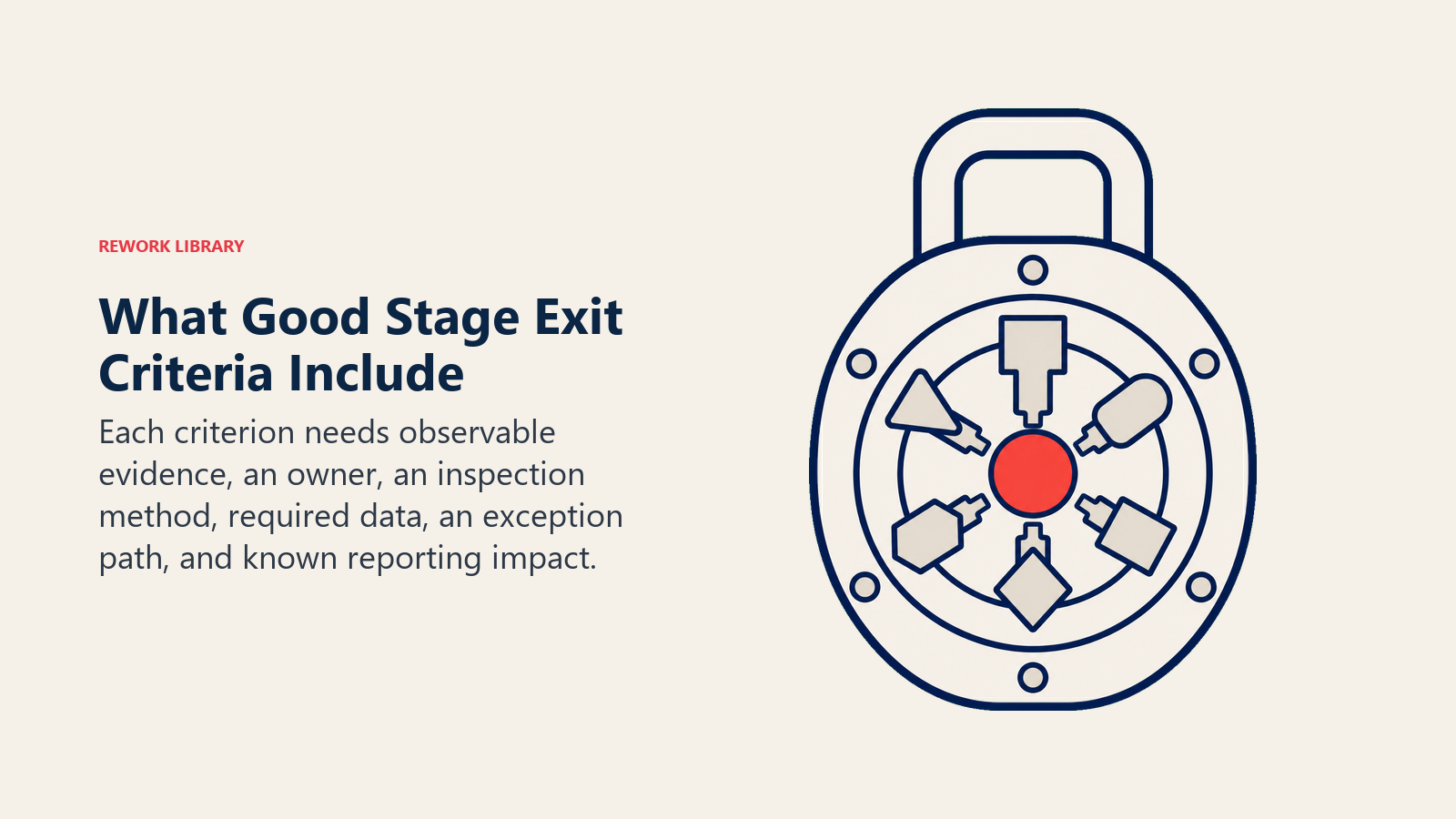
Good criteria include evidence, owner, inspection method, and reporting impact.
| Element | Why it matters |
|---|---|
| Evidence | Defines what must be true |
| Owner | Names who is accountable |
| Inspection | Defines how quality is checked |
| Required data | Names structured fields needed |
| Exception path | Handles valid edge cases |
| Reporting impact | Shows which metrics change |
RevOps should maintain criteria in the revenue data dictionary and enforce the field pieces through CRM field governance.
Criteria by stage
Example exit evidence:
| Stage | Exit evidence |
|---|---|
| Captured lead | Valid contact, source, consent or lawful basis, account match |
| MQL | Fit threshold and intent signal met |
| Routed lead | Owner assigned and SLA timer started |
| SQL | Sales accepted and qualification started |
| Qualified opportunity | Business problem, account fit, next step, potential value |
| Discovery | Stakeholders, impact, timeline, decision path, risk |
| Solution fit | Buyer agrees proposed approach matches need |
| Commercial review | Scope, pricing, procurement, legal, and approval path active |
| Commit | Mutual close plan, buyer confirmation, risk reviewed |
| Closed-won | Contract complete and handoff data ready |
| Onboarding | Launch or activation milestone reached |
| Expansion candidate | Growth signal and customer health support outreach |
Use fewer criteria when the motion is simple. Add criteria when ambiguity creates risk.
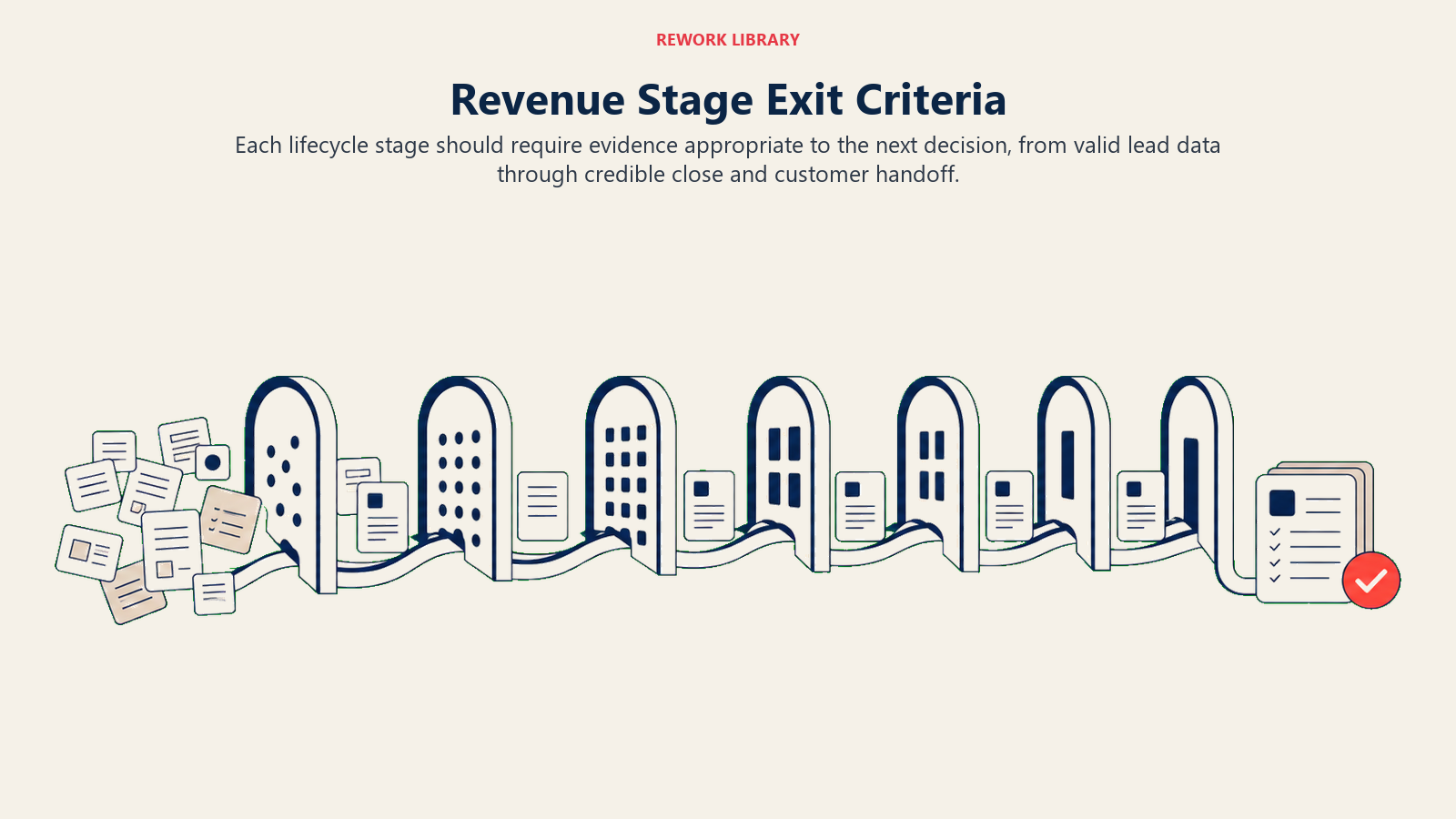
The purpose is not to make every stage harder. The purpose is to make each stage more truthful. A light stage can still be governed if the evidence is clear. A complex stage can still be usable if the criteria are specific and managers inspect them consistently.
Think of exit criteria as a truth standard:
| Stage label says | Evidence should prove |
|---|---|
| Qualified | The record fits the motion and deserves the next team or next step |
| Opportunity | There is a real buying motion, not only interest |
| Proposal | The customer is reviewing a scoped approach, not receiving generic pricing |
| Commit | Timing, risk, and approval path support a credible close |
| Closed-won | The contract and handoff are ready for the next operating team |
| Healthy customer | Usage, value, sponsor, or renewal signal supports the label |
When criteria are clear, stage data becomes comparable across managers and quarters. When criteria are vague, every conversion report becomes a debate about interpretation.
Lead lifecycle criteria
Lead-stage criteria should protect speed and quality at the same time.
A captured lead should not wait for a human review if the routing data is already clear. But it also should not move forward with missing source, bad contact data, or an account conflict.
Useful lead-stage criteria:
| Movement | Exit evidence |
|---|---|
| Captured to enriched | Valid email, company or account signal, source captured |
| Enriched to routed | Region, segment, ownership, or routing rule resolved |
| Routed to accepted | Owner assigned and SLA clock started |
| Accepted to qualified | Need, fit, or intent confirmed |
| Accepted to disqualified | Disqualification reason captured |
Lead criteria should avoid turning speed into sloppiness. A fast response is valuable only if the right person responds with enough context.
Opportunity-stage criteria
Opportunity criteria should protect forecast quality.
The most common failure is premature movement. A deal moves from discovery to proposal because the rep had a positive call, not because the buyer confirmed problem, value, process, and next step.
Opportunity exit criteria should answer:
- Is there a real business problem?
- Is the account a fit?
- Is there a stakeholder with influence?
- Is there a reason to act now?
- Is the next step a customer action or only a seller task?
- Is the amount tied to a real scope?
- Is the close date tied to a buyer process?
- Is the forecast category supported by evidence?
The criteria should be strictest where false movement creates the most damage: opportunity creation, late-stage movement, commit, and closed-won.
Customer lifecycle criteria
Exit criteria are not only for sales stages.
Customer stages need evidence too.
| Movement | Exit evidence |
|---|---|
| Closed-won to onboarding | Handoff accepted, scope clear, kickoff path known |
| Onboarding to live | Launch milestone reached and owner confirms readiness |
| Live to healthy | Usage, adoption, or value milestone achieved |
| Healthy to expansion candidate | Need, usage signal, and customer health support outreach |
| At-risk to escalated | Risk reason, owner, action plan, and timeline documented |
Customer lifecycle criteria prevent the post-sale team from relying on vague labels like "healthy" or "ready for expansion." Those labels should mean something observable.
Evidence quality
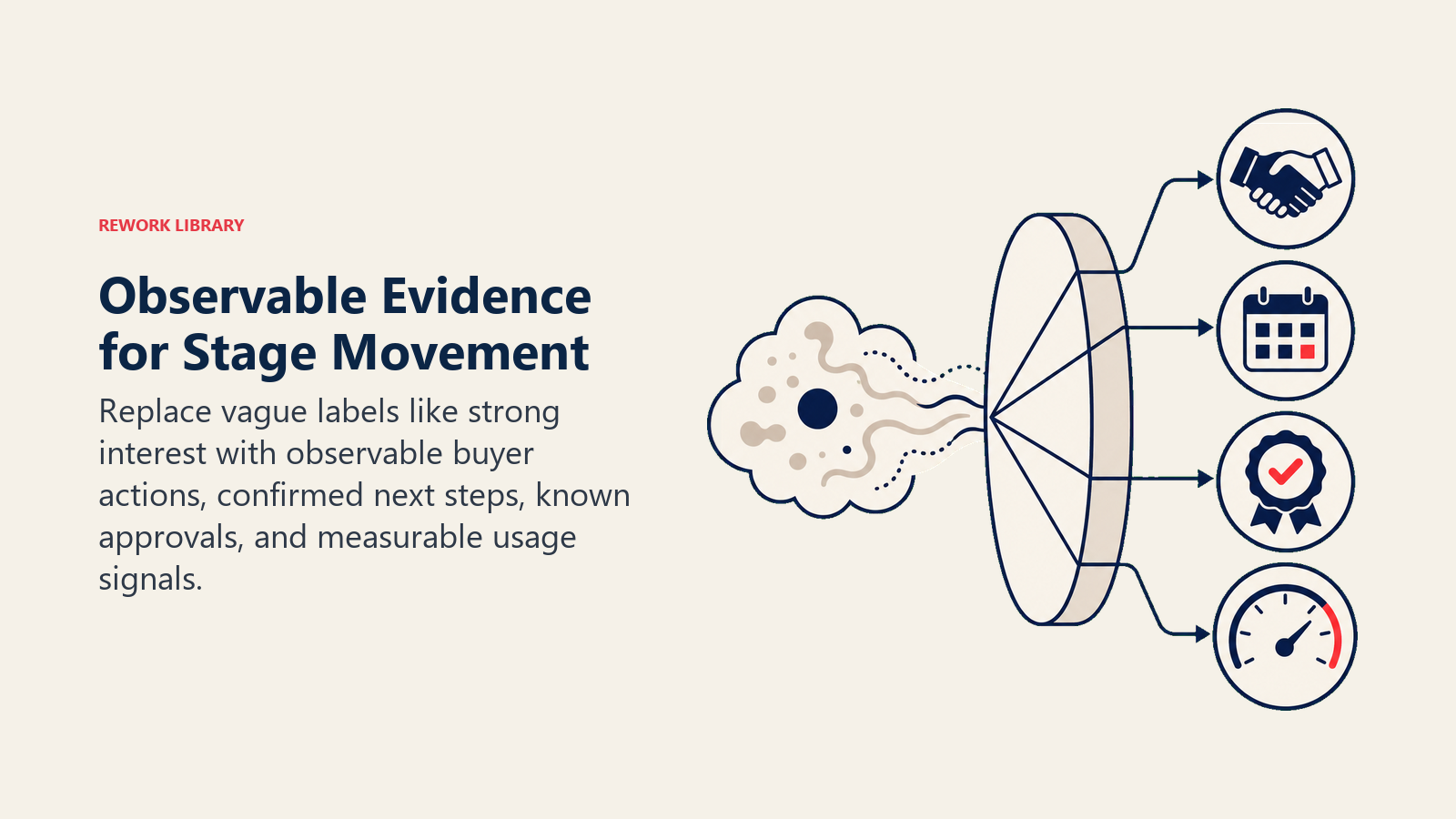
Good evidence is observable.
Weak evidence:
- "Seems interested"
- "Good call"
- "Likely to close"
- "Customer is happy"
- "Expansion possible"
Stronger evidence:
- Buyer confirmed business problem and next step.
- Economic buyer joined the process.
- Procurement timeline is known.
- Customer usage reached plan limit.
- Renewal sponsor confirmed risk or expansion scope.
RevOps should train managers to ask for evidence, not vibes.
The easiest way to improve evidence quality is to replace adjective-based language with observable language. "Strong interest" should become "economic buyer agreed to review business case next Tuesday." "Good fit" should become "customer meets segment, use case, and technical requirements." "Likely renewal" should become "sponsor confirmed renewal intent and no open success blocker remains."
This language change sounds small, but it changes inspection. Managers can coach observable evidence. They cannot coach vague optimism.
Criteria examples
A weak opportunity exit criterion says: "Discovery complete."
A stronger version says:
- Business problem documented
- Impact or value discussed
- Primary stakeholder identified
- Buying process understood enough for next step
- Next customer action scheduled
- Fit confirmed against ICP
A weak commit criterion says: "Customer verbally agreed."
A stronger version says:
- Mutual close plan exists
- Economic buyer or approver path is known
- Commercial terms are agreed or in final review
- Legal, security, and procurement risks are documented
- Close date is tied to buyer process, not seller hope
Criteria should make stage movement harder only where false movement creates risk.
Exit criteria and required fields
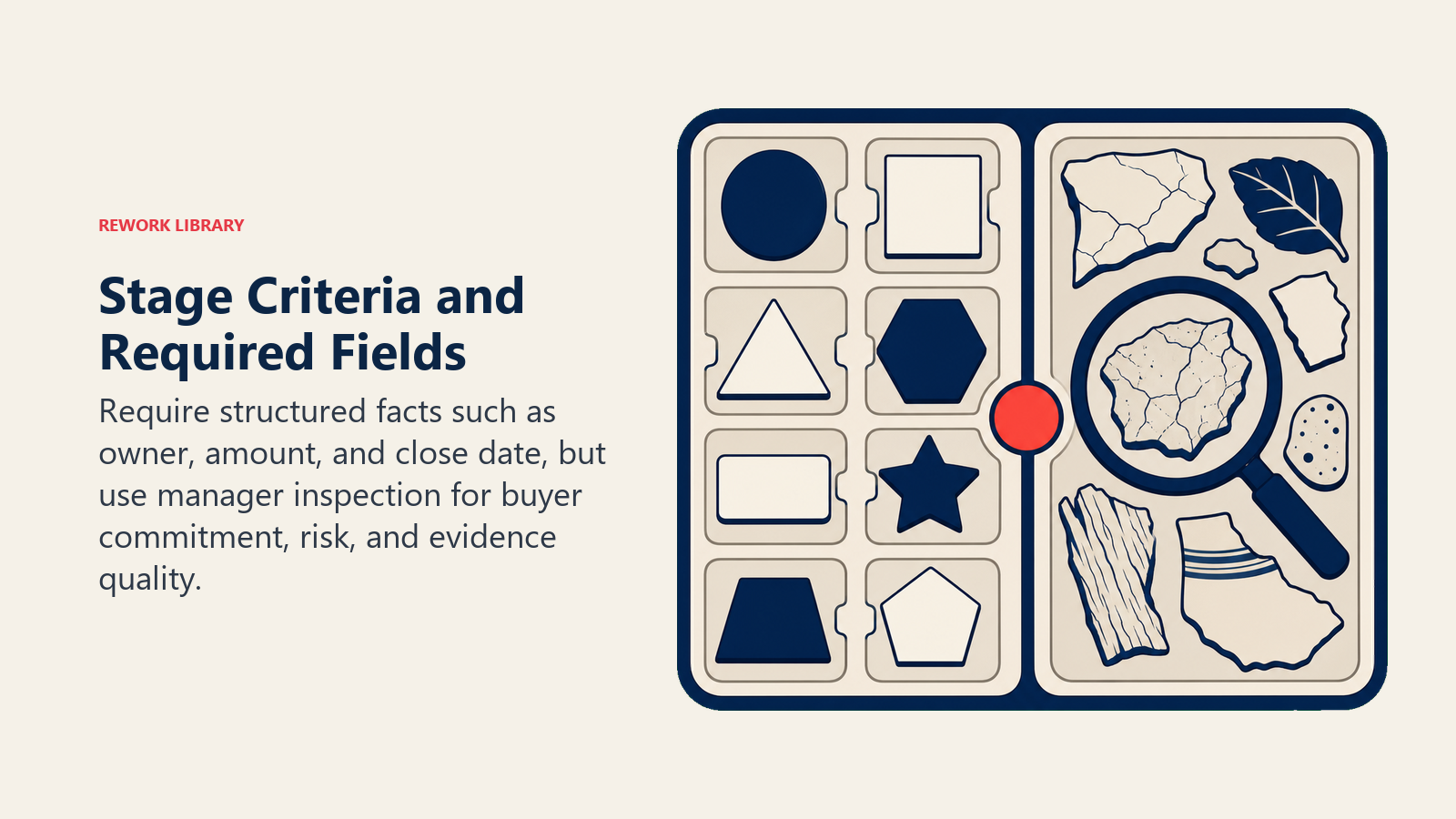
Do not turn every criterion into a required field.
Use required fields for data that must be structured:
- Source
- Owner
- Close date
- Amount
- Forecast category
- Renewal date
- Handoff status
Use manager inspection for judgment:
- Is the business problem real?
- Is the next step meaningful?
- Is the buyer engaged?
- Is the risk understood?
- Is the customer healthy enough for expansion?
This balance keeps the CRM usable while making stage evidence real.
Enforcement matrix
RevOps should decide how each criterion will be enforced.
| Criterion type | Best enforcement | Example |
|---|---|---|
| Objective field | Required field or validation | Close date, amount, owner |
| Timed process | Automation or SLA report | Lead routed within SLA |
| Manager judgment | Pipeline inspection | Buyer process is credible |
| Cross-functional handoff | Acceptance workflow | Customer success accepts closed-won handoff |
| Risk signal | Dashboard plus manager review | Deal has security or procurement risk |
| Historical definition | Data dictionary and change log | Stage definition changed on a specific date |
This matrix prevents over-automation. A CRM can require a close date. It cannot know whether the buyer's procurement process is real without human inspection.
Criteria health metrics
Criteria should be measured after rollout.
Useful metrics:
- Stage aging by stage
- Stage regression rate
- Records moved forward then moved backward
- Opportunities in stage without required evidence
- Commit conversion rate
- Closed-won handoff completeness
- Disqualification reason completeness
- Manager override rate
- Exception queue volume
- Forecast slippage after stage movement
If criteria are working, stage movement becomes more consistent and less surprising. If criteria are too heavy, exception volume and placeholder data increase. If criteria are too loose, stage aging and forecast misses continue.
Criteria calibration
Managers need calibration, especially after criteria change.
Calibration means managers review the same sample records and compare decisions. Would they move the record forward, hold it, move it backward, or mark it as an exception?
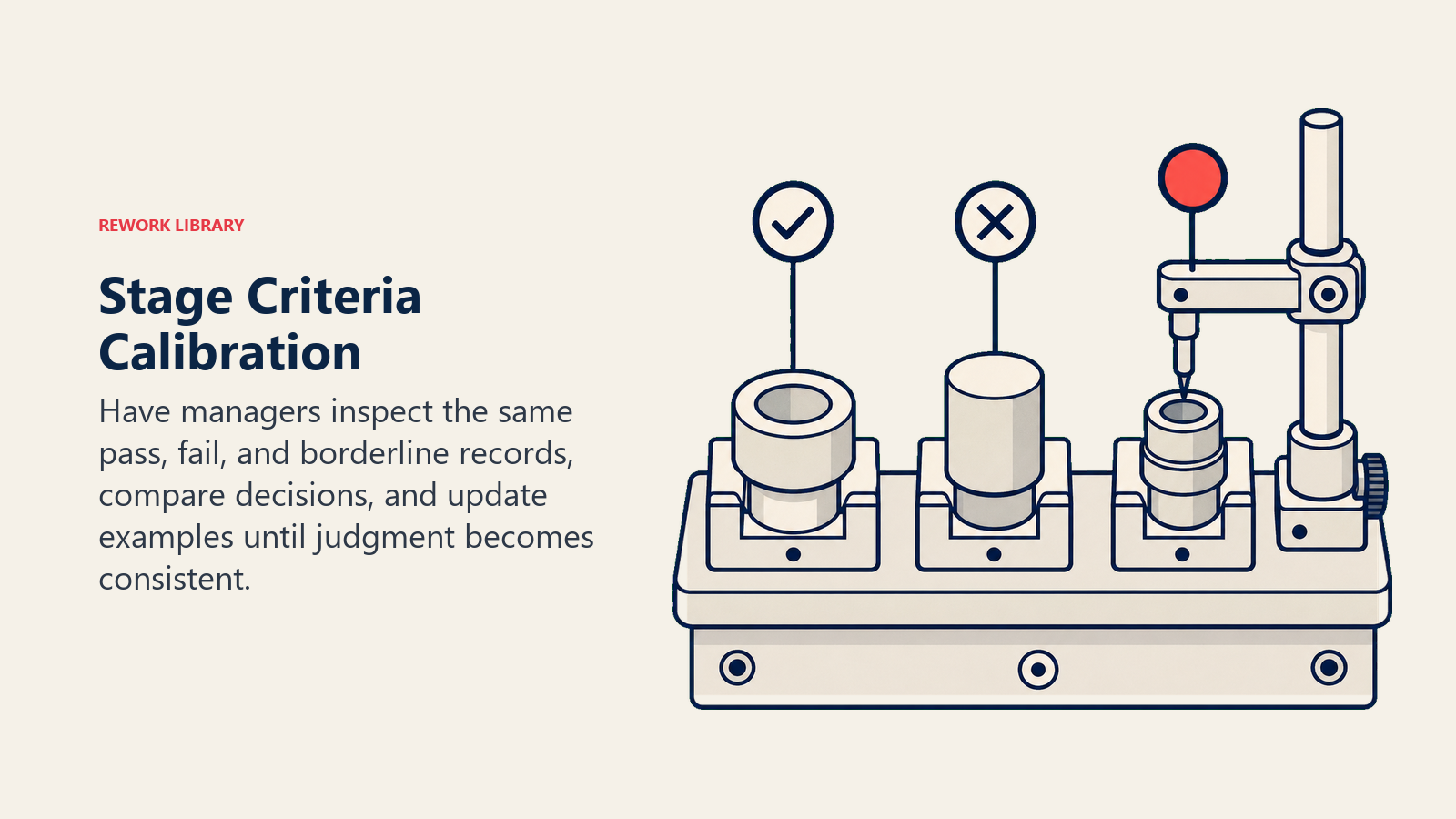
Use three record types:
- Clear pass
- Clear fail
- Borderline case
The borderline case is the most valuable. It reveals where managers interpret criteria differently.
Calibration questions:
- Which evidence is strong enough?
- Which missing field blocks movement?
- Which risk should be documented but not block movement?
- Which exception is valid?
- Which stage label best reflects the record?
RevOps should capture the decisions and update examples. This turns written criteria into shared judgment.
Exception handling
Criteria should not pretend every real deal fits the standard path.
There will be exceptions:
- Strategic customer with executive approval
- Procurement sequence that does not match normal stage order
- Renewal and expansion motion happening together
- Partner-led opportunity where seller evidence is incomplete
- Security review that starts earlier than expected
The answer is not to ignore criteria. The answer is to mark the exception.
An exception should include:
- Reason
- Owner
- Risk
- Approval if needed
- Next review date
- Reporting treatment
Visible exceptions protect trust. Hidden exceptions create drift.
What to do when criteria fail
Criteria failure has different causes.
| Symptom | Likely cause | Fix |
|---|---|---|
| Users enter fake values | Criteria required too early | Move requirement later or improve values |
| Managers disagree often | Criteria are vague | Add examples and manager calibration |
| Stage aging rises sharply | Criteria too strict or process blocked | Inspect bottleneck and revise |
| Forecast still misses | Criteria not tied to real buyer evidence | Strengthen late-stage and commit evidence |
| Exceptions pile up | No owner for edge cases | Add exception owner and SLA |
| Reports shift unexpectedly | Criteria changed without context | Add change date and reporting caveat |
Do not assume the rule is right just because adoption is weak. The rule may need revision.
How to enforce criteria
Use a mix of controls.
| Control | Best for |
|---|---|
| Required fields | Structured data that must exist |
| Manager inspection | Judgment-heavy evidence |
| Automation | Timestamps, owner rules, SLA timers |
| Dashboards | Stage aging, missing evidence, exceptions |
| Notes or call review | Qualitative evidence |
| Handoff review | Closed-won or customer transition criteria |
For example, close date should be a field. Buyer confidence may be better inspected in notes or manager review. Promises made should be captured in a structured handoff field when they affect onboarding.
Manager review guide
Managers should ask:
- What evidence supports this stage?
- What changed since the last review?
- What is the next customer action?
- What risk could block movement?
- Which data is missing?
- Does this record meet exit criteria or only activity criteria?
This creates consistency without making the CRM unbearable.
Managers are the key enforcement layer. RevOps can define criteria, but managers decide whether reps follow them. If managers do not inspect criteria, reps will learn that the written rules do not matter.
Exit criteria by motion
Different motions need different criteria.
High-velocity inbound may use lighter criteria because speed matters. Enterprise sales may need stronger evidence because deal quality and forecast risk are higher. Product-led expansion may use usage thresholds. Services revenue may require scope and delivery capacity before close.
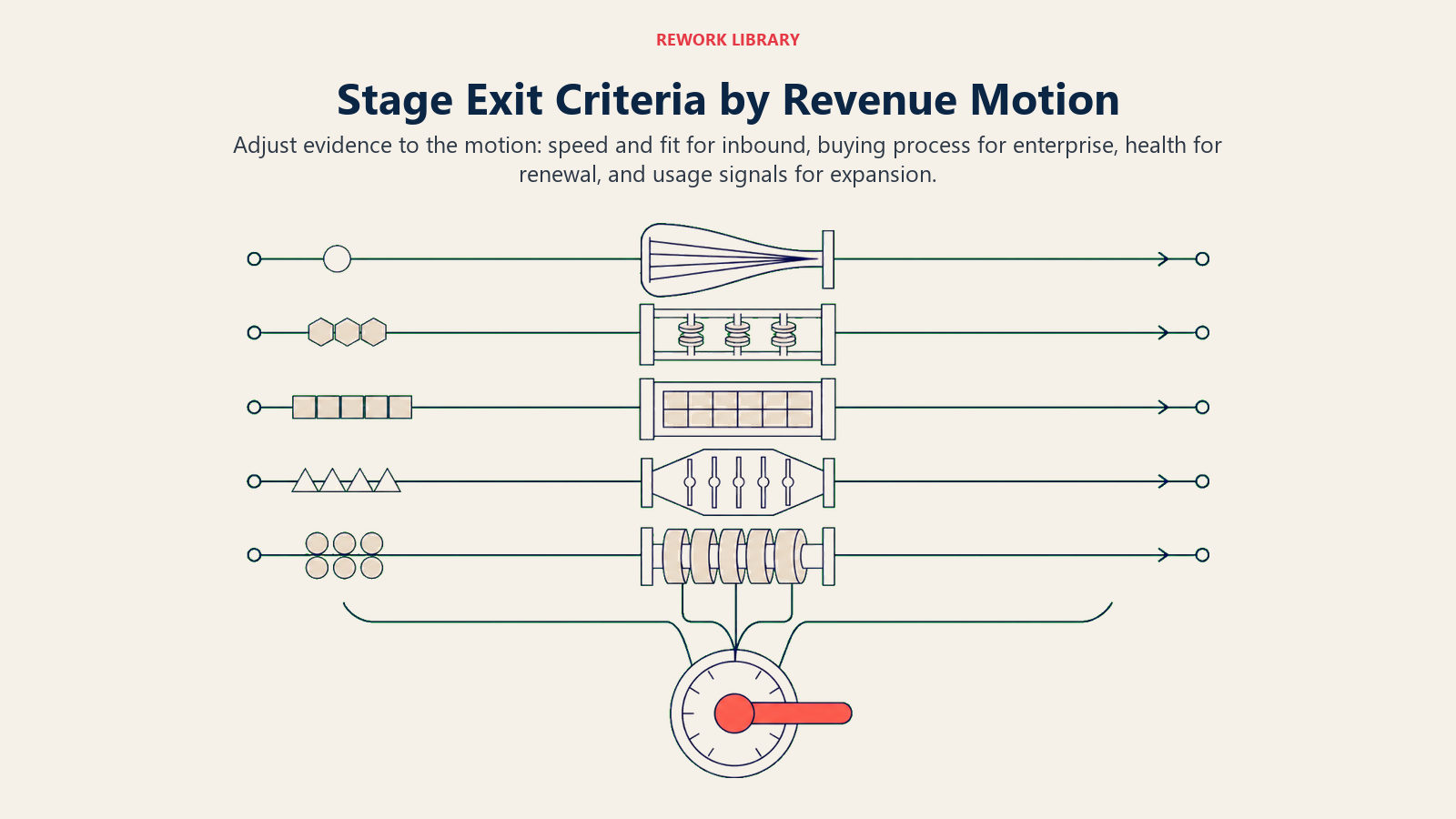
Examples:
| Motion | Criteria emphasis |
|---|---|
| Inbound SMB | Fit, intent, response, simple next step |
| Mid-market sales-led | Pain, stakeholder, value, decision path |
| Enterprise | Buying committee, business case, procurement, risk |
| Renewal | Health, sponsor, value proof, contract timing |
| Expansion | Usage, new need, customer health, commercial path |
RevOps should define criteria by motion when one universal model creates bad behavior.
Criteria and forecast quality
Stage exit criteria affect forecast trust.
If late-stage opportunities do not require buyer-process evidence, the forecast becomes opinion-heavy. If commit criteria do not require risk review, managers cannot compare deals consistently. If close dates are not tied to customer action, finance cannot trust timing.
This is why stage exit criteria should connect to forecast governance and commit criteria, not sit in a separate sales enablement document.
Criteria and compensation
Be careful when stage criteria affect compensation or quota reporting.
If opportunity creation criteria become stricter, pipeline creation may appear to drop. That might be a quality improvement, not a performance decline. If commit criteria become stricter, commit forecast may shrink but become more reliable.
Leaders should understand this before rollout. Otherwise teams may resist because clean governance looks like worse performance at first.
Audit process
Audit exit criteria with real records.
Pick a sample from each stage and ask:
- Does the record meet the written criteria?
- Is the evidence visible in the system?
- Would two managers agree?
- Which fields or notes are missing?
- Did the record move too early?
- Did the record stay too long?
Record the gaps. Then decide whether the issue is criteria, training, manager inspection, or system design.
Training examples
Train with real examples.
Show a record that should not move and explain why. Show a record that should move and explain what evidence is present. Show a borderline record and let managers discuss how to inspect it.
This is more useful than a policy document alone. Managers need shared judgment, not only shared words.
Change control
Criteria should not change casually.
When criteria change:
- Update the data dictionary.
- Update dashboards and reports.
- Train managers.
- Check workflow and automation impact.
- Document the change date.
- Decide whether historical comparisons still hold.
If criteria change silently, conversion rates become hard to interpret.
Implementation plan
Start with the stages that affect forecast and handoff most.
For many companies, those are:
- SQL to opportunity
- Early opportunity to qualified opportunity
- Late-stage to commit
- Commit to closed-won
- Closed-won to onboarding
- Renewal risk to escalated risk
Write criteria for those first. Then test them against real records.
Criteria worksheet
For each stage, document:
| Item | Question |
|---|---|
| Stage name | What is the stage called? |
| Owner | Who owns execution? |
| Exit evidence | What must be true before movement? |
| Required data | Which fields must be complete? |
| Inspection owner | Who checks quality? |
| Exception path | What happens if criteria are not met? |
| Reporting impact | Which dashboards use this stage? |
This worksheet should live with the data dictionary and funnel governance docs.
Readiness checklist
Before rollout:
- Criteria are written for core stages.
- Criteria use evidence, not feelings.
- Required fields are limited to decision-critical data.
- Managers know how to inspect criteria.
- Dashboards show stage aging and missing evidence.
- Exceptions have an owner.
- Finance understands criteria that affect forecast.
- Criteria changes are dated in the change log.
Exit criteria are working when two managers can inspect the same record and reach the same conclusion most of the time.
Common mistakes
Criteria are too vague. "Qualified" means different things by manager.
Criteria are too heavy. Reps enter junk data to move records.
Criteria are not tied to reporting. Dashboards still use old definitions.
Finance is excluded. Forecast criteria affect planning and should be understood by finance.
Customer success is excluded. Closed-won and renewal criteria affect customer outcomes.
Managers are not trained. Written criteria do not matter if managers do not inspect them.
What good looks like
Exit criteria are strong when stage movement tells leaders something true.
If a late-stage opportunity means the buyer process is known, risk is documented, and close timing is credible, leaders can manage the forecast. If it only means the rep feels good, the stage is not governed.
The practical goal is consistency. When stage movement means the same thing across reps, managers, segments, and quarters, leaders can compare performance without rebuilding the story every time.
Exit criteria will sometimes reveal uncomfortable truth. Pipeline may shrink. Stage conversion may look worse. Commit may become smaller. That does not mean the process failed. It may mean the previous funnel was overstated.
RevOps should prepare leaders for that moment. The goal is not prettier stage math. The goal is a funnel that tells the truth early enough to act.
That also means criteria should not be judged only by whether users like them. Useful criteria often create short-term discomfort because they reveal weak records. The right question is whether they improve decision quality: cleaner pipeline review, better forecast confidence, fewer surprise handoff issues, and more consistent manager coaching.
If criteria reduce trust or create fake data, revise them. If they reduce inflated pipeline and force better evidence, keep them even if the first report looks worse.
Exit-criteria review packet
When reviewing stage exit criteria, inspect real records.
Use:
- Ten records that advanced.
- Ten records that stalled.
- Five records that moved backward or were closed-lost.
- Evidence present at movement.
- Missing evidence.
- Manager override reasons.
- Forecast impact.
- Handoff impact.
The review should answer whether the criteria are too loose, too strict, or simply not inspected. Stage rules only matter when managers use them to control movement.
Frequently Asked Questions about Stage Exit Criteria
Who owns stage exit criteria?
RevOps governs the criteria. Functional leaders own execution inside their stage. Managers enforce the criteria in day-to-day inspection.
How detailed should criteria be?
Detailed enough that two managers inspecting the same record reach the same conclusion most of the time. If criteria require too much interpretation, they are not clear enough.
Should all criteria be required fields?
No. Required fields work for structured data. Manager inspection works better for judgment-heavy evidence such as buyer commitment, risk quality, and decision confidence.
How often should criteria be reviewed?
Review core criteria quarterly or whenever the sales motion, customer journey, reporting model, or forecast process changes.
Learn more

Principal Solution Architect
On this page
- Why exit criteria matter
- Entry vs exit criteria
- What good criteria include
- Criteria by stage
- Lead lifecycle criteria
- Opportunity-stage criteria
- Customer lifecycle criteria
- Evidence quality
- Criteria examples
- Exit criteria and required fields
- Enforcement matrix
- Criteria health metrics
- Criteria calibration
- Exception handling
- What to do when criteria fail
- How to enforce criteria
- Manager review guide
- Exit criteria by motion
- Criteria and forecast quality
- Criteria and compensation
- Audit process
- Training examples
- Change control
- Implementation plan
- Criteria worksheet
- Readiness checklist
- Common mistakes
- What good looks like
- Exit-criteria review packet
- Learn more