Customer to Expansion Process: How RevOps Governs Post-Sale Growth
Expansion should not depend on someone noticing a good customer by accident.
In a recurring revenue business, expansion is an operating process. Product usage, adoption milestones, stakeholder growth, support patterns, renewal health, and account goals should create signals that customer success and sales can act on.
RevOps governs the system that captures and routes those signals.
Forrester's customer success platforms landscape frames customer success systems around retention, growth, outcomes, and engagement at scale. Gainsight's Customer Success Index also links higher NRR with investment in customer success and CS operations. Expansion is not random upside. It is part of the revenue system.
Key operating facts
- Customer-to-expansion is a post-sale revenue process, not a lucky moment inside a renewal call.
- RevOps should define the signal model, owner model, qualification rules, routing path, forecast treatment, and feedback loop.
- Not every healthy customer is ready for expansion. Expansion needs customer value, a clear use case, stakeholder support, and a commercial path.
- CS often sees the signal first. Sales may own the commercial motion. RevOps makes the handoff and reporting model consistent enough that neither team has to negotiate ownership from scratch.
The process map
| Step | Owner | RevOps control |
|---|---|---|
| Onboard customer | CS | Required handoff fields |
| Track adoption | CS and product | Health data model |
| Identify expansion signal | CS or automation | Trigger definition |
| Qualify expansion | CS and sales | Opportunity creation rule |
| Forecast expansion | Sales, CS, finance | Forecast category and amount rules |
| Close and update account | Sales and CS | Renewal and account data updates |
Expansion triggers
Useful triggers include:
- Seat usage near plan limit
- New team or region added
- High product adoption
- Repeated feature requests
- Executive sponsor engagement
- Renewal conversation with growth scope
Connect this work to RevOps and Customer Success and Net Revenue Retention.
Why expansion needs governance
Expansion often fails quietly.
A customer uses more seats, but no one reviews plan limits. A new department asks for access, but the account owner does not hear about it. A CSM hears that the customer wants to expand, but sales does not receive enough context. A renewal conversation includes growth scope, but finance never sees it in the forecast.
These are not only sales issues. They are operating design issues.
RevOps should make expansion signals visible, route them to the right owner, and define when they become pipeline.
Expansion signal model
Separate signals by type:
| Signal type | Examples | Likely owner |
|---|---|---|
| Usage | Seat limit, volume growth, feature adoption | CS or product analytics |
| Relationship | New executive sponsor, new team, champion promotion | CS |
| Business need | New use case, new region, new workflow | CS and sales |
| Renewal | Customer wants broader scope during renewal | CS, sales, finance |
| Support | Repeated advanced requests | CS or product |
| Commercial | Procurement asks about larger contract | Sales |
RevOps should define which signals are informational and which require action. Not every usage spike is an expansion opportunity. But every meaningful signal should have a place to land.
Signal strength model
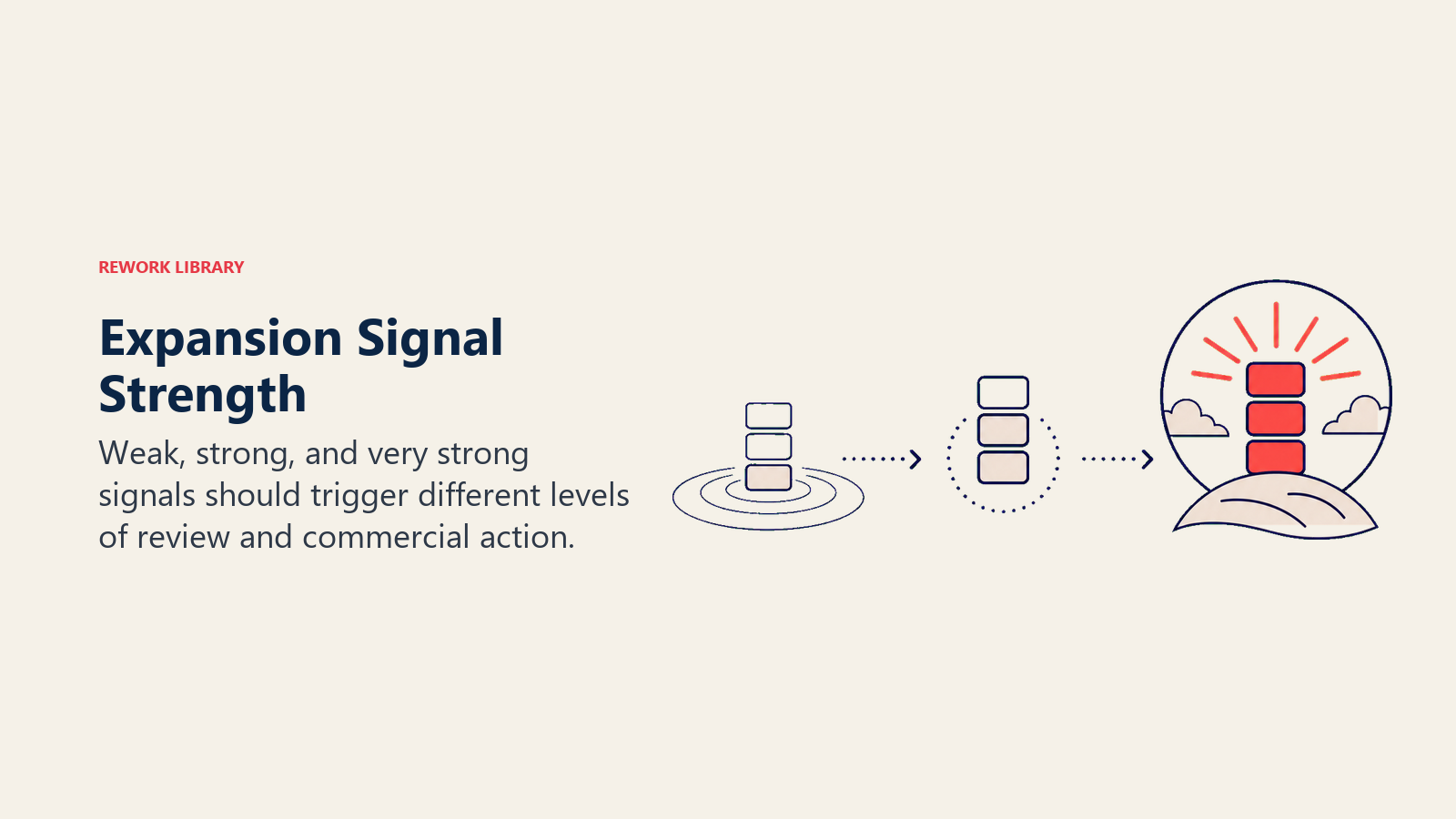
Expansion signals should be weighted by strength. A weak signal may create a CSM note. A strong signal may create an account review or sales handoff. A very strong signal may become a qualified expansion opportunity.
Turn this article into takeaways for your work.


Each assistant summarizes the article only for you and suggests best practices for your work.
| Signal strength | Example | Recommended action |
|---|---|---|
| Weak | Usage increases for one week | Monitor or add note |
| Moderate | Multiple users from a new team request access | CSM reviews account context |
| Strong | Champion asks about a second department rollout | Joint CS and sales review |
| Very strong | Executive sponsor requests proposal for broader scope | Create expansion opportunity if criteria are met |
This prevents two bad habits. The first is ignoring early signals until the renewal window. The second is creating pipeline from every sign of engagement. RevOps should help teams distinguish interest, adoption, and commercial readiness.
The signal model should also account for negative context. A customer with high usage but low satisfaction may need success work before expansion. A customer with strong stakeholder interest but unresolved implementation risk may need a save plan before a growth plan. Expansion governance should protect the customer relationship, not only create more pipeline.
Qualification rules
An expansion signal should become an expansion opportunity only when there is evidence.
Useful criteria:
- Clear customer need
- Account is healthy enough for growth
- Stakeholder or sponsor exists
- Use case is understood
- Commercial path is realistic
- Owner is assigned
- Expected value is estimated
- Timing is known or discoverable
This prevents teams from inflating expansion pipeline with weak signals. It also protects CS from being pushed into commercial motion before the customer is ready.
Ownership model
Expansion ownership depends on deal size and motion.
| Expansion type | Common owner | RevOps governance |
|---|---|---|
| Small seat increase | CS or account manager | Trigger, approval, and reporting rules |
| Department expansion | Sales and CS | Opportunity criteria and handoff |
| Enterprise expansion | Sales | Forecast, stakeholder, and risk governance |
| Renewal expansion | CS, sales, finance | Renewal and expansion forecast rules |
| Usage-based growth | CS and finance | Usage data and billing alignment |
The ownership model should be written down. If CS and sales negotiate ownership deal by deal, expansion will be inconsistent and political.
Expansion handoff criteria
When CS hands an expansion signal to sales, the handoff should include enough context for a commercial conversation.

Minimum handoff context:
| Field | Why it matters |
|---|---|
| Expansion trigger | Explains why the account is being reviewed |
| Current health | Shows whether growth is safe to pursue |
| Current adoption | Proves value or reveals risk |
| Use case | Prevents generic upsell outreach |
| Stakeholder | Names who has interest or influence |
| Timing | Shows whether this is active or future potential |
| Contract context | Connects expansion to renewal, billing, or procurement |
| CS recommendation | Explains whether CS supports commercial action |
This handoff should be short. It should not force CSMs to write a sales memo. It should capture enough evidence that sales can decide whether to accept, reject, or request more context.
Rejection should also be governed. If sales rejects an expansion signal, the reason should be captured: no clear need, poor timing, account unhealthy, no stakeholder, low value, duplicate, or already in renewal motion. Those reasons help CS and RevOps improve the trigger model.
Forecasting expansion
Expansion forecast should be visible but conservative.
RevOps should define:
- When an expansion opportunity is created
- Which forecast category is allowed
- How amount is estimated
- Whether the expansion is tied to renewal
- Who updates close date and risk
- How finance sees expansion forecast
Expansion forecast is different from new-business forecast because it depends on customer health, adoption, renewal timing, and relationship context. RevOps should make those inputs visible.
Feedback to acquisition
Expansion data should improve acquisition.
If customers from one source expand faster, marketing should know. If one segment has strong logo conversion but weak expansion, sales and marketing should review fit. If expansion depends on a specific use case, discovery and content should reflect it.
RevOps should connect expansion learning back to:
- ICP definition
- Qualification rules
- Use case messaging
- Sales discovery
- Customer handoff fields
- Pricing and packaging feedback
This is how post-sale growth improves the whole funnel.
Metrics
Track:
- Expansion signal volume
- Signal-to-opportunity conversion
- Expansion opportunity win rate
- Expansion pipeline by source segment
- Expansion tied to renewal vs off-cycle
- Time from signal to owner action
- Expansion forecast accuracy
- NRR and GRR trend
- Expansion by original acquisition source
Do not track expansion only as closed-won revenue. By then it is too late to manage the process.
Expansion quality review
Review expansion quality monthly, not only expansion amount.
Useful review questions:
- Which triggers produced qualified opportunities?
- Which triggers created noise?
- Which accounts were healthy but not commercially ready?
- Which expansion opportunities stalled after handoff?
- Which expansion motions were tied to renewal and which were off-cycle?
- Which source segments produce customers that expand later?
- Which churn or contraction reasons should change expansion targeting?
The review should include CS, sales, RevOps, and finance. CS brings account context. Sales brings commercial reality. Finance brings planning impact. RevOps keeps the definitions, fields, and routing model consistent.
The best outcome is a better signal model. If usage growth creates many weak opportunities, add stakeholder or business-need criteria before sales handoff. If CSM referrals convert well but are underreported, make the handoff easier. If renewal-linked expansion is strong but off-cycle expansion is weak, separate the forecast view so leaders do not treat both motions the same.
Common mistakes
Treating every healthy customer as an expansion target. Health is necessary, but not always enough.
Creating expansion opportunities too early. This inflates pipeline.
Leaving CS out of commercial context. CS often knows whether the timing is right.
Leaving sales out of customer context. Sales needs the adoption story, not just a lead.
Not involving finance. Expansion affects planning, revenue forecast, and renewal assumptions.
Readiness checklist
Before rollout, confirm:
- Expansion signals are defined.
- Owners are named by expansion type.
- Opportunity creation rules are clear.
- Renewal and expansion forecasts are connected.
- CS and sales know handoff expectations.
- Finance can see expansion pipeline.
- Expansion data feeds ICP and qualification learning.
If expansion relies on memory, the process is not governed yet.
Expansion play types
Expansion is not one motion.
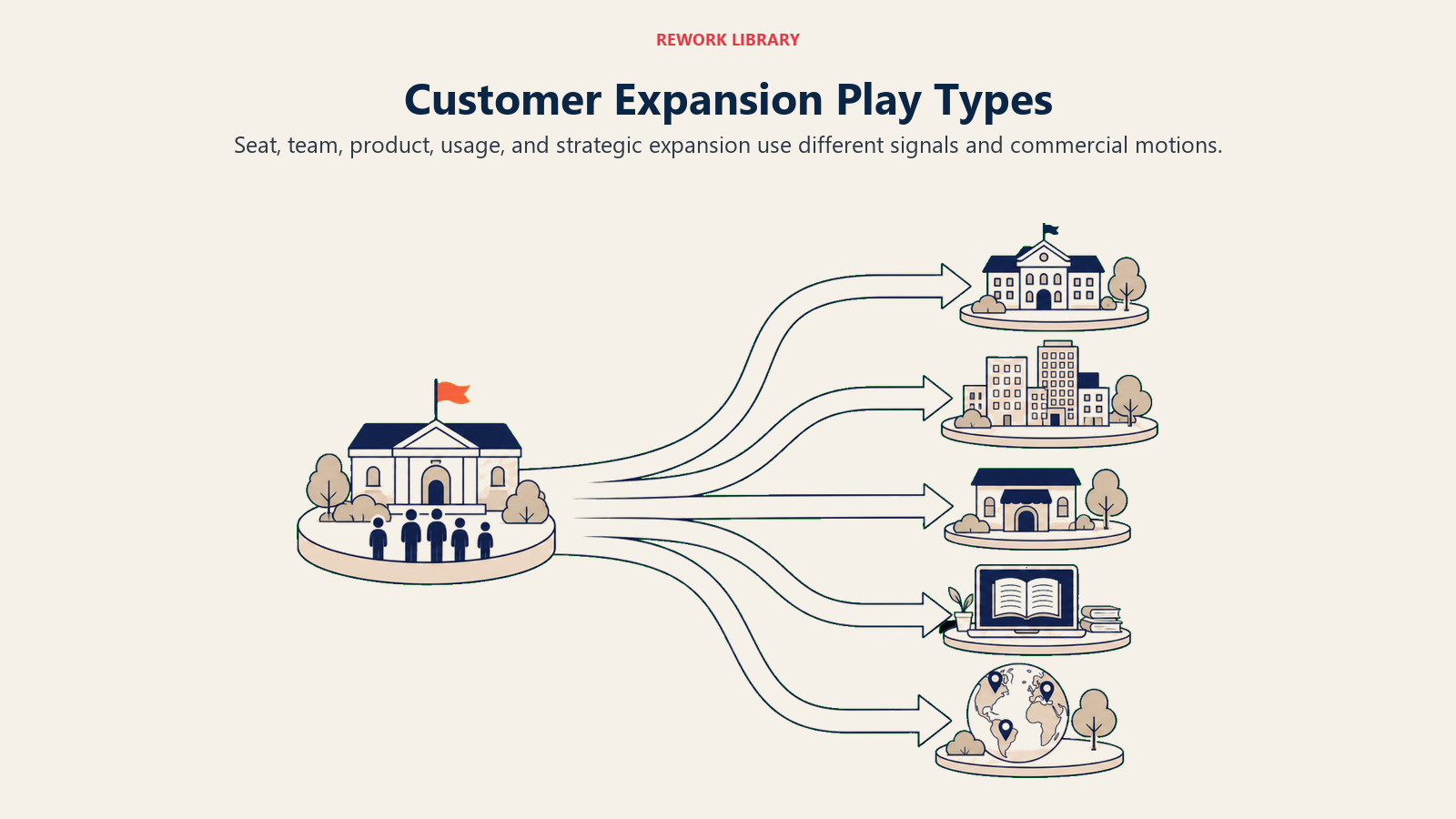
Common play types include:
| Play | Signal | Typical motion |
|---|---|---|
| Seat expansion | Usage near seat cap | CS confirms need, sales handles commercial update |
| Team expansion | New team asks for access | CS maps use case, sales qualifies opportunity |
| Use-case expansion | Customer adopts one workflow and asks about another | CS and sales build value case |
| Geographic expansion | New region or business unit appears | Sales leads, CS provides adoption proof |
| Product expansion | Customer needs additional module | Sales leads commercial process |
| Renewal expansion | Renewal includes larger scope | CS, sales, and finance coordinate forecast |
RevOps should define how each play enters the system. If all expansion is treated the same, small low-friction upgrades and strategic expansion deals will be managed with the same process, which slows one and under-governs the other.
Customer health and expansion
Expansion should be connected to customer health, but health alone is not enough.
A healthy customer may not have a growth need. An unhealthy customer may still request more licenses because the buying center changed, but expanding before value is stable can create churn risk.
RevOps should help CS and sales separate:
- Healthy and ready for growth
- Healthy but no growth signal
- Mixed health with potential growth
- At risk and not ready for expansion
- At risk but commercially active
This prevents teams from chasing expansion that creates future retention problems.
Expansion handoff
When CS identifies a growth signal, the handoff to sales should include:
- Customer outcome achieved
- Expansion signal
- Stakeholders involved
- Current contract and usage
- New use case
- Timing
- Risks
- Suggested owner
- Expected value range
If sales only receives "customer might expand," the opportunity is weak. If sales receives the adoption story and business reason, the conversation starts with context.
Renewal-linked expansion
Expansion often appears during renewal.
RevOps should define whether renewal expansion is tracked as:
- Renewal amount increase
- Separate expansion opportunity
- Combined renewal and expansion forecast
- Contract amendment
The right answer depends on finance and CRM design. What matters is consistency. If one manager tracks renewal expansion as a renewal uplift and another creates a new opportunity, reporting will double count or undercount growth.
Finance should be consulted on this rule because it affects forecast, bookings, NRR, and board reporting.
Expansion governance cadence
A monthly expansion review should cover:
- New signals
- Signals accepted or rejected
- Expansion opportunities created
- Expansion pipeline by source
- Expansion tied to renewal
- Expansion closed-won and closed-lost
- Customer health of expansion candidates
- Stale expansion opportunities
The review should include CS, sales, finance, and RevOps when expansion materially affects the plan.
Anti-patterns
CS holds expansion signals too long. The customer need may be real, but commercial timing is missed.
Sales receives no adoption context. The expansion conversation starts cold.
Every signal becomes pipeline. Forecast becomes inflated.
Expansion is disconnected from renewal. Finance gets an incomplete view of customer revenue.
Expansion wins are not fed back to acquisition. Marketing and sales miss which use cases create durable growth.
Example process
A customer reaches 85 percent seat usage and adds a second team.
The system flags the account. CS confirms that usage growth reflects real adoption, not temporary activity. CS captures the new team, use case, stakeholder, timing, and current health. RevOps routes the signal based on expansion size. Sales qualifies the opportunity if commercial scope is meaningful. Finance sees the forecast if the deal affects the quarter or renewal plan.
That is a governed process. No one has to hope the right person notices the signal.
Example process test
Ask this question: if a customer is ready to expand, would the company know before the customer asks for a quote?
If the answer is no, the customer-to-expansion process needs stronger signals, ownership, or cadence.
Implementation plan
Start with the simplest expansion motion first.
For many companies, that is seat growth or renewal-linked expansion. Pick one signal, define the owner, define the opportunity rule, and report it for one month before adding more complexity.
Example implementation:
- Identify accounts above 80 percent seat usage.
- Exclude accounts with unresolved high-risk health status.
- Route the signal to the CSM.
- CSM confirms whether usage reflects real adoption.
- If confirmed, CSM adds use case and stakeholder context.
- Sales qualifies commercial scope.
- RevOps tracks signal-to-opportunity conversion.
- Finance receives expansion forecast if material.
This creates a narrow loop the team can learn from.
Data fields
Useful fields include:
- Expansion signal type
- Signal date
- Signal source
- Signal owner
- Customer health status
- Expansion use case
- Expansion qualified date
- Expansion opportunity link
- Expansion forecast category
- Expansion outcome
Keep the fields focused. If the process requires too much data before anyone acts, teams will stop using it.
Governance review questions
In the monthly review, ask:
- Which signals created real opportunities?
- Which signals were noise?
- Which owners acted too slowly?
- Which customer segments expanded most often?
- Which acquisition sources produced expansion?
- Which expansion deals were blocked by poor adoption?
- Which expansion wins should change ICP or discovery?
The review should improve both post-sale motion and front-end targeting.
Team agreement
CS and sales should agree on handoff rules in writing.
CS should not be expected to sell complex expansion without commercial support. Sales should not be expected to chase weak expansion hints without adoption context. Finance should not discover expansion only after the deal closes.
RevOps keeps those agreements visible in the system.
Launch checklist
Before launch, confirm:
- The first expansion signal is selected.
- The signal can be measured in the system.
- CS knows how to validate the signal.
- Sales knows when to accept the handoff.
- Finance knows when expansion enters forecast.
- RevOps can report signal, action, opportunity, and outcome.
- Customer health is checked before outreach.
- Renewal-linked expansion has a consistent tracking rule.
Then review the first month with actual records. The team should look at which signals were useful, which were noise, and which handoffs lacked context. That first review will usually improve the process more than a long planning document.
The practical goal is simple: every meaningful expansion signal should either become an owned action or be rejected with a clear reason. Nothing important should sit unseen in notes, usage data, customer calls, or renewal reviews.
That visibility is the foundation of scalable expansion.
Expansion decision packet
Expansion signals should become decisions, not only alerts.
For each expansion opportunity, capture:
- Trigger source.
- Customer health status.
- Usage or value evidence.
- Stakeholder owner.
- Commercial owner.
- Renewal timing.
- Risk to core relationship.
- Next customer action.
- Forecast treatment.
This helps RevOps separate useful expansion signal from noise. A strong expansion process protects customer trust while still making growth visible.
Frequently Asked Questions about Customer to Expansion Process
Who owns expansion?
It depends on the company. CS may own smaller expansions, sales may own commercial expansion, and RevOps should own process visibility.
Why does RevOps matter after the sale?
Because renewal, churn, and expansion data affect revenue planning and acquisition quality.
Learn more

Principal Solution Architect
On this page
- The process map
- Expansion triggers
- Why expansion needs governance
- Expansion signal model
- Signal strength model
- Qualification rules
- Ownership model
- Expansion handoff criteria
- Forecasting expansion
- Feedback to acquisition
- Metrics
- Expansion quality review
- Common mistakes
- Readiness checklist
- Expansion play types
- Customer health and expansion
- Expansion handoff
- Renewal-linked expansion
- Expansion governance cadence
- Anti-patterns
- Example process
- Example process test
- Implementation plan
- Data fields
- Governance review questions
- Team agreement
- Launch checklist
- Expansion decision packet
- Learn more