Commit Criteria: Evidence-Based Rules for Forecast Confidence
Commit should mean evidence, not confidence.
If reps and managers can move deals into commit based on optimism, the forecast becomes a confidence survey. RevOps should help define evidence-based commit criteria.
Gartner's forecast confidence research is directly relevant because commit quality is one of the fastest ways to improve or damage forecast trust. McKinsey's sales productivity research also supports a more evidence-based operating approach to sales management.
Key operating facts
- Commit should mean the deal meets evidence-based criteria, not that the rep or manager feels confident.
- Commit criteria should include buyer evidence, timing evidence, commercial evidence, risk review, and manager inspection.
- RevOps should make commit rules visible in forecast packets, pipeline inspection, and post-period accuracy review.
- Different revenue motions may need different commit evidence, but the differences should be documented.
Common commit evidence
- Economic buyer engaged
- Business problem confirmed
- Decision process known
- Commercial terms reviewed
- Legal or procurement path understood
- Close date tied to customer event
- Mutual action plan agreed
- No unresolved blocker hidden from manager
Commit criteria should connect to Forecast Governance and Forecast Call Operating Model.
How to enforce commit criteria
Do not rely only on manager reminders. Put the evidence into the operating workflow:
- Require a close plan or next-step field before commit.
- Track close-date changes after a deal enters commit.
- Review commit conversion after every period.
- Separate "best case" from "commit" clearly.
- Audit lost commit deals for the missing evidence pattern.
RevOps should not make the commercial judgment for every deal. But it should make the standard visible enough that two managers do not use commit in completely different ways.
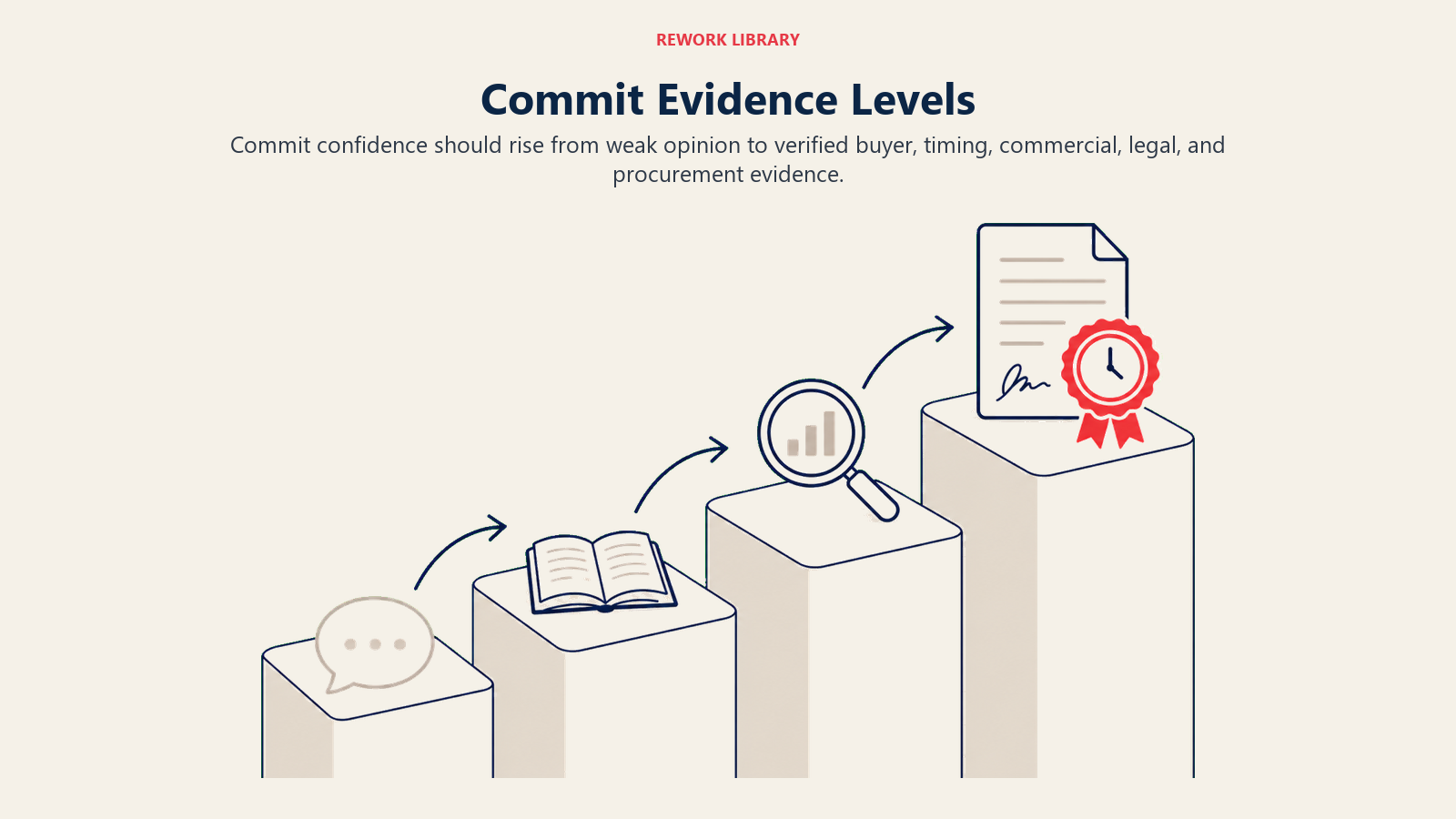
Commit evidence levels
Not all evidence has the same strength.
Turn this article into takeaways for your work.


Each assistant summarizes the article only for you and suggests best practices for your work.
| Evidence level | Example | Commit implication |
|---|---|---|
| Weak | Rep says champion is excited | Not enough |
| Moderate | Buyer confirmed problem and next meeting | May support best case |
| Strong | Economic buyer engaged, procurement path known, mutual plan active | May support commit |
| Very strong | Commercial terms aligned, legal or procurement active, date tied to buyer event | Strong commit evidence |
This model helps managers calibrate. It also reduces the habit of treating buyer excitement as evidence. A positive conversation can be meaningful, but commit should require the buyer's process to be visible enough that the close date is credible.
Commit vs best case
Commit and best case should not be synonyms.
| Category | Meaning |
|---|---|
| Commit | The team expects the deal to close and can explain buyer evidence |
| Best case | The deal could close, but timing or evidence is incomplete |
If managers use best case as weak commit, the forecast becomes inflated. If commit includes deals with unresolved blockers, finance will discount the number.
Evidence checklist
Before a deal enters commit, inspect:
- Buyer problem
- Business impact
- Decision process
- Economic buyer
- Legal or procurement path
- Commercial scope
- Implementation risk
- Close plan
- Next customer action
- Known blockers
The evidence standard can be lighter for transactional deals and stricter for enterprise deals. But the standard should be written.
Commit hygiene
Track:
- Commit added
- Commit removed
- Commit slipped
- Commit lost
- Commit closed-won
- Commit with close-date movement
- Commit with missing next step
- Commit with unresolved blocker
This gives RevOps a way to improve the standard over time.
Manager inspection
Managers should ask:
- What changed since last review?
- What customer action supports commit?
- What could stop the deal?
- What help is needed?
- Is the close date tied to buyer process?
- What evidence would make this best case instead?
The goal is not to interrogate reps. The goal is to keep commit meaningful.
Common mistakes
Commit based on rep confidence. Confidence is not evidence.
No date discipline. Commit slips repeatedly.
No post-period review. The team never learns which criteria failed.
Same criteria for every motion. Enterprise and transactional deals may need different evidence.
Commit without implementation review. Deals close but create post-sale risk.
Readiness checklist
Before rollout:
- Commit definition is written.
- Best-case definition is separate.
- Required evidence is documented.
- Managers inspect criteria.
- RevOps tracks commit movement.
- Finance understands the standard.
- Post-period review is scheduled.
Commit is working when the category becomes boring: fewer surprises, clearer risk, and better forecast trust.
Commit evidence by deal type
Different motions need different evidence.
| Motion | Evidence emphasis |
|---|---|
| Transactional | Buyer intent, payment path, no blocker |
| Mid-market | Business problem, decision process, commercial terms |
| Enterprise | Buying committee, legal, procurement, executive sponsor |
| Renewal | Health, sponsor, contract timing, value proof |
| Expansion | Adoption, use case, stakeholder, commercial scope |
Do not force one heavy enterprise checklist onto every deal. But do not let complex deals enter commit with light evidence.
Commit entry checklist
Before commit:
- Is the buyer's next action clear?
- Is the close date based on buyer timing?
- Are blockers documented?
- Is the approver path known?
- Are commercial terms understood?
- Has the manager inspected the deal?
- Is post-sale risk visible?
If not, the deal may belong in best case.
Commit exit review
At the end of the period, review every commit deal:
- Closed-won
- Slipped
- Closed-lost
- Pulled
- Amount changed
- Category changed
For slipped or lost commit, capture the missing evidence pattern.
Commit and customer handoff
Some deals can be commercially likely but operationally risky.
RevOps should make post-sale risk visible before commit when implementation complexity, promised outcomes, or customer readiness could affect revenue quality. A deal can close and still create churn risk.
Commit dashboard
Show:
- Commit amount
- Commit count
- Commit conversion
- Commit slippage
- Commit age
- Commit by manager
- Commit with missing evidence
- Commit closed-won trend
This helps leaders improve commit quality over time.
Manager coaching
Managers should use commit criteria to coach, not just police.
Questions:
- What evidence makes this commit?
- What evidence is missing?
- What action would increase confidence?
- What would make this best case instead?
- What changed since last call?
This creates consistent judgment.
Common anti-patterns
Sandbagging. Managers keep real commit out of commit to avoid risk.
Happy commit. Reps commit deals because they feel good.
End-of-quarter commit stuffing. Weak deals move into commit late to close a gap.
No post-period learning. Commit mistakes repeat.
What to do instead
Commit should be a promise backed by visible buyer evidence. If that evidence is not visible, the deal may still be important, but it should not carry commit confidence.
Commit criteria maturity model
Teams usually mature through stages.
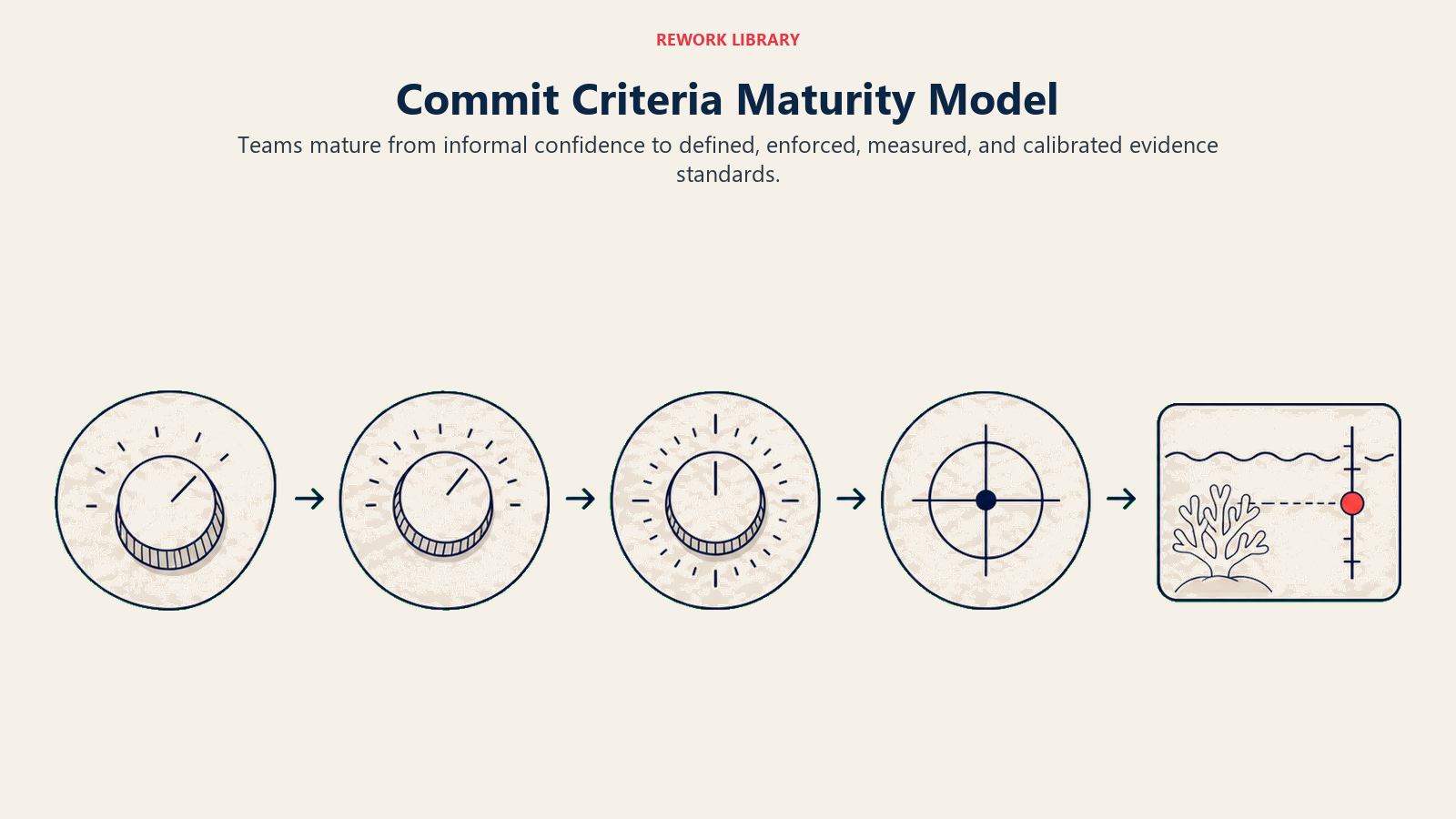
| Stage | Behavior |
|---|---|
| Informal | Commit means the rep or manager feels good |
| Defined | Commit definition exists but is not inspected consistently |
| Enforced | Managers review evidence before commit movement |
| Measured | RevOps tracks commit conversion, slippage, and misses |
| Calibrated | Criteria are tuned by segment, product, and motion |
Most teams do not need a complex model on day one. They need a written standard, manager discipline, and a post-period review. Complexity can come later when the business has enough data to tune criteria by segment.
How to write commit criteria
Good criteria are specific, inspectable, and tied to buyer behavior.
Weak criterion: "Customer is interested."
Better criterion: "Customer confirmed the business problem, decision owner, and next buying step."
Weak criterion: "Procurement should be fine."
Better criterion: "Procurement owner is known, process has started, and no required vendor step is unknown."
Weak criterion: "Champion says they want it."
Better criterion: "Champion has influence, economic buyer is identified, and the business case is accepted."
RevOps should write criteria in language managers can use during inspection. If the rules sound like policy text, they may be ignored. If they sound like practical deal questions, managers can coach with them.
Commit criteria by field
The CRM should support commit criteria without becoming a form-heavy burden.
Useful fields include:
- Forecast category
- Close date
- Next customer action
- Decision process
- Economic buyer
- Procurement status
- Legal status
- Blocker
- Mutual plan status
- Manager inspection date
Not every field needs to be mandatory for every stage. But commit should require the evidence fields that matter to the motion. A late-stage enterprise deal with no procurement status is a real forecast risk. A transactional deal may need a lighter standard.
Commit exceptions
Some deals will not fit the normal pattern.
The team should allow exceptions, but exceptions should be visible. For example, a strategic account may enter commit without completed procurement if the executive sponsor has confirmed timing and legal work is already scoped. That can be a valid commercial judgment, but it should be marked as an exception with the reason.
Exception handling should include:
- Who approved the exception
- Which evidence is missing
- Why the deal remains commit
- What action closes the evidence gap
- When the exception will be reviewed again
This keeps flexibility without weakening the standard for everyone.
Commit and deal reviews
Commit criteria should appear in manager deal reviews before the forecast call.
Deal review questions:
- What buyer evidence supports commit?
- What evidence changed since last week?
- What could still prevent close?
- Who owns the next buyer action?
- What is the date tied to?
- What internal resource is needed?
- What would move this deal out of commit?
Managers should avoid turning the checklist into a mechanical exercise. The point is judgment. The checklist keeps judgment grounded in evidence.
Commit quality by manager
RevOps should compare commit quality across managers carefully.
Useful comparisons:
- Commit conversion rate
- Commit slippage rate
- Commit lost rate
- Average date pushes after commit
- Commit added late in period
- Commit removed after forecast call
These metrics can reveal coaching opportunities, but they should not become a public blame board. If one manager has low commit accuracy, the cause may be poor inspection, tougher territory, new segment mix, weak qualification, or unclear definitions. RevOps should help diagnose before leaders decide.
Commit criteria and finance trust
Finance does not need every deal detail, but finance needs to understand the standard behind the number.
When commit criteria are written and measured, finance can trust the sales call more. When criteria are vague, finance often creates a shadow forecast. That shadow forecast may be rational, but it creates duplicated work and tension.
RevOps can help by showing:
- Commit definition
- Commit conversion history
- Slippage trend
- Large deal caveats
- Segment differences
- Known data gaps
Trust improves when finance can see how the number was built.
Rolling out commit criteria
Rollout should be practical:
- Audit recent commit misses.
- Identify common missing evidence.
- Write simple criteria.
- Review with sales managers.
- Add only necessary CRM fields.
- Train reps through example deals.
- Review commit movement weekly.
- Review accuracy after the period closes.
The first version should be simple enough to use immediately. A perfect unused standard is worse than a clear standard that can improve.
Testing the standard
Before rollout, test criteria against recent closed-won, slipped, and closed-lost deals.
Ask whether the criteria would have correctly separated real commit from weak commit. If the answer is no, revise the standard. If the criteria would have blocked many deals that actually closed, they may be too strict. If they would have allowed many slipped deals into commit, they are too loose.
This historical test makes the rules more credible.
Commit criteria examples
Example: a mid-market deal has a strong champion, clear business pain, and pricing agreement, but no known approver path. It may be best case, not commit. The next action is to identify the approval path, not to argue about rep confidence.
Example: an enterprise deal has executive alignment and a signed business case, but legal has not started. If legal timing is material to close date, the deal should carry a caveat or remain outside commit until the path is known.
Example: a renewal has strong usage and no commercial blocker, but the sponsor has changed. The deal may still be likely, but the manager should inspect relationship risk before allowing it to carry clean commit confidence.
These examples help managers apply the standard without turning it into a rigid script.
What to review after the period
After close, compare commit evidence to actual outcomes.
Review:
- Which commit deals closed?
- Which commit deals slipped?
- Which commit deals were lost?
- Which evidence was missing in slipped deals?
- Which criteria were too strict?
- Which criteria were too loose?
- Which managers need calibration?
- Which CRM fields did not help decisions?
This review should produce one or two changes at a time. Too many changes make the standard hard to use.
Minimum viable version
A team can start with four required checks:
- Buyer problem is confirmed.
- Decision path is known.
- Close date is tied to buyer timing.
- No material blocker is hidden.
That simple standard is better than an elaborate checklist managers do not use. Add legal, procurement, implementation, and executive-sponsor detail when deal complexity requires it.
Keep the first version inspectable.
Review it after the first forecast cycle.
A good standard should make manager judgment clearer, not replace it. If a manager overrides the criteria, capture the reason. Overrides are useful when they teach the team which evidence matters and which rules need tuning.
Deal review packet
Commit criteria work best when the forecast call is not the first time a deal is inspected.
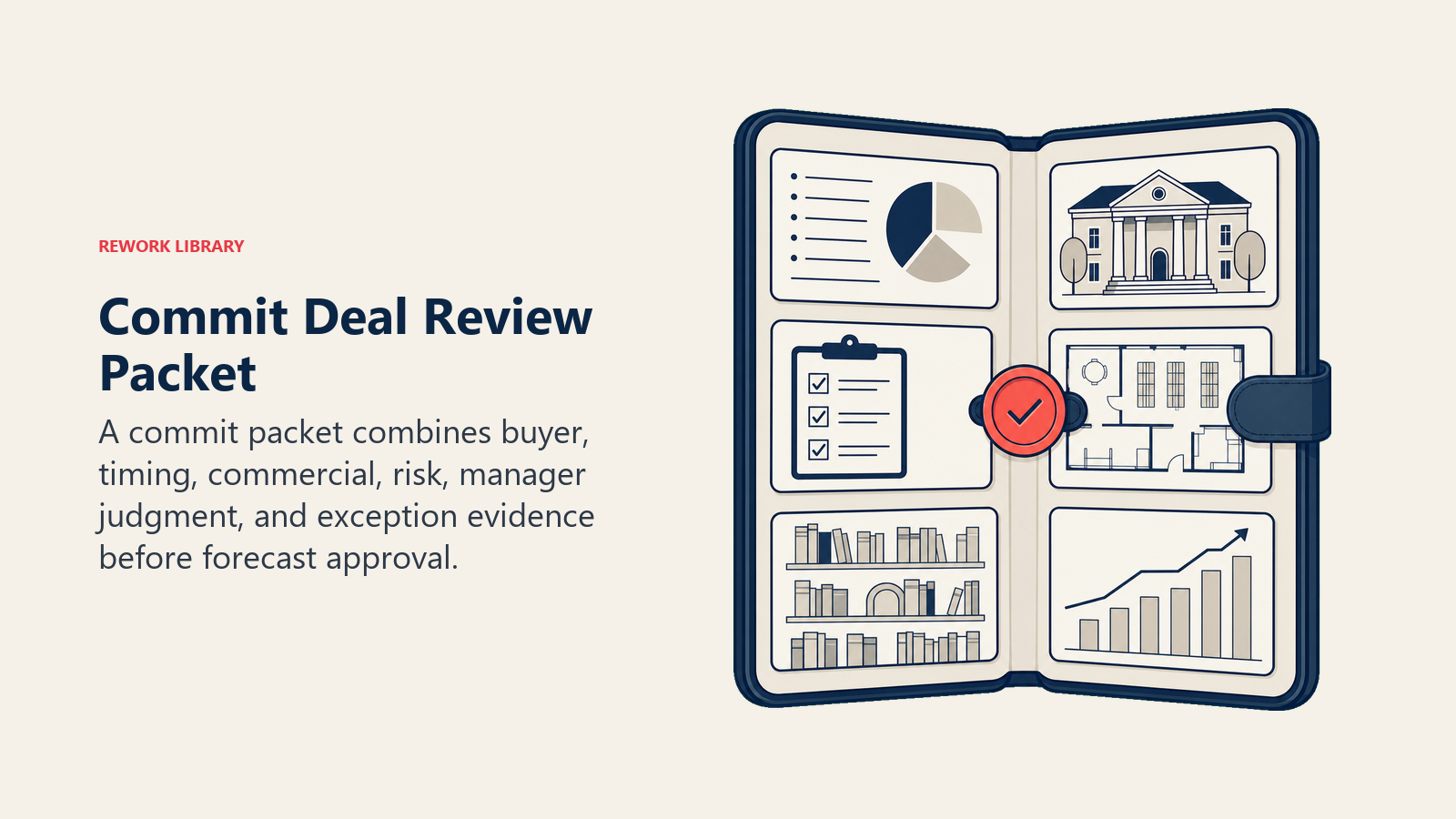
Before a deal can enter commit, managers should have a short review packet:
| Item | What to show |
|---|---|
| Buyer evidence | Problem, impact, economic buyer, decision path, and next customer action |
| Timing evidence | Why the close date is tied to buyer timing, not seller preference |
| Commercial evidence | Scope, price, approval path, legal or procurement status |
| Risk evidence | Known blockers, missing stakeholders, implementation risk, competitor risk |
| Manager judgment | Why the manager accepts commit or keeps the deal in best case |
| Exception note | What evidence is missing and why the deal still deserves commit if an exception is approved |
This packet keeps the standard usable. Reps know what evidence to collect. Managers know what to inspect. Finance can understand why commit should be trusted. RevOps can review misses after the period without reconstructing the story from memory.
Frequently Asked Questions about Commit Criteria
Who owns commit criteria?
Sales leadership owns the standard. RevOps governs definitions, fields, reporting, and accuracy tracking.
Should every commit deal have a mutual plan?
For complex B2B deals, yes. For transactional deals, the evidence standard may be simpler.
Learn more

Principal Solution Architect
On this page
- Common commit evidence
- How to enforce commit criteria
- Commit evidence levels
- Commit vs best case
- Evidence checklist
- Commit hygiene
- Manager inspection
- Common mistakes
- Readiness checklist
- Commit evidence by deal type
- Commit entry checklist
- Commit exit review
- Commit and customer handoff
- Commit dashboard
- Manager coaching
- Common anti-patterns
- What to do instead
- Commit criteria maturity model
- How to write commit criteria
- Commit criteria by field
- Commit exceptions
- Commit and deal reviews
- Commit quality by manager
- Commit criteria and finance trust
- Rolling out commit criteria
- Testing the standard
- Commit criteria examples
- What to review after the period
- Minimum viable version
- Deal review packet
- Learn more