Services Revenue Growth: Building Scalable Professional Services
Turn this article into takeaways for your work.


Each assistant summarizes the article only for you and suggests best practices for your work.
Services revenue is seductive because it often comes with high margins, recurring relationships, and direct feedback from real customers. But it is also subject to constraints that product revenue is not. You cannot ship a second copy of a consultant. You cannot scale a services business without scaling the people who deliver the service.
This creates a fundamental leadership challenge: how do you grow services revenue without proportionally growing headcount, sacrificing quality, or burning out your delivery team?
The answer is not a single tactic. It is a set of strategic and operational choices that, made well, allow services businesses to grow profitably. Made poorly, they produce rapid top-line growth followed by delivery failure, talent attrition, and client churn.
The Economics of Services Businesses
Before deciding how to grow, leaders need to understand the structural economics of their services business. The key metrics are different from product metrics, and the levers are different too.
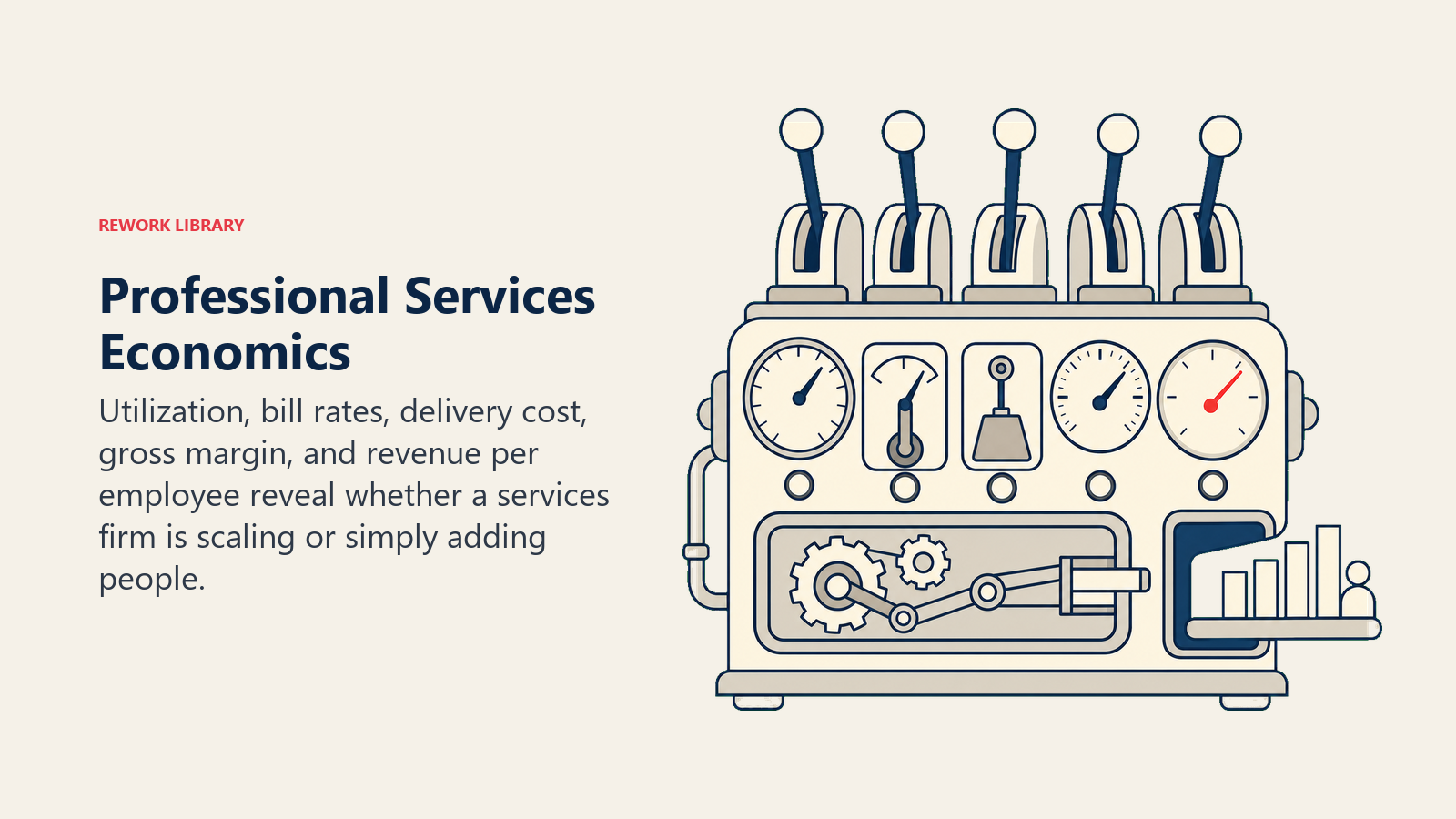
Utilization rate is the share of billable hours available that are actually billed to clients. A utilization rate that is too low means you are carrying capacity that is not generating revenue. Too high means your people are at risk of burnout and you have no slack for non-client work like knowledge development, business development, or internal improvement.
The sustainable utilization target varies by service type, but for most professional services organizations, the healthy range sits between 65% and 80% of available hours. Above 80% consistently means something is wrong: either you are understaffed, people are hiding time off, or non-client work is being neglected.
Realization rate is the share of work actually performed that you bill and collect. Not every hour worked becomes revenue. You write off hours due to scope creep, quality rework, discounting at the end of a project, or client disputes. Low realization rates signal either pricing problems, scope management problems, or both.
Revenue per employee is the blended measure of utilization, billing rate, and realization. It is the single number that most directly captures services productivity. Growing revenue per employee while maintaining quality is the core challenge of scaling a services business.
Gross margin in services is almost entirely determined by the ratio of billing rates to delivery costs. If you bill at $200 per hour and your all-in delivery cost is $120 per hour, your gross margin is 40%. Growing revenue without letting costs grow proportionally is possible only if you can either raise rates, lower costs, or get more work done in fewer hours.
The Four Growth Pathways
Services revenue can grow through four distinct pathways, each with different risk profiles and resource requirements.
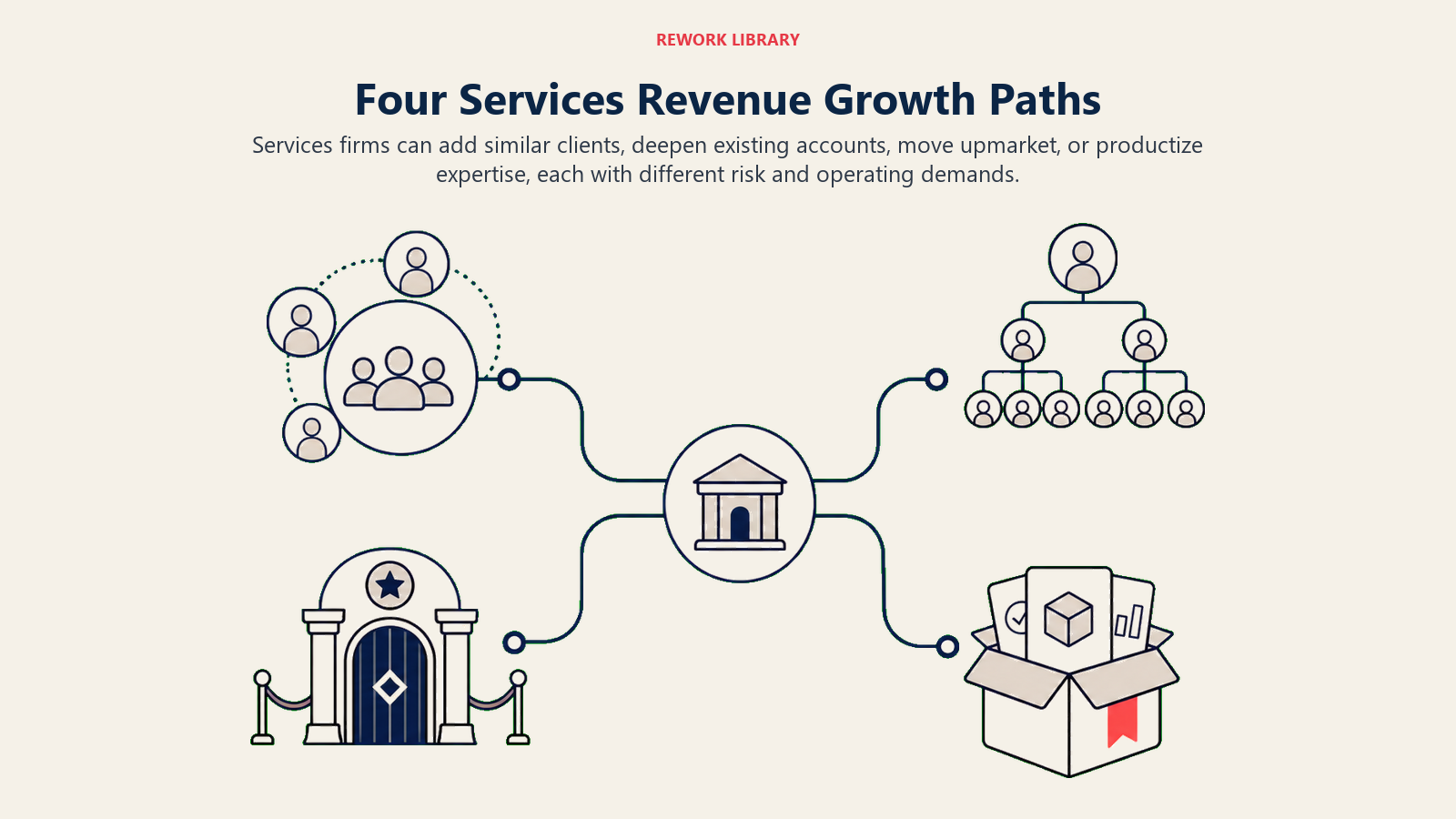
1. More clients in the same segment
The most straightforward growth path: find more clients who need what you already deliver. The economics are relatively predictable because you have established delivery processes and can estimate effort with reasonable accuracy.
The constraint is sales capacity. Services businesses often underinvest in business development because delivery is what generates revenue in the short term. But delivery-only firms hit a ceiling quickly because client relationships end and new ones must be developed.
Effective services growth requires maintaining a pipeline of prospective work even when the team is fully booked. The default failure mode is to defer business development until existing work ends, then scramble to fill the gap. The result is a feast-famine cycle that is difficult to manage and exhausting for the people who live through it.
2. Expanded scope with existing clients
Existing clients who are satisfied with current work are the highest-return growth opportunity in most services businesses. Acquisition costs are minimal, trust is established, and the sales conversation is much shorter.
But upsell and expansion with existing clients does not happen automatically. It requires proactively surfacing adjacent problems the client has not thought to bring to you, delivering visible value that creates a reason for the conversation, and having someone in your organization whose job it is to maintain and deepen client relationships rather than just deliver the current engagement.
Leaders who want to grow through account expansion need to think about what structure creates those conversations. If every person on the delivery team is 100% allocated to execution, no one has time to spot expansion opportunities or have the relationship discussions that lead to them.
3. Higher rates for the same work
Raising billing rates is the most direct way to improve revenue per employee, and it is underused by most services leaders because it feels risky. But rate increases are often more achievable than headcount growth and have no delivery capacity constraints.
The conditions that support rate increases: the market benchmark has moved (if peers are charging more, you should too), the work has become more strategic or specialized (complexity justifies higher rates), you have a track record of outcomes that clients value (demonstrated ROI reduces price sensitivity), or demand exceeds supply (scarcity is a natural lever).
Raising rates works best when framed around value delivered rather than cost of delivery. Clients do not care that your costs went up. They care about whether the work is worth what you charge. The conversation needs to anchor on the latter.
4. Productizing services
Productization means taking a service that currently requires custom delivery and creating a standardized version that can be delivered faster, at lower cost, and at higher volume. This is the pathway that most directly breaks the constraint of headcount.
Examples: a consulting firm that develops a proprietary assessment tool that replaces three weeks of custom diagnostic work with two days of structured analysis. A managed services company that automates a manual monitoring task, allowing one engineer to do the work that previously required five. A training company that converts a live workshop into a structured self-paced course.
Productization is not suitable for every service. Work that is highly customized, requires deep contextual knowledge, or where the personal relationship is part of the value proposition resists productization. But most services organizations have at least some repeatable work that could be made more efficient through standardization.
The leadership challenge is that productization requires upfront investment in an asset that pays off over time. That investment competes with delivering current client work, which generates revenue immediately. Building the organizational discipline to make that investment consistently is harder than it sounds when the delivery team is fully utilized.
Hiring and Scaling Delivery Capacity
Services growth requires people. The question is whether headcount grows proportionally to revenue or whether each new hire generates more revenue than the last.
The leverage problem. Early in a services business, revenue per employee tends to increase as you figure out what you do well and get more efficient at delivering it. But growth pressure often pushes organizations to hire faster than they can develop people, creating a talent quality distribution problem: senior people deliver high-value work efficiently; junior people take longer, need supervision, and carry risk on complex work.
If you are growing by adding junior staff to service more clients, you need to invest proportionally in supervision and training, or quality degrades. Organizations that treat junior staff as cheap leverage without investing in their development create a model that works until it doesn't, and the failure mode is a client quality incident at the worst possible moment.
The staffing model. Every services organization needs to decide its staffing model: Do you staff with specialists or generalists? How senior is the default profile for client-facing work? How many "benched" staff can you carry before utilization math breaks down?
There is no universal answer, but the staffing model is a strategic decision that has downstream consequences for everything from hiring to pricing to the types of clients you can serve. Changing it mid-flight is expensive. Getting it right early saves significant pain.
Onboarding as leverage. One of the highest-return investments in services growth is an effective onboarding program that gets new hires to full productivity faster. Every week that a new hire is not fully productive is a week of utilization you are not capturing. A six-week reduction in ramp time, multiplied across ten new hires per year, represents a meaningful revenue impact.
Client Relationship Management
Long-term client relationships are the most valuable asset in a services business, and they are frequently treated as an afterthought.
The risk in services businesses is over-rotation toward delivery and under-investment in relationship. When things are going well on a project, the default is to keep heads down and deliver. But the conversations that lead to repeat business and expanded scope happen outside the project cadence, in quarterly reviews, informal check-ins, and discussions about where the client is heading next.
Services leaders need to build explicit structures for client relationship management:
Formal account reviews. Quarterly reviews with senior client stakeholders, distinct from project status meetings. The agenda covers not just project performance but the client's evolving strategic priorities and how your work connects to them.
Post-project retrospectives. Structured conversations at the end of each engagement to understand what worked, what could have been better, and what the client is thinking about next. The best time to identify the next opportunity is when the last one is freshly completed.
Senior executive relationships. Delivery relationships are typically with operational buyers. But budget decisions and strategic priorities are set by people above them. Maintaining relationships with senior client executives who are not day-to-day contacts is a business development activity that most services firms underinvest in.
Key Facts
- Services revenue per employee is the single most important productivity metric. Not revenue growth alone, not headcount growth alone. The ratio between them determines whether your business is scaling or just getting bigger.
- Scope creep is the silent margin killer. Undocumented scope expansion is endemic in services businesses. Building the organizational discipline to capture and price scope changes is not about being rigid with clients. It is about being able to sustain the business that serves them.
- The client who is loudest about price is not always the most price-sensitive. Rate conversations often reveal relationship strength rather than genuine price limits. Clients who genuinely trust the value of your work are more willing to pay than their initial negotiating position suggests.
Frequently Asked Questions about Services Revenue Growth
What is the most common mistake in growing a services business?
Treating headcount as the only growth lever. Revenue grows, so you hire. Hiring costs rise, margins compress, utilization becomes harder to manage. The more sustainable approach combines selective headcount growth with investments in productization, rate improvement, and account expansion that grow revenue per employee.
How do you price services appropriately?
Value-based pricing is the right framework but the hardest to execute. Start by understanding the economic value the client gets from your work, then price at a discount to that value rather than at a markup to your cost. Cost-plus pricing is safer but consistently leaves revenue on the table and makes rate increases feel arbitrary.
Should a services business have dedicated sales staff or should delivery people sell?
Most successful services businesses use a hybrid model: delivery professionals who maintain and grow client relationships (the most natural form of business development in services), supported by business development specialists who develop new client relationships. Relying entirely on delivery people to sell creates a capacity problem when the team is fully utilized. Relying entirely on salespeople who are not close to delivery creates a quality-expectation mismatch problem.
How do you decide which services to productize?
Look for services where the questions you ask and the work you do follow a repeatable pattern across different clients. If you could write a playbook that a different team could follow and get a similar outcome, that service is a productization candidate. If every engagement is genuinely different and requires deep customization, productization will likely compromise quality.
Related Reading

Co-Founder, Rework.com