Multitasking: Does It Work and How to Do It Better
Turn this article into takeaways for your work.


Each assistant summarizes the article only for you and suggests best practices for your work.
Multitasking doesn't work, at least not the way most people picture it. When you're switching between two things that both require focused thought, like drafting a proposal while half-listening to a call, your brain isn't doing both at once. It's toggling rapidly back and forth, and every toggle costs you time and accuracy you don't get back.
That doesn't mean juggling tasks is always a mistake. Pair a demanding task with something genuinely automatic, like folding laundry while catching up with a friend, and you really can do both. The skill worth building isn't "multitasking better." It's knowing which combinations are safe, protecting the ones that aren't, and switching to single-tasking or batching when the work actually matters.
Key Facts
Key Facts: Multitasking
- Psychologist David Meyer has estimated that the mental blocks created by shifting between tasks can cost as much as 40% of a person's productive time, according to the American Psychological Association.
- People resumed interrupted work in an average of 23 minutes and 15 seconds, and got back to it the same day 81.9% of the time, according to Gloria Mark's UC Irvine research reported by Gallup.
- Only 2.5% of participants in a 200-person driving study qualified as "supertaskers" who showed no performance loss from doing two demanding tasks at once, per Watson and Strayer's 2010 research.
- Heavy media multitaskers performed worse, not better, on task-switching tests than light multitaskers, a 2009 Stanford study published in PNAS found.
- Attention lingers on an unfinished task after you switch away from it, a phenomenon researcher Sophie Leroy calls "attention residue" in her 2009 study on task switching.
What multitasking actually means
"Multitasking" gets used for three different things, and the difference matters for whether it works.
True parallel processing is when two tasks run at the same time using different mental systems, with almost no overlap in attention. Walking while listening to a podcast is a good example: walking is largely automatic once you've learned it, so it barely competes with the attention you're giving the podcast.
Task switching is what most people actually mean when they say they're multitasking. You're not doing two things simultaneously. You're rapidly alternating between them, and each switch pulls on the same limited pool of what psychologists call executive control, the mental system that decides what to focus on and which rules apply to the task in front of you. Writing a report while answering Slack messages is task switching dressed up as multitasking.
Sequential focus, or single-tasking, is working on one attention-demanding task until it's done or you deliberately pause it, then moving to the next. It's the least glamorous of the three and, for anything cognitively demanding, the one that produces the most output per hour.
| Term | What's actually happening | Example | Cognitive cost |
|---|---|---|---|
| True parallel processing | Two tasks run with little overlap in attention because one is automatic | Walking while listening to a podcast | Minimal to none |
| Task switching | Attention alternates rapidly between tasks competing for the same executive control resources | Writing a report while monitoring a group chat | High, and it compounds with every switch |
| Sequential focus (single-tasking) | One task gets full attention before you move to the next | Blocking 90 minutes for a proposal, then checking email | Lowest per unit of output |
Most of what gets called multitasking at work is the middle row. That's why the honest answer to "does multitasking work" is: rarely, and mostly not in the way people hope.
Does multitasking work? What the research actually shows
The short answer is that for cognitively demanding work, no. The people who study this for a living have been saying so for more than two decades, though the most quoted number around it is often misused.
Psychologist David Meyer has said that the mental blocks created by shifting between tasks can cost as much as 40% of someone's productive time. That's a real estimate from a real researcher, and the American Psychological Association reports it directly on its own multitasking research page. What it isn't is the finding of a single controlled study. No published paper measured a 40% productivity loss. It's Meyer's characterization of the broader body of switch-cost research, not a data point you can trace to one experiment.
The peer-reviewed study behind that broader research is Rubinstein, Meyer, and Evans (2001), published in the Journal of Experimental Psychology: Human Perception and Performance. Across four experiments, the researchers had people alternate between different rule sets (classifying shapes one way, then another; solving arithmetic one way, then another) and measured how much time the switch itself cost. The finding: switching carries a real, measurable time penalty, and that penalty grows as the tasks get more complex and less familiar. Simple, well-practiced switches cost less. Complex, unfamiliar ones cost more, sometimes a lot more.
Two other studies round out the picture:
| Study | Researchers | What it found |
|---|---|---|
| Executive Control of Cognitive Processes in Task Switching (2001) | Rubinstein, Meyer & Evans | Switching costs time, and the cost grows with task complexity and unfamiliarity |
| Cognitive Control in Media Multitaskers (2009) | Ophir, Nass & Wagner, Stanford | People who chronically multitask across media performed worse, not better, on task-switching and distraction-filtering tests |
| Supertaskers: Profiles in Extraordinary Multitasking Ability (2010) | Watson & Strayer | Only 2.5% of a 200-person sample showed no performance loss from doing two demanding tasks at once |
| Why Is It So Hard to Do My Work? (2009) | Sophie Leroy | Attention lingers on an unfinished task after you switch away, dragging down performance on whatever comes next |
None of these say multitasking is impossible. They say it has a cost, that the cost is real and repeatable across different research designs, and that the cost is worse for exactly the kind of work most professionals are trying to protect: complex, non-routine, judgment-heavy tasks. Attention to detail is one of the first casualties, since catching a subtle error requires the sustained focus that switching interrupts.
Why switching costs add up: the mechanism behind the cost
Meyer's research describes switching as happening in two stages: "goal shifting" (the decision to stop one task and start another) and "rule activation" (turning off the old task's mental rules and turning on the new ones). Each stage takes a fraction of a second, which sounds trivial until you count how often it happens: a single work hour can include dozens of app switches, notification checks, and conversation pivots. Small costs, repeated constantly, add up to a large one.
Gloria Mark's field research at UC Irvine, tracking real office workers throughout their days, put numbers on the human side of this. People resumed interrupted work in an average of 23 minutes and 15 seconds, and got back to it the same day 81.9% of the time, according to her interview with Gallup. But resuming isn't the same as picking up cleanly. Mark's research also found that people typically complete about two other tasks in between before returning to the original one, and roughly 44% of interruptions are self-initiated rather than caused by someone else, which means a meaningful share of this cost is within your control to reduce.
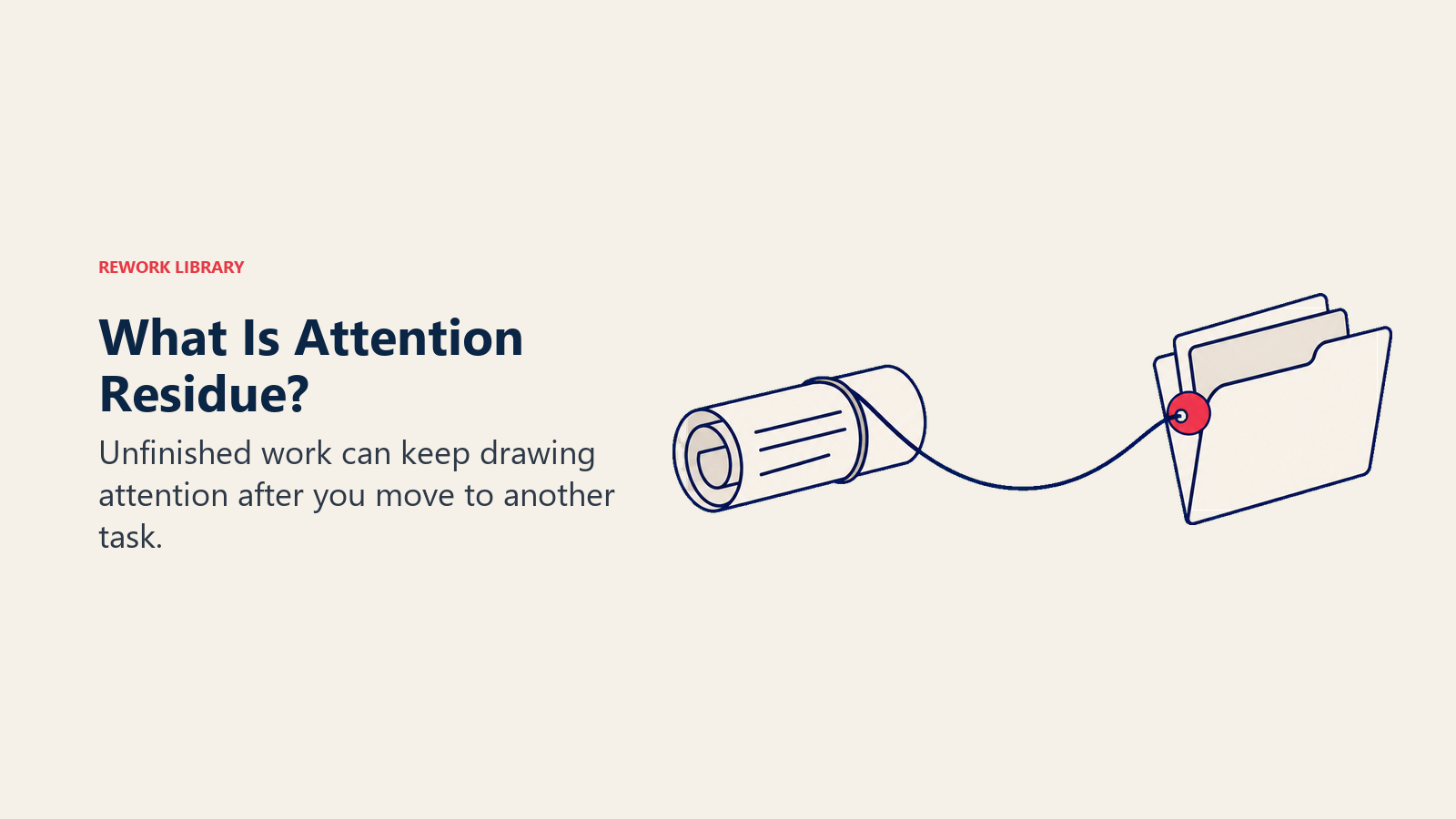
There's a second mechanism working against you even after you've technically switched: attention residue. Sophie Leroy's 2009 research found that people need to genuinely stop thinking about one task before they can perform well on the next, and that unfinished, interrupted work leaves a kind of mental afterimage that keeps drawing on attention, an effect strongest when the task you left was time-pressured or incomplete. Building the self-discipline to close a loop, even briefly, before switching tasks measurably reduces that residue.
The cumulative effect shows up as stress as much as lost time: constant switching keeps the nervous system in a low-grade state of vigilance, since every interruption is a small, unresolved decision about what deserves attention next.
When multitasking is actually fine
Here's the part that gets lost in the "multitasking is bad" version of this conversation: pairing tasks is fine, sometimes genuinely productive, when one of the two tasks doesn't require conscious attention. The American Psychological Association's own guidance puts it plainly: throwing a load of laundry in the wash while talking to a friend will probably work out fine, because folding and starting a wash cycle are automatic enough not to compete with the conversation.
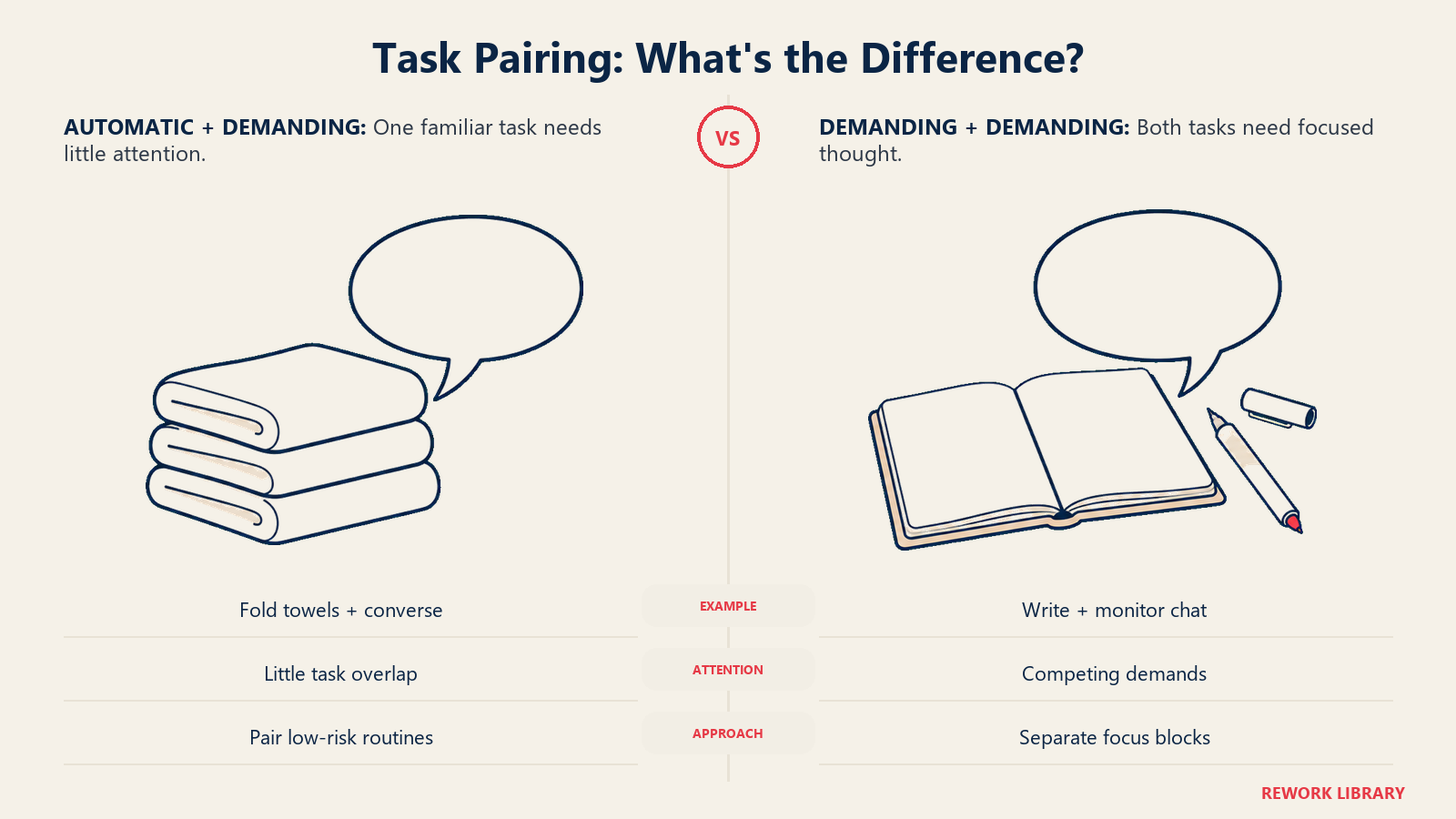
The rule of thumb is simple: pair one automatic task with one demanding task, never two demanding tasks. "Automatic" means you could do it while thinking about something else entirely, the way an experienced driver navigates a familiar commute without consciously tracking every turn.
| Usually fine (automatic + demanding) | Usually costly (two demanding tasks) |
|---|---|
| Folding laundry while catching up with a friend | Writing a proposal while monitoring a group chat |
| Walking on a treadmill while listening to a podcast | Reviewing a contract during a live status meeting |
| Eating lunch while reading a low-stakes email | Coding a fix while fielding a stream of chat pings |
| Driving a familiar commute while listening to the radio | Talking on a phone (even hands-free) while driving, which the APA notes can cost enough attention at 30 mph to matter |
Notice what's on the right side isn't "bad" multitasking versus "good" multitasking on the left. It's the same underlying rule applied consistently: when both tasks draw on focused attention, one of them loses, and you usually don't get to choose which. That's the argument for prioritization: decide in advance which task in any pairing gets your real attention, instead of discovering the answer after the mistake happens.
The "supertaskers": who multitasking really works for
If pairing two demanding tasks almost always costs something, why do some people insist they're an exception? Watson and Strayer's research gives a partial, and humbling, answer.
In a 2010 study, 200 participants completed a driving simulation alone and combined with a demanding auditory memory task. Nearly everyone performed worse on one or both tasks when doing them together. But 2.5% of participants, five people out of two hundred, showed no measurable performance loss at all. In single-task conditions, these "supertaskers" scored in the top quartile on the driving and memory measures separately, and in the combined condition some outperformed their own single-task numbers. Statistical checks ruled out random chance as the explanation.
That's a genuinely rare ability, not a skill you train your way into over a weekend. There's no dependable self-test for identifying a supertasker, so the honest planning assumption for almost everyone, including the confident, is that they're in the 97.5%. Building a team or a personal system around the hope of being the exception is a bet that loses almost every time.
What chronic media multitasking does to attention
There's a common assumption that heavy multitaskers get better at it with practice, the same way any skill sharpens with repetition. Stanford's 2009 study by Ophir, Nass, and Wagner tested that assumption directly, and found the opposite.
The researchers grouped people by how much they habitually multitasked across media (texting, browsing, messaging, watching, often several at once) and tested everyone on the same cognitive tasks. Heavy media multitaskers didn't outperform light multitaskers on task switching. They performed worse: more susceptible to interference from irrelevant environmental information and irrelevant memories, and slower and less accurate specifically on the task-switching tests, the exact skill you'd expect them to have practiced most.
The researchers' interpretation: chronic multitaskers develop a broad, easily distracted style of attention rather than a trained, focused one. Practice didn't build an edge; it appeared to erode the filtering ability that results-oriented work depends on. That's a good reason to treat "I multitask all day, I'm used to it" as a warning sign, not a credential.
What to do instead: batching and single-tasking
If task switching is the default cost and true multitasking only works for automatic-plus-demanding pairings, the practical answer is to reduce how often you switch between demanding tasks in the first place. Two techniques do most of the work.
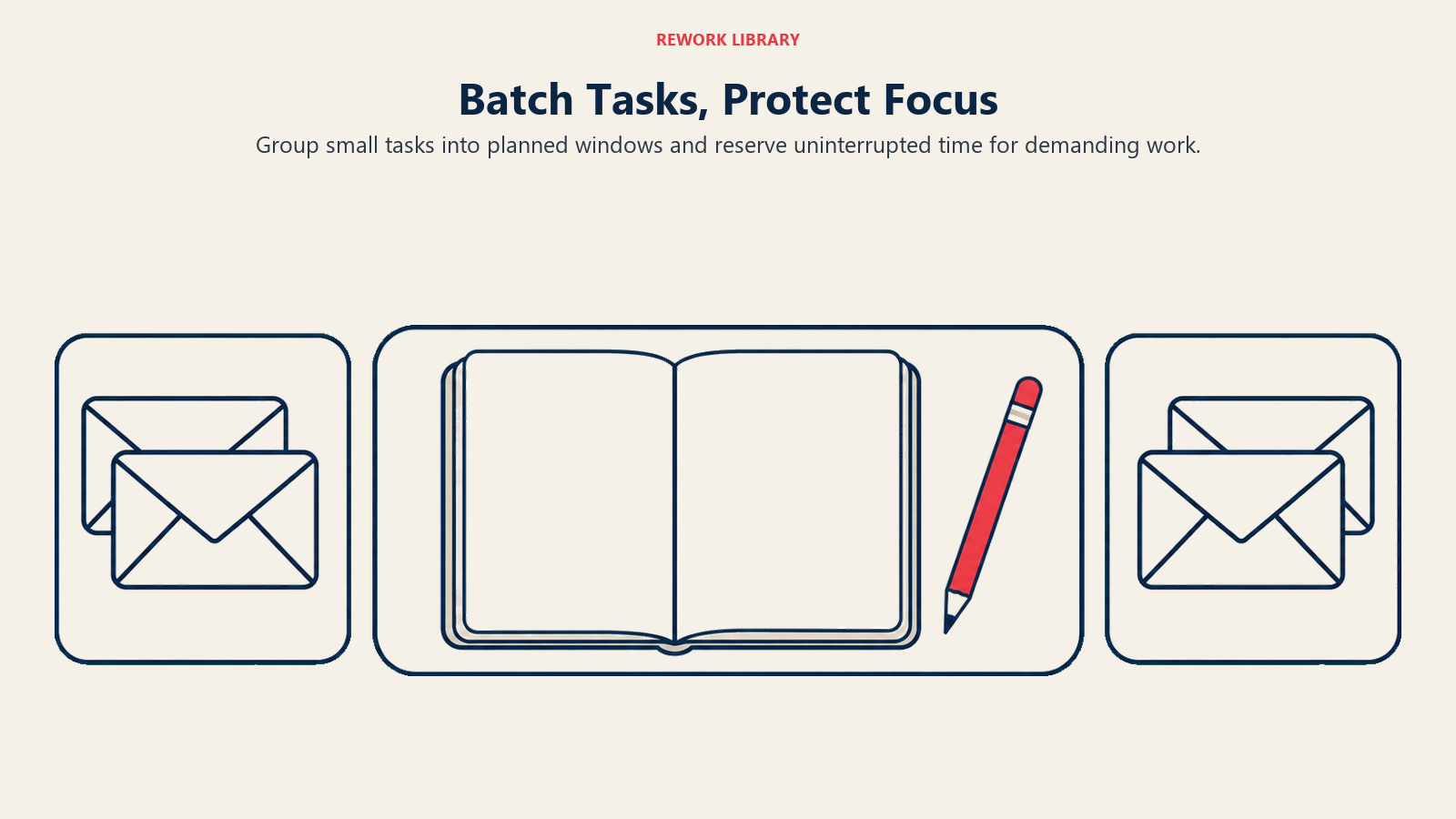
Batching groups similar small tasks into a scheduled block instead of doing them as they arrive. Every notification you answer the instant it appears is a small, self-inflicted switch, the same self-initiated interruptions Gloria Mark's research flagged as roughly 44% of the total. Batching turns dozens of scattered switches into one or two planned ones.
Single-tasking protects a block of time for one demanding piece of work, with the switching cost paid once at the start and once at the end instead of continuously throughout.
| Task type | Task-switching approach (costly) | Batching approach (better) |
|---|---|---|
| Email and chat | Answering after every notification | Three fixed windows a day, for example 9am, 1pm, and 4pm |
| Meetings | Scattered across the day between deep-work attempts | Clustered into one or two blocks, with focus time protected around them |
| Admin and approvals | Handled in small pieces between other work | One weekly 30-minute batch |
| Analytical or creative work | Interrupted repeatedly by messages and pings | A protected block, notifications off, scheduled during your highest-energy hours |
A few smaller habits make both techniques stick. Close the loop before you switch: even a one-line note on where you left off measurably reduces the attention residue Leroy's research describes, since it gives your brain permission to stop actively holding the unfinished task. Turn off notification badges for anything that isn't genuinely time-critical, and treat your task list as a queue, not a dashboard: work from one prioritized list instead of toggling between apps trying to remember what's urgent. Strong organizational skills and a clear approach to goal setting make batching sustainable instead of one more system that falls apart after a busy week. Solid time management habits are really just batching and single-tasking applied consistently, day after day.
How to protect attention on a team
Individual habits only go so far if the environment around you punishes single-tasking. If a fast reply is what gets rewarded, people will keep their notifications on no matter what a productivity article tells them. Protecting attention at the team level takes deliberate norms, not just individual willpower.
Set explicit response-time expectations. If "urgent" isn't defined, everything defaults to urgent and nobody feels safe going heads-down. A norm like "chat gets a same-day reply, email gets 24 hours, only a tagged alert means drop what you're doing" lets people single-task without worrying they'll look unresponsive. Predictability here is part of what makes someone dependable, which is hard to separate from reliability.
Default to asynchronous updates over live interruptions. A written status update people read on their own schedule protects more team focus time than the same information delivered as five separate pings through the day.
Protect focus blocks on shared calendars. If leadership books over "focus time," the norm dies immediately. Treating a protected block as no less legitimate than a client meeting is what makes the policy real.
Push non-judgment work off individual plates instead of interrupting people for it. If a task genuinely doesn't need someone's specific expertise, the fix isn't asking them to multitask around it. It's delegating it to someone whose job that is, or building a lighter-weight process that doesn't need a specialist's attention at all.
Model it from the top. Leaders who visibly single-task, close their laptops in meetings, and don't answer messages during someone else's focus block set the real standard, regardless of what the team handbook says.
Multitasking isn't a character flaw or a productivity hack, it's a specific, measurable trade-off. Pair an automatic task with a demanding one and it's close to free. Pair two demanding tasks and it costs real time and real accuracy, and the research on switch costs, interruption recovery, and attention residue all points the same direction. Teams that protect focus deliberately, batch what can be batched, and single-task what actually matters aren't being precious about it. They're just working with how attention actually functions instead of against it.
Related Reading

Senior Customer Retention Strategist
On this page
- Key Facts
- What multitasking actually means
- Does multitasking work? What the research actually shows
- Why switching costs add up: the mechanism behind the cost
- When multitasking is actually fine
- The "supertaskers": who multitasking really works for
- What chronic media multitasking does to attention
- What to do instead: batching and single-tasking
- How to protect attention on a team
- Related Reading