Reliability at Work: Definition and Examples
Turn this article into takeaways for your work.


Each assistant summarizes the article only for you and suggests best practices for your work.
Reliability at work means people can predict what you'll do, and they're right. You said the report would be done by Friday, and it's done by Friday. You said you'd be in the 9am standup, and you're in the 9am standup, prepared. It sounds unglamorous because it is. Nobody writes a LinkedIn post celebrating the coworker who simply did what they said they'd do, again.
That's exactly why reliability is undervalued. Nobody notices the person who always delivers; they only notice the person who doesn't. This guide defines reliability as a workplace competency, shows what it actually looks like across roles and seniority levels, and lays out how to build it, and rebuild it, on purpose.
Key Facts
Key Facts: Reliability at Work
- Google's Project Aristotle ranked dependability, defined as whether "members reliably complete quality work on time," second among the five dynamics that separate its most effective teams, behind only psychological safety. (Google re:Work)
- Barrick and Mount's 1991 meta-analysis of 117 studies found conscientiousness, the personality trait closest to reliability, was the only one of the Big Five traits that consistently predicted job performance across every occupational group tested, from professionals to sales staff. (Personnel Psychology)
- People weigh a single unreliable moment more heavily than many reliable ones. Roy Baumeister's research on negativity bias found that bad events, impressions, and feedback consistently outweigh good ones of similar size, across nearly every domain studied. (Review of General Psychology, 2001, via Baumeister)
- Simple "if-then" plans measurably improve follow-through. A meta-analysis of 94 independent tests found implementation intentions produced a medium-to-large improvement (d = 0.65) in goal attainment over holding an intention alone. (Gollwitzer and Sheeran, 2006)
- Employees trust their employer more than any other institution measured. The 2026 Edelman Trust Barometer put trust in "my employer" at 78%, 14 points ahead of trust in business generally and 25 points ahead of government. (Edelman)
What Is Reliability at Work?
Reliability at work is the consistency between what someone says they'll do and what they actually do, sustained over time, without needing to be chased. It's a track record, not a claim. Telling someone in an interview that you're reliable doesn't mean much; it's only proven by a pattern of kept commitments that a colleague or manager can point to.
That pattern shows up in a handful of concrete behaviors: work lands on the date promised, or the date gets renegotiated early instead of quietly missed. Quality holds steady whether or not anyone is watching closely that week. Informal commitments (the small favor agreed to in a hallway, not just the assigned task) get honored at roughly the same rate as formal ones. Reliability is one of the few competencies that is, by design, boring to observe and expensive to lose.
Reliability vs Accountability vs Ownership vs Being Busy
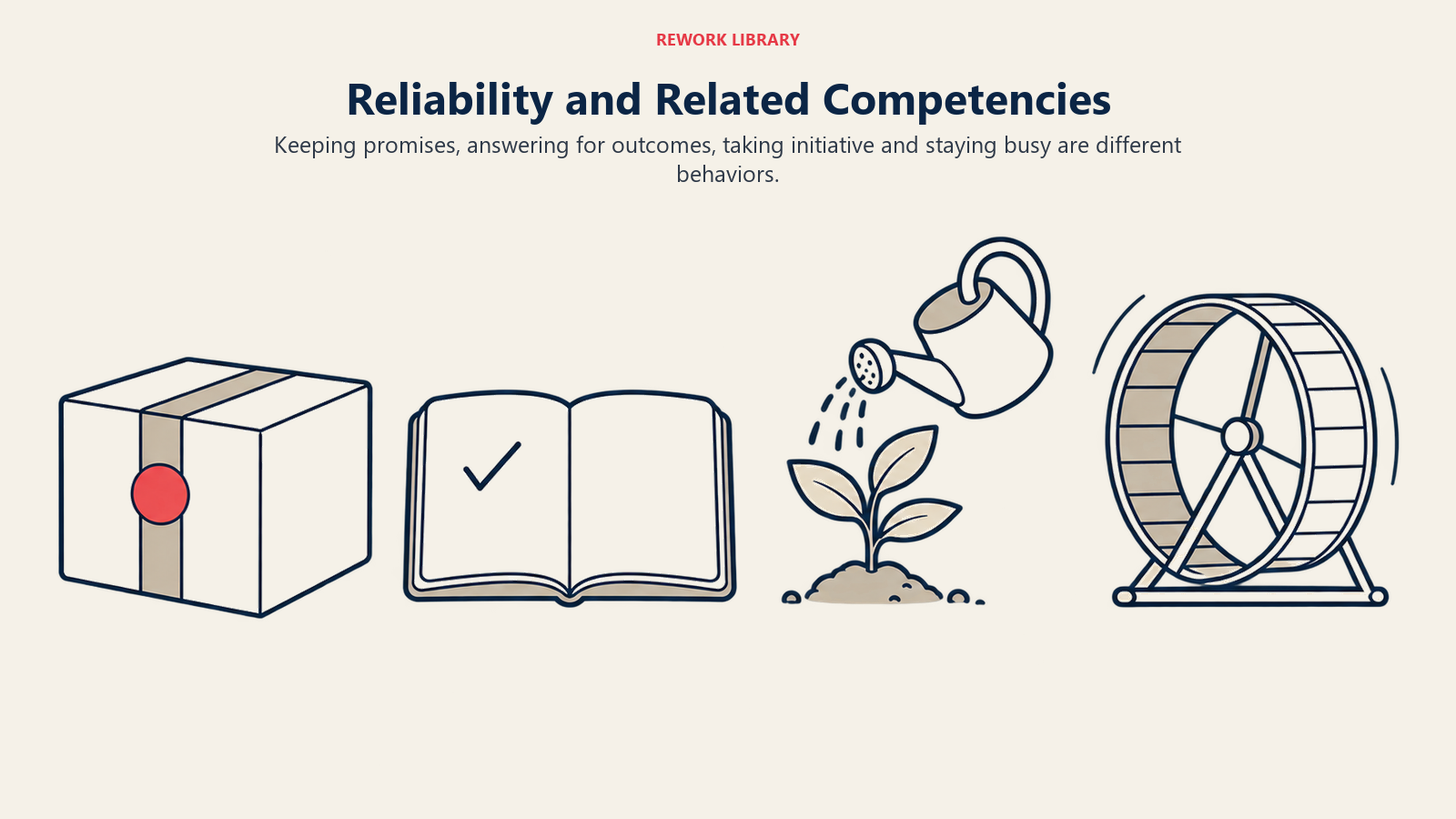
These four get mixed up constantly, especially in performance reviews, and the mix-up causes real damage: managers reward activity instead of delivery, or they confuse someone's willingness to apologize for a miss with the discipline to prevent the next one.
| Competency | What it actually measures | Core question it answers | Can it exist without reliability? |
|---|---|---|---|
| Reliability | Consistency between commitment and delivery | Did what you said would happen, happen? | No. It is that consistency. |
| Accountability | Willingness to own outcomes, including failures | Who answers for this? | Yes. Someone can own a miss honestly and still miss the next one. |
| Ownership mindset | Proactive stewardship of a problem beyond your assigned scope | Whose problem is this, even if nobody assigned it? | Yes. Someone can care deeply about an outcome and still be inconsistent about delivering on it. |
| Being busy | Volume of visible activity or hours logged | How much are you doing? | Yes, easily. Busy and reliable are not correlated. |
Accountability and reliability get confused because they show up next to each other. Accountability is what happens after something goes wrong: you name the miss and own the fix. Reliability is what happens before anything goes wrong: the track record that makes owning up to a rare miss credible instead of routine. A person with strong accountability but weak reliability apologizes well and often. A person with strong reliability rarely needs to.
Ownership mindset is the closest neighbor and easiest to conflate. Ownership is about scope: treating a problem as yours even when nobody assigned it. Reliability is about delivery: doing the thing you already agreed to do, correctly, on schedule. You can have ownership without much reliability (the passionate volunteer who can't keep pace with it all), or reliability without much ownership (the dependable order-taker who never raises a hand beyond the brief). The professionals who advance fastest usually have both, but they're two different muscles.
Results orientation and work ethic sit closer to reliability than busyness does, but they're not the same either. Results orientation is about whether the outcome mattered. Reliability is about whether it arrived when it was promised. A brilliant result delivered three weeks late still damaged the plan everyone else built around your date.
What Reliability Looks Like in Practice
Reliability is easy to claim and easy to fake for a week. Specific, repeated behavior is what makes it real, and that's also what a self-review or CV bullet actually needs.
As an individual contributor
- Flags a deadline at risk three days out, not the morning it's due.
- Turns in a first draft close enough to final that a manager doesn't need to rewrite it.
- Applies the same quality bar to a task nobody will check as to one that will be reviewed closely.
- Says no to a new request when it would break an existing commitment, instead of quietly overcommitting.
As a manager
- Runs 1:1s on the same cadence every week and cancels only for genuine emergencies.
- Delivers feedback and ratings on the schedule promised, not "whenever there's time."
- Follows up on what was raised in the last 1:1, so people stop needing to raise it twice.
- Protects the team's prioritization commitments from leadership's next request, instead of passing volatility straight down.
As a senior leader or executive
- Follows through on the priorities announced at the last all-hands, so the next one isn't a reset.
- Keeps commitments made to a board or major customer even when the numbers get uncomfortable.
- Makes decisions on the timeline promised, since a delayed decision at the top stalls every time management plan built beneath it.
The pattern across all three levels is the same: reliability isn't measured by intent, it's measured against a prior statement of what would happen. That's what makes it verifiable in a way "hard worker" or "great attitude" never are.
| Situation | Reliable behavior | Unreliable behavior |
|---|---|---|
| A deadline is at risk | Flags it two to three days ahead with a revised date | Stays quiet, hopes to catch up, then goes silent near the deadline |
| Asked a small favor outside your role | Does it, or names a specific time you'll get to it | Says "sure" and it quietly never happens |
| A recurring meeting (1:1, standup) | Shows up on time and prepared, every time | Shows up late or unprepared once things get busy |
| Handing off work to another team | Documents context so the next person isn't guessing | Hands off with gaps, assuming someone else fills them in |
| Under pressure or during a crunch | Quality holds, or the reader is told exactly what got cut and why | Quality quietly drops and nobody is told until it's found |
| A mistake happens | Reports it before it's discovered, with a fix already in hand | Waits to be asked, or minimizes how big it actually is |
Why Nobody Notices Reliability Until It's Gone
This is the part of reliability that makes it feel thankless, and it's also why it's rare enough to be valuable. Roy Baumeister's widely cited research on negativity bias, "Bad Is Stronger Than Good," found that across emotions, relationships, feedback, and impression formation, negative events consistently carry more psychological weight than positive ones of comparable size. Ten kept promises barely register as a pattern. One broken one gets remembered for years.
That asymmetry explains a lot of workplace behavior that otherwise looks irrational. A manager who trusts someone completely can have that trust shaken by a single missed handoff, even after months of flawless delivery. It's not fair, and it isn't going to change, which is exactly why the buffer has to be large enough to absorb the one miss that will eventually happen to everyone.
Why Reliability Compounds into Trust and Career Growth
Every kept commitment is a small deposit. Unlike a single impressive win, reliability compounds because it's cumulative evidence, and people correctly weight a long pattern more heavily than any single data point.
Google's own research backs this up at the team level. Project Aristotle, its two-year study of what separates its highest-performing teams, found five dynamics mattered most, and dependability (whether teammates reliably complete quality work on time) ranked second, directly behind psychological safety. That's why reliable people so often become the ones others want on their teamwork projects: not because they're the most talented in the room, but because working with them removes an entire category of risk everyone else has to plan around.
That effect scales up past the team level. The 2026 Edelman Trust Barometer found "my employer" is now the single most trusted institution measured, at 78% trust among employees, well ahead of business or government. That trust isn't built by a mission statement. It's built transaction by transaction, between coworkers who keep showing up the way they said they would.
The career payoff follows the same logic. Managers extend bigger scope and better opportunities to people whose delivery they don't have to double-check. That's not favoritism; it's risk management. Reliability is what earns the benefit of the doubt that ambition alone can't buy.
The Systems That Make You Reliable, Not Just Willpower
Relying on memory and good intentions to be reliable is fragile, especially once your calendar fills up. The people with the strongest reputations for reliability usually aren't relying on willpower at all; they've built small systems that make follow-through close to automatic.
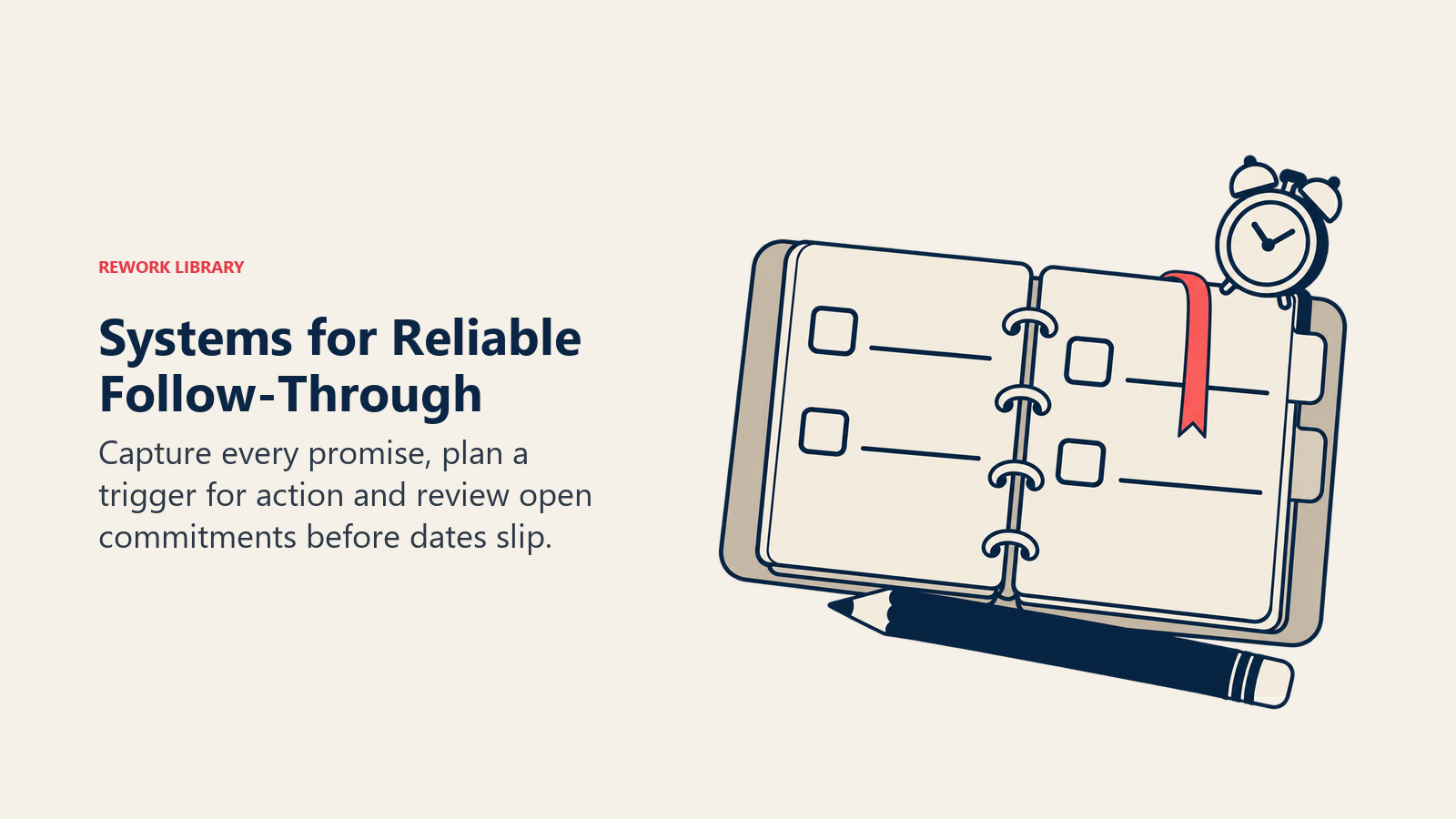
One of the best-studied tools for this is the implementation intention: a specific "if-then" plan made in advance, rather than a general intention to try harder. Gollwitzer and Sheeran's meta-analysis of 94 independent tests found people who set a concrete if-then plan ("if it's 4pm and I haven't heard back, then I'll send a status update") followed through at meaningfully higher rates than people who simply intended to, an effect (d = 0.65) that's unusually strong for something this cheap to set up. It's a direct extension of good goal setting: a goal names the destination, an implementation intention names the exact moment you'll act.
| System or habit | What it prevents |
|---|---|
| A single capture system for every commitment | A promise made in one channel getting lost by the time you're back at your desk |
| If-then plans for known interruptions | The same recurring blocker derailing a commitment every time it shows up |
| Deadline buffers built in ahead of time, not improvised | A normal-sized surprise turning into a missed date |
| A weekly review of open commitments | Small promises quietly aging past their due date, unnoticed |
| An early-flag habit for at-risk work | A miss landing as a surprise instead of a heads-up |
None of these are complicated. What separates reliable people isn't a smarter system; it's that they run it every week, not just when they remember to. Self-discipline and organizational skills are what keep the system running when motivation dips.
How to Recover When Your Reliability Is in Question
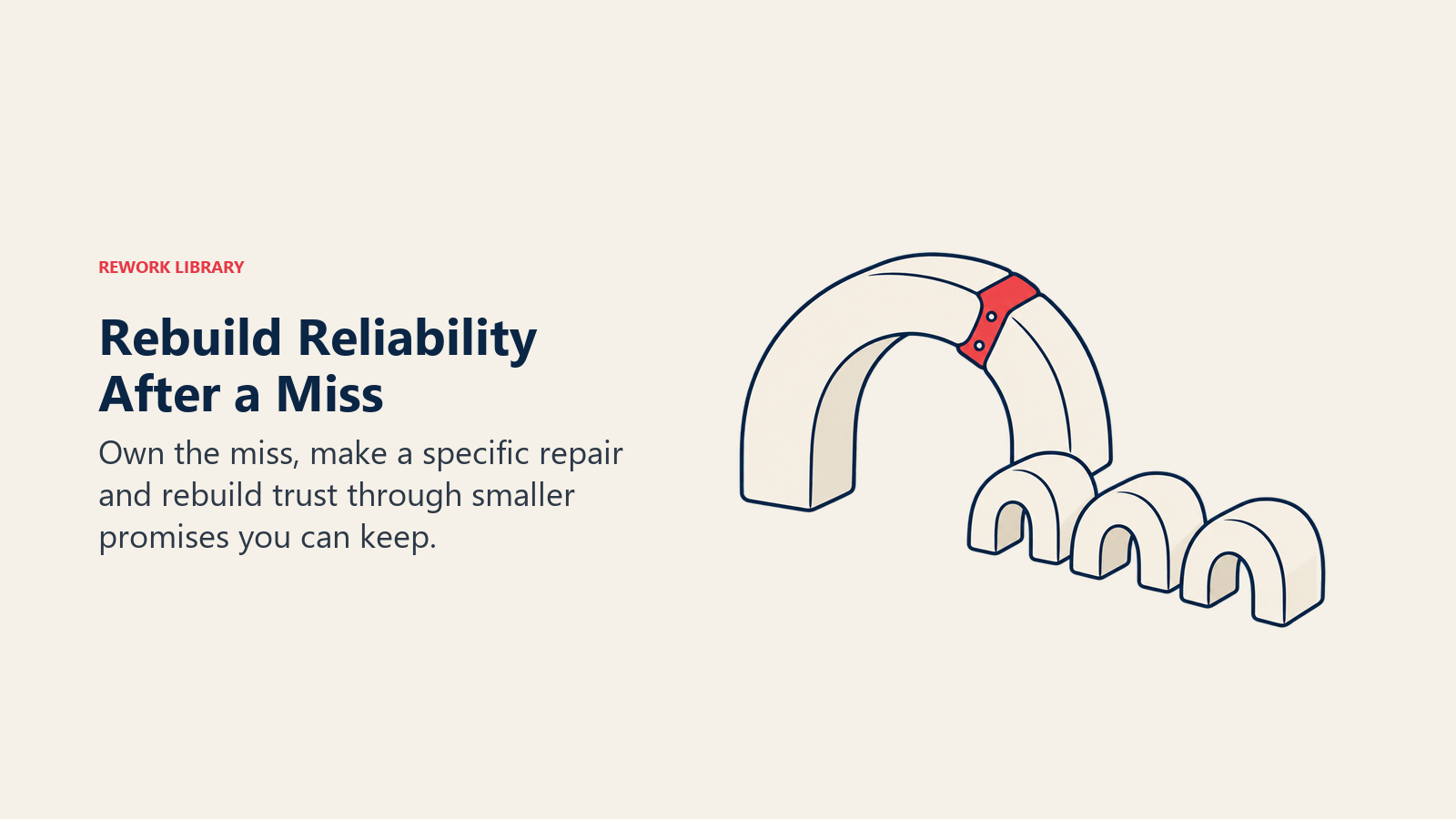
Reliability breaks for everyone eventually. What happens next matters more than the miss itself.
| Phase | What to do | What to avoid |
|---|---|---|
| Right after the miss | Name it before anyone else has to point it out, with a specific fix attached | A vague apology with no concrete next step |
| First two to four weeks | Take on fewer, smaller commitments and hit every single one | Taking on a big flagship project to "prove yourself" fast |
| Ongoing | Over-communicate status on anything with a deadline attached | Going quiet until the deadline arrives |
| If trust still hasn't returned | Ask directly what evidence would actually rebuild it | Assuming time alone will fix it |
The instinct after a visible miss is to overcorrect with a big, ambitious commitment to prove the lapse was an anomaly. That usually backfires, because it raises the stakes right when your margin for error is thinnest. Small, visible, kept promises rebuild trust faster than one large, risky one. Being genuinely coachable matters too: taking specific feedback without getting defensive is itself evidence of the consistency you're trying to demonstrate.
How Managers Actually Assess Reliability
Few performance review templates have a line item called "reliability." Managers still assess it constantly, just through proxies that are easy to observe week to week.
| Signal a manager watches | What it actually tells them |
|---|---|
| Do deadlines get hit without a reminder? | Whether they can plan around your dates or need to build in checking time |
| Do you self-report problems, or do they have to surface them? | Whether they can trust your status updates at face value |
| Is your first draft usually close to final? | Whether delegating to you saves them time or creates review work |
| Do you show up prepared to recurring meetings? | A cheap, frequent proxy for how you treat every other commitment |
| Does your time estimate match your actual delivery? | Whether they can build a real plan on the numbers you give them |
Reliability gets assessed through small, frequent, low-stakes moments far more than through the occasional big project. A manager forms an opinion about whether they can count on you long before the annual review, usually from a dozen small interactions that never show up on paper.
How to Show Reliability on a CV and in Interviews
Reliability is hard to claim credibly and easy to prove with a specific number.
Resume examples:
- Delivered every sprint commitment on time across 18 consecutive months without a missed date
- Maintained a 100% on-time delivery record across 40+ client deliverables over two years
- Flagged and resolved three at-risk deadlines before they slipped, keeping the program on schedule
- Documented a standard handoff checklist between design and engineering, cutting rework by 30%
Interview Q&As:
- "Tell me about a time you almost missed a deadline." Walk through when you noticed the risk, when you flagged it, what you changed, and what the actual outcome was. The timing of the flag matters more than the drama of the recovery.
- "How do you make sure things don't fall through the cracks?" Describe your actual system (a single tracker, a weekly review, an if-then habit), not a vague claim to being organized. Specificity is what makes the answer credible.
- "Describe a time your reliability was questioned." Own it directly without over-explaining, then describe the concrete evidence you built afterward. The recovery, not the miss, is what the interviewer is actually evaluating.
Reliability doesn't get celebrated the way a big win does, and that's exactly the point. It's the competency that makes every other one usable: creativity nobody can ship and results nobody can plan around are worth far less than a track record people can build on. The professionals who take it seriously aren't the flashiest people in the room. They're the ones everyone quietly routes the important work to.
Learn More

Senior Customer Retention Strategist
On this page
- Key Facts
- What Is Reliability at Work?
- Reliability vs Accountability vs Ownership vs Being Busy
- What Reliability Looks Like in Practice
- As an individual contributor
- As a manager
- As a senior leader or executive
- Why Nobody Notices Reliability Until It's Gone
- Why Reliability Compounds into Trust and Career Growth
- The Systems That Make You Reliable, Not Just Willpower
- How to Recover When Your Reliability Is in Question
- How Managers Actually Assess Reliability
- How to Show Reliability on a CV and in Interviews
- Learn More