Commercial Awareness: What It Is and How to Develop It
Turn this article into takeaways for your work.


Each assistant summarizes the article only for you and suggests best practices for your work.
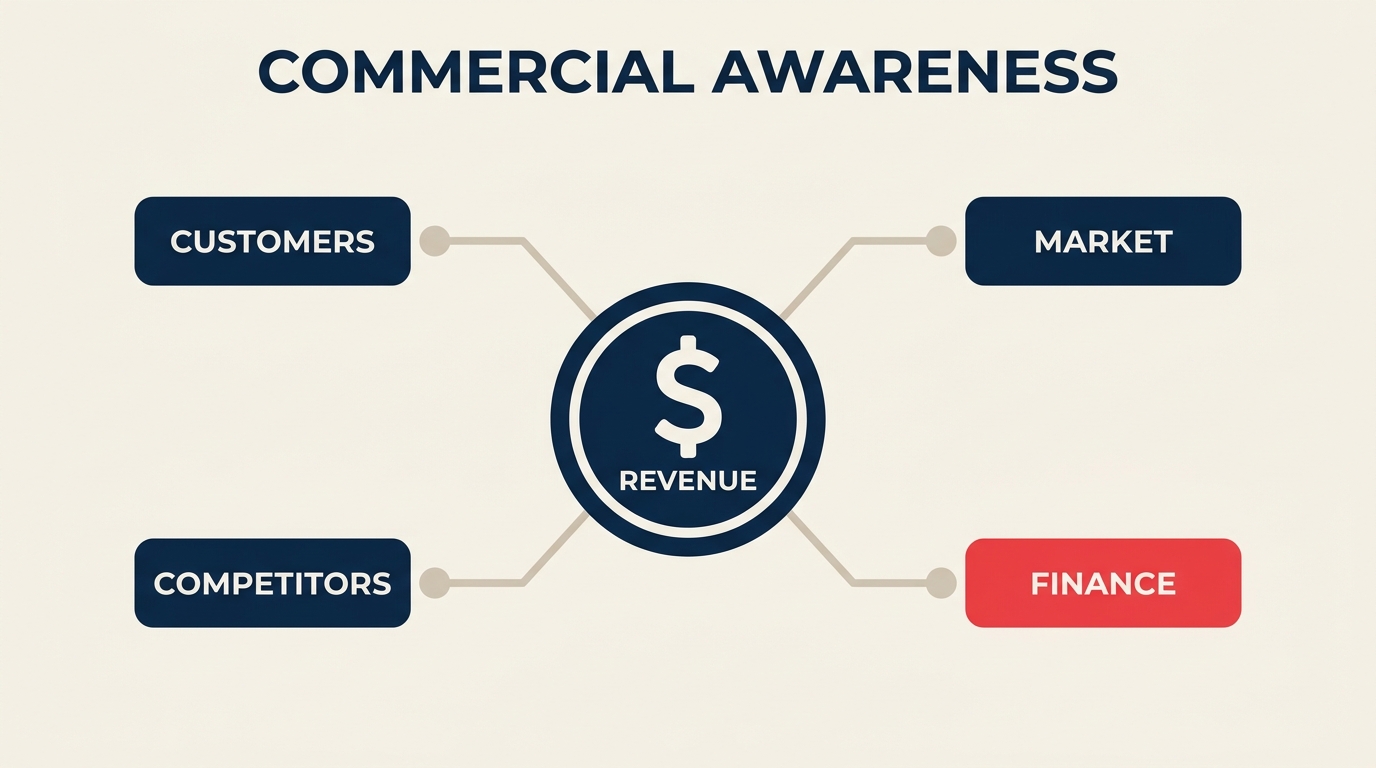
Commercial awareness is what separates employees who do their jobs from employees who understand why their jobs exist. It's the ability to see your work in context: how the company earns revenue, who the customers are, what competitors are doing, and where the industry is heading. And it's consistently one of the competencies recruiters say candidates lack most.
If you've ever sat in a strategy meeting and felt like you were missing half the conversation, or if you've been passed over for a promotion you thought you deserved, this competency is likely part of the gap. The good news is that commercial awareness is entirely learnable. It's not something you're born with. It's built through deliberate attention to the business around you.
What Is Commercial Awareness?
Commercial awareness is the ability to understand how an organization operates commercially: how it generates revenue, what drives costs, who its customers are, and how it fits into the broader market and competitive environment. It means connecting your day-to-day work to the bigger picture of what the business is trying to achieve and why.
The term is sometimes used interchangeably with business acumen or commercial acumen. While there's significant overlap (all three refer to understanding the business side of work), commercial awareness tends to emphasize market and customer context, while business acumen is slightly broader and often includes internal operational and financial judgment. For practical purposes, treating them as closely related is reasonable.
Commercial awareness isn't reserved for people in sales, finance, or strategy roles. A software engineer with strong commercial awareness knows which features drive retention. A marketer with it understands the unit economics of the campaigns they run. An HR professional with it ties workforce planning to revenue forecasts.
Key Facts
- Commercial awareness has ranked as the top employability skill gap identified by UK graduate recruiters for over a decade, consistently cited by more than 70% of employers in the annual High Fliers Research "The Graduate Market" survey (High Fliers Research, 2023).
- A survey by the Chartered Institute of Personnel and Development (CIPD) found that commercial awareness and business acumen are among the top five skills gaps employers report when assessing current employees for senior or leadership roles (CIPD, 2022).
- Research from Deloitte's Global Human Capital Trends report found that organizations where employees at all levels understand the business model outperform peers on revenue growth and employee retention (Deloitte, 2023).
What Commercial Awareness Covers
Commercial awareness isn't a single knowledge domain. It's a cluster of related areas that, together, give you a complete picture of how the business works and competes.
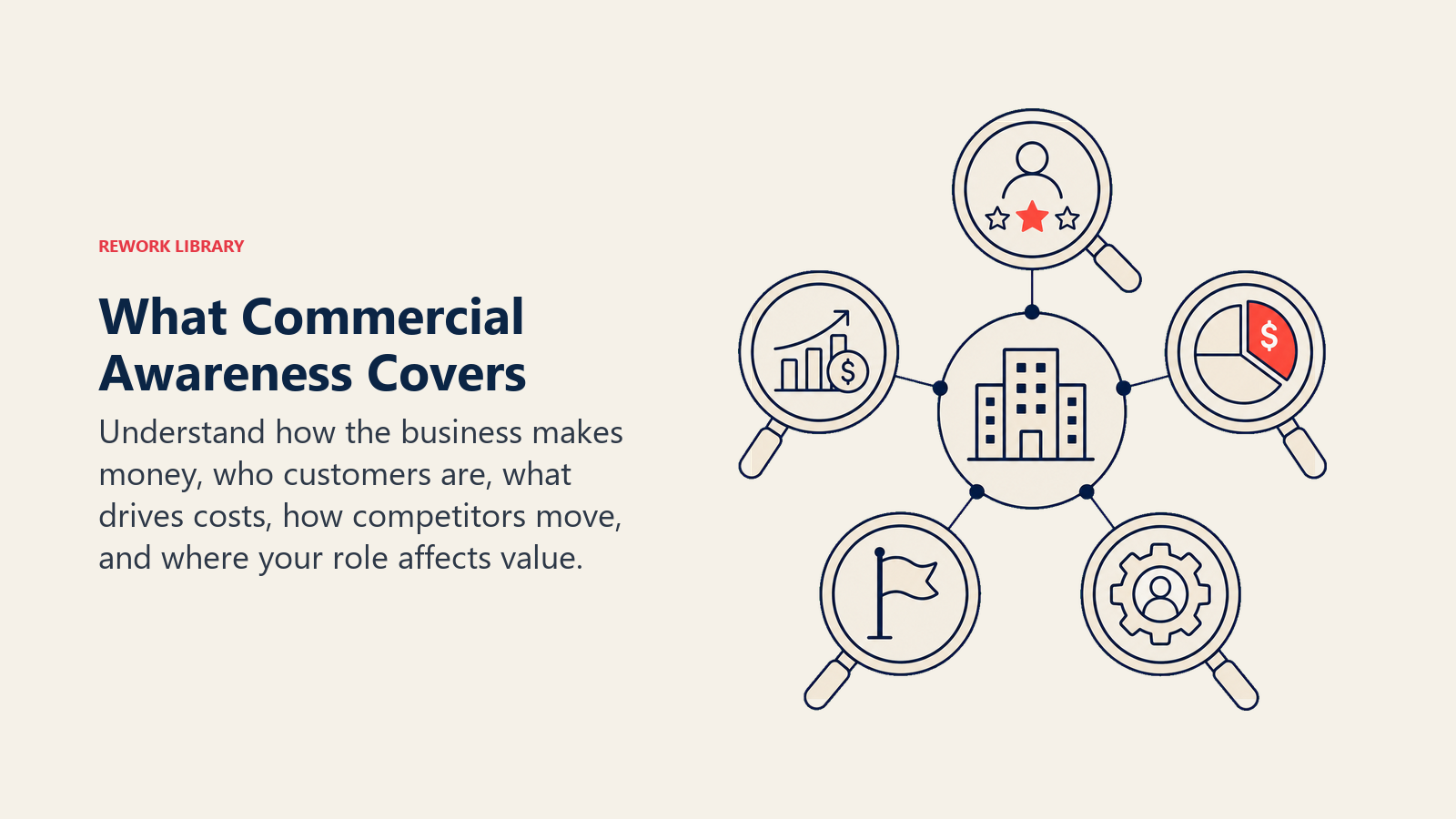
| Area | What it means in practice |
|---|---|
| Business model and revenue | How the company makes money: pricing, revenue streams, margins, and what drives profitability |
| Customers and market | Who buys the product or service, why they buy it, what they value, and how they behave |
| Competitors | Who the main competitors are, how they position themselves, and what your company does differently |
| Industry trends | What forces are reshaping the sector (technology, regulation, shifts in demand) and how fast |
| Financial basics | Reading a P&L, understanding gross margin, knowing what cost of goods sold means, interpreting basic KPIs |
| Regulation and external environment | Legal, political, or economic factors that constrain or enable the business |
You don't need to be an expert in all of these. But you should be fluent enough in each area to follow a conversation, ask a smart question, and connect your work to what matters commercially.
Commercial Awareness vs Business Acumen
The two terms overlap so heavily that treating them as synonyms in most conversations is fine. But there is a distinction worth knowing.
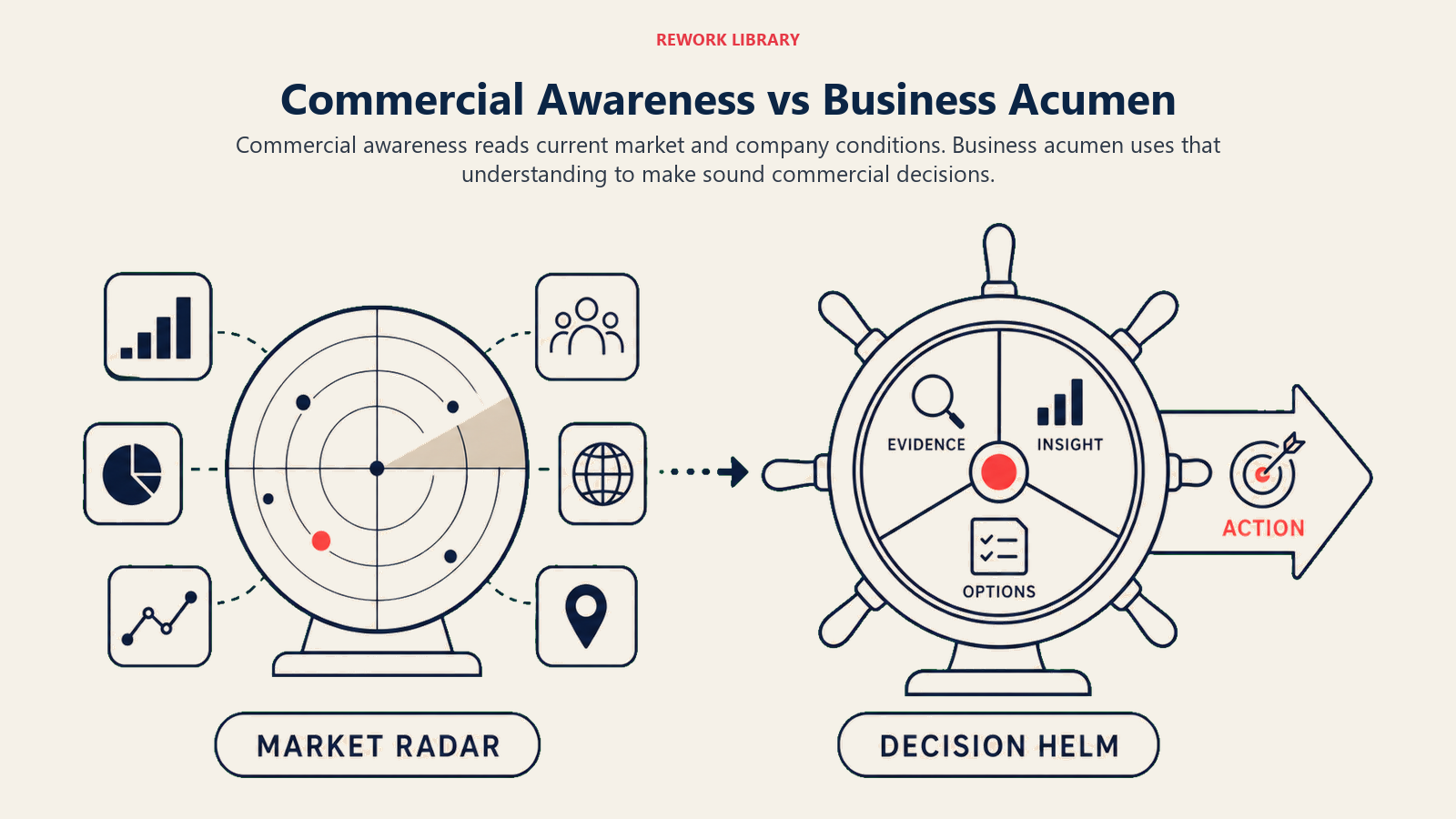
Commercial awareness tends to focus outward: customers, market position, competitors, and industry dynamics. It's about understanding the commercial environment in which the business operates.
Business acumen, covered in depth at business acumen, tends to be broader. It includes commercial awareness but also encompasses internal operational judgment: prioritizing resources, making decisions under uncertainty, spotting inefficiencies, and executing. Acumen implies not just understanding but good judgment applied to business problems.
Think of it this way: commercial awareness is the input; business acumen is what you do with it. A person with strong commercial awareness understands the market well. A person with strong business acumen uses that understanding to make better decisions.
In practice, you build both together, and they reinforce each other.
Why Commercial Awareness Matters
Decisions land differently. When you understand what the company is trying to achieve commercially, your recommendations make more sense to decision-makers. You frame tradeoffs in terms of revenue impact, customer retention, or competitive positioning rather than just operational convenience. That makes you easier to promote and easier to fund.
Promotions go to people who think bigger. Managers consistently say they promote people who "get the business." That phrase almost always means commercial awareness. If you can talk about your work in terms of outcomes the business cares about (pipeline, churn, cost per acquisition, margin), you signal readiness for broader responsibility. This connects closely to strategic thinking, which is how commercial awareness gets applied at the leadership level.
Interviews reward it heavily. Graduate and professional recruiters explicitly screen for commercial awareness. They want to know whether you read industry news, understand the company's competitive position, and can discuss what's happening in the sector. Candidates who walk in having done this work stand out immediately.
Your functional work improves. A sales rep who understands gross margin targets differently approaches discounting decisions. A product manager who understands customer acquisition costs approaches feature prioritization differently. Commercial context makes every functional skill sharper.
Commercial Awareness Examples
What commercial awareness looks like depends on your role. Here's what it shows up as in practice across different functions.
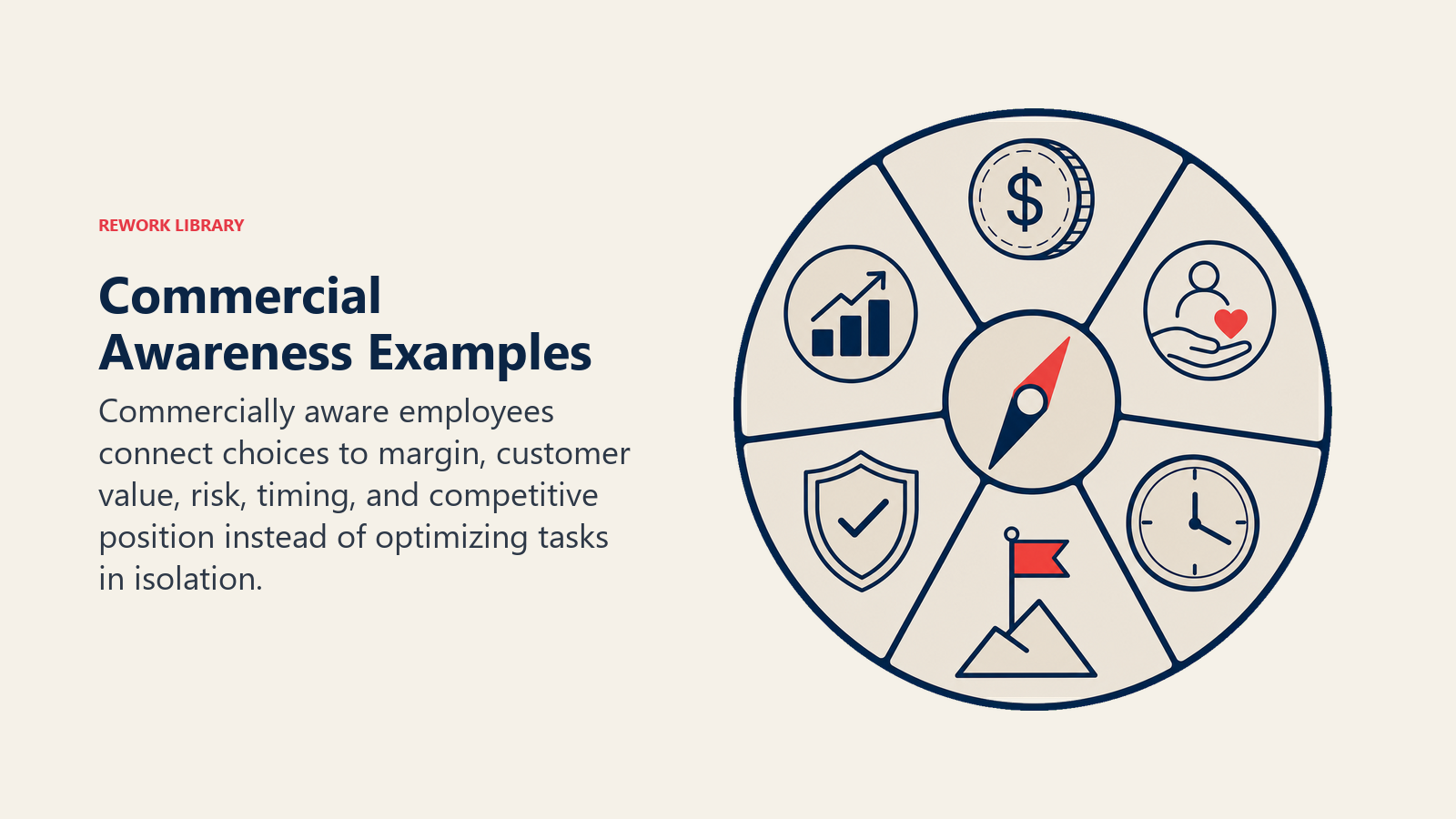
| Role | What commercial awareness looks like |
|---|---|
| Software engineer | Knows which product features drive the highest-value customers; flags when a technical decision will affect billing or data portability |
| Marketing manager | Understands cost per acquisition relative to customer lifetime value; builds campaigns around the highest-margin segments |
| HR/People team | Ties hiring plans to revenue projections; understands which roles have the highest leverage on growth |
| Customer success | Knows which accounts generate the most revenue; understands churn's financial impact and escalates risk accordingly |
| Finance analyst | Not just reports the numbers but explains what they mean for the business model and competitive position |
| Product manager | Frames product decisions in terms of market share, pricing power, and what the customer is actually paying for |
In every case, the pattern is the same: connecting your function's output to a commercial result the business cares about.
How to Develop Commercial Awareness
Step 1: Read your company's numbers
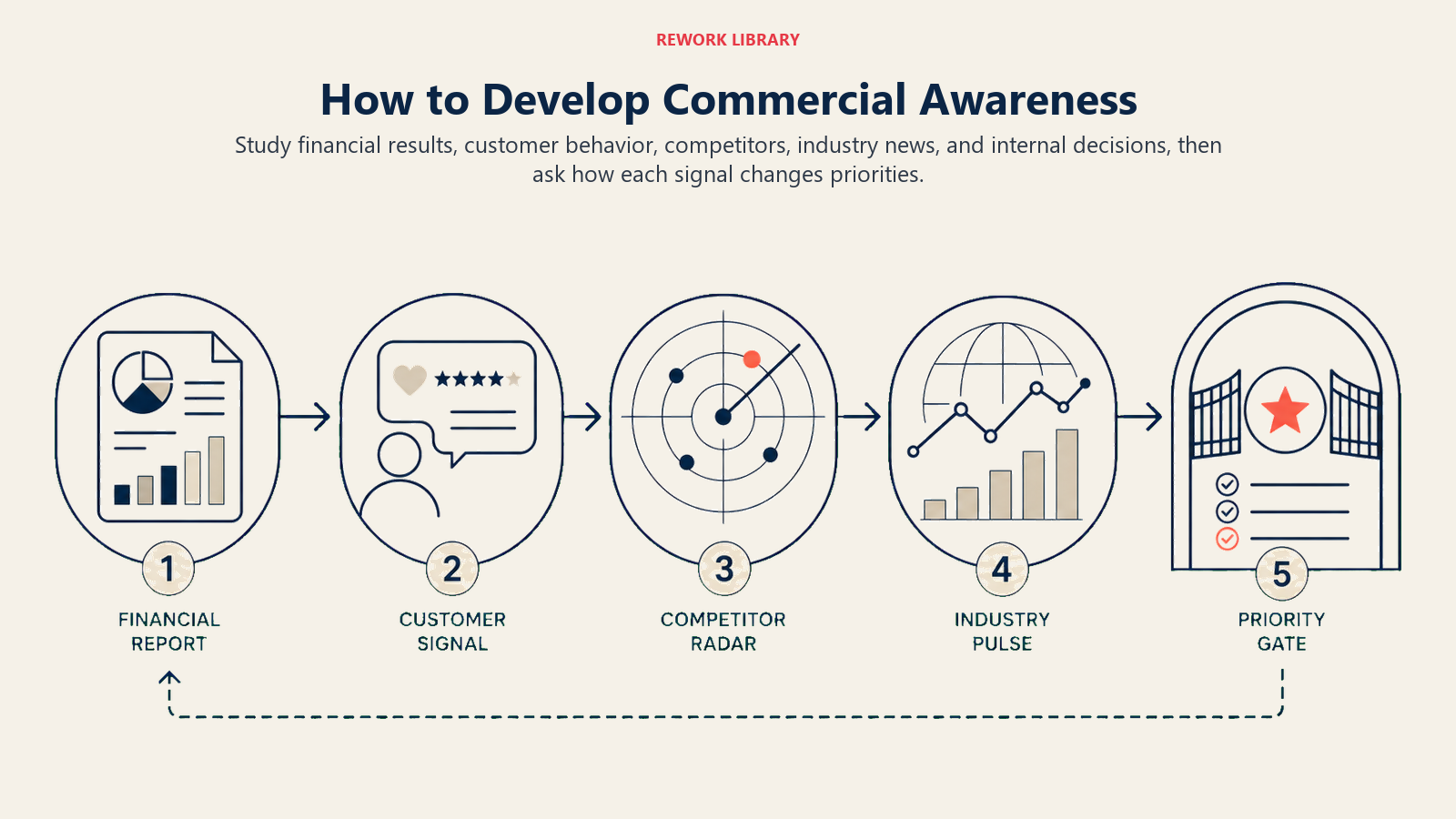
Start with what's available internally. Annual reports, board presentations, quarterly business reviews, and investor letters are rich with commercial context. If you're at a private company, ask your manager or finance team to walk you through the P&L structure. You don't need to become an accountant, but you should understand: what are the main revenue lines, what's the gross margin, and what's growing or shrinking? This is the foundation of financial literacy applied to your own business.
Step 2: Follow the industry
Pick two or three industry publications, newsletters, or analyst reports and read them consistently. For most sectors, 15 minutes a week is enough to stay current. Follow industry-relevant accounts on LinkedIn. Set up Google Alerts for your company and its top three competitors. The goal isn't to become a forecaster. It's to have enough context that industry news clicks rather than confuses.
Step 3: Talk to customers and sales
Nothing builds commercial awareness faster than spending time with the people who are closest to the market. Sit in on a sales call if you can. Listen to customer support recordings. Talk to the account managers who hear objections and churn reasons directly. Customer conversations reveal what the market actually values versus what the company thinks it values. That gap is commercially important and often invisible if you stay in your functional lane.
Step 4: Understand your competitors
Know who the top three or four competitors are, how they position their product or service, what their pricing looks like (if public), and what customers say about them versus you. This isn't about obsessing over the competition. It's about understanding the options your customers are choosing between and what your company's actual differentiation is. Customer focus and competitive awareness are two sides of the same coin.
Step 5: Connect your work to revenue
At the end of each week, ask yourself: what did I do that moved the needle commercially? Which of my outputs made the company more money, saved it money, reduced churn risk, or opened a door with a prospect? You might not always have a clean answer. But the habit of asking the question trains your attention toward commercial outcomes rather than activity. Over time, you'll start prioritizing differently because you'll see more clearly what actually matters.
How to Show Commercial Awareness in an Interview
Interviewers testing commercial awareness are looking for three things: that you've done your homework on the company, that you understand the sector, and that you can connect your experience to business outcomes.
Do your homework before the interview. Know what the company sells, who it sells to, what its revenue model looks like, and who the main competitors are. Read the last few earnings calls or press releases if it's a public company. Look at recent news. Know something specific.
Then connect your past work to commercial results. Don't say "I managed a content calendar." Say "I ran content for a SaaS team where our MQL-to-opportunity conversion was 18%; we improved it to 26% over two quarters by shifting content toward bottom-of-funnel comparison pages." Numbers, outcomes, commercial context.
Example phrases that land well:
- "Looking at your last earnings call, growth is concentrated in the mid-market segment. That's exactly the buyer I've spent the last three years selling to."
- "I noticed your main competitor repositioned to a usage-based pricing model last year. I'd be curious how that's affecting your sales cycle."
- "In my current role, I track my work against gross retention and net revenue retention rather than just activity metrics."
Each of these signals that you think commercially, not just functionally. For sharpening how you think through problems before framing them commercially, the skills in analytical skills and organizational skills build well alongside commercial awareness.

On this page
- What Is Commercial Awareness?
- What Commercial Awareness Covers
- Commercial Awareness vs Business Acumen
- Why Commercial Awareness Matters
- Commercial Awareness Examples
- How to Develop Commercial Awareness
- Step 1: Read your company's numbers
- Step 2: Follow the industry
- Step 3: Talk to customers and sales
- Step 4: Understand your competitors
- Step 5: Connect your work to revenue
- How to Show Commercial Awareness in an Interview