Skills Agility: Mastering Rapid Skill Acquisition for Career Success

Turn this article into takeaways for your work.


Each assistant summarizes the article only for you and suggests best practices for your work.
What You'll Get From This Guide
- Understand why skills agility is the defining career competency of 2026 and beyond
- Apply a proven 5-level framework to assess and develop your skill acquisition capabilities
- Master the learning-to-learn meta-skill that accelerates all future learning
- Build a strategic skills portfolio that keeps you relevant in a rapidly changing job market
- Navigate skills-based hiring trends with confidence and intention
You've probably noticed something unsettling in the past few years: the skills that got you hired aren't necessarily the skills keeping you valuable. That project management certification from five years ago? It's still useful, but now everyone expects you to understand AI-assisted workflows too. The marketing expertise you built over a decade? It matters, but data literacy has become just as essential.
This isn't a criticism of your career choices. It's simply the reality of work in 2026. And the professionals who are thriving aren't necessarily the smartest or most experienced. They're the ones who've developed skills agility: the ability to rapidly acquire and apply new capabilities as circumstances demand.
Why Skills Agility Matters More Than Any Single Skill
The World Economic Forum's 2025 Future of Jobs Report delivered a striking finding: 59% of the global workforce will need significant reskilling or upskilling by 2027. But here's what makes this statistic truly meaningful: the half-life of professional skills has shrunk from approximately 10-15 years in the 1980s to just 5 years today. For technical skills, it's often even shorter.
Consider what this means practically. Someone entering the workforce today can expect their initial skill set to become partially obsolete before they've paid off their student loans. A mid-career professional might need to reinvent their capabilities three or four times before retirement.
But this isn't cause for despair. It's actually an invitation to develop a more powerful capability than any specific skill: the ability to learn and adapt quickly. Professionals with high skills agility report 34% higher job satisfaction, are 2.7 times more likely to receive promotions, and experience significantly lower career anxiety despite rapid changes in their industries.
The equation is straightforward: your career security no longer comes from what you know today. It comes from how quickly you can learn what you'll need to know tomorrow.
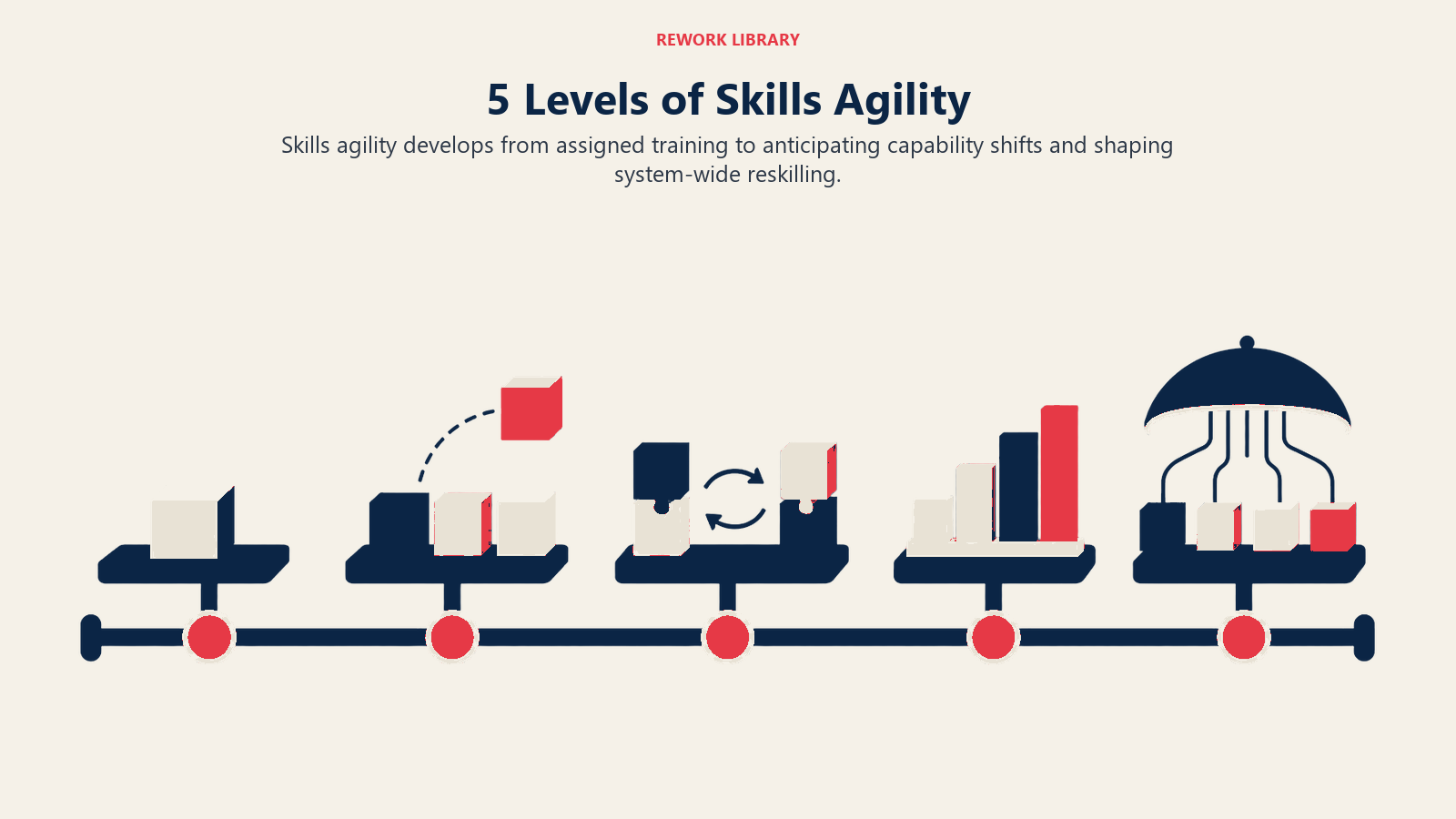
The 5-Level Skills Agility Framework
Level 1: Skill Consumer (0-1 years of development)
You're at this level if: Learning new skills feels overwhelming, you stick with familiar approaches even when they're no longer effective, and you wait for formal training rather than seeking learning opportunities.
Behavioral Indicators:
- You complete assigned training but rarely seek additional learning
- New tools or processes trigger stress rather than curiosity
- You rely heavily on step-by-step instructions
- Skill gaps become apparent during performance reviews
- You view learning as separate from "real work"
Assessment Criteria:
- Completes mandatory training on schedule
- Applies new skills with significant guidance
- Identifies skill gaps when directly asked
- Participates in learning when time is allocated
- Demonstrates basic competence in core job requirements
Development Focus: Build awareness of how you learn best and start viewing skill development as a continuous process rather than occasional events. Practice adaptability in small ways daily.
Quick Wins at This Level:
- Identify your learning style through free online assessments
- Schedule 15 minutes daily for skill-building activities
- Document one thing you learned each week in a simple journal
- Find one colleague whose skills you admire and observe their habits
- Complete one online course in an area relevant to your role
Success Markers: You begin to see learning as part of your job rather than a distraction from it, and you start noticing skill gaps before others point them out.
Level 2: Active Learner (1-2 years of development)
You're at this level if: You proactively identify skills you need, can learn new capabilities from various sources, and adapt your approach based on results.
Behavioral Indicators:
- You regularly seek feedback on skill gaps
- You use multiple learning resources (courses, mentors, practice)
- You apply new skills to real work situations quickly
- You adjust learning strategies when initial approaches don't work
- You allocate personal time for professional development
Assessment Criteria:
- Identifies relevant skills proactively
- Learns new capabilities within reasonable timeframes
- Transfers learning from one context to another
- Maintains structured approach to skill development
- Demonstrates continuous learning habits
Development Focus: Accelerate your learning speed and develop the ability to identify which skills will matter most for your career trajectory.
Quick Wins at This Level:
- Create a skills development roadmap for the next 12 months
- Practice interleaving by studying multiple related skills simultaneously
- Build a learning network of peers pursuing similar growth
- Experiment with different learning formats (video, reading, hands-on)
- Set measurable skill milestones and track progress weekly
Success Markers: You can learn new tools or methods significantly faster than you could a year ago, and you're developing intuition about which skills to prioritize.
Level 3: Agile Learner (2-5 years of development)
You're at this level if: You can rapidly acquire new skills when needed, help others develop their capabilities, and anticipate skill requirements before they become urgent.
Behavioral Indicators:
- You learn new skills in weeks rather than months
- You identify emerging skill needs before they become critical
- You mentor others in effective learning techniques
- You combine skills from different domains creatively
- You maintain a strategic view of skill trends in your industry
Assessment Criteria:
- Demonstrates rapid skill acquisition across multiple domains
- Contributes to team skill development initiatives
- Anticipates and prepares for skill shifts
- Creates efficient learning pathways for others
- Balances depth and breadth in skill portfolio
Development Focus: Become a catalyst for organizational learning while developing expertise in skill forecasting and strategic portfolio management.
Quick Wins at This Level:
- Develop a personal skill radar tracking industry trends
- Create learning resources that help teammates skill up faster
- Practice accelerated learning techniques like spaced repetition and deliberate practice
- Build T-shaped skills combining deep expertise with broad capabilities
- Establish a skills-based career management strategy
Success Markers: You're known as someone who can quickly become competent in new areas, and others seek your guidance on their learning journeys.
Level 4: Learning Architect (5-10 years of development)
You're at this level if: You design learning experiences for others, influence organizational skill strategy, and consistently predict which capabilities will drive future value.
Behavioral Indicators:
- You design team and organizational learning programs
- You forecast skill needs with reasonable accuracy
- You create systems that accelerate collective skill development
- You influence hiring and development decisions based on skill trends
- You model adaptive learning for your organization
Assessment Criteria:
- Leads successful organizational learning initiatives
- Demonstrates accurate skill trend prediction
- Builds scalable learning systems and processes
- Measures and improves learning efficiency metrics
- Develops next generation of agile learners
Development Focus: Shape how your organization approaches skill development while contributing to broader professional communities.
Quick Wins at This Level:
- Launch a skills agility program for your team or department
- Build partnerships with learning providers and platforms
- Develop skill assessment frameworks that guide development investments
- Create internal mobility programs based on skill adjacencies
- Publish insights on skill trends in your industry
Success Markers: Your organization's approach to learning has been influenced by your initiatives, and you're recognized as a strategic advisor on workforce capabilities.
Level 5: Skills Futurist (10+ years of development)
You're at this level if: You're recognized as a thought leader in skills and learning, influence industry practices, and help shape the future of work itself.
Behavioral Indicators:
- You publish influential content on skills and workforce trends
- You advise organizations on skills transformation strategies
- You speak at major conferences on learning and development
- You pioneer new approaches to skill acquisition
- You influence policy discussions about workforce development
Assessment Criteria:
- Recognized industry expert in skills and learning
- Published author or sought-after speaker
- Advisory relationships with multiple organizations
- Proven track record of successful skills transformations
- Influences broader workforce development practices
Development Focus: Contribute to society-level skill development while nurturing the next generation of learning leaders.
Quick Wins at This Level:
- Write for major publications on workforce transformation
- Advise educational institutions on curriculum relevance
- Develop open-source learning frameworks others can use
- Create cross-industry skill development initiatives
- Mentor emerging learning leaders
Success Markers: Your work has influenced how organizations and individuals think about skill development, and you're helping shape a more adaptable workforce.
The Learning-to-Learn Meta-Skill
Here's something that highly adaptive professionals understand: the most valuable skill isn't any specific capability. It's the ability to learn anything efficiently. This meta-skill, once developed, accelerates every future learning effort.
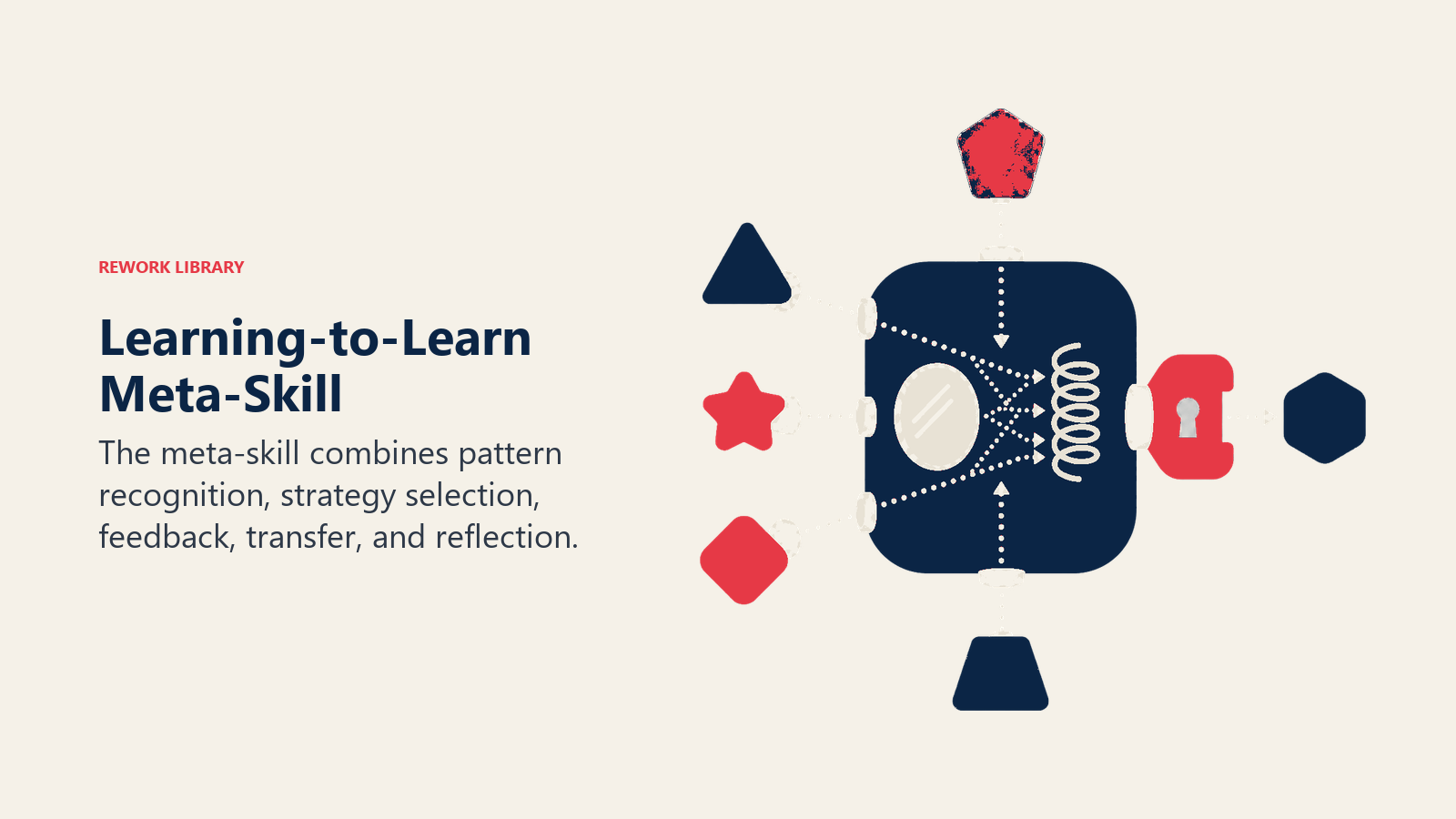
Breaking Down the Meta-Skill
Pattern Recognition Across Domains Expert learners quickly spot how new information connects to what they already know. When learning data analysis, they might link it to problem-solving frameworks they've used elsewhere. This cross-pollination speeds up comprehension significantly.
Efficient Resource Navigation Skilled learners don't try to consume every available resource. They quickly identify the 20% of material that delivers 80% of the value. They know when to watch a video, when to read documentation, and when to just start experimenting.
Productive Struggle Management Learning requires confusion. Novice learners often give up when things get hard. But expert learners recognize productive struggle as the signal that real learning is happening. They've built up tolerance for temporary incompetence.
Feedback Integration Fast learners actively seek and incorporate feedback instead of waiting for formal assessments. They create tight feedback loops, testing their understanding frequently and adjusting their approach based on results.
Developing Your Meta-Learning Capability
Start with Reflection After each learning experience, ask yourself: What worked? What didn't? How could I learn this faster next time? This simple habit, practiced consistently, builds meta-learning awareness.
Study Your Past Learning Think about skills you've acquired successfully. What approaches did you use? What conditions supported your learning? Identifying patterns in your successes gives you a replicable model.
Embrace Transfer Learning Actively look for connections between new skills and existing knowledge. The more bridges you build, the faster you'll absorb new information. Someone learning negotiation might connect it to their understanding of emotional intelligence and influence dynamics.
Practice Deliberate Difficulty Occasionally, make learning harder on purpose. Study without notes, teach concepts immediately after learning them, or practice under time pressure. This builds the cognitive strength that makes future learning easier.
Identifying Which Skills to Prioritize
With limited time and infinite skill options, strategic selection matters enormously. Here's a framework for deciding where to invest your learning energy.
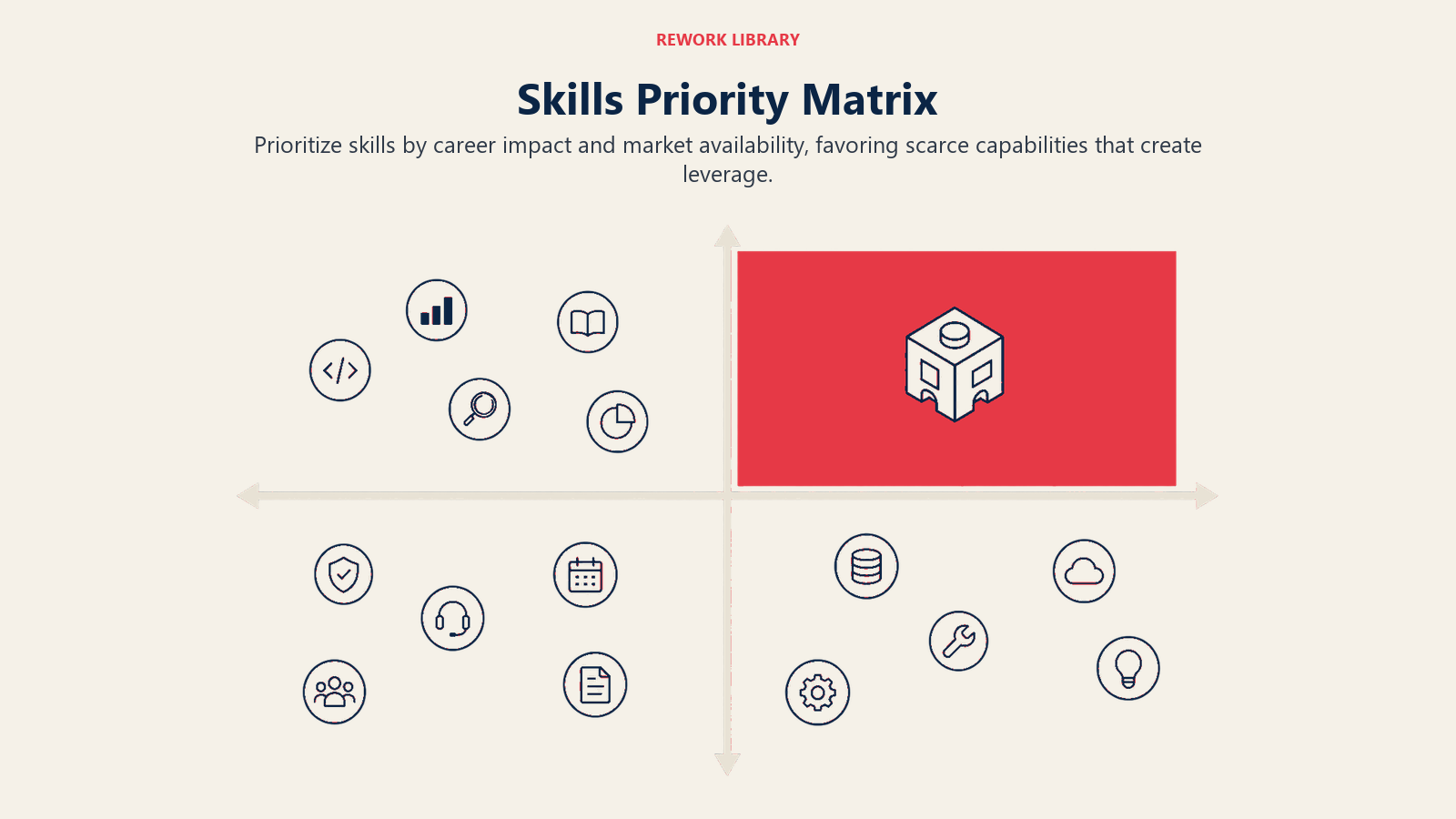
The Skills Priority Matrix
High Impact + Low Availability = Top Priority Skills that significantly improve outcomes and that few people possess offer the greatest career leverage. These might include emerging technologies, specialized analytical capabilities, or rare combinations of expertise.
High Impact + High Availability = Table Stakes These are essential skills everyone in your role should have. You need them to stay competitive, but they won't differentiate you. Prioritize reaching competency, then move on.
Low Impact + Low Availability = Niche Value These skills matter in specific contexts but don't broadly improve outcomes. Develop them only if your career path specifically requires them.
Low Impact + High Availability = Low Priority Don't invest significant time here. These skills neither differentiate you nor drive meaningful results.
Practical Prioritization Steps
1. Map Your Current Skills Create an honest inventory of your capabilities. Rate your proficiency and how current each skill remains. This baseline shows where gaps might be emerging.
2. Research Future Demands Study job postings for roles you want, read industry trend reports, and talk to people in positions you aspire to reach. What skills appear repeatedly? Which ones are emerging?
3. Assess Skill Adjacencies Some skills build naturally on others. If you're strong in qualitative research, quantitative analysis might be a natural adjacent skill. These adjacencies often offer efficient learning paths.
4. Consider Half-Life Prioritize skills with longer half-lives when possible. Fundamental capabilities like critical thinking, communication, and problem-solving endure longer than platform-specific technical skills.
5. Balance Portfolio Risk Don't bet everything on a single skill category. Maintain a mix of stable foundation skills and emerging capabilities. This hedges against unexpected shifts in skill demand.
Rapid Skill Acquisition Techniques
Once you've identified priority skills, these techniques accelerate acquisition.
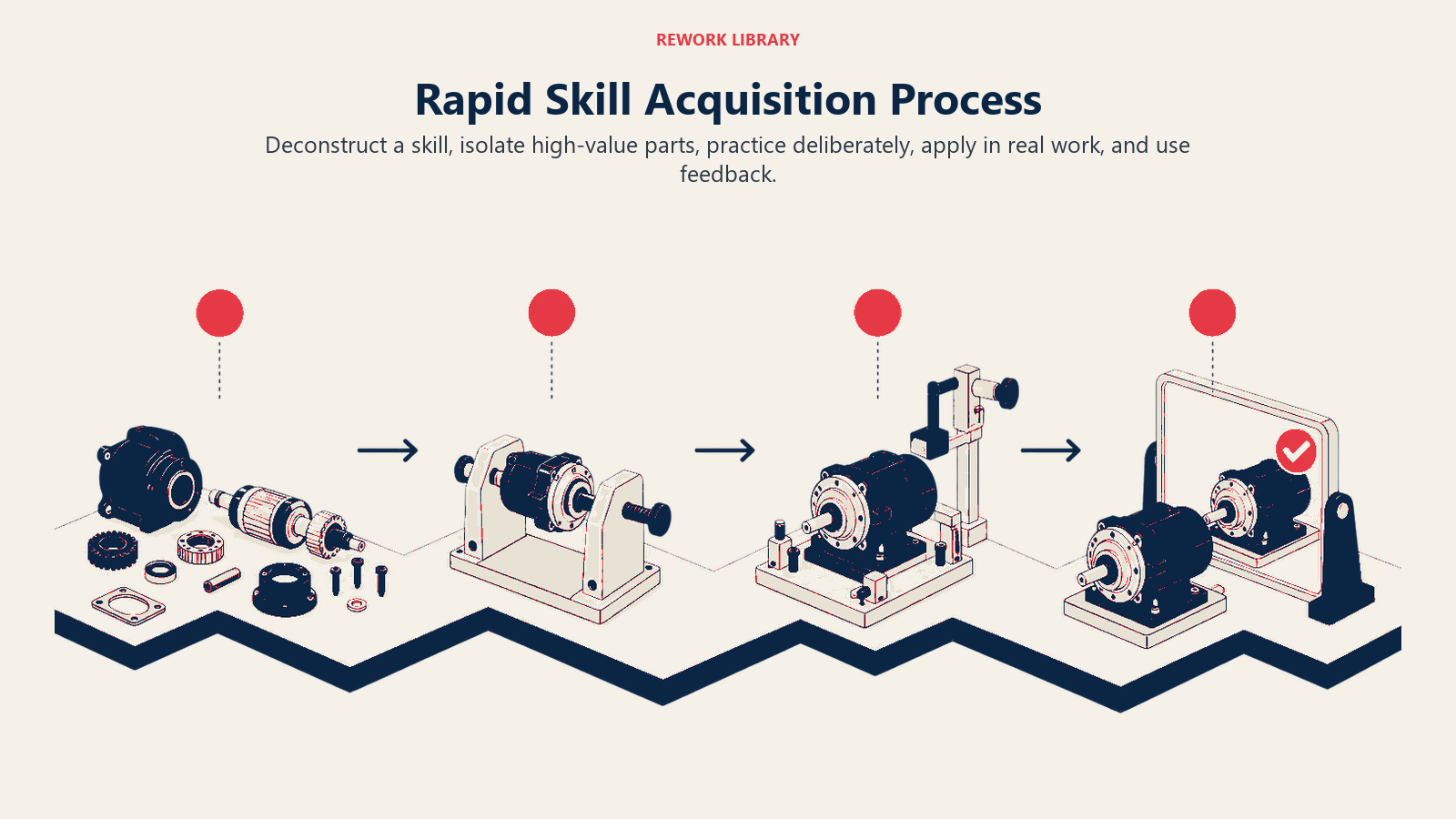
The 20-Hour Framework
Research suggests you can reach reasonable competency in most skills with about 20 hours of focused practice. The key word is focused. Here's how to structure those hours:
Hours 1-5: Deconstruct and Research Break the skill into components. Identify what sub-skills matter most. Find the best learning resources. Talk to people who have the skill.
Hours 6-15: Intensive Practice Focus on the highest-leverage sub-skills. Practice deliberately, seeking feedback frequently. Push beyond your comfort zone.
Hours 16-20: Integration and Application Apply the skill to real situations. Identify gaps revealed through application. Refine your capability through actual use.
Accelerated Learning Practices
Spaced Repetition Instead of cramming, space your learning over time. Review material at increasing intervals. This dramatically improves long-term retention.
Interleaving Instead of mastering one skill before moving to the next, alternate between related skills. This feels harder but produces better learning outcomes and stronger transfer.
Elaborative Interrogation Keep asking "why" and "how" as you learn. Creating explanations deepens understanding far more than passive absorption.
Dual Coding Combine verbal and visual learning whenever possible. Create diagrams, mind maps, or visual representations of concepts. Using multiple modalities strengthens memory.
Immediate Application Apply new learning to real work as quickly as possible. The gap between learning and application is where skills go to die.
Environment Design for Learning
Create Learning Triggers Associate learning with existing habits. If you always have morning coffee, make it learning time. Environmental cues automate the behavior.
Reduce Friction Make learning easier to start. Keep books visible, courses bookmarked, practice materials ready. The smaller the barrier to getting started, the more you'll learn.
Build Accountability Share learning goals with others. Find an accountability partner or learning group. Social commitment makes a big difference in follow-through.
Protect Learning Time Block time specifically for skill development. Treat it as seriously as any meeting. Without protected time, learning always loses to urgent tasks.
Building Your Personal Skills Portfolio
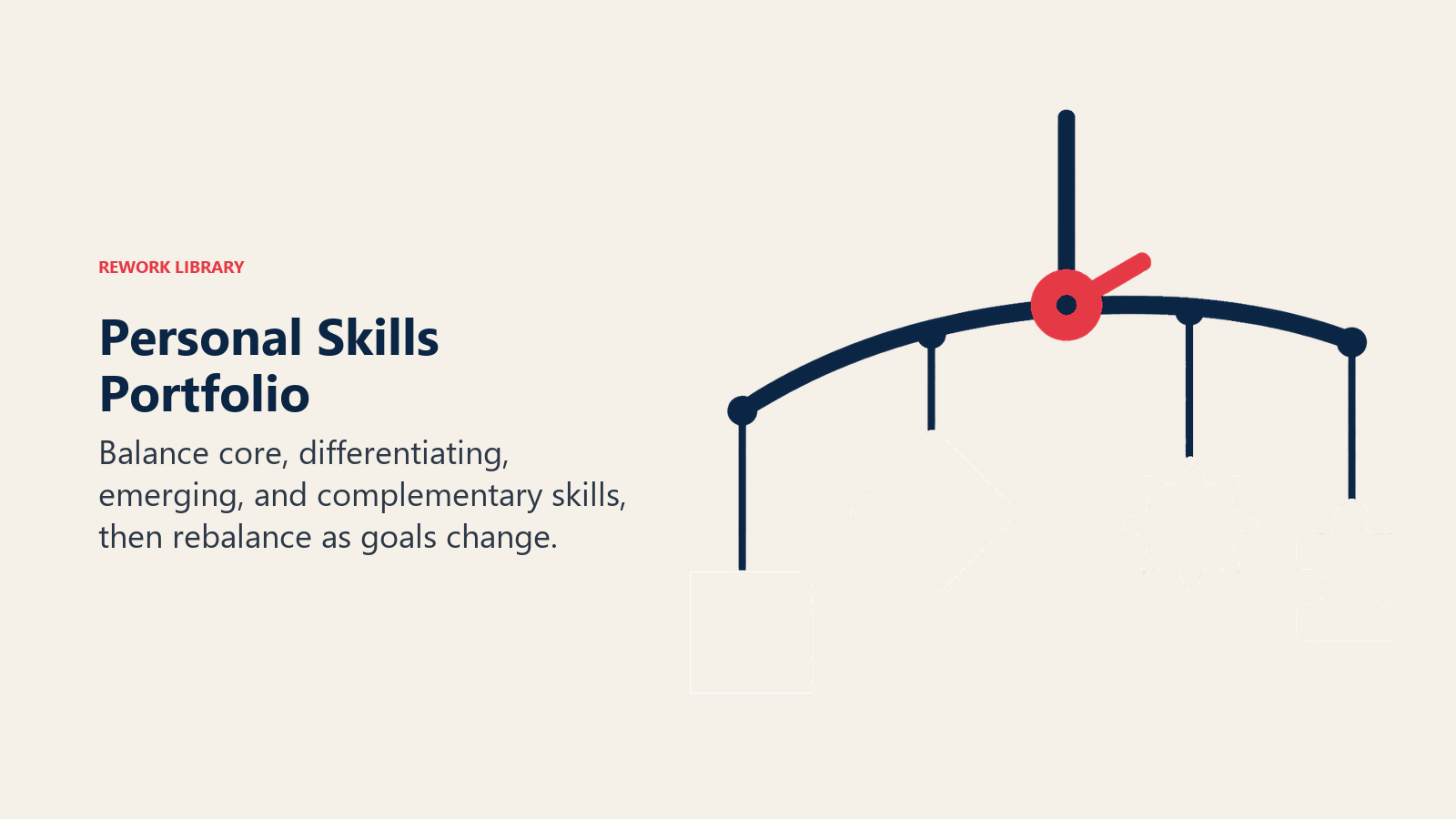
Think of your skills as an investment portfolio requiring active management. Just as financial portfolios need diversification and rebalancing, your skills portfolio needs strategic attention.
Portfolio Components
Core Skills (40-50%) These are fundamental capabilities that underpin your professional value. Communication, problem-solving, collaboration, and domain expertise belong here. They should be strong and regularly maintained.
Growth Skills (30-40%) These are capabilities you're actively building, usually aligned with where your career is heading. They represent your investment in future relevance.
Experimental Skills (10-20%) These are skills you're exploring without certainty they'll pay off. They might represent emerging trends or personal interests that could become professionally relevant.
Portfolio Management Practices
Quarterly Skills Review Every three months, assess your portfolio. Which skills have you strengthened? Which are becoming obsolete? What should you add or deprioritize?
Annual Skills Audit Once yearly, conduct a comprehensive review. Evaluate your skills against market demand, career goals, and emerging trends. Make significant portfolio adjustments based on this analysis.
Continuous Skill Maintenance Even strong skills degrade without use. Schedule regular practice for capabilities you want to retain. Use it or lose it applies to professional skills too.
Document Your Skills Maintain clear records of your capabilities, including how and when you developed them. This documentation supports job searches, promotion conversations, and self-assessment.
Navigating Skills-Based Hiring Trends
The shift toward skills-based hiring is transforming how organizations evaluate candidates. Instead of relying primarily on degrees and job titles, employers increasingly assess specific capabilities. Here's how to position yourself well.
Understanding the Shift
Companies are finding that traditional credentials don't reliably predict job performance. Meanwhile, skill requirements change faster than educational programs can keep up. The result: more employers are focusing on demonstrable skills instead of pedigrees.
This shift favors professionals who can clearly articulate and demonstrate their capabilities, regardless of how they acquired them.
Demonstrating Skills Effectively
Build a Skills Evidence Portfolio Collect concrete evidence of your capabilities. Project outcomes, work samples, certifications, and quantified achievements all demonstrate skills more convincingly than claims.
Use Skills-Based Language Update your resume and profiles to emphasize skills rather than just responsibilities. Instead of "Managed marketing campaigns," try "Applied data analysis, content strategy, and A/B testing to increase conversion rates 40%."
Pursue Recognized Credentials While degrees matter less, industry-recognized certifications and micro-credentials still signal capability. Choose credentials from respected providers that directly relate to skills employers value.
Create Public Demonstrations Blog posts, open-source contributions, portfolio projects, and public presentations all demonstrate skills visibly. These allow potential employers to assess your capabilities directly.
Positioning for Internal Mobility
Skills-based approaches also affect internal career movement. Organizations increasingly use skills taxonomies to match employees with opportunities.
Map Your Skills to Organizational Needs Understand what skills your organization values and where gaps exist. Position your development to fill strategic needs.
Communicate Skill Development Don't keep your growing capabilities secret. Share learning achievements with managers. Volunteer for projects that showcase new skills.
Seek Stretch Assignments Look for opportunities to apply developing skills. Stretch assignments build capabilities while demonstrating potential for expanded roles.
Building Skills Agility Into Daily Work
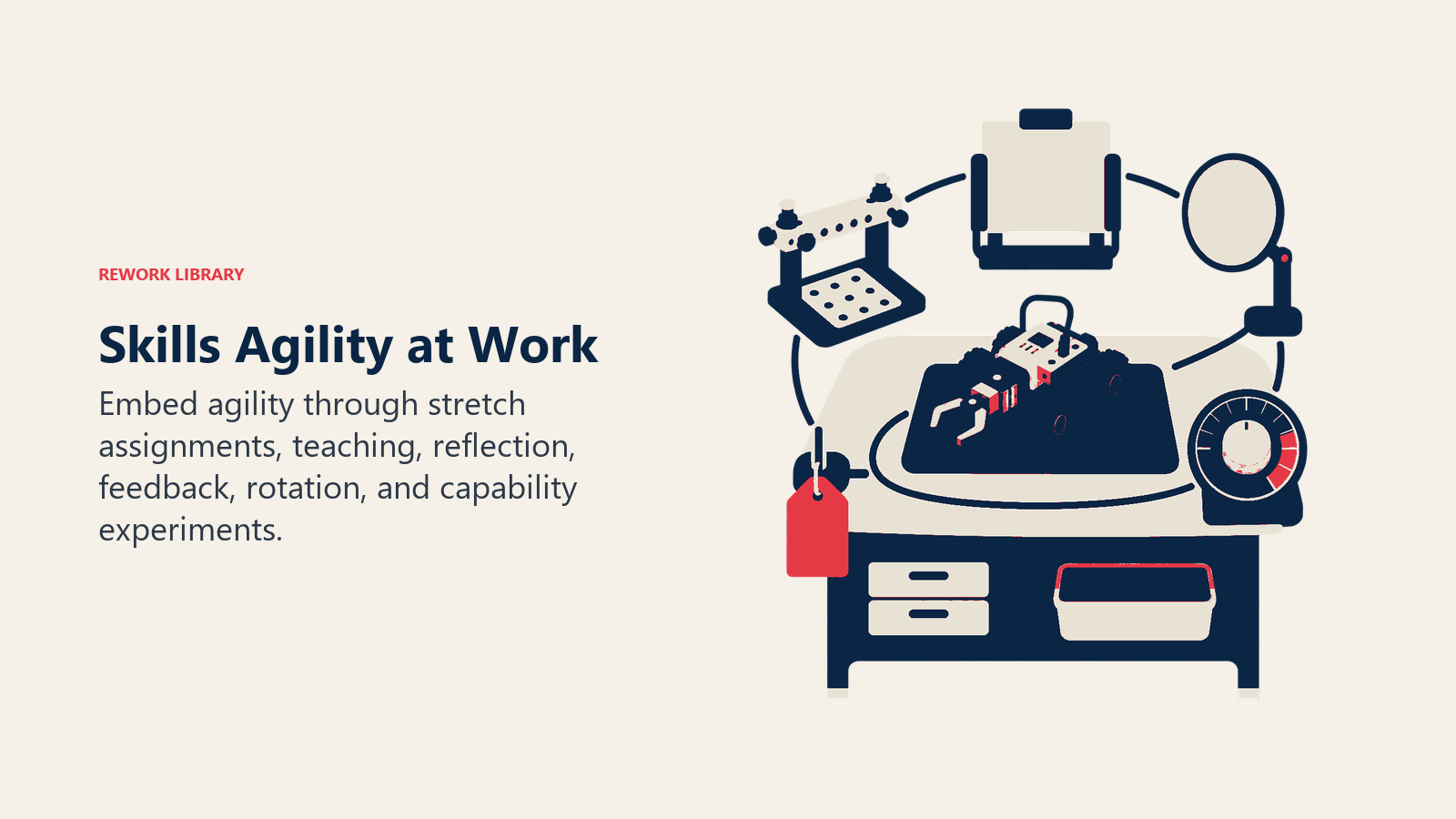
Skills agility shouldn't be a separate activity from your job. The most effective professionals integrate learning into everyday work.
Embedding Learning in Work
Learn-by-Doing Projects Volunteer for projects that require skills you want to develop. The combination of real stakes and actual application speeds up learning significantly.
Teaching as Learning Offer to help colleagues with skills you're developing. Teaching consolidates understanding and reveals gaps in your knowledge.
Cross-Functional Exposure Seek opportunities to work with other departments. Exposure to different perspectives and methods expands your capability while building valuable relationships.
Reflection Routines Build brief reflection moments into your day. What did you learn today? What skill did you practice? Regular reflection converts experiences into lasting capability.
Maintaining a Growth Mindset
Skills agility requires believing that abilities can be developed. Without this core belief, the effort required for continuous learning feels pointless.
Embrace Challenge View difficult situations as learning opportunities, not threats. The struggle of learning is the mechanism of growth.
Learn from Setbacks Failed attempts provide information. Analyze what didn't work, adjust your approach, and try again. Every master was once a disaster.
Celebrate Progress Notice and appreciate your growth. Recognizing progress sustains motivation for continued development.
Seek Feedback Actively request input on your developing skills. External perspectives reveal blind spots and accelerate improvement.
Common Questions About Skills Agility
How do I find time for skill development when my job already demands 50+ hours weekly?
Integration beats addition. Look for ways to build skills through your existing work instead of adding separate learning time. Take on projects that require capabilities you want to develop. Use micro-learning moments during commutes or breaks. Most importantly, recognize that some current activities may be less valuable than skill building. An hour spent developing a high-leverage skill often delivers more long-term value than an hour of routine work.
What if the skills I develop become obsolete before I can use them?
First, prioritize skills with longer half-lives. Foundational capabilities like analytical thinking, communication, and collaboration endure longer than specific technical skills. Second, focus on learning agility itself. The ability to learn quickly is the skill that never becomes obsolete. Finally, accept that some bets won't pay off. That's why you maintain a diversified skills portfolio rather than concentrating in one area.
How do I know which emerging skills are worth learning versus which are hype?
Look for convergent signals. When multiple credible sources point to the same skill, it's more likely to matter. Talk to people in roles you aspire to reach. They often have clearer visibility into what capabilities actually drive success. Be skeptical of skills pushed primarily by vendors selling training. And remember that adjacent skills offering clear paths from your current capabilities usually provide faster returns than completely novel domains.
I'm not naturally a fast learner. Can I still develop skills agility?
Absolutely. Learning speed isn't fixed. It improves with practice and better techniques. Most people who think of themselves as slow learners are actually using ineffective learning methods. By adopting evidence-based learning techniques like spaced repetition, interleaving, and deliberate practice, you can dramatically improve acquisition speed. Skills agility is itself a learnable capability.
How should I balance depth versus breadth in my skills portfolio?
The T-shaped model provides useful guidance: develop deep expertise in one or two areas while maintaining breadth across many related capabilities. Your deep skills differentiate you, while breadth enables collaboration and adaptability. The ideal balance depends on your role and industry. Specialists benefit from going deeper, while generalists need more breadth. Most professionals do well with moderate depth in their primary domain plus conversational competence across adjacent areas.
What's the best way to demonstrate skills I've developed through self-study rather than formal education?
Build a portfolio of evidence. Create projects that showcase your capabilities. Write about what you've learned. Contribute to open-source projects or industry discussions. Seek certifications that validate self-taught skills. Most importantly, apply your skills in your current role and document the results. Measurable outcomes from applied skills speak louder than any credential.
How do I prioritize skills development when my manager doesn't support learning time?
Take ownership of your development regardless of organizational support. Use personal time strategically for high-priority skills. Demonstrate value by applying new capabilities to current work. Frame learning in terms of business outcomes, not personal development. Look for informal learning opportunities within work. And consider whether an organization that doesn't support skill development is the right long-term fit for your career.
How frequently should I add new skills to my portfolio?
Quality matters more than quantity. Aim to meaningfully develop two to four new capabilities each year, depending on their complexity. Rushing through superficial exposure to many skills builds a weak portfolio. Moderate depth in fewer skills provides more value. That said, you should continuously explore through reading, conversation, and small experiments. These explorations inform which skills deserve deeper investment.
What if I'm mid-career and feel behind on skills that younger workers already have?
Your experience is a foundation, not a limitation. You likely have judgment, context, and professional skills that younger workers are still developing. The combination of domain expertise with newly acquired technical skills is particularly valuable. Focus on skills that complement your existing strengths. And recognize that learning agility often improves with experience. You may acquire new skills faster than you expect.
How do I know when a skill is developed enough to move on to the next one?
Define success criteria before you start learning. What specific capabilities will show you've reached your target? Generally, aim for the ability to apply the skill independently to real situations with acceptable results. You don't need mastery to move on. Competence that lets you contribute is usually enough. You can always deepen the skill later if needed. The goal is building a functional portfolio, not collecting expertise badges.
Your 90-Day Skills Agility Action Plan
Days 1-30: Foundation
Week 1: Assess Your Starting Point
- Complete a comprehensive skills inventory
- Identify your current learning style and preferences
- Assess your meta-learning capabilities honestly
- Review your career goals and skill requirements
Week 2: Research and Prioritize
- Research skill trends in your industry
- Map skill requirements for your desired career path
- Prioritize 2-3 skills for focused development
- Identify learning resources for each priority skill
Week 3-4: Build Learning Infrastructure
- Establish a daily learning habit (minimum 20 minutes)
- Set up your learning environment for success
- Find accountability partners or learning communities
- Create measurable milestones for priority skills
Days 31-60: Acceleration
Week 5-6: Intensive Skill Building
- Apply the 20-hour framework to your top priority skill
- Practice accelerated learning techniques
- Seek feedback on your progress regularly
- Document learning insights and methods that work
Week 7-8: Application and Integration
- Apply developing skills to real work situations
- Teach something you've learned to a colleague
- Adjust learning approach based on results
- Begin exploring your second priority skill
Days 61-90: Sustainability
Week 9-10: Portfolio Development
- Create evidence of your developed skills
- Update professional profiles with new capabilities
- Seek opportunities to demonstrate skills formally
- Continue systematic practice on priority skills
Week 11-12: System Refinement
- Conduct first quarterly skills review
- Evaluate learning methods and adjust approach
- Plan next quarter's skill priorities
- Establish sustainable long-term learning practices
Making Skills Agility Your Career Superpower
The professionals who thrive in 2026 and beyond won't be those with the most impressive static skill sets. They'll be the ones who can continuously learn, adapt, and grow as circumstances change. Skills agility isn't just another competency to develop. It's the competency that makes all other development possible.
Start with one skill. Pick something relevant to your current role that you've been meaning to learn. Apply the techniques from this guide. Track your progress. And notice how your learning itself improves as you practice learning.
The skills economy rewards those who can evolve. Every hour you invest in building skills agility pays off across your entire career. The question isn't whether to develop this capability. It's whether to start today or fall behind while others move ahead.
Your future self will thank you for the learning you begin now. The best time to plant a tree was twenty years ago. The second best time is today. The same goes for developing skills agility.
What skill will you start learning this week?
Learn More: Essential Competencies for Skills Agility
Building skills agility connects deeply with other professional competencies. Explore these related guides:
Learning and Growth
- Continuous Learning - Build the habits that sustain lifelong development
- Growth Mindset - Develop the belief system that enables skill acquisition
- Adaptability - Apply new skills effectively as circumstances change
Career Development
- Career Management - Align skill development with long-term career goals
- Self Awareness - Understand your learning style and development needs
- Initiative - Take ownership of your professional development
Professional Effectiveness
- Critical Thinking - Evaluate which skills to prioritize
- Problem Solving - Apply newly acquired skills to real challenges
- Digital Literacy - Build essential technology capabilities

Senior Customer Retention Strategist
On this page
- Why Skills Agility Matters More Than Any Single Skill
- The 5-Level Skills Agility Framework
- Level 1: Skill Consumer (0-1 years of development)
- Level 2: Active Learner (1-2 years of development)
- Level 3: Agile Learner (2-5 years of development)
- Level 4: Learning Architect (5-10 years of development)
- Level 5: Skills Futurist (10+ years of development)
- The Learning-to-Learn Meta-Skill
- Breaking Down the Meta-Skill
- Developing Your Meta-Learning Capability
- Identifying Which Skills to Prioritize
- The Skills Priority Matrix
- Practical Prioritization Steps
- Rapid Skill Acquisition Techniques
- The 20-Hour Framework
- Accelerated Learning Practices
- Environment Design for Learning
- Building Your Personal Skills Portfolio
- Portfolio Components
- Portfolio Management Practices
- Navigating Skills-Based Hiring Trends
- Understanding the Shift
- Demonstrating Skills Effectively
- Positioning for Internal Mobility
- Building Skills Agility Into Daily Work
- Embedding Learning in Work
- Maintaining a Growth Mindset
- Your 90-Day Skills Agility Action Plan
- Days 1-30: Foundation
- Days 31-60: Acceleration
- Days 61-90: Sustainability
- Making Skills Agility Your Career Superpower
- Learn More: Essential Competencies for Skills Agility
- Learning and Growth
- Career Development
- Professional Effectiveness