Attention to Detail: Definition, Examples, and Tips
Turn this article into takeaways for your work.


Each assistant summarizes the article only for you and suggests best practices for your work.
Attention to detail is one of the most consistently cited competencies in job descriptions, performance reviews, and promotion decisions. But what it actually means on the job, and how to build it, often goes unexamined.
What is attention to detail?
Attention to detail is the ability to notice, process, and accurately complete all aspects of a task without missing small but significant elements. It means catching the typo before the report goes to a client, spotting the formula error before the budget is approved, and following a multi-step process without skipping steps when you're rushed.
It's not about being slow or obsessive. It's about having habits and systems that make thoroughness feel natural rather than laborious. That's why employers list it on nearly every job posting, from accountants to software developers to nurses. Mistakes carry real costs, and people who catch them before they compound are genuinely valuable.
Key Facts
- A KPMG report found that data entry errors alone cost businesses up to $3.1 trillion annually in the U.S. (KPMG, 2023).
- According to a Gallup Workplace study, quality failures caused by human error are cited in 74% of customer complaints across service industries (Gallup, 2022).
- LinkedIn's Global Talent Trends report lists attention to detail among the top 10 soft skills most frequently mentioned in job postings for professional roles (LinkedIn, 2024).
Why attention to detail matters at work
A single missed digit in a contract can void an agreement. A wrong unit in a medical dosage can harm a patient. A broken link in a marketing email can tank a campaign that took weeks to build.
The cost of inattention isn't always dramatic. Often it's slower: a project takes two extra days because a requirement was misread early on, a client loses trust after the third small error, a team member spends Friday afternoon re-doing work that should have been done right on Tuesday.
Strong attention to detail supports critical thinking because both depend on examining information carefully before acting on it. It reinforces decision-making by ensuring the inputs to a decision are accurate. And it's foundational to quality excellence, which requires not just good intentions but reliable execution.
On the career side, people known for catching errors tend to get assigned work that matters. Managers trust them with sensitive documents, client deliverables, and complex projects. That trust compounds over time.
Examples of attention to detail by role
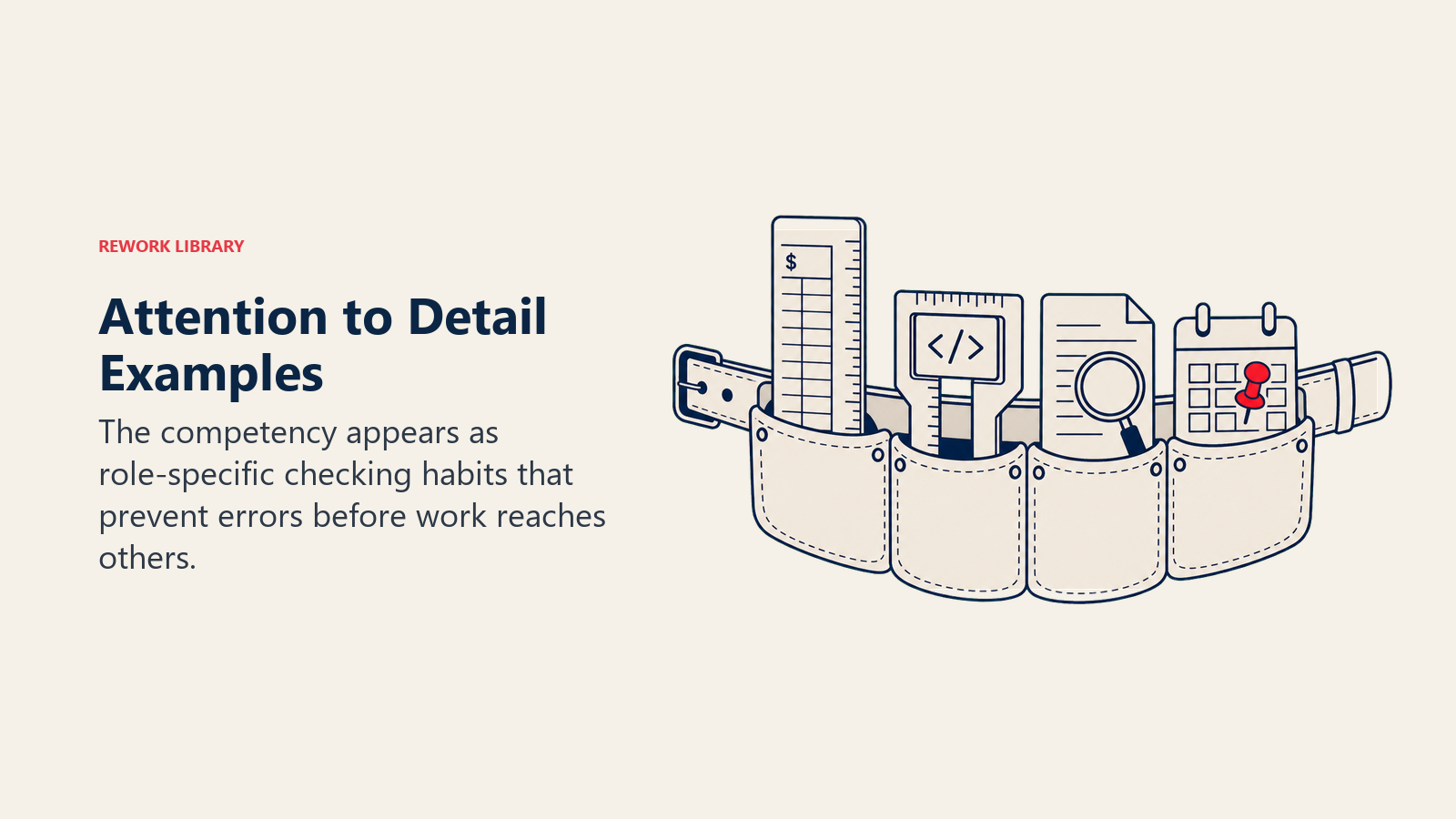
The competency appears as role-specific checking habits that prevent errors before work reaches others.
| Role | What attention to detail looks like |
|---|---|
| Accountant | Cross-checking every line in a reconciliation report before submitting it; catching a misclassified expense before the audit |
| Software developer | Reviewing code for edge cases and off-by-one errors; reading error logs carefully instead of guessing at the fix |
| Marketer | Checking every link, image, and recipient segment before sending a campaign; proofreading copy across all placements |
| Nurse | Verifying patient ID and medication dose against the order at every administration; noting subtle changes in a patient's vitals |
| Administrative assistant | Formatting meeting agendas consistently; confirming travel bookings against all requested details before confirming to the traveler |
| Project manager | Tracking dependencies between tasks so a late deliverable doesn't go unnoticed until it blocks another team |
The skill looks different by context, but the underlying behavior is consistent: noticing what others overlook and acting on it before it becomes a problem.
Signs of strong vs weak attention to detail
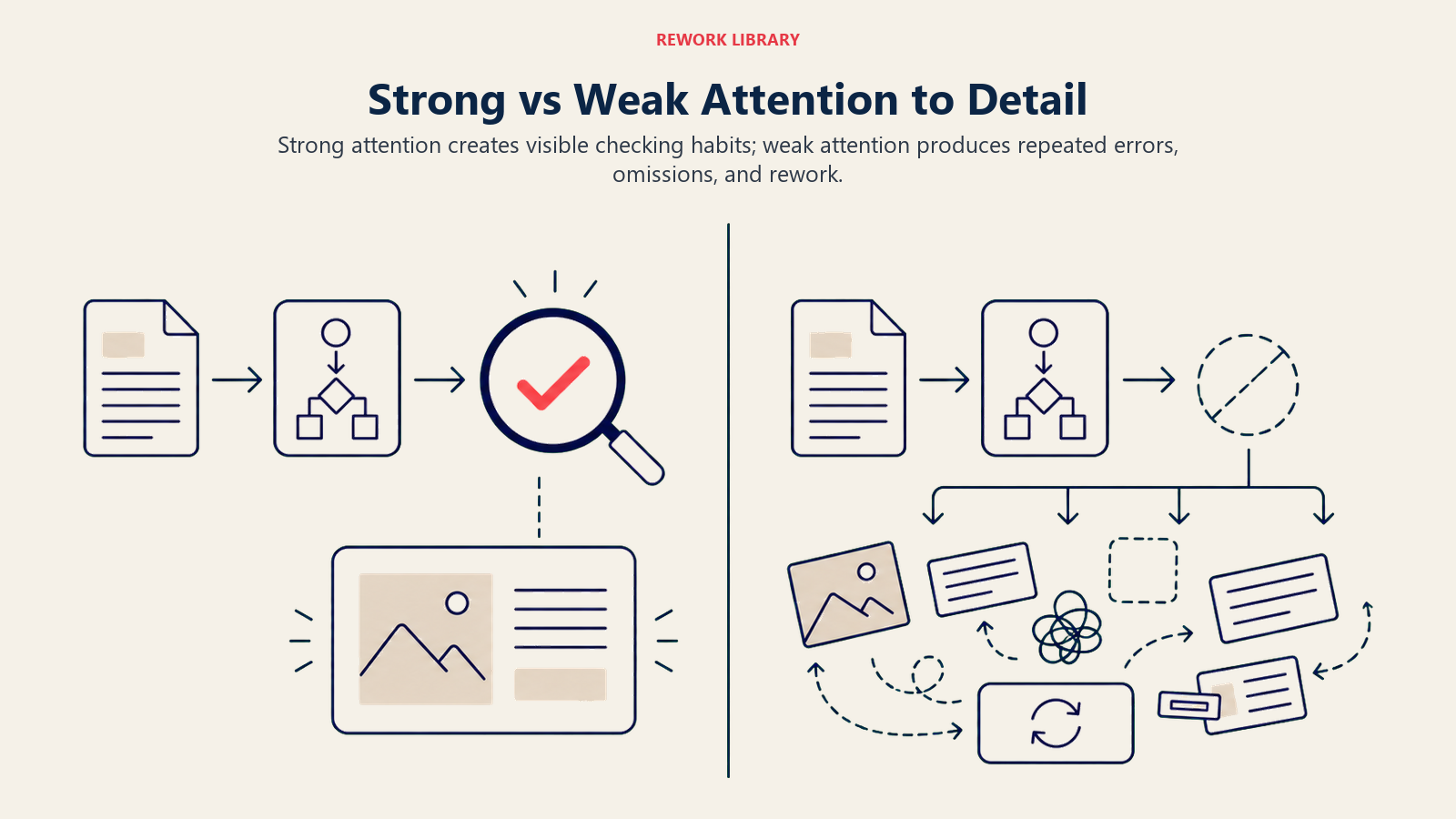
The contrast below is easiest to spot in repeated work: strong attention creates visible checking habits, while weak attention shows up as preventable rework and missed inconsistencies.
| Strong attention to detail | Weak attention to detail |
|---|---|
| Uses checklists and verifies steps even for familiar tasks | Skips steps on tasks that feel routine |
| Re-reads important emails before sending | Sends messages with typos, wrong names, or missing attachments |
| Spots inconsistencies between two data sources | Accepts one source without cross-referencing |
| Flags ambiguities before starting a task | Starts with assumptions, discovers misunderstandings mid-way |
| Reviews work from fresh eyes after a break | Submits immediately after finishing |
| Asks clarifying questions about requirements | Makes assumptions to avoid looking unsure |
| Keeps organized records and file naming | Struggles to locate past work or versions |
The clearest indicator of weak attention to detail isn't malice or laziness. It's usually habit. People who rush, who trust memory over checklists, or who never build a review step into their process will produce inconsistent work even when they care about quality.
Common causes of careless mistakes
Most errors at work aren't random. They follow patterns linked to specific conditions.
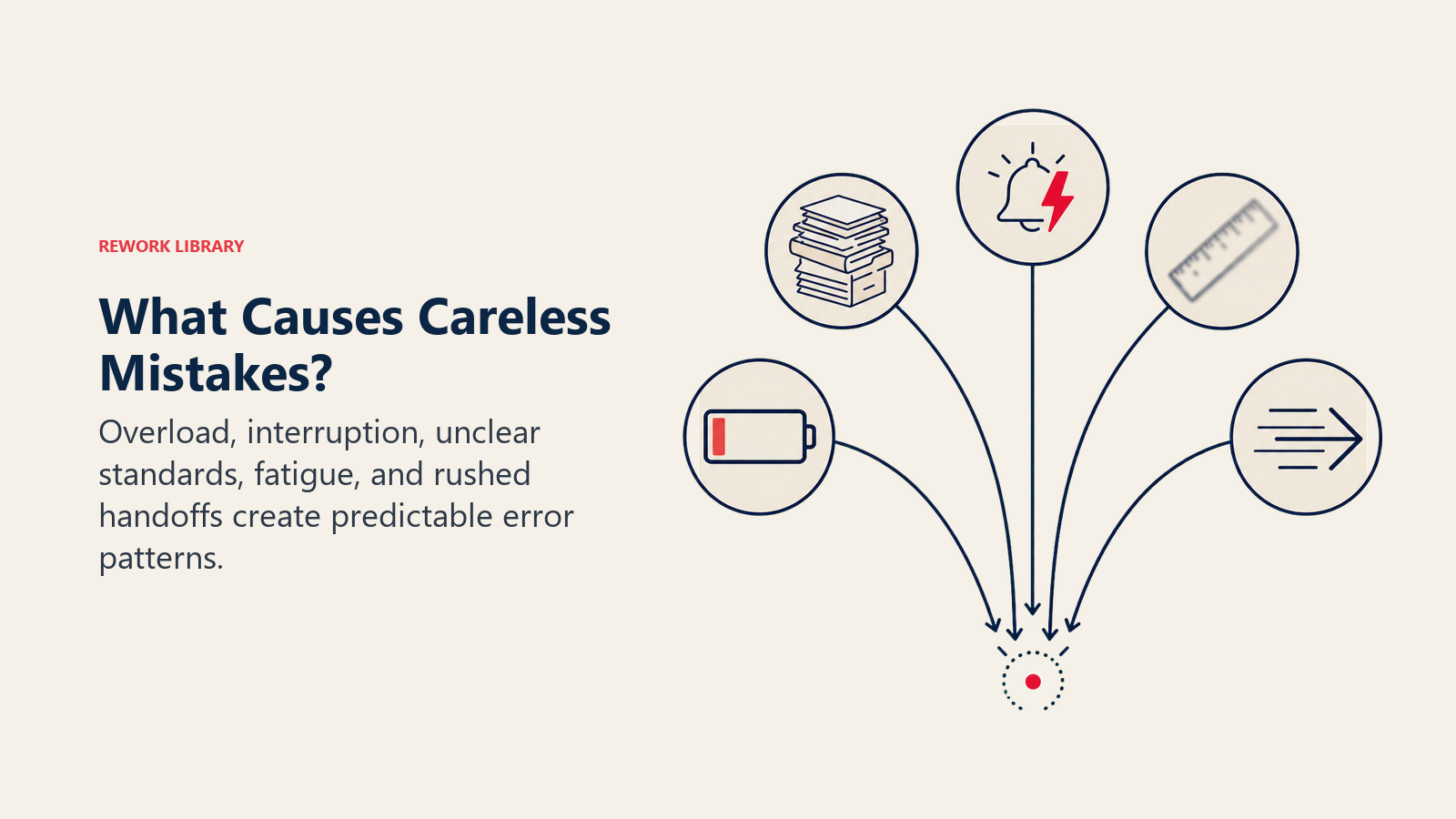
Multitasking. When you split attention between two tasks, both suffer. Research on task-switching shows that performance drops significantly when people try to monitor multiple active threads at once. The feeling of being productive masks the drop in accuracy.
Fatigue. Judgment and vigilance decline as cognitive load accumulates through the day or week. Errors spike on Friday afternoons, after long meetings, and during deadline crunches, not because people stop caring, but because mental resources are genuinely depleted.
No checklist or template. Relying on memory for multi-step processes is a structural problem, not a character flaw. Memory is reconstructive and context-sensitive. A checklist removes the cognitive burden of remembering what comes next and creates a physical record that a step was done.
Rushing. Time pressure causes people to skip verification steps they'd otherwise take. The irony is that rushing often creates rework that costs more time than the verification would have.
Unclear requirements. If the brief, ticket, or brief was ambiguous, errors appear even when execution is careful. Attention to detail also means reading the requirements closely and surfacing gaps before work begins.
Distractions. Open offices, constant notifications, and context-switching between tools all interrupt the focused state where careful work happens. Each interruption forces a cognitive restart.
How to improve attention to detail
Improving attention to detail is less about trying harder and more about designing routines that make accurate work easier to repeat.
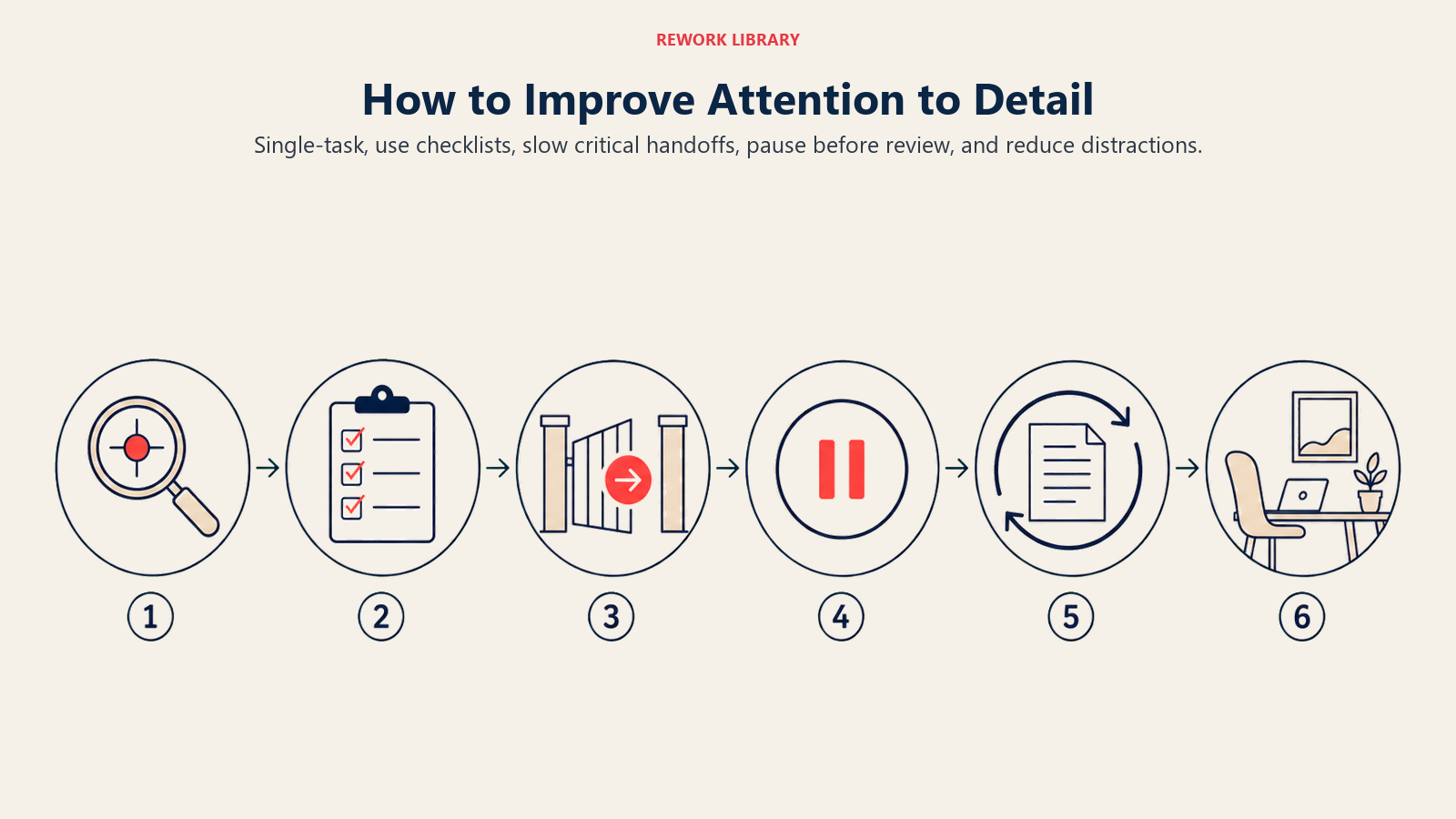
Step 1: Single-task during high-stakes work
Block time for work that requires accuracy and close everything else. One focused hour produces better output than three interrupted hours. Turn off notifications, close unused tabs, and signal to colleagues that you're unavailable. This is especially important for financial reviews, technical documentation, and client-facing deliverables.
Step 2: Build a personal checklist for recurring tasks
For any process you repeat, write down the steps once and use the list every time. Checklists aren't a sign of inexperience. Surgeons, pilots, and engineers use them precisely because experienced people are most prone to skipping familiar steps from overconfidence. If you write reports weekly, your checklist might include: verify all figures against source data, check headers match table of contents, confirm recipient list, proofread subject line. Start small and refine it as you catch new error categories.
Step 3: Slow down at critical handoff points
The most expensive mistakes happen at transitions: when a document moves from draft to final, when data moves from one system to another, when a task moves from your hands to a colleague's. Build a deliberate pause at these points. Re-read before you send. Verify the file name and version. Confirm the recipient. Five seconds of intentional checking prevents hours of cleanup.
Step 4: Take breaks before reviewing your own work
Fresh eyes catch errors that familiar eyes miss. After finishing a piece of work, step away for at least 10-15 minutes before reviewing it. Even a short break changes the cognitive state enough that you'll read what you actually wrote instead of what you intended to write. For important deliverables, sleep on it if schedule allows.
Step 5: Build a review habit into your workflow
Review shouldn't be an optional last step that gets cut when you're busy. Block a fixed review period at the end of each work block. Some people find it useful to use a different medium for review: print a document to review on paper, read a long email aloud, or change the font before proofreading. These small changes force you to process the content differently, which surfaces errors that read-through misses.
Step 6: Reduce environmental distractions
A detail-oriented mindset is a fragile state that gets disrupted by interruptions. Work with your team to protect focus time. Use headphones, status indicators, or scheduled focus blocks. Turn off non-critical notifications during deep work periods. The goal isn't to be unreachable; it's to create windows where your full attention is available for the work in front of you.
Applying these steps consistently reinforces results orientation because you're building systems that make good output repeatable, not just occasional. They also connect to time management, since review time needs to be planned for, not improvised.
How to show attention to detail on a resume and in interviews
On a resume: Specific examples beat generic claims. "Reviewed and corrected financial reports" says less than "Identified a $12,000 billing discrepancy during monthly reconciliation and corrected it before client invoicing." Quantify where you can: error rates reduced, rework eliminated, time saved through process checks.
Use language that signals systems thinking, not just care. Phrases like "developed a QA checklist for," "implemented a two-step review process for," or "built a template that standardized" show that your attention to detail is structural, not situational.
For roles where technical documentation matters, mention specific tools or processes you use for version control, review, or accuracy checks.
In interviews: When asked "how would you describe your attention to detail?" avoid the trap of saying "I'm very detail-oriented" without evidence. Instead, walk through a specific situation: what the task was, what you caught, what would have happened if you hadn't, and what you changed in your process as a result.
Strong answers to behavioral questions follow this pattern: the situation, what you noticed, the action you took, and the result. A weak answer is abstract. A strong answer names the specific thing you caught and what it prevented.
If the interviewer asks you to give an example of a time your attention to detail caused a problem, be honest. Describe a time you over-checked something at the cost of speed, or a time you built a review process that others found excessive. This shows self-awareness and growth, which is what the question is actually testing.
For roles involving problem-solving, connect attention to detail to your diagnostic process: noticing the details that others overlook is often how you identify root causes rather than just symptoms.
Related reading
- Critical Thinking - Analyzing information carefully before acting on it
- Problem Solving - Diagnosing root causes rather than surface symptoms
- Time Management - Planning review time so it doesn't get cut under pressure
- Results Orientation - Delivering accurate outputs consistently, not just occasionally
- Technical Documentation - Writing and maintaining records that hold up to scrutiny
- Decision Making - Making choices based on accurate, verified information
- Negotiation - Reviewing terms and language carefully before committing

Senior Customer Retention Strategist
On this page
- What is attention to detail?
- Why attention to detail matters at work
- Examples of attention to detail by role
- Signs of strong vs weak attention to detail
- Common causes of careless mistakes
- How to improve attention to detail
- Step 1: Single-task during high-stakes work
- Step 2: Build a personal checklist for recurring tasks
- Step 3: Slow down at critical handoff points
- Step 4: Take breaks before reviewing your own work
- Step 5: Build a review habit into your workflow
- Step 6: Reduce environmental distractions
- How to show attention to detail on a resume and in interviews
- Related reading