Interpersonal Skills: Definition, Examples, and How to Improve
Turn this article into takeaways for your work.


Each assistant summarizes the article only for you and suggests best practices for your work.
Interpersonal skills are what make the difference between someone who gets results alone and someone who gets results with everyone around them. They show up in every meeting, every hard conversation, and every moment when a team has to pull together under pressure.
Key Facts
- The National Association of Colleges and Employers (NACE) Job Outlook survey consistently ranks communication and teamwork as the top two attributes employers seek in new hires, above GPA and technical skills (NACE, 2024).
- LinkedIn's 2023 Most In-Demand Skills report lists communication, collaboration, and interpersonal skills among the top five soft skills hiring managers prioritize globally.
- A Queens University of Charlotte study found that 75% of employers rate teamwork and collaboration as "very important," yet only 18% of employees receive communication skills evaluations during performance reviews.
What Are Interpersonal Skills?
Interpersonal skills are the behaviors and abilities you use to interact and communicate effectively with other people. They're also called people skills or soft skills, and they cover everything from how you listen in a one-on-one to how you navigate a team disagreement or negotiate a deadline.
Unlike hard skills (writing code, building a financial model), interpersonal skills aren't tied to a specific job function. They transfer across every role, industry, and level of an organization. A junior analyst needs them. So does a CEO. In fact, the higher you go, the more they matter.
The core interpersonal skills include:
- Communication: expressing ideas clearly, both verbally and in writing
- Active listening: giving full attention and truly understanding what someone is saying
- Empathy: recognizing and responding to how others feel
- Teamwork: collaborating toward a shared goal
- Conflict resolution: working through disagreements constructively
- Negotiation: finding outcomes that work for everyone involved
- Dependability: following through so others can count on you
Together, these form the foundation of how you build trust and get things done with other people.
Why Interpersonal Skills Matter at Work
Strong interpersonal skills don't just make work more pleasant. They directly affect your career trajectory and your team's performance.
For individuals, people with strong people skills tend to be promoted faster, trusted with higher-stakes work, and given more autonomy. They're the ones managers call when a client relationship needs repairing or a team conflict needs defusing. That visibility compounds over time.
For teams, interpersonal skills reduce friction. When people communicate clearly and listen well, fewer things fall through the cracks. Decisions get made faster. Conflict gets resolved before it turns into something bigger. And people actually want to work together, which matters more than most leaders admit.
For organizations, the cost of poor interpersonal skills is real. Miscommunication alone is estimated to cost businesses billions annually in lost productivity, rework, and employee turnover. Teams with high interpersonal trust outperform those without it on nearly every metric: speed, quality, and resilience under pressure.
Strong interpersonal skills also underpin other competencies. Communication becomes sharper when it's grounded in empathy. Teamwork works better when everyone practices active listening. And conflict resolution becomes less painful when people can read each other's emotions accurately.
Types of Interpersonal Skills
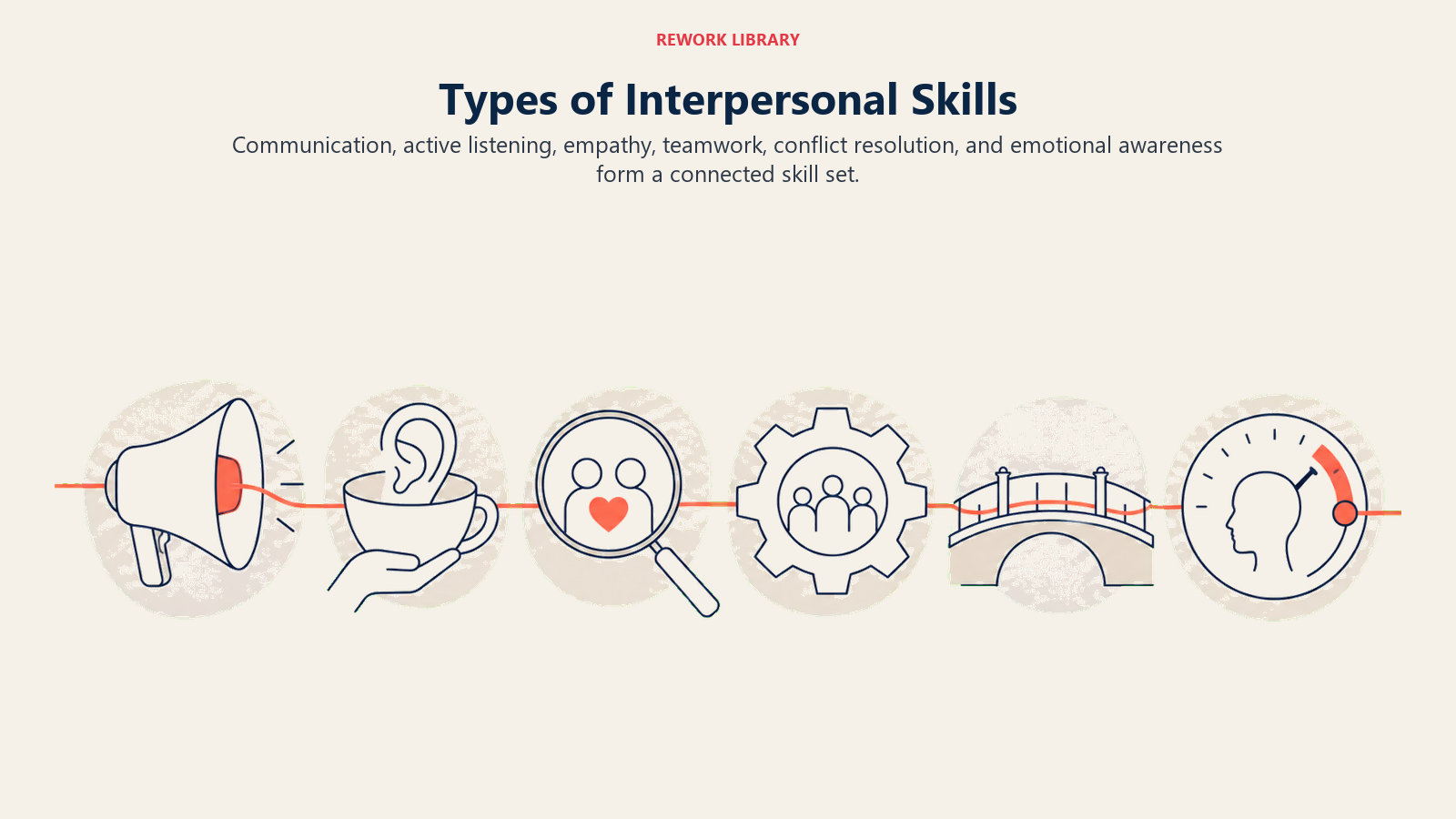
There's no single interpersonal skill. It's a cluster of related abilities that reinforce each other. Here's what each one looks like when it's working well:
| Skill | What It Is | What Good Looks Like |
|---|---|---|
| Communication | Expressing ideas clearly across spoken, written, and non-verbal channels | Messages are understood the first time; tone matches the context |
| Active Listening | Giving full attention, suspending judgment, and reflecting back what you heard | The speaker feels genuinely heard; follow-up questions are specific and relevant |
| Empathy | Understanding and acknowledging how another person feels | Responses address both the problem and the person's emotional state |
| Teamwork | Contributing to a group effort and supporting others' work | Pulls their weight and picks up slack; no credit-hoarding |
| Conflict Resolution | Addressing disagreements constructively and reaching workable solutions | Conflicts get resolved, not buried; relationships stay intact afterward |
| Negotiation | Finding agreements that meet key needs on both sides | Outcomes feel fair; both parties can commit to what was decided |
| Dependability | Doing what you say you'll do, when you said you'd do it | Others don't have to chase you; deadlines are kept or flagged early |
These skills overlap. Someone with strong empathy will naturally listen better. Someone who communicates clearly will find negotiation easier. Building one tends to strengthen the others.
Interpersonal Skills Examples
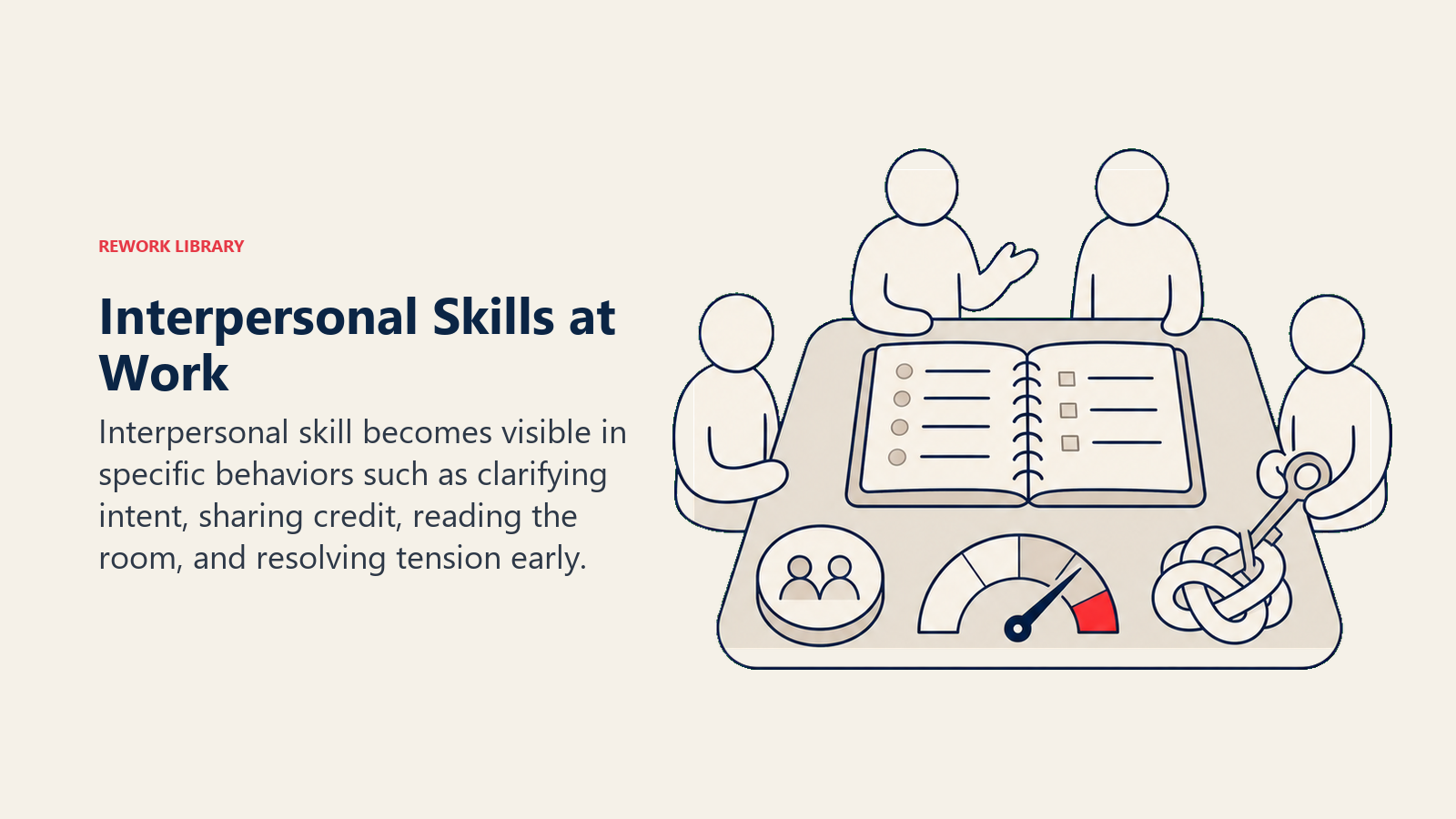
Abstract definitions only go so far. Here's how interpersonal skills show up in real workplace situations:
| Scenario | Skill in Action | What It Looks Like |
|---|---|---|
| A manager gives critical feedback | Empathy + Communication | Frames feedback around behaviors, not character; checks how the person is receiving it |
| A sales rep handles an upset client | Active Listening + Conflict Resolution | Lets the client finish before responding; summarizes the complaint accurately; proposes a specific fix |
| An engineer raises a scope concern with their PM | Communication + Negotiation | Flags the issue early with data; proposes trade-offs rather than just saying "it won't work" |
| A new hire joins a cross-functional project | Teamwork + Dependability | Asks clarifying questions, commits to realistic tasks, and delivers on time |
| Two team members disagree on a direction | Conflict Resolution + Active Listening | Both sides articulate their view; a third path gets explored; no one leaves angry |
| A leader runs a tight meeting | Communication + Empathy | Keeps things on track without making people feel cut off; reads when someone needs to be heard |
| A junior employee suggests a process change | Influencing + Communication | Makes a clear case with examples; anticipates objections; brings others along |
The pattern is consistent: interpersonal skills aren't one big thing. They're small, specific behaviors that, when done well, build trust and move things forward.
How to Improve Your Interpersonal Skills
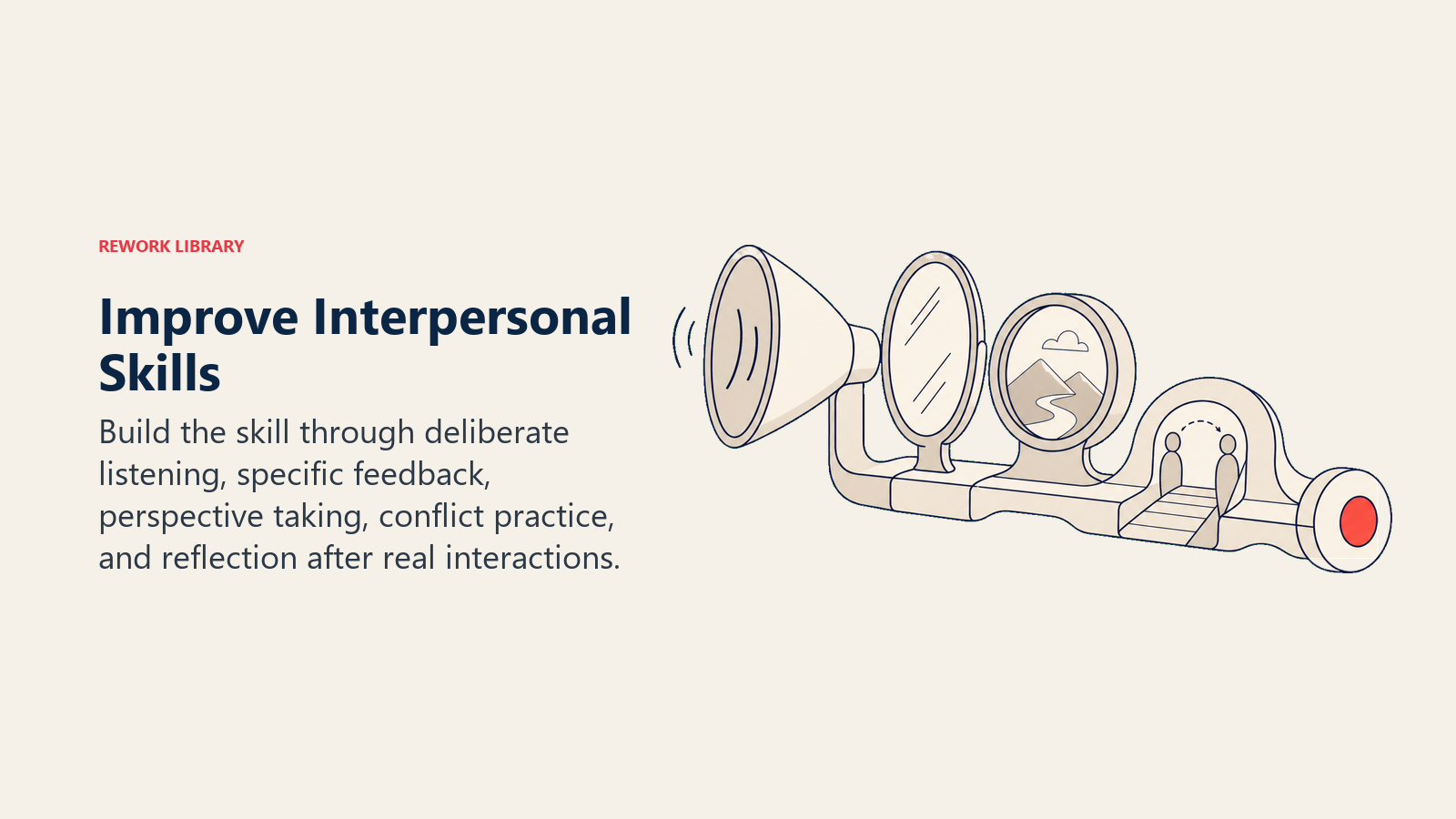
Interpersonal skills improve with deliberate practice. The key word is deliberate. Spending 10 years in meetings doesn't automatically make you a better communicator if you're repeating the same patterns. Here's how to actually get better.
Step 1: Identify Your Weakest Point
Don't try to improve everything at once. Pick one skill that's holding you back most. Ask a trusted colleague: "Where do you see me struggle most in working with others?" Their answer will probably be more useful than your own self-assessment.
If you're unsure, notice where you feel friction. Do conversations often go sideways? That might be communication or empathy. Do people stop coming to you with things? That might be dependability. Do you avoid certain conversations? That might be conflict resolution.
Step 2: Build One Habit Around That Skill
Pick a single, observable behavior to practice. Not "be a better listener" but "before I respond in any 1:1, I'll summarize what the other person just said." Not "improve empathy" but "when someone brings me a problem, I'll acknowledge how they feel before I suggest a solution."
Small, specific behaviors compound over weeks. And because they're visible to others, you'll get real-world feedback quickly.
Step 3: Seek Feedback Regularly
Ask for it. Don't wait for performance reviews. After a meeting you facilitated, ask a colleague: "Was there a moment where I could have listened better?" After a difficult conversation, ask: "Did that feel fair to you?"
People who improve fastest at interpersonal skills are the ones who treat every interaction as a chance to learn, not just to perform.
Step 4: Practice in Lower-Stakes Situations
If you want to get better at negotiation, start with small, low-pressure situations: agreeing on a deadline, dividing up meeting prep, deciding where to have lunch. Build the muscle before you need it in a high-stakes moment.
Same with conflict. If you avoid all disagreement, you won't be ready when something serious needs addressing. Practice saying "I see it differently" in safe contexts so it stops feeling dangerous.
Step 5: Study How Others Do It
Find two or three people in your organization whose interpersonal skills you genuinely admire. Watch how they handle tension in meetings, how they give feedback, how they respond when something goes wrong. You don't have to copy them, but noticing what they do differently is one of the fastest ways to expand your own range.
Pairing this with reading on emotional intelligence or relationship building can help you put a name to what you're observing.
Step 6: Reflect After Key Interactions
Spend two minutes after a significant conversation asking: What went well? What would I do differently? Did I listen or just wait to talk? Did I say what I meant clearly?
This isn't self-criticism. It's the same feedback loop that makes any skill improve over time. The people who get dramatically better at interpersonal skills are the ones who do this consistently, not the ones who wait for a course to fix it.
How to Show Interpersonal Skills on a Resume and in Interviews
"Good communication skills" on a resume means nothing. Everyone claims it. The way to stand out is to show specific evidence.
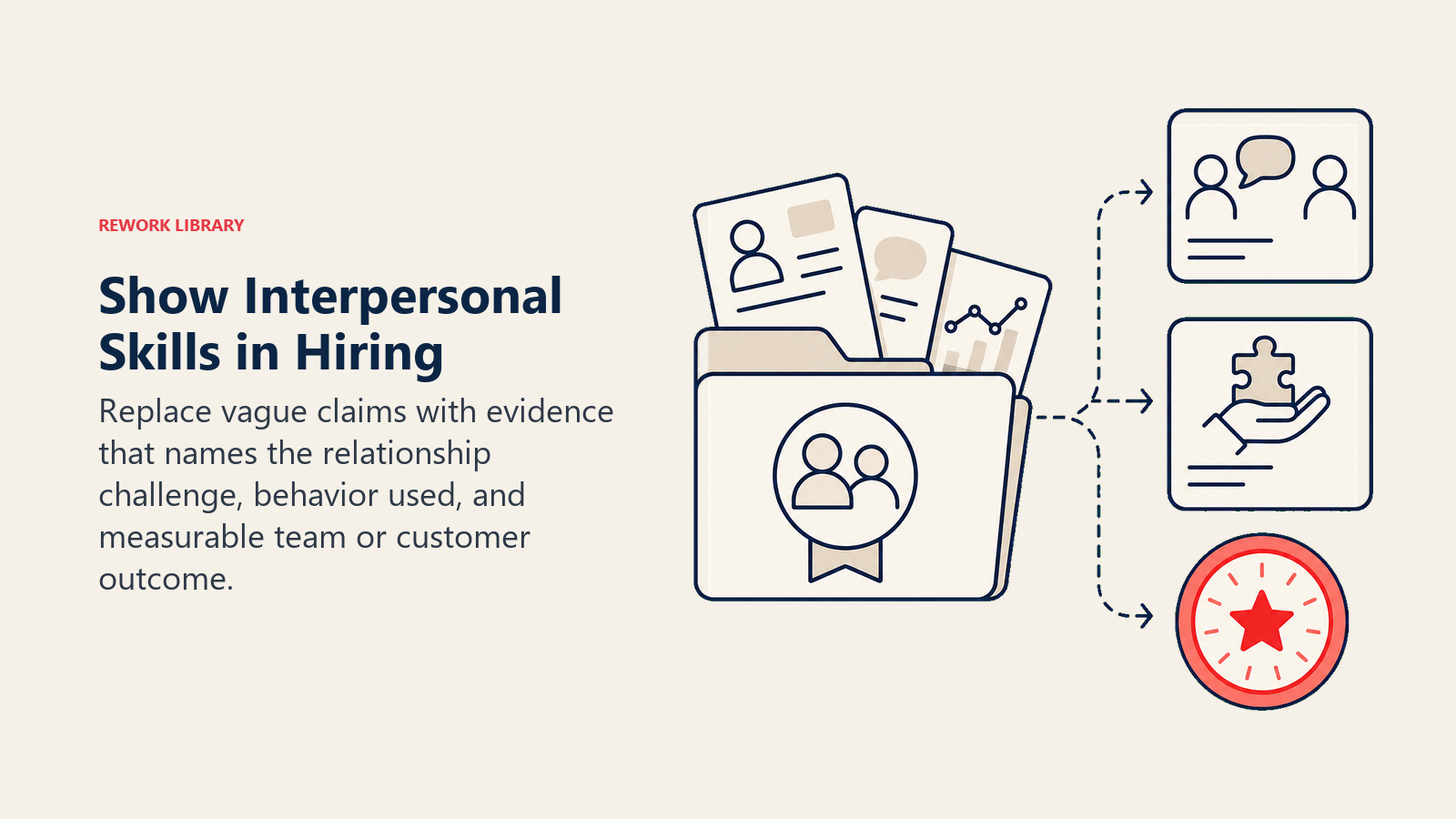
On your resume, replace vague claims with concrete situations. Instead of "strong interpersonal skills," write "collaborated with three cross-functional teams to launch a product integration ahead of schedule" or "mediated a recurring disagreement between sales and engineering that had stalled a client project for six weeks."
In your cover letter, pick one interpersonal skill that's directly relevant to the role and tell a short story: the situation, what you did, and what the result was.
In interviews, prepare three to five stories using the STAR method (Situation, Task, Action, Result) that show your interpersonal skills in action. Common questions to prepare for:
- "Tell me about a time you had a conflict with a colleague and how you resolved it."
- "Describe a situation where you had to influence someone without formal authority."
- "Give me an example of when you had to adapt your communication style."
- "Tell me about a difficult conversation you had to initiate."
The key in all of these is specificity. The details are what make the story credible. "I gave feedback" is forgettable. "I had a direct conversation with a teammate about missing deadlines, which turned out to be a workload problem I hadn't known about, and we restructured the project together" is memorable.
During the interview itself, your interpersonal skills are on display in real time. Listen carefully. Answer the question that was asked, not the one you'd prefer. If you're unsure, ask for clarification instead of guessing. Make the conversation feel like one, not an audition.
Common Mistakes
Most people who want to improve their interpersonal skills focus on the wrong things. Here are the patterns that get in the way:
Mistaking talking for communicating. Saying more isn't the same as being understood. The most effective communicators are often the most concise ones, because they take the time to think before they speak.
Listening to respond, not to understand. If you're forming your reply while the other person is still talking, you're not listening. You're waiting. The difference shows, and people feel it.
Avoiding conflict and calling it being nice. Letting problems fester isn't kind. It's just more comfortable in the short term. Real interpersonal skill means addressing things early, directly, and respectfully, not letting them accumulate until someone explodes.
Assuming your communication style works for everyone. What feels direct to you might feel blunt to someone else. What feels thorough to you might feel like too much information to your manager. Good interpersonal skills include reading who you're talking to and adjusting.
Confusing personality with skill. Extroverts aren't automatically better at interpersonal skills. Some of the most effective listeners, empathizers, and conflict-resolvers are introverts who've built these skills deliberately. And plenty of outgoing people talk over others, miss emotional cues, and fail to follow through. Personality is a starting point, not a finish line.
Skipping the follow-through. Interpersonal skills aren't just about the conversation. Dependability, which might be the most underrated people skill, is about what happens after. If you commit to something, deliver it. If something changes, communicate early. Trust is built in the small, consistent moments, not the big ones.
Frequently Asked Questions about Interpersonal Skills
What are interpersonal skills?
Interpersonal skills are the behaviors and abilities that let you interact effectively with other people. They include communication, active listening, empathy, teamwork, conflict resolution, negotiation, and dependability. They're often called people skills or soft skills, and they apply across every role and level of an organization.
What are some examples of interpersonal skills?
Practical examples include: summarizing what someone said before responding (active listening), acknowledging how a colleague feels before jumping to problem-solving (empathy), flagging a deadline risk early instead of going silent (dependability), and steering a team disagreement toward a specific decision instead of letting it stall (conflict resolution). Each of these is a concrete, observable behavior, not a vague trait.
What's the difference between interpersonal skills and communication skills?
Communication is one type of interpersonal skill. It covers how you express ideas clearly, in writing, verbally, and through body language. But interpersonal skills are broader: they include empathy, teamwork, conflict resolution, and dependability, none of which are purely about how you communicate. You can be a clear communicator and still struggle with empathy or conflict. The full set of interpersonal skills covers the whole relationship, not just the message.
How do I improve my interpersonal skills?
Start by identifying one specific area where you have friction, not "all of the above." Build one concrete habit around it (like summarizing before responding). Ask for feedback after real interactions. Practice in lower-stakes situations before you need the skill in a high-pressure moment. And reflect briefly after significant conversations so you're learning from experience, not just repeating it.
Why do employers value interpersonal skills so highly?
Because technical skills solve technical problems, but most work problems involve people. Miscommunication, team conflict, poor listening, and failure to follow through cost organizations far more than technical errors do. Employers know that someone who can work well with others will get more done, retain clients longer, and make the whole team function better. That's why NACE surveys consistently show interpersonal skills ranking above GPA and technical skills as the attributes employers prioritize most in candidates.
Interpersonal skills aren't a fixed trait you either have or don't. They're a set of learnable, practicable behaviors that improve over time with the right kind of attention. The more deliberately you build them, the more every other skill you have gets amplified by your ability to work well with the people around you.
If you're looking for a place to start, pick one article from the list below and spend a week practicing just that one thing. Small, consistent effort beats trying to change everything at once.
- Communication: the foundation for expressing ideas clearly across all channels
- Active Listening: what it actually means to hear someone, not just wait for your turn
- Emotional Intelligence: reading and responding to emotions, yours and others'
- Conflict Resolution: working through disagreements without damaging relationships
- Teamwork: what real collaboration looks like beyond a buzzword
- Relationship Building: the long game of trust and professional connection
- Influencing Skills: moving people without formal authority
- Presentation Skills: communicating ideas to a room with clarity and confidence
- Negotiation: finding agreements that hold and relationships that last

Senior Customer Retention Strategist
On this page
- What Are Interpersonal Skills?
- Why Interpersonal Skills Matter at Work
- Types of Interpersonal Skills
- Interpersonal Skills Examples
- How to Improve Your Interpersonal Skills
- Step 1: Identify Your Weakest Point
- Step 2: Build One Habit Around That Skill
- Step 3: Seek Feedback Regularly
- Step 4: Practice in Lower-Stakes Situations
- Step 5: Study How Others Do It
- Step 6: Reflect After Key Interactions
- How to Show Interpersonal Skills on a Resume and in Interviews
- Common Mistakes