Public Speaking: How to Overcome Fear and Improve
Turn this article into takeaways for your work.


Each assistant summarizes the article only for you and suggests best practices for your work.
Public speaking skills are the engine behind careers that seem to accelerate faster than others. The people who get promoted, who earn trust in the room, who shape decisions rather than just implement them: they can all stand up and speak with clarity and confidence. The gap between having a good idea and getting that idea adopted is often nothing more than the ability to communicate it out loud.
What Are Public Speaking Skills?
Public speaking skills are the abilities that let you plan, structure, and deliver spoken communication to a group, whether that group is three colleagues in a conference room or three thousand people at an industry event.
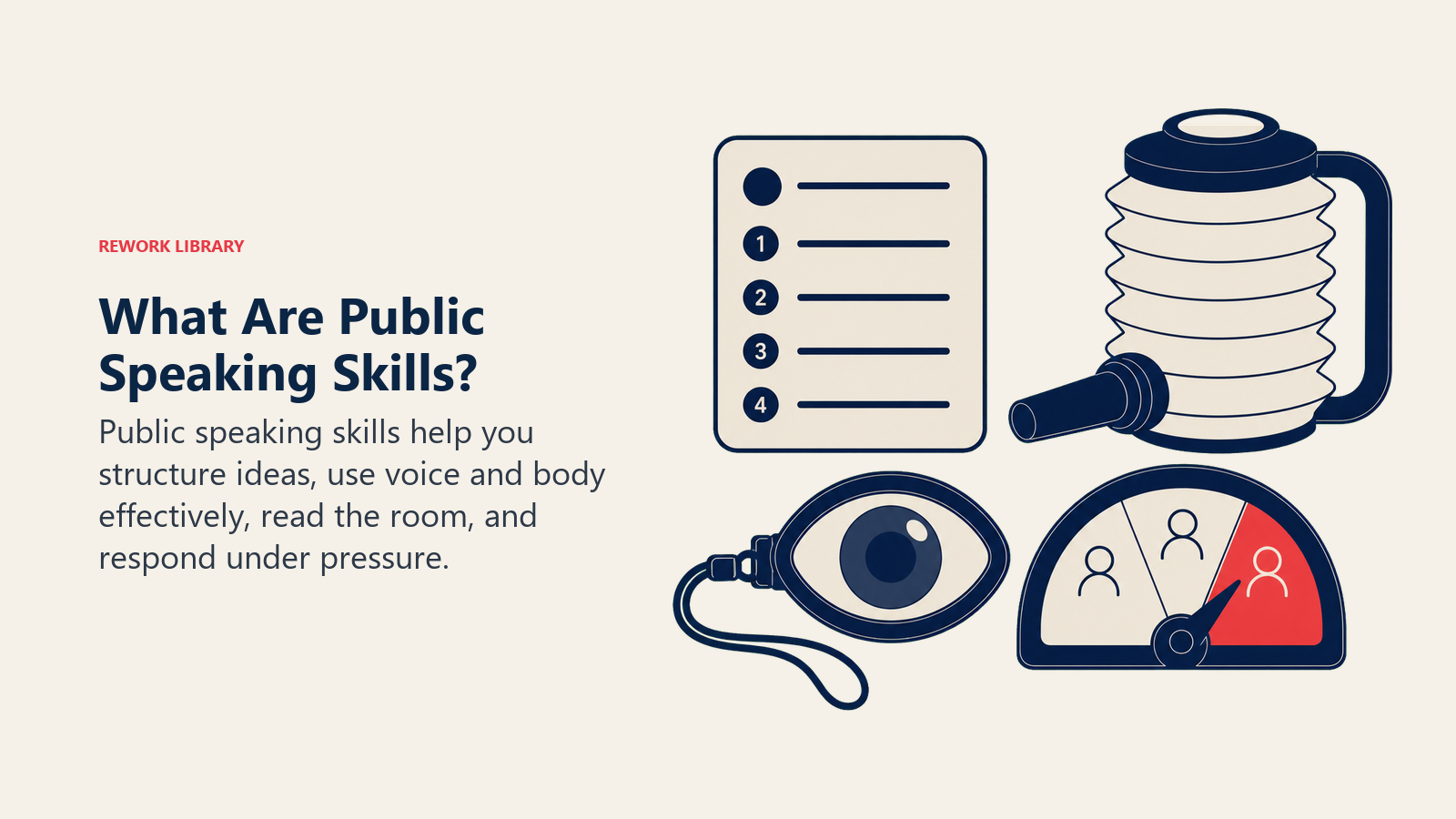
The skill set bundles together several things: organizing your thinking so it flows logically, managing your voice so it carries and varies, using your body language to build rather than undermine your credibility, reading your audience in real time, and keeping your composure when nerves or hard questions hit.
Public speaking is sometimes treated as a personality trait. Outgoing people can do it; introverted people can't. That's simply not true. It's a craft, and like any craft, it responds to deliberate practice.
Key Facts
- Glossophobia (the fear of public speaking) is among the most common phobias, with surveys consistently finding 40-70% of people report meaningful anxiety about speaking in front of groups (Chapman University Survey of American Fears, 2022).
- People who communicate clearly and confidently in front of groups earn 15-20% more on average across their careers, according to research by economist James Heckman on non-cognitive skills and labor market outcomes (Heckman, 2012).
- Toastmasters International, with 280,000 members in 140 countries, was founded in 1924, making structured public speaking training one of the oldest documented forms of professional development.
Why Public Speaking Skills Matter
Careers don't advance quietly. At some point, every professional has to stand up and make the case for something: a budget, a hire, a strategic direction, a product, a team. The people who can do that clearly get more chances to do it again. The ones who avoid it hand that influence to someone else.
There are three specific career levers where public speaking pays off most.
Visibility at the leadership level. Leaders are assessed constantly on how they communicate, not just on what they decide. A VP who can run an all-hands meeting and leave the room energized has a different standing than one who reads from slides and rushes through it. Strong communication skills are a prerequisite for senior roles in almost every industry.
Influence without formal authority. You don't need to be someone's manager to shape their thinking. But you do need to be able to articulate ideas clearly and confidently in front of a group. This is how individual contributors build cross-functional credibility. It's the same principle behind influencing skills: the person who can speak well has more informal power than their org chart suggests.
Personal brand and career momentum. Presenting at a conference, leading a workshop, or handling a high-stakes town hall all create visible proof of competence. They're the kind of moments that get talked about afterward. Every strong speaking performance builds a reputation that carries forward.
Public Speaking vs Presentation Skills
These terms get used interchangeably, but they're not identical. The distinction matters because they have slightly different development paths.
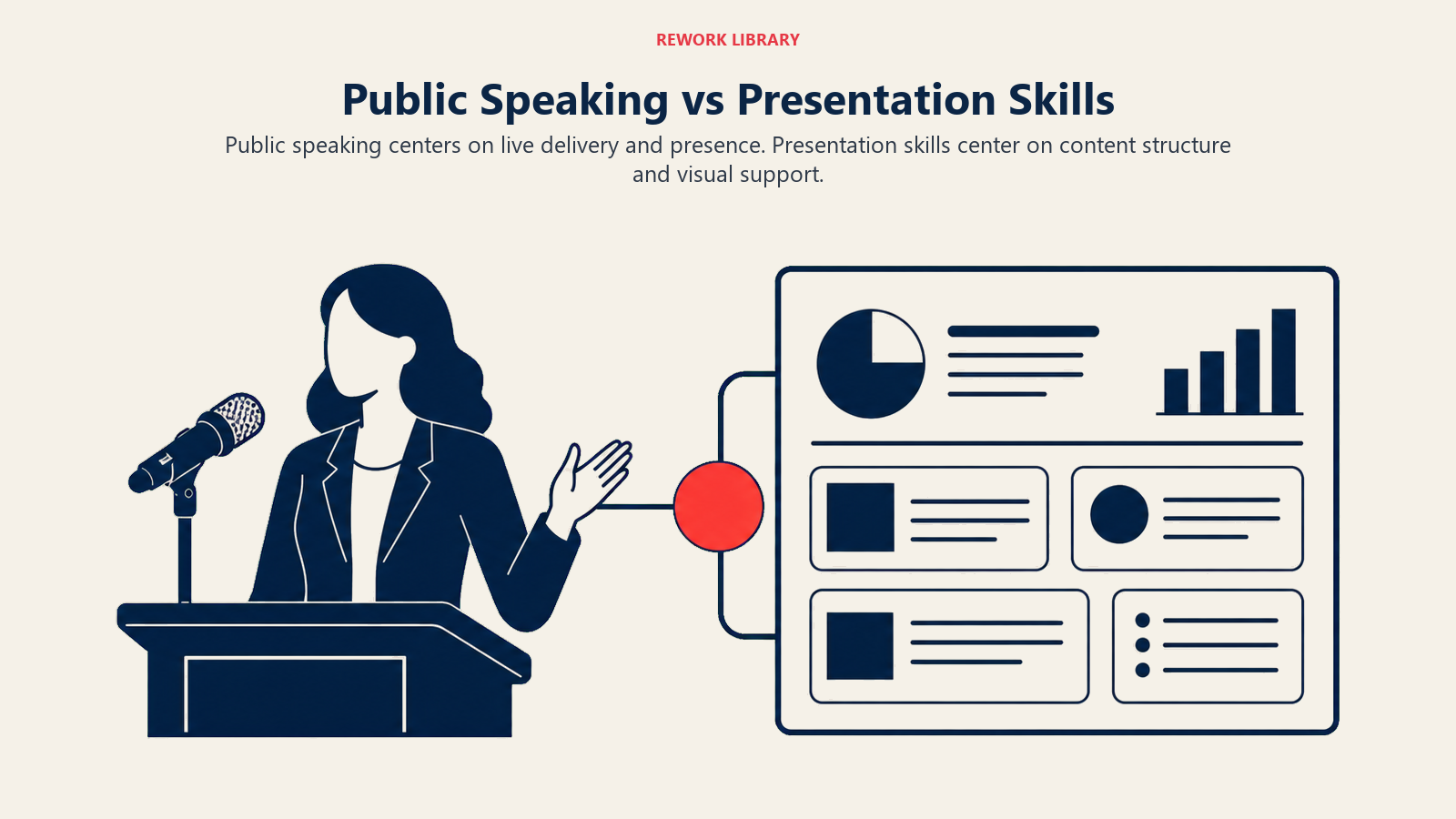
| Dimension | Public Speaking | Presentation Skills |
|---|---|---|
| Core focus | Live verbal delivery, voice, body, presence | Structure, visual design, content architecture |
| Primary medium | Your voice and body | Slides, data, visual aids plus delivery |
| When it matters most | Speeches, panels, town halls, pitches, facilitation | Business reviews, decks, workshops, demos |
| Key development activity | Speaking practice (Toastmasters, impromptu sessions) | Content design + rehearsal with slides |
| Shared foundation | Audience awareness, clarity, managing nerves | Audience awareness, clarity, managing nerves |
In practice, strong professionals develop both. Presentation skills and public speaking reinforce each other: better structure makes live delivery easier, and better delivery makes any presentation land harder.
Common Causes of Speaking Anxiety
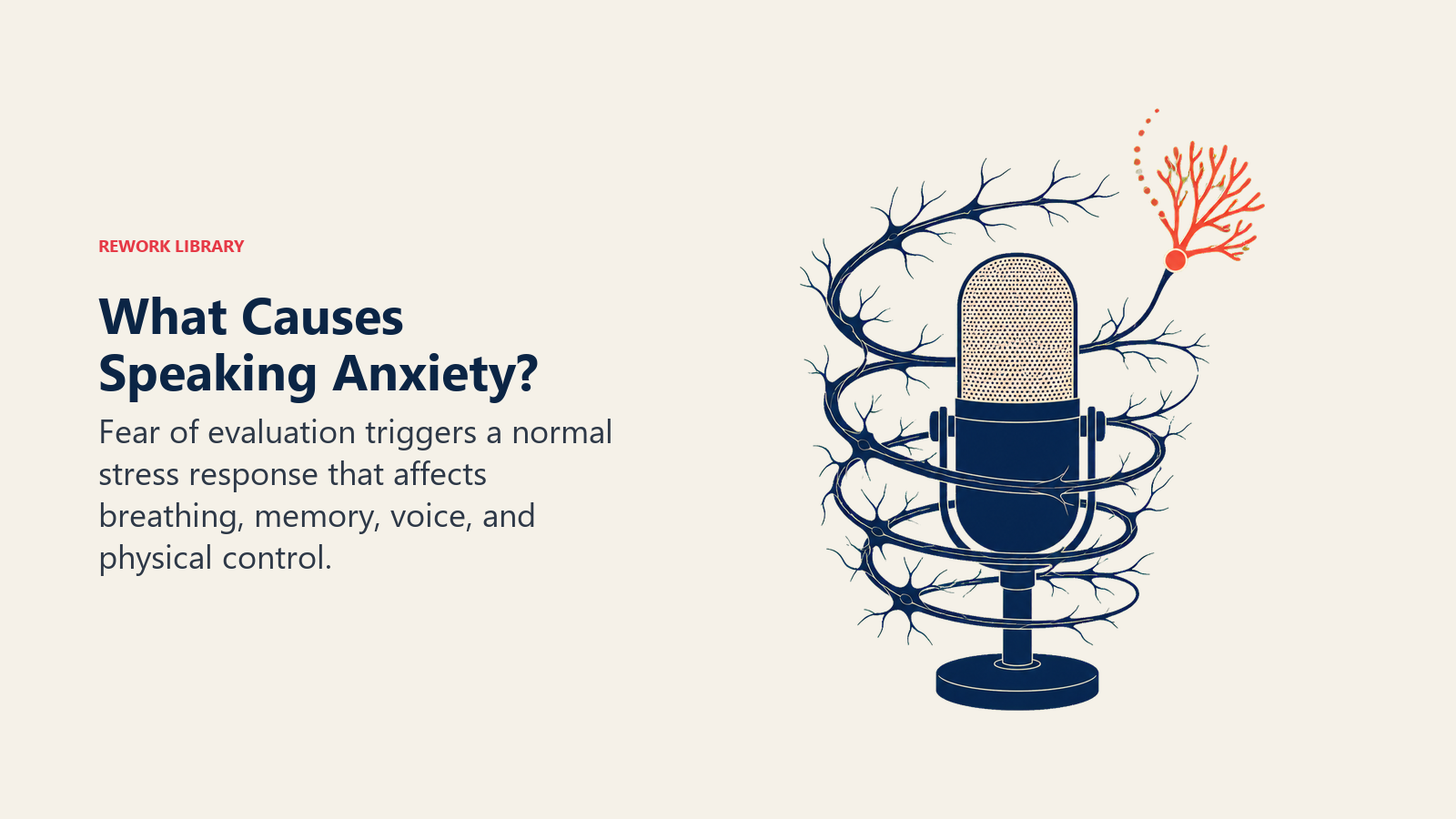
Glossophobia, the clinical name for the fear of public speaking, is not a character flaw. It's a predictable nervous system response to perceived evaluation and social risk. Your brain registers "speaking in front of a group" as a situation where you might be judged, rejected, or exposed as inadequate. That triggers a stress response that's meant to protect you.
The most common triggers:
Fear of forgetting your place. You haven't rehearsed enough to trust yourself, so your brain fills the gap with worst-case scenarios.
Fear of negative judgment. Social evaluation anxiety is real. It spikes when you're new to a role, presenting to seniors, or covering a topic you feel uncertain about.
Physical symptoms that snowball. Racing heart, dry mouth, shaky hands. These are normal stress responses, but many people interpret them as signs they're failing, which makes the anxiety worse.
Lack of experience. Anxiety decreases with exposure. People who avoid speaking because they're anxious grow more anxious over time because they never build tolerance.
Perfectionism. Holding yourself to flawless delivery is a setup for anxiety. Great speakers have an easy relationship with imperfection.
Understanding the cause doesn't fix the fear automatically, but it's the starting point for the right interventions.
How to Improve Your Public Speaking
Improvement here isn't mysterious. It follows the same pattern as any skill: deliberate practice, feedback, and iteration. These steps build on each other.
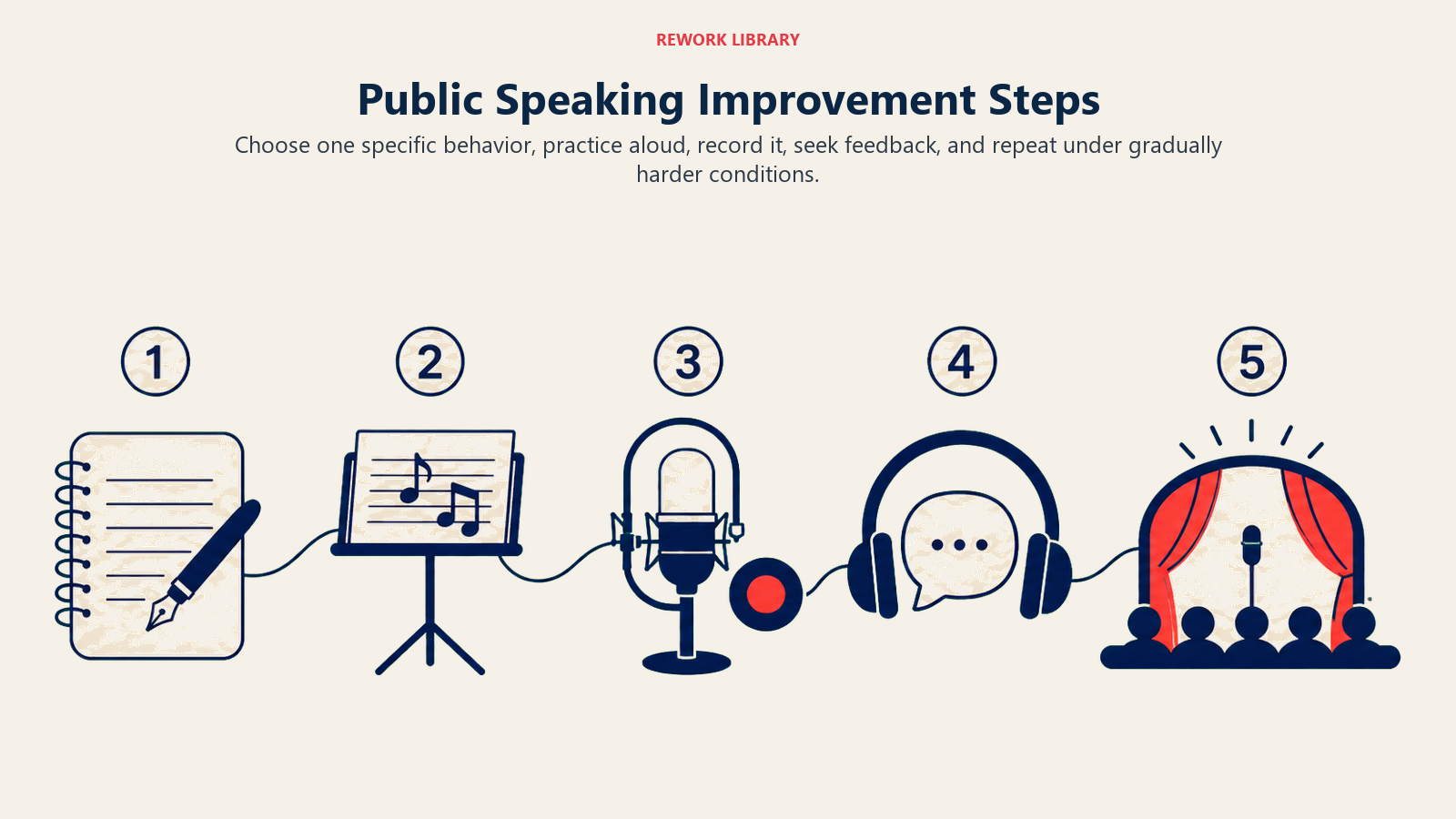
Step 1: Start with a concrete goal, not a vague resolve
"I want to be a better speaker" isn't a practice target. "I want to eliminate filler words from a five-minute talk" is. "I want to maintain eye contact with three different sections of the room during my next team presentation" is. Specific micro-goals give you something to work on and measure.
Pick one thing per speaking event. Fix that one thing. Then pick the next.
Step 2: Record yourself and watch it back
This is uncomfortable. Do it anyway. Recording yourself on a phone and watching it back is one of the fastest feedback loops available to any speaker. You'll catch filler words, awkward pacing, closed body language, and downward inflections that undercut confident statements.
Most people are surprised by the gap between how they imagine they sound and how they actually sound. Better to find that out in a practice session than in a board meeting.
Step 3: Build content clarity before delivery
A common mistake is practicing delivery on content that isn't clear yet. If your argument isn't logically sound, no amount of vocal polish will save it. Before rehearsing how you speak, make sure the structure works: a strong opening that earns attention, a clear through-line that connects your points, and an ending that tells the audience what to do next.
Clear structure reduces cognitive load during delivery. When you're not trying to remember what comes next, you have more mental bandwidth to be present, read the room, and adjust in the moment.
Step 4: Rehearse out loud, in real conditions
Reading your slides silently is not rehearsal. Stand up, speak at full volume, and time yourself. Do it in the room you'll present in if you can, or simulate it as closely as possible.
Rehearsing out loud in real conditions does two things. It builds procedural memory for the words, so delivery feels automatic rather than effortful. And it surfaces the parts of your content that don't flow naturally when spoken, which is different from how they read.
Step 5: Get low-stakes repetitions
The fastest way to improve is to speak more. Find opportunities to present in lower-stakes contexts: team meetings, lunch-and-learns, Toastmasters, internal workshops. Each repetition builds tolerance for the discomfort and makes your nervous system recalibrate the perceived risk.
This is the same principle behind active listening development: you can't build a real-time interpersonal skill by reading about it. You build it by doing it repeatedly, with feedback.
Step 6: Debrief after each presentation
Right after you finish, while the experience is fresh, write down three things: what worked, what you'd cut or change, and one specific thing to try next time. This reflection loop is what converts experience into skill. Without it, you repeat the same patterns indefinitely.
If you can get structured feedback from a trusted colleague or manager, that's even better. Ask them to watch for one specific thing, not general impressions.
Techniques to Manage Nerves
The goal isn't to eliminate nerves. Some activation actually helps performance. The goal is to stay functional and credible when the stress response kicks in. These techniques work across different scenarios.
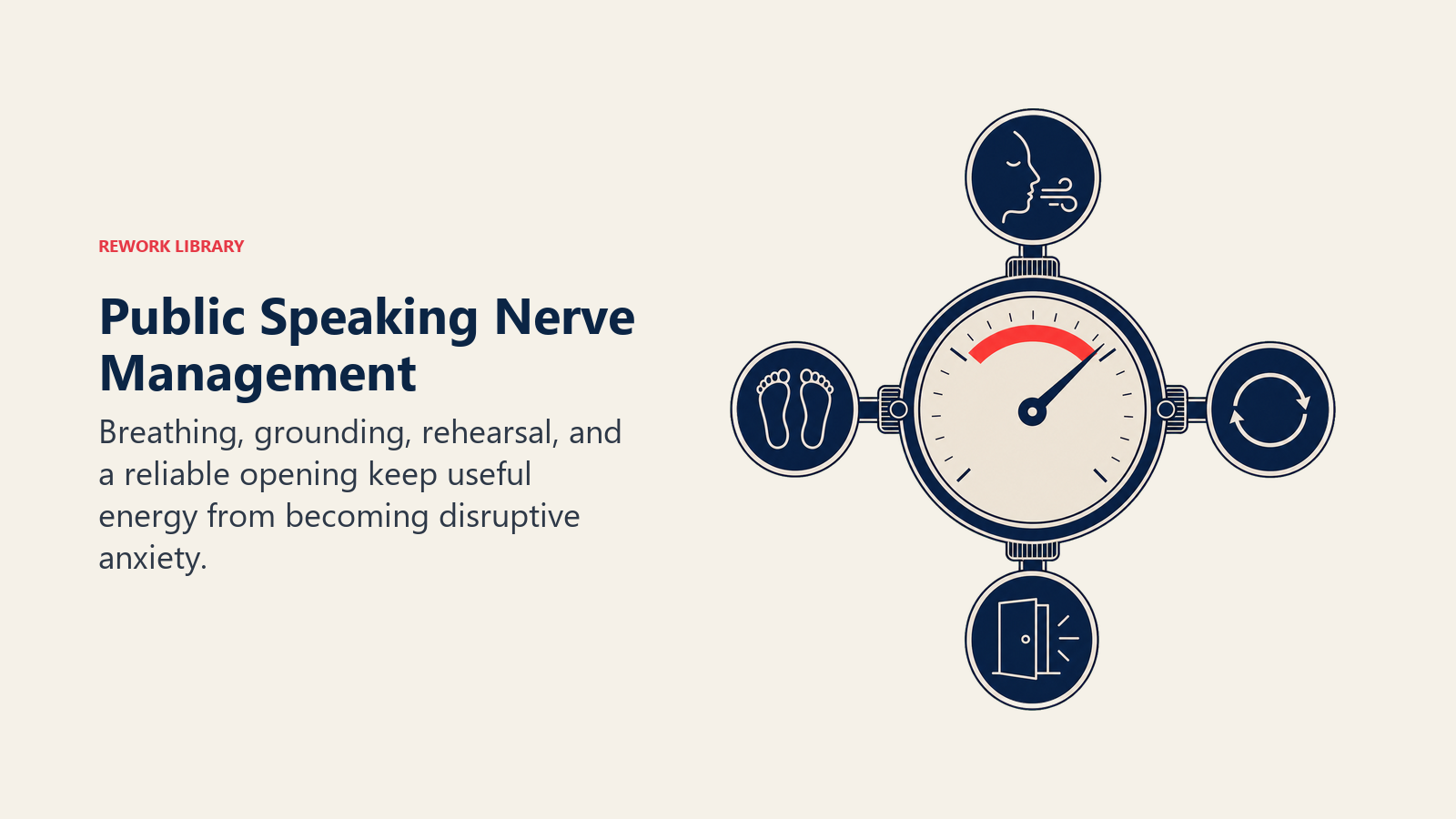
| Technique | How It Works | When to Use It |
|---|---|---|
| Diaphragmatic breathing | Slow breathing (4 counts in, hold 2, 4 counts out) activates the parasympathetic nervous system, which counteracts the stress response. | 2-5 minutes before going on. In a restroom or quiet corner. |
| Over-preparation on the opening | Memorize the first 90 seconds cold. The beginning is when anxiety peaks. Once you're past it, momentum carries you. | During rehearsal, days before the event. |
| Power posing | Open, expansive body positions (standing tall, arms wide) can shift your psychological state toward confidence, per research by Amy Cuddy (though replications are mixed, many speakers find it useful). | 2 minutes before presenting, in private. |
| The reframe | Label the adrenaline as excitement rather than fear. "I'm excited" outperforms "I'm calm" as a self-talk strategy, per research from Harvard Business School. | In the moment, right before delivery. |
| Purposeful pausing | Silence feels much longer to the speaker than to the audience. Deliberate pauses signal confidence and let both you and the audience process what was said. | During delivery, especially after key points. |
| Anchoring to preparation | Remind yourself: "I know this material. I've rehearsed this. I can answer questions because I understand it, not because I memorized a script." | In the minutes before presenting. |
| Audience connection | Find a few friendly faces in the room early and make natural eye contact with them. It converts a sea of judgment into a conversation with people. | First 60 seconds of delivery. |
Emotional intelligence is the deeper skill underneath several of these techniques. The ability to recognize your own emotional state and regulate it under pressure is what separates speakers who fall apart under nerves from those who use them well.
Public Speaking Examples at Work
Strong public speaking looks different depending on the context. The core skill is the same; the application varies.
| Scenario | What Strong Public Speaking Looks Like |
|---|---|
| Team meeting | Concise, structured. Gets to the point without meandering. Invites input deliberately rather than dominating. Leaves clear actions. |
| Executive or board presentation | Leads with the recommendation, not the background. Uses data selectively. Handles hard questions without deflection or defensiveness. |
| Client or sales pitch | Opens with the client's problem before mentioning the product. Responds to objections by acknowledging them fully before reframing. Closes with a clear ask. |
| All-hands or town hall | Sets the tone for the room. Speaks with enough energy to carry a large space. Handles sensitive questions with transparency and without being evasive. |
| Conference or external talk | Opens with a provocation or story that earns attention in the first 30 seconds. Builds to a single clear takeaway. Doesn't read from slides. |
| Job interview presentation | Shows evidence rather than making claims. Invites questions as opportunities to demonstrate depth rather than threats. Ends with a clear synthesis of why the work matters. |
Best Practices: Dos and Don'ts
Do:
- Know your opening cold. The first 90 seconds set the room's confidence in you.
- Make eye contact across the whole room, not just with friendly faces.
- Use pauses intentionally. Silence signals thinking, not weakness.
- Prepare for the hardest three questions someone could ask.
- End with a clear call to action or a single memorable statement.
- Rehearse out loud, timed, at full volume, at least twice.
Don't:
- Start with an apology or disclaimer about your nerves or the quality of your deck.
- Read from your slides. If everything you're saying is on the slide, why are you there?
- Try to cover everything. Cut at least a third of what you planned, and go deeper on fewer points.
- Ignore the room. If you lose the audience's attention, the content doesn't matter.
- End with "so yeah, that's it." The closing moment is when the audience decides what they'll do next.
- Assume more practice on bad content will fix it. Fix the structure first.
Self-awareness is the meta-skill underneath most of these. Speakers who don't know how they come across can't fix what's not working. Seek feedback, watch recordings, and stay curious about the gap between your intent and your impact.
Where to Go From Here
Public speaking is a compounding skill. Each time you stand up in front of a group, you're making a deposit that pays back over an entire career. Pick the next opportunity to speak, however small, and apply one thing from this article: a stronger opening, a rehearsed run-out-loud, one deliberate pause.
For the broader communication stack, presentation skills sharpens content structure, active listening makes Q&A sharper, emotional intelligence helps you read the room, and self-awareness surfaces blind spots in how you come across. Persuasion skills and networking skills build naturally on a foundation of confident public communication, and self-confidence is the competency sitting underneath all of it.
The ability to speak well isn't a gift. It's a decision to keep practicing until the discomfort is smaller than the opportunity.

Senior Customer Retention Strategist
On this page
- What Are Public Speaking Skills?
- Why Public Speaking Skills Matter
- Public Speaking vs Presentation Skills
- Common Causes of Speaking Anxiety
- How to Improve Your Public Speaking
- Step 1: Start with a concrete goal, not a vague resolve
- Step 2: Record yourself and watch it back
- Step 3: Build content clarity before delivery
- Step 4: Rehearse out loud, in real conditions
- Step 5: Get low-stakes repetitions
- Step 6: Debrief after each presentation
- Techniques to Manage Nerves
- Public Speaking Examples at Work
- Best Practices: Dos and Don'ts
- Where to Go From Here