Ownership Mindset: How to Build It in Your Team
Turn this article into takeaways for your work.


Each assistant summarizes the article only for you and suggests best practices for your work.
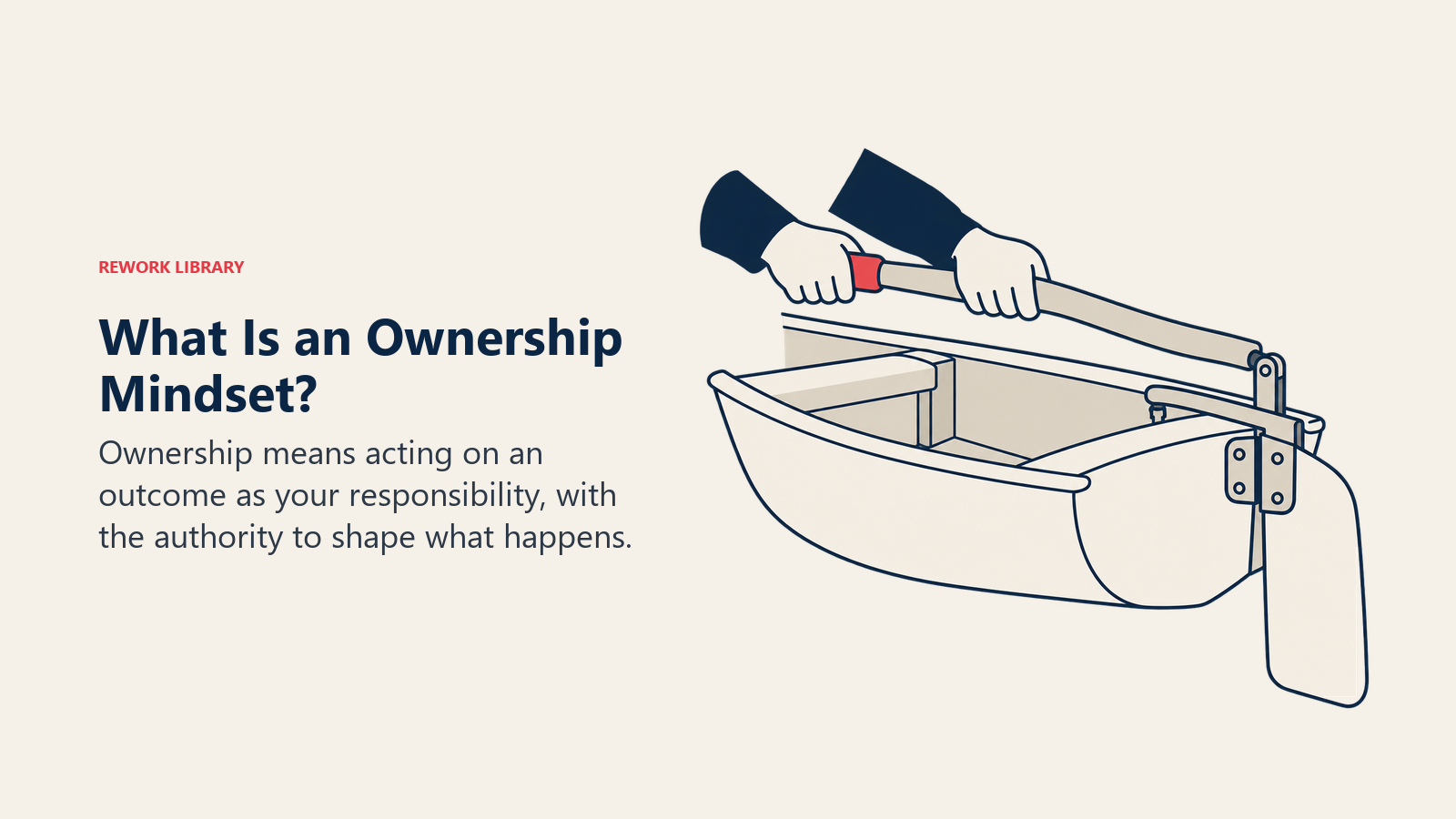
An ownership mindset is what you get when someone treats a problem as theirs to solve, not someone else's to escalate. They notice the gap before you point it out. They fix what's broken without waiting for a meeting to approve it. And when the outcome is bad, they say so before you ask.
Most managers want more of this and get less of it every quarter. Here's the part most "ownership culture" advice skips: telling someone to own something you've never let them decide isn't asking for ownership. It's asking them to carry the blame that comes with none of the authority.
Key Facts
Key Facts: Ownership Mindset
- Global employee engagement fell to 20% in 2025, its lowest level in years, per Gallup's State of the Global Workplace 2026 report.
- Manager engagement dropped to 22% in 2025, down nine points from 31% in 2022, per the same Gallup report.
- Gallup estimates the cost of low engagement at $10 trillion a year, or 9% of global GDP.
- Gallup's manager research found that managers account for at least 70% of the variance in team engagement scores, based on data from more than 2.5 million work units.
- Bain & Company's research behind the RAPID decision framework found that only about 15% of companies practice effective decision making, the structural gap behind most "ownership culture" pushes that go nowhere.
What is an ownership mindset?
An ownership mindset is the tendency to act on a problem as if the outcome were personally yours, even when nobody assigned it to you and nobody is watching. Organizational psychologists call the underlying feeling psychological ownership: a sense that a task, a project, or a team is "mine," distinct from actually owning it on paper. Jon Pierce, Tatiana Kostova, and Kurt Dirks, who built the foundational theory of psychological ownership in organizations, found it develops through three routes: control (the more a person can shape something, the more it feels like theirs), intimate knowledge (deep familiarity fuses identity with what someone knows well), and self-investment (pouring time and effort into something makes people see themselves in it).
That framework tells you exactly what to change if you want more ownership on your team: give people more control, more context, and more skin in the outcome. A poster in the break room won't do it.
Ownership mindset gets confused with a few other things constantly, and the mix-up costs teams real clarity.
Ownership is not accountability. Accountability is who answers for the result, after the fact. Ownership is who decided to act, and how much they cared, before and during. Psychological safety researcher Amy Edmondson collapses the two on purpose, defining accountability itself as a form of psychological ownership: an internal commitment rather than fear of punishment. You can build accountability systems (deadlines, dashboards, check-ins) with no real ownership underneath them, and people will hit the metric while never caring about the outcome.
Ownership is not reliability. A reliable employee does what they said they'd do, on time, every time. Reliability keeps commitments you were given; ownership notices commitments nobody gave you yet and acts on them anyway. You can be completely reliable and completely passive: doing your assigned tasks well while a problem one desk over never gets your attention, because it isn't technically yours.
Ownership is not working longer hours. A work ethic built on pure effort produces busy people who execute the wrong thing carefully. Ownership adds what work ethic doesn't: the judgment to decide what's worth doing, and the willingness to be the one who decided it.
| Trait | What it answers | When it shows up | Failure mode without it |
|---|---|---|---|
| Ownership mindset | "Whose problem is this?" | Before anyone assigns it | Problems sit unclaimed until they get expensive |
| Accountability | "Who answers for the result?" | After the outcome is known | People hit the metric, not the goal |
| Work ethic | "How hard did they try?" | During execution | Effort goes into the wrong priority |
| Reliability | "Did they do what they said?" | On assigned commitments | Nothing outside the job description gets noticed |
What an ownership mindset actually looks like
Ownership is easy to praise in a review and hard to define in a hallway conversation. Here's the gap between talk that sounds like ownership and behavior that actually is it.
| Sounds like ownership | Actually is ownership |
|---|---|
| "That's not my area, but someone should look at it." | Flags the gap, names an owner, and follows up until it's assigned |
| Says "we" for wins, "the team" for misses | Says "I decided X, and it didn't work" without being asked |
| Volunteers for visible, low-risk projects | Takes on the unglamorous fix nobody's watching |
| Escalates a call to avoid being wrong | Makes the decision, documents the reasoning, owns the outcome either way |
| Waits for the retro to mention the miss | Raises the miss in the moment, before it compounds |
| Puts in long hours on assigned tasks | Redefines the task when the original ask stops making sense |
The common thread: people with an ownership mindset treat initiative and problem-solving as defaults, not exceptions that need permission first, and they orient toward the outcome, not the activity. A results-orientation without ownership produces someone who hits their numbers through whatever process they were handed. Ownership adds the judgment to change the process when the numbers say it's wrong.
Why teams don't have an ownership mindset (it's rarely attitude)
When leaders complain a team "lacks ownership," the diagnosis usually points at the wrong layer. Attitude is the symptom; the causes are structural, and they're fixable because you built them.
| Structural cause | What it looks like day to day | What actually fixes it |
|---|---|---|
| No real decision rights | "Ask before you do anything outside your lane" is the unwritten rule | Name who decides what, in writing, at each level |
| Outcomes are vague, tasks are precise | People get a checklist, not a target they can weigh tradeoffs against | Replace the task list with a defined outcome and let people choose the path |
| Blame flows down, credit flows up | The person closest to a miss gets the write-up; leadership gets the win in the all-hands | Leaders publicly own team misses and name individual wins |
| Mistakes get punished, not reviewed | The first bad call ends the experiments; people stop volunteering ideas | Run blameless reviews that separate the decision from the outcome |
| No slack in the calendar | Every hour is booked to assigned work, none to the unassigned problem nobody's tracking | Protect time that isn't allocated to a ticket |
Every one of those causes points at the same root: people are asked to feel responsible for outcomes they don't control. That's an authority problem wearing an ownership costume. Fix the causes above and the mindset tends to show up on its own.
The autonomy prerequisite: no decision rights, no ownership
This is the part most ownership initiatives skip, and it's the one that actually moves the needle.
Self-determination theory, the decades of research from psychologists Edward Deci and Richard Ryan, treats autonomy as one of three basic psychological needs, alongside competence and relatedness, that shape whether motivation is genuine or just compliant. Autonomy-supportive conditions produce the most volitional, high-quality motivation, including better performance, persistence, and creativity. Controlling conditions, where every decision routes through a manager regardless of the person's own judgment, tend to produce the opposite: compliance instead of commitment.
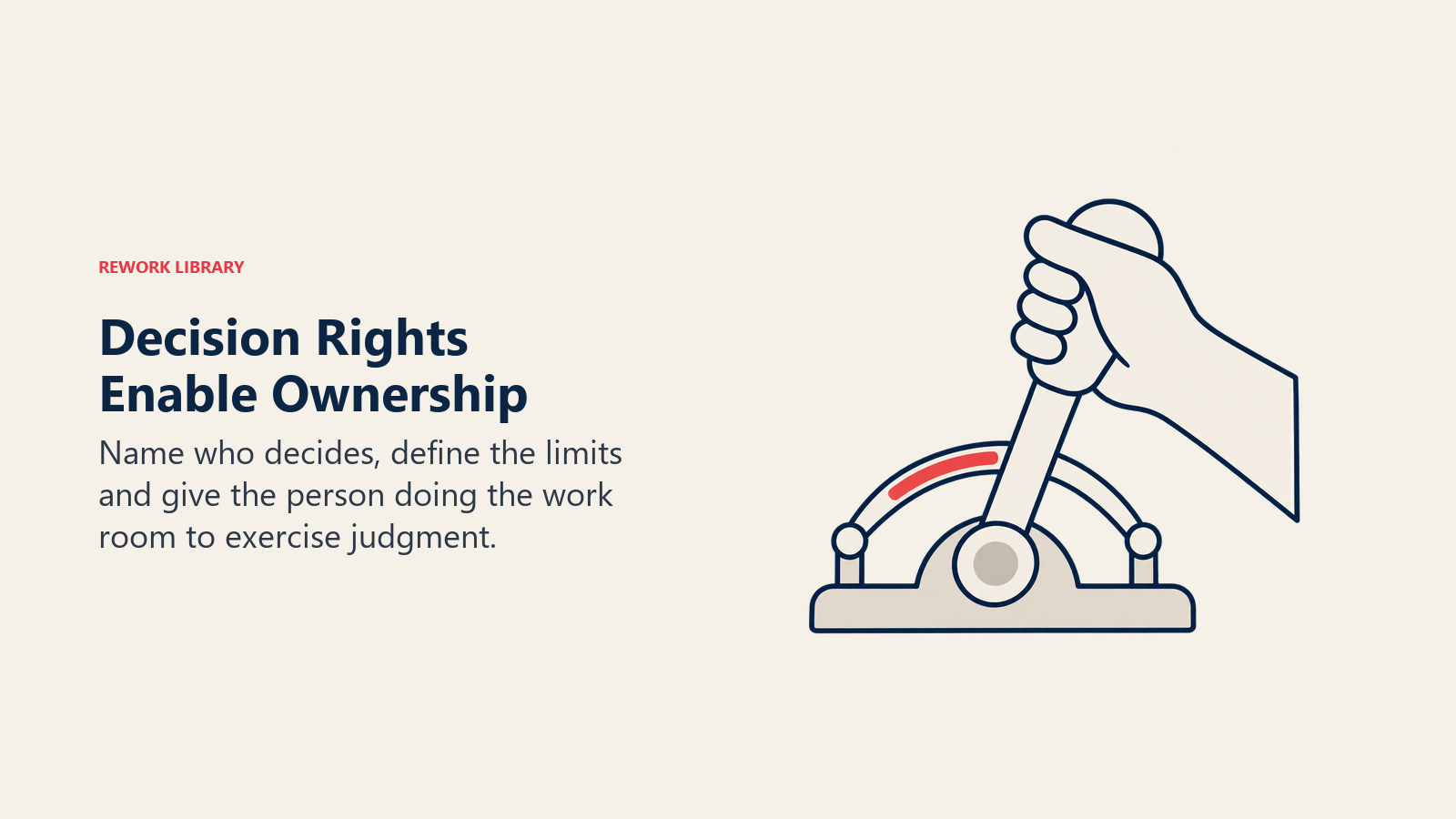
In practice, an ownership mindset has a hard prerequisite: decision rights. If someone can't decide anything, calling their job "ownership" just relabels an obligation as an opportunity. Bain & Company's research behind the RAPID framework, its tool for assigning decision roles, found that only about 15% of companies practice effective decision making. Most organizations haven't decided who decides.
Use a decision-rights framework, not a vibe
RAPID assigns five roles to any decision: who Recommends a course of action, who has veto rights to Agree, who will Perform the work, who provides Input without a veto, and who actually Decides. Writing the roles down forces a question most teams never ask out loud: does this person get to decide, or will they just be blamed for a decision someone else made?
Run this on the five or six decisions your team makes most often. You'll usually find one of two problems: nobody holds the Decide role, so everything escalates and nobody develops judgment, or the person who should Decide is stuck providing Input to someone two levels up with neither the context nor the time to decide well.
Decision-making as a skill can't develop in people who never get to exercise it. You build judgment by using it, including the times it's wrong.
| Decision | Who typically has it today | Who should Decide, if you want ownership here |
|---|---|---|
| Which tool or method to use inside a project | Manager, by habit rather than necessity | The person doing the work |
| How to resolve a routine customer issue | Escalated to a supervisor | The frontline owner, within a defined range |
| Whether to change a recurring process | Nobody; it just persists as-is | Whoever runs the process most often |
| Spending under a set threshold | Requires sign-off regardless of amount | The budget owner, up to a stated limit |
| How to prioritize within an assigned project | Reassigned weekly in status meetings | The project owner, against a stated goal |
How to build an ownership mindset in your team
1. Give people outcomes, not task lists
Goal-setting that specifies a target and a deadline, then stops there, does more for ownership than any task list. A checklist tells someone what to do. A goal tells them what has to be true when they're done and leaves the how up to their judgment. That gap is exactly where an ownership mindset lives or dies.
2. Delegate the decision, not just the task
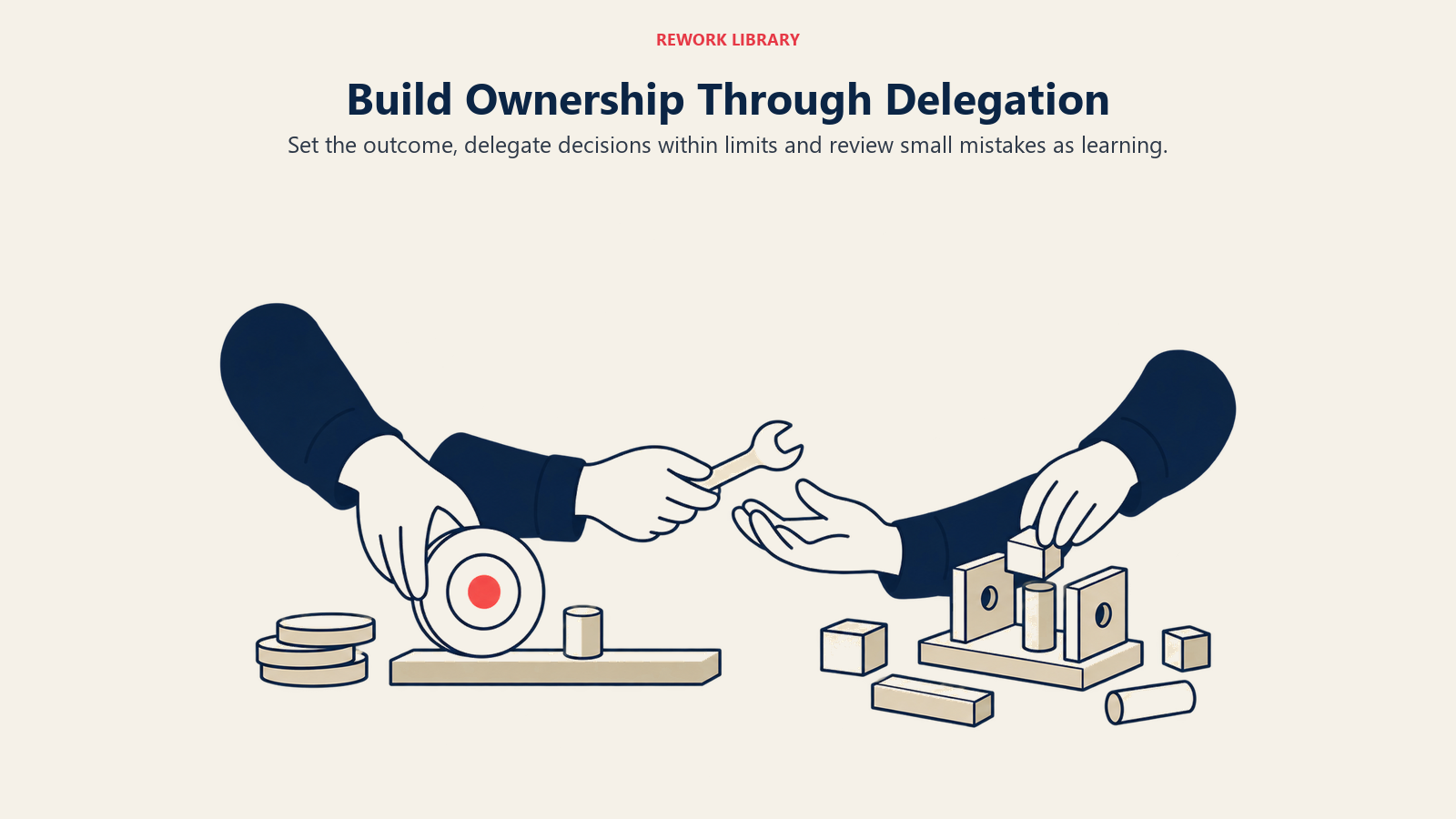
Delegation that hands off the work but keeps the decision is the most common way leaders sabotage the ownership they say they want. If you're still making the call, you've delegated labor, not ownership. Hand off the decision inside a range you're comfortable with, and say so: "you decide, keep me posted" beats "do this, check with me first."
3. Change how blame and credit move through the room
Own your team's misses publicly, in front of your own boss. Name individual wins publicly, in front of your team. Do it consistently enough that people stop calculating the political cost of taking a risk.
4. Let people make small, reversible mistakes
Ownership grows by exercising judgment and living with the result, including when it's wrong. Draw a clear line between decisions with a small blast radius (let people make these and learn) and decisions with a large one (keep tighter control, and explain why). Most managers draw that line more conservatively than the actual risk requires.
5. Explain the why, not just the what
People act like owners on problems they understand, and like employees on problems they were just handed. Fifteen minutes explaining why a target matters buys more ownership than a week of monitoring whether they hit it.
6. Ask before you decide for them
When someone brings you a problem, resist answering it. Ask what they'd do first. Half the time their answer is right and you just needed to say "go." The rest of the time, you've turned a decision you'd have made alone into one they helped make, which is where ownership starts.
How to hire and interview for ownership mindset
Ownership is hard to fake in an interview, because the tell isn't what candidates say they'd do. It's whether they can describe a time they actually did it, unasked.
| What to ask | What you're listening for | Red flag |
|---|---|---|
| "Tell me about a problem you fixed that wasn't your job." | A specific, unprompted example with a real outcome | Only examples of assigned work done well |
| "Tell me about a decision you made that turned out wrong." | Owns the call, explains the reasoning, states what changed after | Blames the process, the data, or someone else |
| "What did you do the last time a project you weren't leading fell behind?" | Names the gap and what they did about it, even in a small way | "Not my project" or a vague answer about raising it in a meeting |
| "How do you decide when to escalate versus decide it yourself?" | A real, thought-out line, not "always escalate" or "never escalate" | No line at all, just pure instinct with no framework |
| "Describe a time you disagreed with your manager's decision." | Made the case directly, then supported the call either way | Complied silently or undermined it after the fact |
Look for self-motivation and coachability alongside ownership signals, not instead of them. A candidate who takes initiative but can't take feedback will make confident, unreviewed mistakes. One who takes feedback well but never acts without direction won't own anything until you tell them to.
How to reinforce ownership without creating hero culture or burnout
Ownership mindset has a failure mode of its own, and it tends to show up right after you succeed at building it: a handful of people absorb every unowned problem because nobody else will, and quietly burn out carrying work that was never formally theirs.
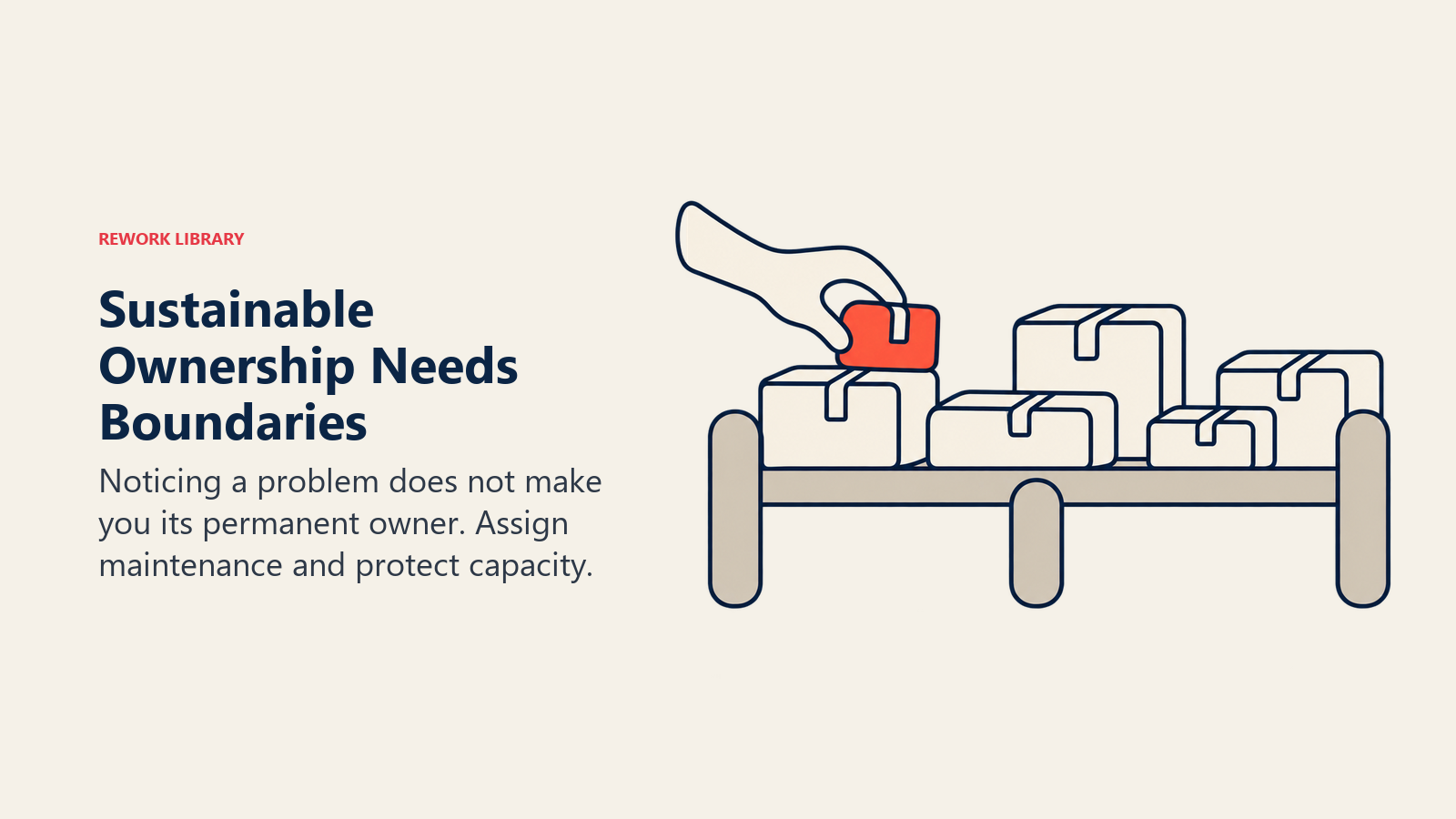
Guard against it with three habits.
Name owners explicitly once a problem is real. The person who first noticed a gap doesn't automatically have to own fixing it forever. Ownership at the moment of noticing is different from ownership of long-term maintenance. Assign the second one on purpose instead of letting it default to whoever spoke up first.
Reward the catch, not just the fix. If only the people who personally solve every problem get recognized, you're training your best people into single points of failure. Treat flagging a problem and routing it to the right owner as equally valuable to fixing it yourself.
Protect a floor, not just a ceiling. Professional ethics around sustainable workloads matters here: a culture that quietly expects unpaid overtime from its most engaged people will burn through them within a year. A growth mindset toward mistakes, treating a wrong call as information rather than a verdict on someone's character, keeps the system sustainable, because people stop needing to be heroic to avoid being blamed.
How to measure ownership mindset
Ownership resists a clean metric, but a few proxies show whether it's growing or shrinking on your team.
| Proxy metric | What it tells you |
|---|---|
| Ratio of problems raised by the team vs. by you | A rising ratio means people are noticing gaps before you do |
| Percentage of decisions made without escalation, within a stated range | Shows whether decision rights are real or just theoretical |
| How often people volunteer for unassigned or unglamorous work | Signals whether ownership extends past visible, career-safe tasks |
| Time between a miss happening and someone naming it out loud | A shrinking gap means people are catching and owning problems earlier |
| Whether people give feedback upward unprompted | Unsolicited upward feedback is one of the clearest ownership signals there is |
Frequently Asked Questions about Ownership Mindset
What is an ownership mindset in the workplace?
An ownership mindset is the tendency to treat a problem or outcome as personally yours, even when nobody assigned it and nobody is watching. It shows up as noticing gaps early, deciding instead of escalating, and owning both the credit and the consequences of a call. Researchers call the underlying feeling psychological ownership, built through control, deep familiarity, and personal investment.
What's the difference between ownership mindset and accountability?
Accountability is what happens after the fact: who answers for a result. Ownership mindset is what happens before and during: who decided to act, and how much they cared about getting it right. You can build accountability systems like deadlines and dashboards with no real ownership underneath them, which produces people who hit the metric without caring about the outcome.
Can you actually teach someone to have an ownership mindset?
Yes, but not through a values statement. Give people real decision rights inside a defined range, replace task lists with outcomes, change how blame and credit move through the team, and let them make small, reversible mistakes without punishment. Ownership grows through repeated, safe practice, not through being told to care more.
Why do some hard-working employees still seem to lack ownership?
Usually because ownership and work ethic are different traits. Someone can work long hours and still wait for permission on anything outside their assigned task list. If every decision above a small threshold has to be escalated, the structure is teaching people to wait, no matter how hard they're willing to work.
How do you measure ownership mindset on a team?
Track proxies rather than a single score: the ratio of problems the team raises versus the ones you catch first, the share of decisions made without escalation inside a stated range, how often people volunteer for unglamorous work, and whether people give you feedback upward without being asked.
Learn More
- Accountability: how it differs from ownership
- Delegation: handing off the decision, not just the task
- Decision-Making: the judgment ownership depends on
- Initiative: the bias to act that ownership requires
An ownership mindset isn't something you inspire with a speech. It's something you build, decision by decision, by handing people real authority over outcomes that matter and then getting out of the way. Ask for more ownership than you fund with actual autonomy, and you'll get exactly what you paid for: people who say the right things in the all-hands and quietly wait to be told what to do.

Senior Customer Retention Strategist
On this page
- Key Facts
- What is an ownership mindset?
- What an ownership mindset actually looks like
- Why teams don't have an ownership mindset (it's rarely attitude)
- The autonomy prerequisite: no decision rights, no ownership
- Use a decision-rights framework, not a vibe
- How to build an ownership mindset in your team
- 1. Give people outcomes, not task lists
- 2. Delegate the decision, not just the task
- 3. Change how blame and credit move through the room
- 4. Let people make small, reversible mistakes
- 5. Explain the why, not just the what
- 6. Ask before you decide for them
- How to hire and interview for ownership mindset
- How to reinforce ownership without creating hero culture or burnout
- How to measure ownership mindset
- Learn More