Delegation Skills: How to Delegate Effectively
Turn this article into takeaways for your work.


Each assistant summarizes the article only for you and suggests best practices for your work.
Delegation skills are the difference between a manager who scales and one who becomes the bottleneck. Most professionals know they should delegate more, but few have a clear model for how much authority to hand over, to whom, and when.
What is delegation?
Delegation is the process of assigning a task, decision, or area of responsibility to someone else while retaining accountability for the outcome. It is not the same as dumping work on a report, which is assigning tasks without context or support. And it is not abdication, which is handing over responsibility entirely and walking away. Effective delegation sits between those extremes: the manager transfers authority at the right level, provides what the person needs to succeed, and stays available without hovering.
Key Facts
- A Gallup study found that CEOs who delegate well generate 33% more revenue than those who do not (Gallup, 2015).
- Managers report spending 20-30% of their week on tasks they could have delegated, per a Harvard Business Review survey (HBR, 2022).
- The 7-level delegation model is rooted in the Tannenbaum-Schmidt continuum (1958) and popularized for modern teams by Jurgen Appelo's Management 3.0 (Appelo, 2010).
Why delegation matters as a competency
Delegation is not just a time management tactic. It is a core leadership competency that affects how far a team can scale, how fast people develop, and how well a manager performs as their scope grows.
Career impact. Managers who cannot delegate create a ceiling on their own career. A director who still runs every execution decision cannot focus on the cross-functional alignment and strategic thinking that promotion to VP requires.
Team scaling. A team that depends on the manager for every decision does not grow its own judgment. When the manager is unavailable, on leave, or promoted, the team stalls. Delegation, done well, builds accountability and initiative across the team rather than concentrating them at the top.
Manager bandwidth. The HBR statistic above is striking. If a manager is spending 25% of a 40-hour week on delegatable tasks, that is 500 hours a year they could redirect to hiring, strategy, coaching, and cross-functional relationships. That is not a marginal gain.
Burnout. Managers who do not delegate are among the highest-risk groups for burnout. They carry the cognitive load of their own role plus the execution load that should sit with their team. The burden compounds as the team grows.
The 7 levels of delegation
The most useful model for practicing delegation comes from the intersection of two frameworks: the Tannenbaum-Schmidt Leadership Continuum (1958), which mapped manager authority against subordinate freedom, and Jurgen Appelo's Delegation Poker from Management 3.0 (2010), which operationalized it into seven practical levels teams can use in daily decisions.
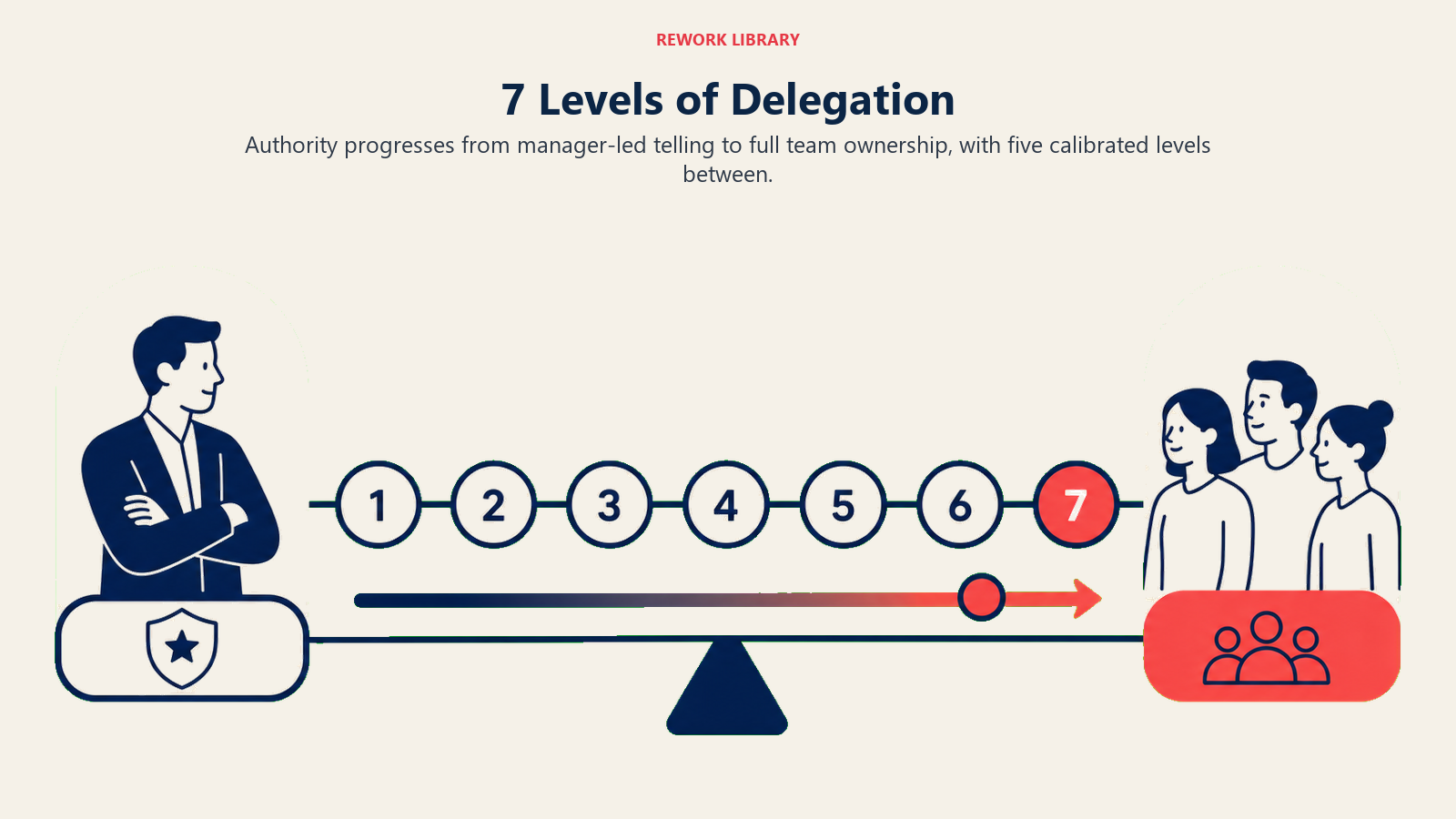
Each level describes how much authority you transfer to the other person.
Level 1: Tell
You decide and announce. The other person executes with no input into the decision. This is appropriate for safety-critical instructions, legal requirements, or situations where context makes consultation impossible (a live incident, for example).
Level 2: Sell
You decide, then explain your reasoning and invite questions. The person still has no decision authority, but they understand the "why." Use this when buy-in matters for execution quality and you have the time to explain.
Level 3: Consult
You gather input before deciding. The person influences the outcome but does not make the call. Good for decisions that benefit from frontline expertise and where the manager retains final accountability for the outcome.
Level 4: Agree
You and the person decide together, by consensus. Neither party has a veto. Use this when both parties have equal skin in the game and the relationship supports joint ownership of the result.
Level 5: Advise
The person decides, but you offer your view before they finalize. Your advice is available and welcome, not mandatory. This level starts real authority transfer. It works well when the person has strong domain knowledge and the stakes allow for some risk.
Level 6: Inquire
The person decides and then informs you afterward. You may ask questions but will not override the decision unless a serious rule is broken. Use this for team members with proven judgment in a specific domain.
Level 7: Delegate
Full authority transferred. The person decides, acts, and reports on outcomes at whatever cadence you have agreed. Your role is to set the context, provide resources, and hold the outcome accountable at review time, not to monitor the path.
Most managers default to Levels 1-3 for nearly everything. The goal of developing delegation skills is to push the right tasks to Levels 5-7 for the right people, freeing the manager and growing the team.
What to delegate and what to keep
Delegate repeatable execution and development opportunities while leaders retain strategy, sensitive decisions, and high-risk commitments.
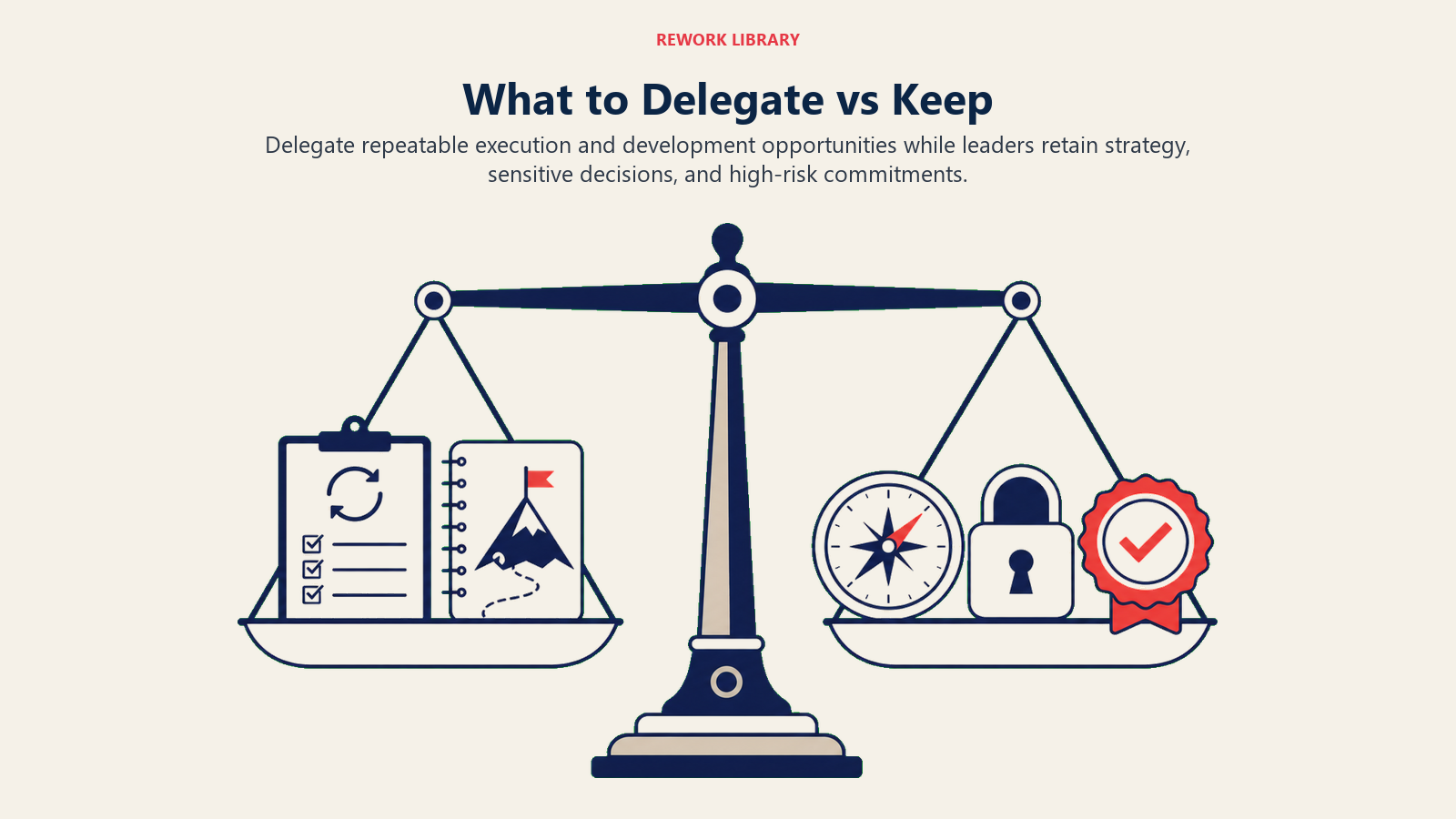
| Delegate | Keep |
|---|---|
| Recurring reporting and data pulls | Company strategy and annual planning |
| Project coordination within defined scope | Sensitive HR decisions (performance plans, terminations) |
| Research and options analysis | Legal sign-off and financial commitments above threshold |
| Tasks that stretch a team member's skills | Confidential executive communications |
| Processes the team member can run at 70%+ quality | Vision and values alignment decisions |
| Meeting facilitation for operational reviews | Accountability conversations for direct reports |
| First drafts of documents, templates, and presentations | Final stakeholder communications on high-stakes deals |
A useful rule: if someone on your team can do this task at 70% or more of your quality, and the cost of the occasional error is recoverable, delegate it. Reserve your own time for decisions where your specific judgment, seniority, or access is genuinely irreplaceable.
Time management and delegation are deeply connected. Doing a weekly audit of your calendar against this table is one of the fastest ways to find delegation opportunities hiding in plain sight.
How to delegate effectively: step by step
Knowing what to delegate is the first half. The second half is doing it in a way that sets the other person up to succeed.
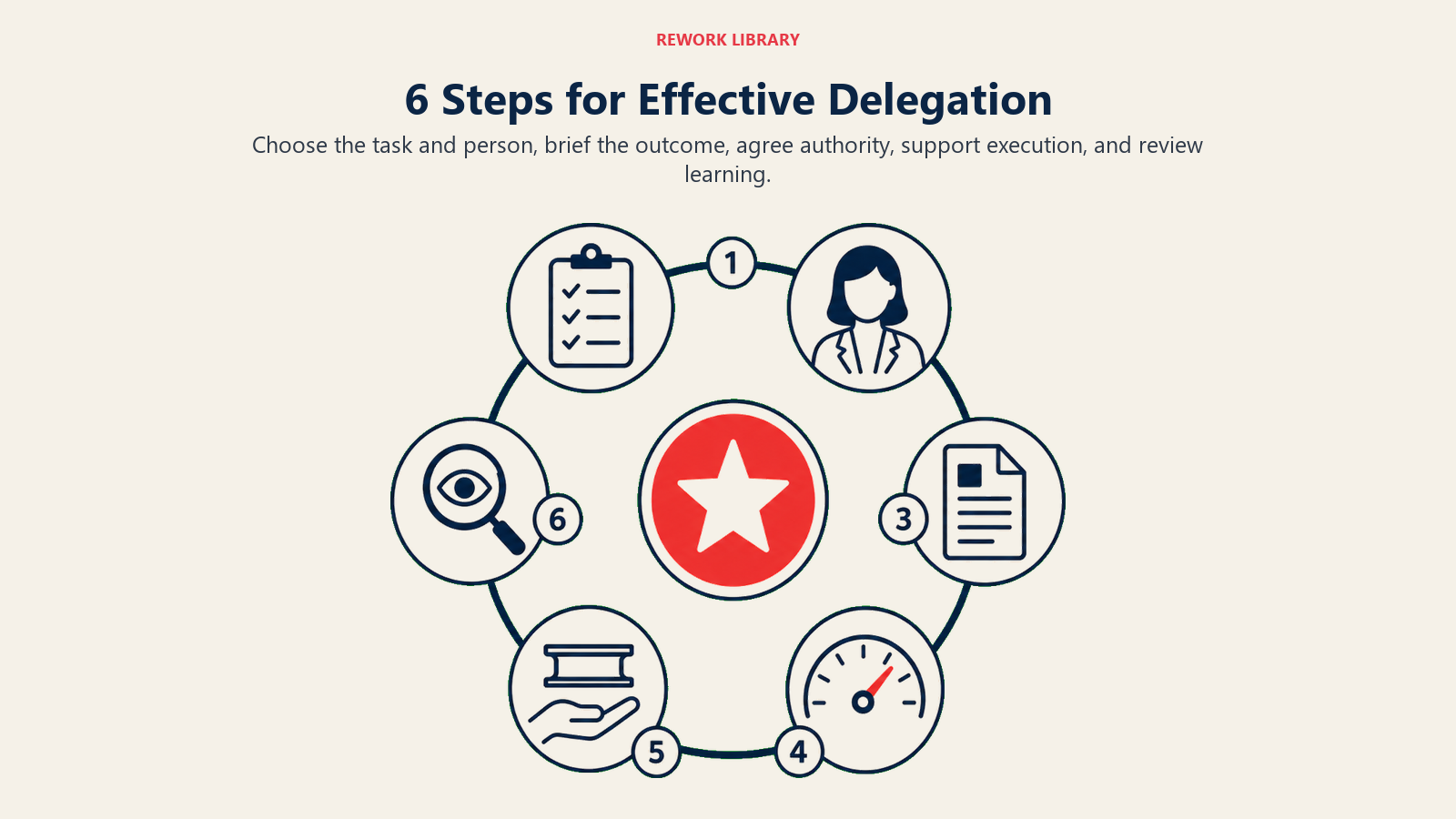
Step 1: Pick the right task
Start with tasks that are clearly defined, repeatable, or within a domain where someone on your team already has context. Avoid delegating a task that is not yet scoped, because handing over ambiguity is not delegation, it is dumping.
Step 2: Pick the right person
Match the task to a person based on current capability plus growth potential. Consider: who has the skills to do this at an acceptable level now? And separately: who would grow significantly from doing this? Both are valid criteria, but the weight you give each depends on the stakes involved.
Step 3: Brief on outcome, not method
Tell the person what success looks like, not how to achieve it. "I need the competitive analysis ready by Thursday, formatted for a board slide, covering these five competitors" is a good brief. Walking them through each source to check and each section to write is micromanagement. Strong communication at this stage sets the entire handoff up correctly.
Step 4: Agree on the level of authority
Use the 7-level model. Explicitly name the level. "I'd like you to own this at Level 5: make the call, but run your recommendation by me before you finalize it" removes ambiguity that kills most delegated projects mid-stream.
Step 5: Set check-in cadence
Agree on when and how you will touch base. This is not about control; it is about surfacing blockers early enough to fix them. A delegated task with no check-in structure often drifts silently until it is too late to course-correct.
Step 6: Debrief
When the task is complete, spend 15 minutes reviewing what went well, what was harder than expected, and what you would both do differently next time. This closes the learning loop and builds the person's confidence and capability for the next delegated task.
Delegation examples by role
| Role | Common tasks to delegate | Common tasks to keep |
|---|---|---|
| Engineering manager | Sprint planning facilitation, code review scheduling, status updates to stakeholders | Architectural decisions with long-term implications, hiring final decisions, performance reviews |
| Marketing director | Campaign execution and reporting, content production, vendor management | Brand positioning, messaging framework, executive presentation sign-off |
| Sales VP | Forecast compilation, deal desk coordination, onboarding new reps | Strategic account relationships, executive escalations, comp plan design |
| HR business partner | Benefits administration questions, onboarding logistics, policy documentation updates | Disciplinary processes, sensitive employee relations cases, org design recommendations |
The pattern across roles: delegate the operational cadence, keep the judgment calls that require context only you carry.
Common delegation mistakes
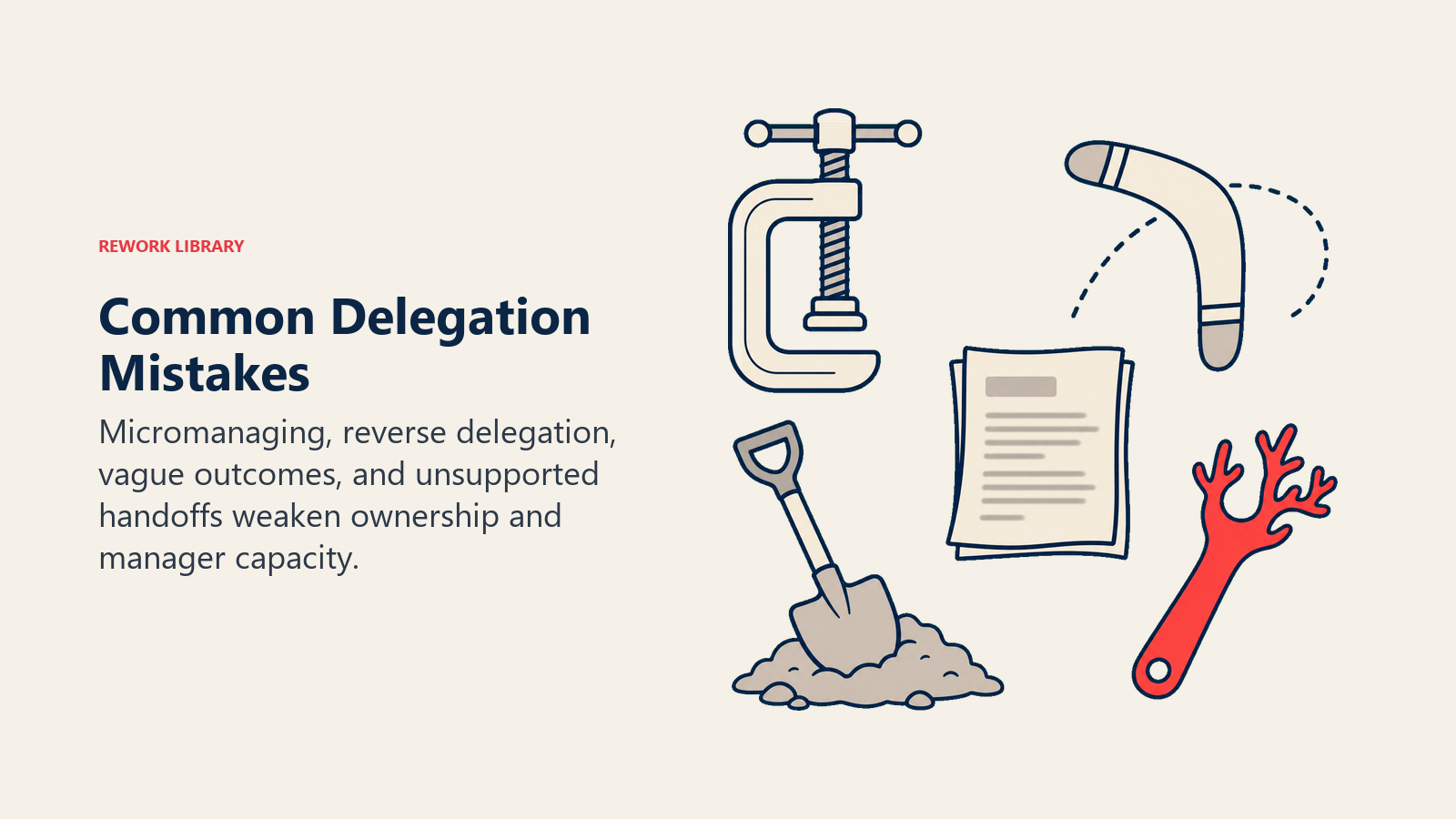
Micromanaging, reverse delegation, vague outcomes, and unsupported handoffs weaken ownership and manager capacity.
| Mistake | What it looks like | Better approach |
|---|---|---|
| Micromanaging | Checking in daily on a Level-6 task, rewriting the person's work before it goes out | Set the level explicitly at the start and stick to the agreed check-in cadence |
| Reverse delegation | Employee brings problem back, manager solves it instead of coaching | Ask "what do you think we should do?" before offering an answer |
| Delegating only grunt work | Reports only get admin tasks, never decisions | Use the task as a development tool; delegate stretch work to the most ready person |
| Abdicating instead of delegating | No brief, no check-in, no debrief; task disappears into the void | Every delegated task needs an agreed outcome, level, and review point |
| Delegating without authority | Person is told to own a decision but has no authority to act on it | Match the authority level you grant to the responsibility you assign |
Reverse delegation is worth a special mention because it is so common. It happens when a manager's default response to "I'm stuck" is to take the problem back. Over time, teams learn that being stuck is a reliable way to offload work back up. Breaking this pattern requires active listening and the discipline to coach instead of solve.
How to develop delegation as a competency
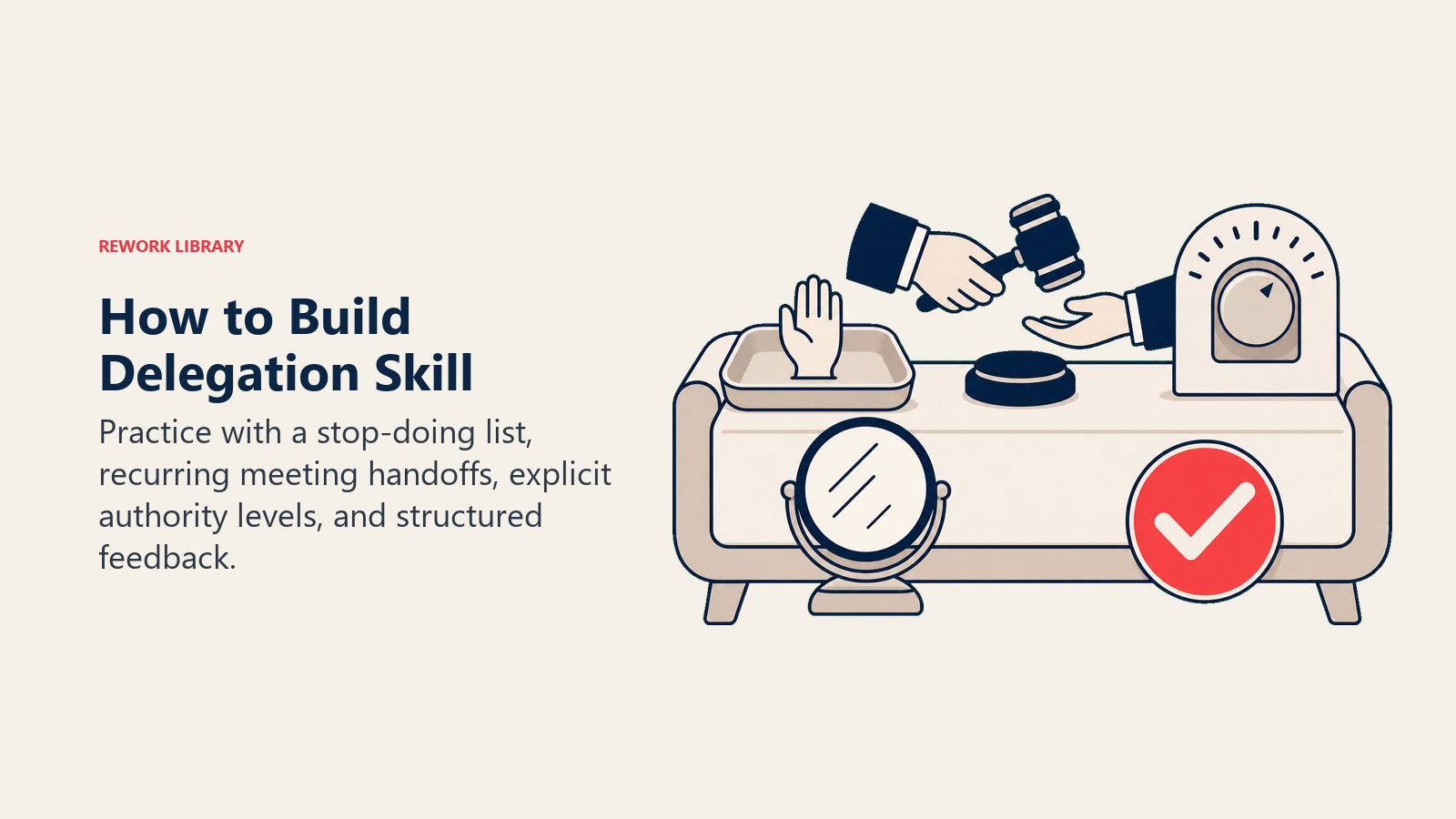
Practice with a stop-doing list, recurring meeting handoffs, explicit authority levels, and structured feedback.
1. Build a "stop doing" list. Each week, write down three things you did that someone else could have handled. The list itself creates awareness. Over four weeks, it reveals patterns in what you are holding onto and why.
2. Hand off one recurring meeting. Pick a meeting you run on autopilot and delegate facilitation to someone on your team. Give them the agenda structure and the context, then sit back. Most managers are surprised how well it goes.
3. Use the 7-level model explicitly. For the next ten tasks you assign, name the level out loud. "I'm delegating this at Level 4" makes the handoff concrete and trains both you and your team to think in terms of authority, not just tasks.
4. Practice the coaching response. When someone brings you a problem, reply with "what options do you see?" before offering your own. Building their problem-solving habit reduces reverse delegation naturally.
5. Track delegation in your 1:1s. Add a standing item: "What have I delegated to you recently, and how is it going?" This normalizes delegation as a two-way conversation rather than a top-down action.
6. Debrief every failed delegation. When a delegated task goes wrong, analyze the system before blaming the person. Was the brief clear? Was the authority level right? Was there a blocker they had no way to surface? The answer usually points to a process fix, not a person problem.
Strong relationship building with your team members makes delegation easier because you have the context to match tasks to people well, and the trust to hand over real authority without anxiety.
Best practices
- Delegate outcomes, not activities. Define what done looks like, not how to get there.
- Delegate to develop, not just to offload. The best delegations stretch the person's capability.
- Document what you delegate. A shared list of who owns what prevents confusion and supports accountability.
- Normalize asking for delegation levels. Encourage your team to ask "what level of authority do I have on this?" before starting.
- Separate the task from your preference for method. If someone completes the task well using a different approach than you would have used, that is success, not a problem.
- Build redundancy. If only one person can do a task because only you know how, delegating it to them also means documenting it so others can learn it too.
- Revisit delegation levels as people grow. A task that was Level 3 six months ago may be ready for Level 6 now.
- Celebrate good decisions made without you. Teams that hear "you handled that well, I didn't need to be involved" build the confidence to take more ownership.

Senior Customer Retention Strategist
On this page
- What is delegation?
- Why delegation matters as a competency
- The 7 levels of delegation
- Level 1: Tell
- Level 2: Sell
- Level 3: Consult
- Level 4: Agree
- Level 5: Advise
- Level 6: Inquire
- Level 7: Delegate
- What to delegate and what to keep
- How to delegate effectively: step by step
- Step 1: Pick the right task
- Step 2: Pick the right person
- Step 3: Brief on outcome, not method
- Step 4: Agree on the level of authority
- Step 5: Set check-in cadence
- Step 6: Debrief
- Delegation examples by role
- Common delegation mistakes
- How to develop delegation as a competency
- Best practices