Facilitation Skills: How to Lead Productive Meetings
Turn this article into takeaways for your work.


Each assistant summarizes the article only for you and suggests best practices for your work.
Facilitation skills determine whether a meeting ends with clear decisions and energized participants or with a room full of people wondering why they were there. They are practical, learnable, and arguably more valuable than almost any other workplace competency for people who lead teams or cross-functional work.
What Are Facilitation Skills?
Facilitation skills are the abilities used to guide a group through a discussion or process so it reaches its goal, productively and inclusively, without the facilitator imposing their own answer. A facilitator's role is process leadership, not content authority. That distinction matters. The facilitator's job is not to be the smartest person in the room; it is to make sure the room's collective intelligence produces a better outcome than any individual could alone.
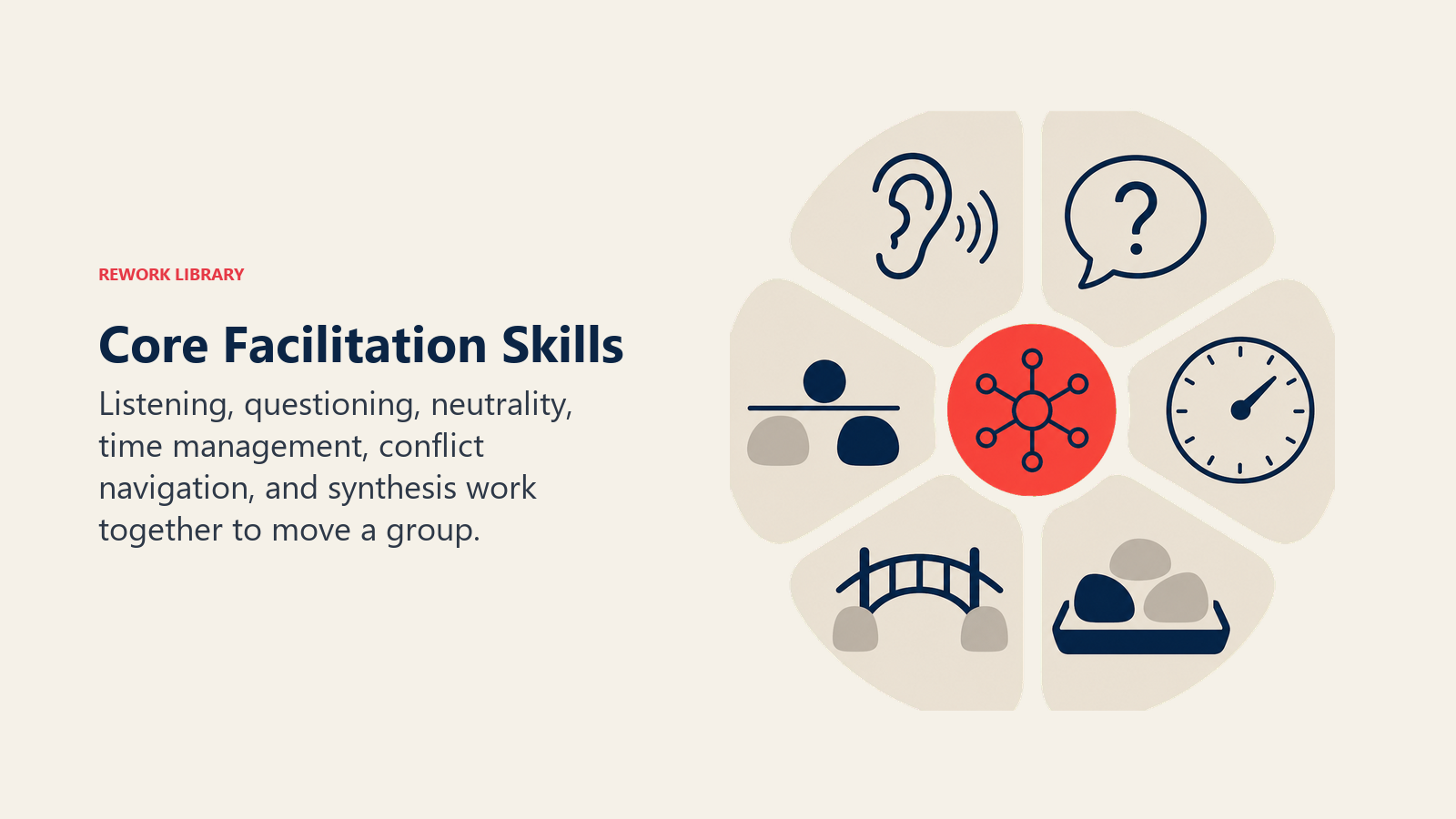
Key facilitation skills include active listening, questioning, neutrality, time management, conflict navigation, and group synthesis. Together, they create the conditions where people contribute, ideas surface, and decisions stick.
Key Facts
- Executives spend an average of 23 hours per week in meetings, and employees rate more than half of those meetings as unproductive. (Microsoft WorkLab, 2022)
- Inclusive meetings, where every participant contributes, produce decisions that teams are 2.2 times more likely to implement successfully. (Cloverpop, 2017)
- Poorly run meetings cost U.S. businesses an estimated $37 billion per year in lost productivity. (Atlassian, 2022)
"A facilitator's job isn't to have the best idea; it's to make sure the best idea gets heard."
Why Facilitation Skills Matter
The cost of unproductive meetings is not just time. It is decision quality, team morale, and organizational trust.
When a meeting has no clear structure, whoever talks loudest tends to set the direction. Quieter voices, often the ones with the most careful thinking, go unheard. The group reaches a conclusion, but half the room mentally disengages because they never got a real say. Those people are less likely to commit to whatever was decided.
Good facilitation changes that dynamic. It ensures everyone in the room has a genuine opportunity to contribute. It keeps discussion on track without silencing dissent. And it drives toward decisions that the group actually owns, which means decisions that get implemented.
Remote and hybrid work has made this even more important. Video calls strip out the social cues that help people know when to speak, when to defer, and when a decision has actually been reached. A facilitator who can read the room on a screen and create structured participation is no longer a nice-to-have; they are a functional necessity.
Strong facilitation also connects directly to broader skills like active listening, communication, and conflict resolution. Those capabilities reinforce each other. A facilitator who listens well notices what isn't being said. One who manages conflict keeps disagreement productive rather than personal.
Core Facilitation Skills
Each of the following skills has a distinct practical expression. They work together rather than in isolation.
| Skill | What it looks like in practice |
|---|---|
| Active listening | Paraphrasing contributions back to the speaker to confirm understanding; noticing when someone's words and body language diverge |
| Questioning | Using open questions to draw out thinking ("What are we missing here?") rather than closed ones that shut down exploration |
| Neutrality | Holding back personal opinions during discussion; separating the role of facilitator from the role of content contributor |
| Time management | Monitoring the agenda clock, calling time on tangents, and protecting time for synthesis and next steps |
| Conflict navigation | Naming disagreement without taking sides; reframing competing views as information rather than opposition |
| Summarizing | Capturing what has been said, reflecting it back, and testing for shared understanding before the group moves forward |
| Reading the room | Picking up on energy shifts, disengagement, or unvoiced tension, and adjusting the approach in real time |
These skills sit at the intersection of interpersonal skills and influencing skills. Influencing without authority is exactly what a facilitator does: shaping the process so the group reaches a stronger outcome than it would have on its own.
How to Facilitate a Productive Meeting
A facilitated meeting follows a repeatable structure. The specific techniques vary depending on the group and the goal, but the underlying sequence is consistent.
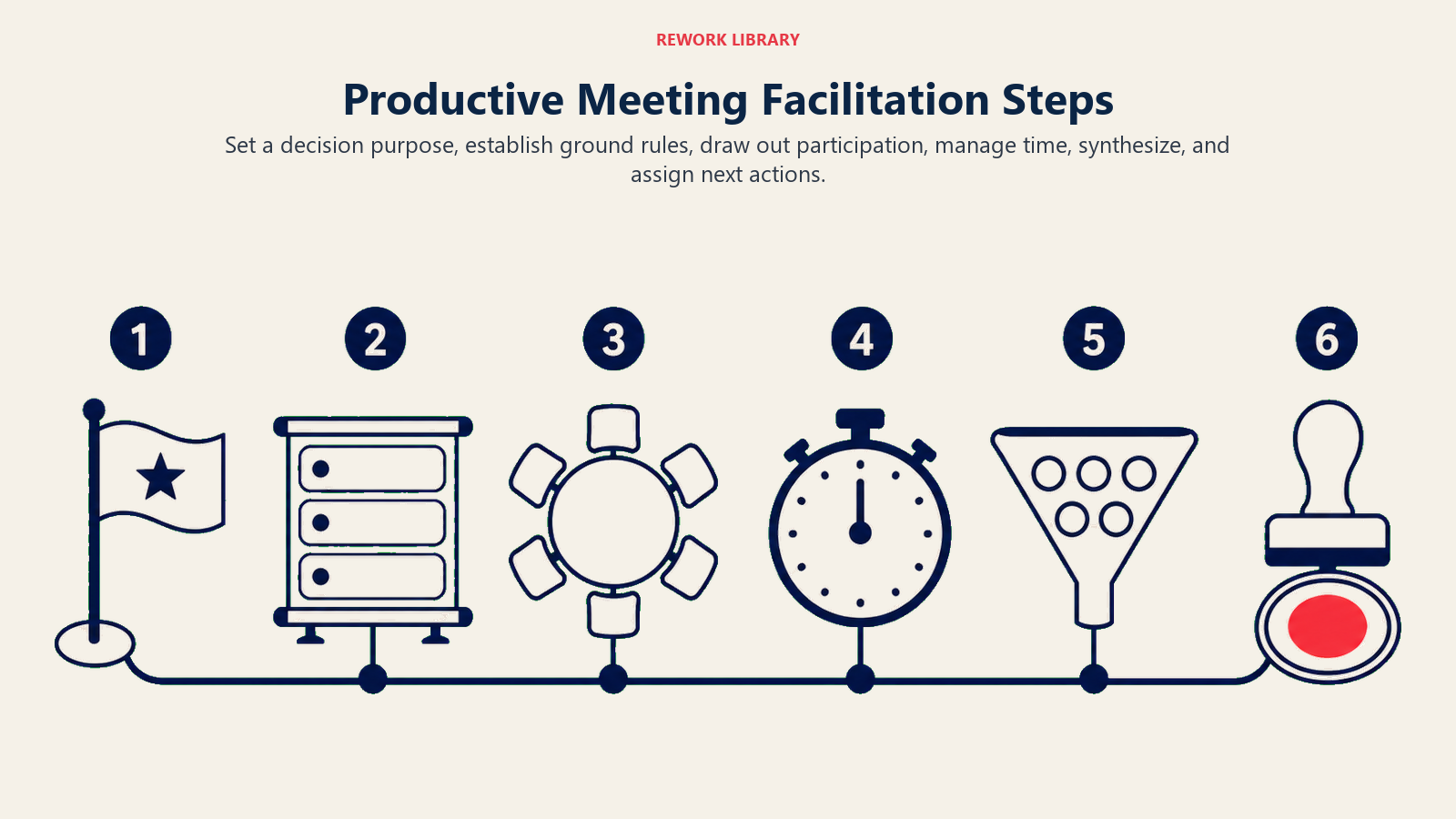
Step 1: Set a Clear Purpose and Agenda
Every meeting needs a single sentence that answers: "What decision or output will this meeting produce?" Not "discuss the product roadmap" but "decide which three features go into Q3." Send the agenda at least 24 hours in advance with estimated time slots per item. When participants know what they are there to accomplish, they show up prepared rather than passive.
Step 2: Establish Ground Rules
At the start, name a short set of working agreements. These can be as simple as "one voice at a time," "phones face down," and "we aim for commitment, not just consensus." Ground rules create shared permission to redirect the conversation when it goes off track. Without them, calling time on someone feels personal; with them, it feels structural.
Step 3: Open and Warm Up
Do not dive into the agenda cold. A one-minute check-in question, a quick show of hands, or even a brief framing of why this meeting matters today helps participants shift from whatever they were doing before into the room. This is not filler; it builds psychological presence.
Step 4: Guide Discussion and Manage Airtime
This is where facilitation earns its keep. Watch for the people who always talk and the people who rarely do. Use tools like round-robin (giving each person a turn) or explicit invitations ("We haven't heard from the operations side yet, what's your read?") to distribute participation. When a discussion loops back on itself, name it: "We've surfaced this concern twice now. Let's park it and decide if it needs its own conversation."
Track time actively. Assign someone to be a timekeeper if the group is large enough that you can't do both.
Step 5: Drive to Decisions and Actions
A meeting that ends with good conversation but no resolution has failed. Before closing any agenda item, confirm: What did we decide? Who owns it? By when? Write those down in real time, visible to the group. Shared visibility on action items during the meeting, not just in a follow-up email afterward, increases accountability significantly.
Step 6: Close and Follow Up
Leave the final three to five minutes for a close. A brief reflection question ("What worked in this meeting? What should we do differently?") builds the group's facilitation culture over time. Send a written summary within 24 hours: decisions made, open questions, action items with owners and deadlines. This turns the meeting into a record, not just a memory.
Facilitation Techniques
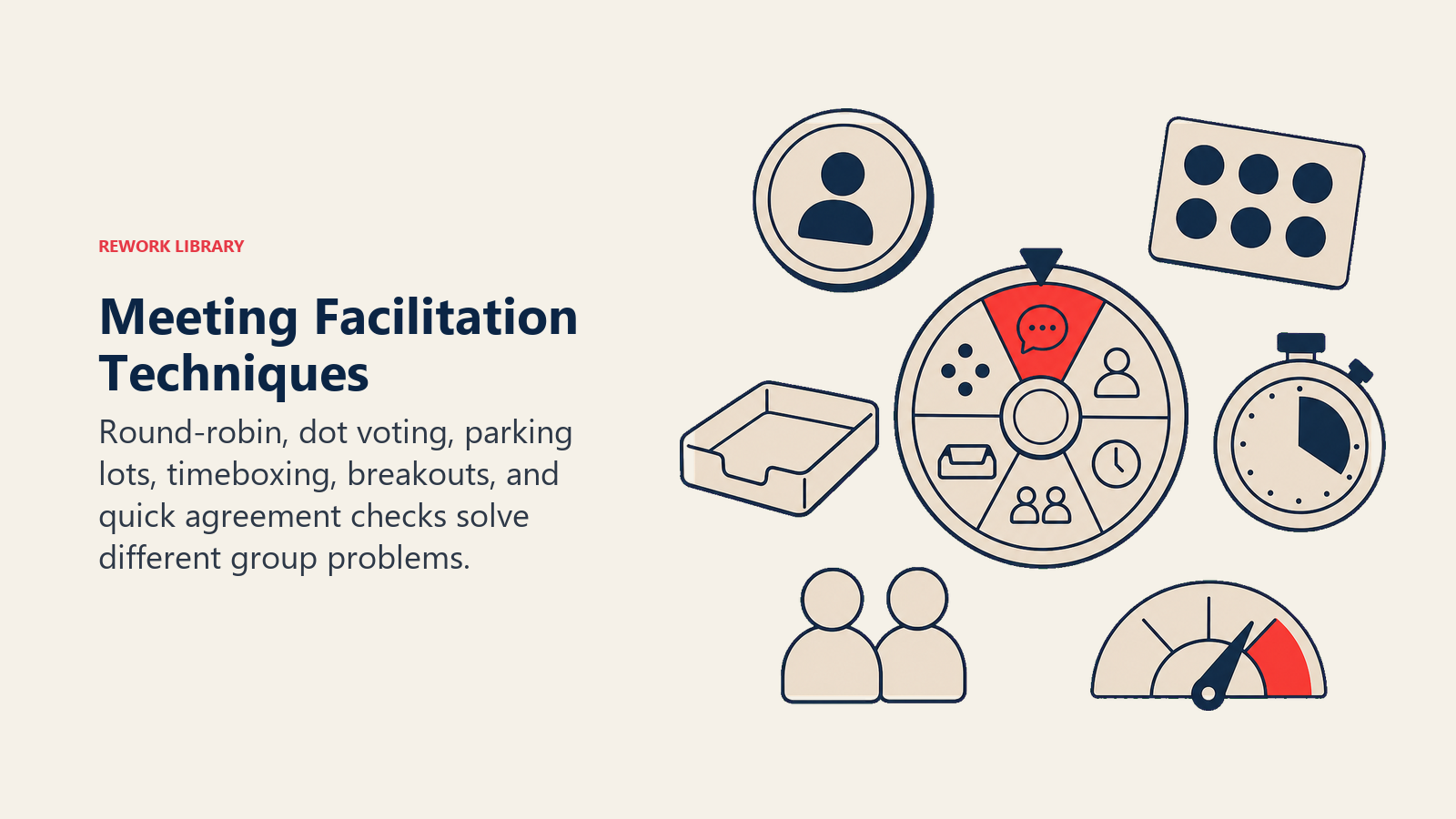
Different situations call for different tools. These techniques are practical and transferable across team sizes and meeting types.
| Technique | When to use it |
|---|---|
| Round-robin | When a small number of voices are dominating and you need balanced input |
| Dot voting | When a group has many options and needs to quickly identify shared priorities |
| Parking lot | When an important but off-agenda topic surfaces; capture it so the group can return to it without losing momentum |
| Timeboxing | When a discussion could run indefinitely; set a visible timer and commit to moving on when it ends |
| Breakout groups | When a topic benefits from parallel small-group work before whole-group synthesis |
| Fist to five | When you need a quick temperature check on agreement (fist = no, five fingers = full support) |
Dot voting and round-robin are particularly useful in remote settings where the usual social cues for participation are weaker. Most video conferencing platforms have polling features that replicate these techniques well enough.
Facilitation Skills Examples
Facilitation looks different depending on the role. Here is how it shows up across common workplace contexts.
Manager running a team retrospective. After a project closes, a manager uses round-robin to give each team member space to name one thing that went well and one thing they would change. Instead of driving toward a conclusion, the manager synthesizes themes across responses and asks the group to dot-vote on the top two process improvements to carry forward. The meeting ends with two specific owners and a timeline.
Scrum master running a sprint planning session. The scrum master holds neutrality while the team debates story point estimates that span a wide range. Rather than weighing in on the technical complexity, they surface the disagreement explicitly: "We have estimates ranging from three to thirteen. What's driving the spread?" That question draws out the hidden assumption, which the team resolves in three minutes rather than twenty.
Workshop lead running a cross-functional design session. In a four-hour workshop, the facilitator uses timeboxing to move through six problem frames. They use a parking lot to capture three important process questions that surface mid-session, and close each block with a brief synthesis before moving on. Participants leave with a ranked list of ideas rather than a tangle of competing opinions.
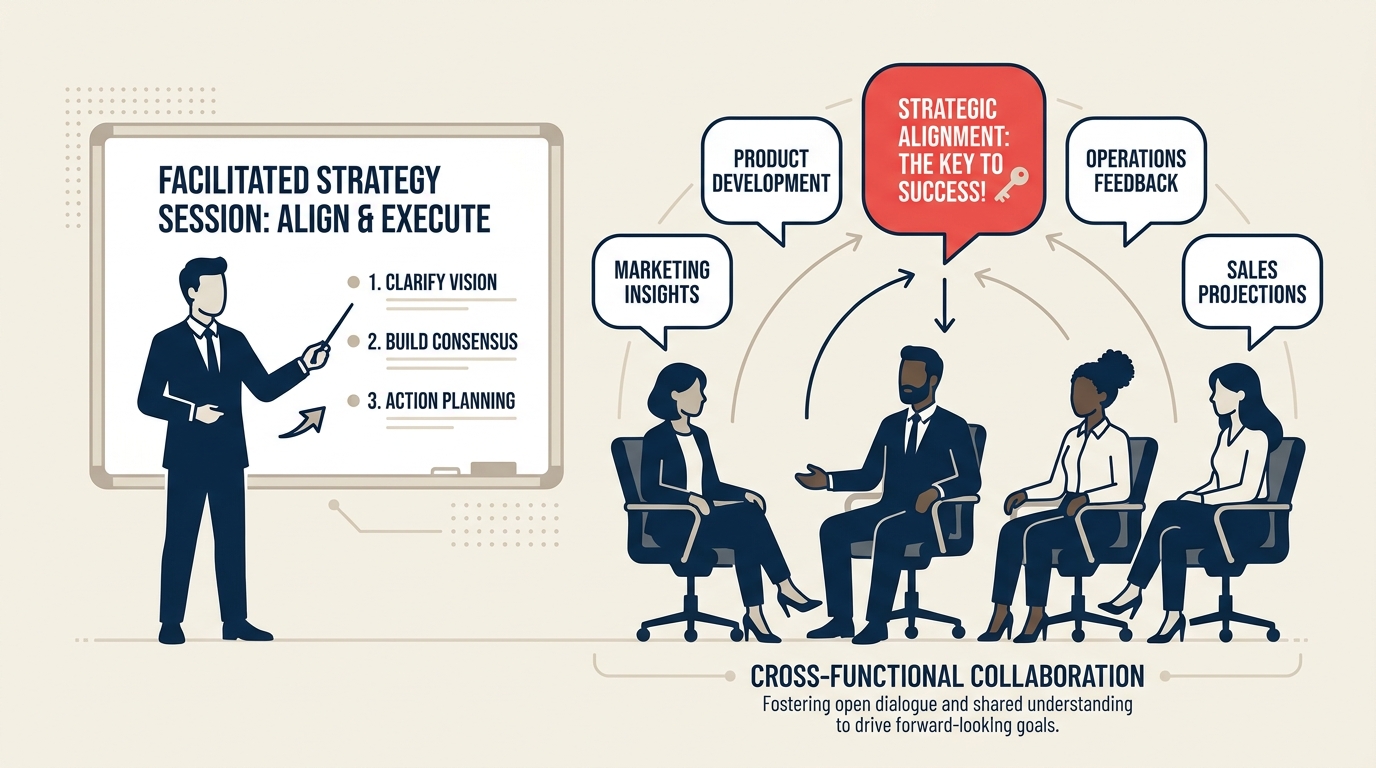
Project lead running a stakeholder alignment meeting. A cross-functional project lead facilitates a meeting with representatives from product, engineering, sales, and finance. None of them report to the lead. Using open questions and explicit summarizing, the facilitator helps the group surface where they actually agree before surfacing where they do not. The meeting closes with a documented decision that all four groups own.
For anyone developing presentation skills or working on storytelling at work, facilitation is a closely related capability. Both require reading an audience and adjusting in real time.
How to Develop Facilitation Skills
Facilitation improves with deliberate practice. A few concrete ways to build the skill:
Volunteer to run meetings you would normally just attend. The fastest way to develop facilitation muscle is to put yourself in the role. Start with low-stakes internal meetings. Ask for feedback afterward.
Study what effective facilitators do differently. Attend workshops, watch recorded facilitation sessions, or observe colleagues who run meetings well. Notice the specific moves they make: how they handle silence, how they redirect tangents, how they close.
Read foundational resources. Roger Schwarz's "The Skilled Facilitator" and Sam Kaner's "Facilitator's Guide to Participatory Decision-Making" are both practically oriented and applicable across industries.
Practice active listening as a standalone skill. Most facilitation failures trace back to the facilitator not actually hearing what participants are saying. Developing active listening as a dedicated practice makes every other facilitation skill sharper.
Get structured feedback. After running a session, ask two or three participants specific questions: "Was there a point where you felt unheard?" and "Did we spend time in the right places?" Specific feedback is far more useful than a general rating.
Work on business writing. Clear meeting summaries and action item documentation are part of the facilitation skill set. Strong written follow-ups reinforce decisions made in the room and reduce the "wait, what did we actually decide?" problem.
Common Mistakes
Even experienced facilitators fall into these patterns. Knowing them is half the battle.
Dominating the room. A facilitator who repeatedly shares their own opinion stops being a facilitator and becomes a presenter. If you find yourself making the argument rather than drawing it out, pause and redirect with a question.
No clear agenda. Walking into a meeting with a vague topic rather than a defined output invites circular discussion. "Discuss the budget" produces very different conversations from "decide which two line items we cut to hit the Q3 target."
Ignoring quiet voices. The people who say least are not necessarily least engaged. Some of the most valuable thinking in a room sits with the people who wait for an opening that never comes. Explicitly create that opening.
Letting time run. Consistently running over on meeting time is a signal that the facilitation structure is not working. Timeboxing and agenda discipline are not optional refinements; they are core to the role.
Treating consensus as the goal. Consensus means everyone can live with the decision. But optimizing for consensus in every meeting leads to watered-down outcomes that no one is especially committed to. Sometimes the right output is a clearly documented decision, even one that not everyone preferred.
Skipping the close. Ending a meeting by running out of time rather than closing with confirmed decisions and owners is one of the most common facilitation failures. Build the close into the agenda and protect time for it.
Frequently Asked Questions about Facilitation Skills
What's the difference between facilitating and leading?
A leader drives toward a goal by providing direction and making decisions. A facilitator drives toward a goal by creating the conditions for a group to make decisions together. In practice, the same person often does both, but the roles are distinct. When you are facilitating, you hold your own position lightly so the group can do the thinking. When you are leading, you bring your own judgment to bear. Good managers know which mode a given situation calls for.
Are facilitation skills a soft skill?
The "soft skill" framing undersells them. Facilitation is a set of specific, teachable behaviors: structuring agendas, deploying techniques like dot voting and round-robin, managing time, synthesizing contributions, and driving to documented decisions. These are as learnable and measurable as any technical capability. Companies that invest in facilitation training typically see direct, measurable impact on meeting efficiency and decision quality.
How do I facilitate a remote meeting?
The core principles are the same, but the execution requires more deliberate structure. Use a shared doc or virtual whiteboard visible to all participants rather than relying on verbal summary alone. Build in more explicit invitations to speak ("I'd like to hear from each person in turn") since remote attendees don't have the social cues that signal when to jump in. Use breakout rooms for small-group work and polling tools in place of dot voting or fist-to-five. And keep remote meetings shorter, with more frequent breaks, than you might for an in-person session of equivalent scope.
Do I need to be the most senior person in the room to facilitate?
No. Facilitation is a role, not a rank. In many of the best-run organizations, junior team members regularly facilitate sessions attended by senior leaders. The facilitator's authority comes from the process structure, not from their position. That said, facilitation works best when the senior people in the room are willing to subordinate their usual authority to the process. If they aren't, that is a culture issue, not a facilitation issue.
How long should a facilitated meeting be?
Long enough to reach the intended output, short enough to maintain engagement. For most decisions and working sessions, 45 to 90 minutes is the practical range. Beyond 90 minutes, cognitive load accumulates and participation quality drops. If the work genuinely requires more time, break it into multiple focused sessions with clear outputs for each. A two-hour meeting that tries to cover six agenda items will almost always produce worse outcomes than three 45-minute sessions that each tackle two items well.
Facilitation is one of those skills that looks invisible when it's working. A well-facilitated meeting feels natural. Decisions happen, people feel heard, and the group leaves with clarity on what happens next. That outcome doesn't come from luck. It comes from someone in the room who understands process leadership and applies it deliberately. Start with one meeting per week where you treat facilitation as the primary objective, not a background condition, and the skill compounds quickly.
Related reading

Senior Customer Retention Strategist
On this page
- What Are Facilitation Skills?
- Why Facilitation Skills Matter
- Core Facilitation Skills
- How to Facilitate a Productive Meeting
- Step 1: Set a Clear Purpose and Agenda
- Step 2: Establish Ground Rules
- Step 3: Open and Warm Up
- Step 4: Guide Discussion and Manage Airtime
- Step 5: Drive to Decisions and Actions
- Step 6: Close and Follow Up
- Facilitation Techniques
- Facilitation Skills Examples
- How to Develop Facilitation Skills
- Common Mistakes
- Related reading