Self-Confidence at Work: How to Build It
Turn this article into takeaways for your work.


Each assistant summarizes the article only for you and suggests best practices for your work.
Self-confidence at work is the belief, backed by evidence, that you can handle what a task or a room is about to ask of you. It is not a personality trait you either have or don't, and it isn't the loudest voice in the meeting. It's closer to a working hypothesis about your own capability, one that gets tested every time you take a position, make a call, or put your name on something before you're fully sure it will land.
That distinction matters because most advice on confidence treats it as something you fake until you feel it, or something you were simply born with. Neither holds up well. This guide defines self-confidence at work as a competency, separates it cleanly from self-efficacy, self-esteem, and arrogance, and lays out what actually builds it: behavior first, feeling second.
Key Facts
Key Facts: Self-Confidence at Work
- Stajkovic and Luthans's 1998 meta-analysis of 114 studies, 157 correlations and 21,616 people found a weighted average correlation of 0.38 between self-efficacy and work performance, one of the more consistently replicated links between a psychological belief and job performance. (Stajkovic and Luthans, 1998, Psychological Bulletin 124(2), 240-261)
- Imposter feelings affect somewhere between 9% and 82% of people depending on the screening tool and cutoff used to measure them; a systematic review of 62 studies and 14,161 participants found no single agreed-upon rate, though the feelings showed up across genders, ages, and professions. (Bravata et al., 2020, Journal of General Internal Medicine)
- Overconfidence buys social standing: across six studies, overconfident people gained higher status in both short-term and longer-term groups, and behaved in ways that made them appear more competent to the people around them. (Anderson, Brion, Moore, and Kennedy, 2012, Journal of Personality and Social Psychology)
- Zenger Folkman scored self-assessed confidence across 12,000 leaders and paired it with 360-degree ratings for a subset of 1,525: the leaders who improved their effectiveness saw their direct reports' engagement sit at the 60th percentile, against the 43rd percentile for those who did not improve. (Zenger Folkman)
What Is Self-Confidence at Work?
Self-confidence at work is the degree to which you trust your own judgment and ability to act, in a specific moment, on a specific task. It shows up as a decision: do you speak up, take the assignment, push back on the plan, or hold your position when someone senior disagrees? Confidence is what you do when you're not fully certain the outcome will go your way.
That's different from feeling generally good about yourself. A confident employee isn't someone who's cheerful or extroverted; plenty of quiet, understated people are deeply confident in their specific domain, and plenty of loud ones are covering for the opposite. What confidence actually predicts is behavior under uncertainty: whether you'll act on your read of a situation or wait to be told it's correct.
Grounded confidence is built from evidence: a track record of having handled hard things before, even if not this exact one. That's what separates it from wishful thinking. Self-awareness does a lot of the quiet work here, since an accurate read of your own strengths and gaps is what keeps confidence calibrated instead of either inflated or chronically underestimated.
Self-Confidence vs Self-Efficacy vs Self-Esteem vs Arrogance
These four get used almost interchangeably in everyday conversation, and the mix-up causes real damage in how people coach themselves and each other: a manager who conflates confidence with arrogance ends up punishing the wrong behavior, and someone who conflates low self-esteem with low competence ends up trying to fix the wrong problem.
| Concept | What it actually measures | Core question it answers | Is it grounded in evidence? |
|---|---|---|---|
| Self-confidence at work | Whether you trust your own judgment enough to act, in this specific moment or role | Can I handle what's about to happen? | Only when it's backed by a real track record; otherwise it's a guess dressed up as certainty |
| Self-efficacy | Bandura's term for your belief in your capacity to execute the specific actions a task requires | Can I actually do this exact thing? | Yes, by definition. It's built from your own mastery experiences, not from vibes |
| Self-esteem | Your global sense of worth as a person, independent of any particular task | Am I a person of value? | Can run high or low no matter what your actual skills are |
| Arrogance | Confidence that has stopped checking itself against feedback or results | Why would I need to double-check? | No. It has detached from evidence, which is exactly what makes it dangerous |
Self-efficacy is the closest neighbor to workplace confidence, and for good reason: most of what people call "confidence at work" is really task-specific self-efficacy wearing a more casual name. Self-esteem sits one level up and further away; you can walk into a room with a stable, healthy sense of your own worth and still feel completely unprepared for the specific spreadsheet in front of you. Arrogance is the one that gets confused with confidence most often, and the two look identical for exactly as long as nobody pushes back. Assertiveness is a useful neighbor to name too: it's the skill of expressing a confident position clearly, but assertiveness without an underlying, earned belief in your own read of the situation just becomes volume.
What Self-Confidence Looks Like in Practice
Confidence is easy to perform for a single meeting and hard to fake once real stakes and real pushback show up. The behaviors below are what actually distinguish it, at every level.
As an individual contributor
- Proposes an idea before being asked for one, and can explain the reasoning when someone pushes back on it.
- Says "I don't know, let me find out" instead of guessing to avoid looking unprepared.
- Takes on a stretch assignment slightly beyond their proven track record, and names what support they'll need to pull it off.
- Asks the clarifying question out loud in the room instead of nodding along and Googling it later.
As a manager
- Makes a call with incomplete information instead of stalling for data that was never going to arrive in time.
- Delivers hard feedback directly, without padding it into something so soft it stops meaning anything.
- Owns a decision that didn't work out, in front of the team, instead of quietly redirecting blame downward.
- Lets a direct report present their own work to leadership, instead of taking over the room "to be safe."
As a senior leader or executive
- Makes an unpopular strategic call and explains the reasoning, instead of hiding behind a consensus that doesn't really exist.
- Says "I was wrong about this" publicly when the data changes, instead of quietly redefining what success meant.
- Sets an ambitious target out loud, tying personal credibility to actually hitting it.
- Trusts a leadership team enough to let them run initiatives without reviewing every input along the way.
The pattern holds across all three levels: confident behavior is the willingness to act, and be judged, on your own read of a situation before someone else confirms it for you. Decision-making and confidence are close cousins for exactly this reason; a decision made under real uncertainty is confidence made visible.
The table below separates grounded confidence from its two most common failure modes, since a manager coaching someone through a rough patch needs to know which one they're actually looking at.
| Situation | Grounded confidence looks like | Low confidence looks like | Arrogance looks like |
|---|---|---|---|
| Getting pushback on an idea | Explains the reasoning, updates the idea if the pushback is right | Drops the idea immediately, or never raises it at all | Dismisses the pushback without actually engaging with it |
| Being asked something you don't know | States that plainly, and commits to finding the answer | Guesses, or deflects the question entirely | Bluffs an answer with total certainty |
| Receiving critical feedback | Separates the feedback from self-worth, asks a follow-up question | Spirals, over-apologizes, or shuts down | Argues the feedback is wrong without checking it |
| Sharing credit or owning a miss | Names their real contribution, owns their real misses | Downplays a contribution that was genuinely theirs | Claims credit that belongs to someone else |
| Facing a stretch assignment | Accepts it, and names the specific support they'll need | Turns it down despite being ready for it | Accepts it while waving off a real skill gap |
Why Confidence Pays Off, and What Low Confidence Actually Costs
Low confidence is expensive in ways that rarely show up on a scorecard. The idea that goes unspoken in a meeting because someone wasn't sure it was worth saying doesn't get logged anywhere; it just quietly never happens. The promotion that goes to someone else because the more qualified candidate didn't put their name forward looks, from the outside, like a normal staffing decision rather than a confidence gap.
Zenger Folkman's research gives one of the cleanest looks at what this costs in measurable terms. The firm scored self-assessed confidence for 12,000 leaders, then paired 360-degree ratings with that data for a subset of 1,525 and tracked who actually improved. The leaders who improved their effectiveness saw their direct reports' engagement sit at the 60th percentile. For those who did not improve, engagement sat at the 43rd percentile, a measurable cost carried by the people working underneath a confidence level that hadn't yet been earned.
The reverse cost, chronic underconfidence, is quieter but no less real. It shows up as declined stretch assignments, unasked questions that would have caught a problem early, and negotiations that end before they start because asking felt too risky. Negotiation is one of the clearest places this plays out: the person who doesn't believe they deserve more rarely asks for it, regardless of what the market would actually support.
Confidence also compounds socially in a way that's worth naming honestly, even though it's uncomfortable. Anderson, Brion, Moore, and Kennedy's 2012 research across six studies found that overconfident people gained higher status in both short-term and longer-term groups, and that overconfidence produced a behavioral signature that made them look more competent to everyone around them. That finding cuts both ways: it explains why underconfident, genuinely skilled people get passed over, and it's exactly why grounded confidence, not performed confidence, is the version worth building. Performing your way into that effect works right up until someone asks you to actually deliver.
How Confidence Is Actually Built: Behavior First, Feeling Second
The most common mistake in building confidence is trying to talk yourself into the feeling directly. Affirmations and pep talks aren't nothing, but they're the weakest lever available, and the research on where self-efficacy actually comes from backs that up clearly.
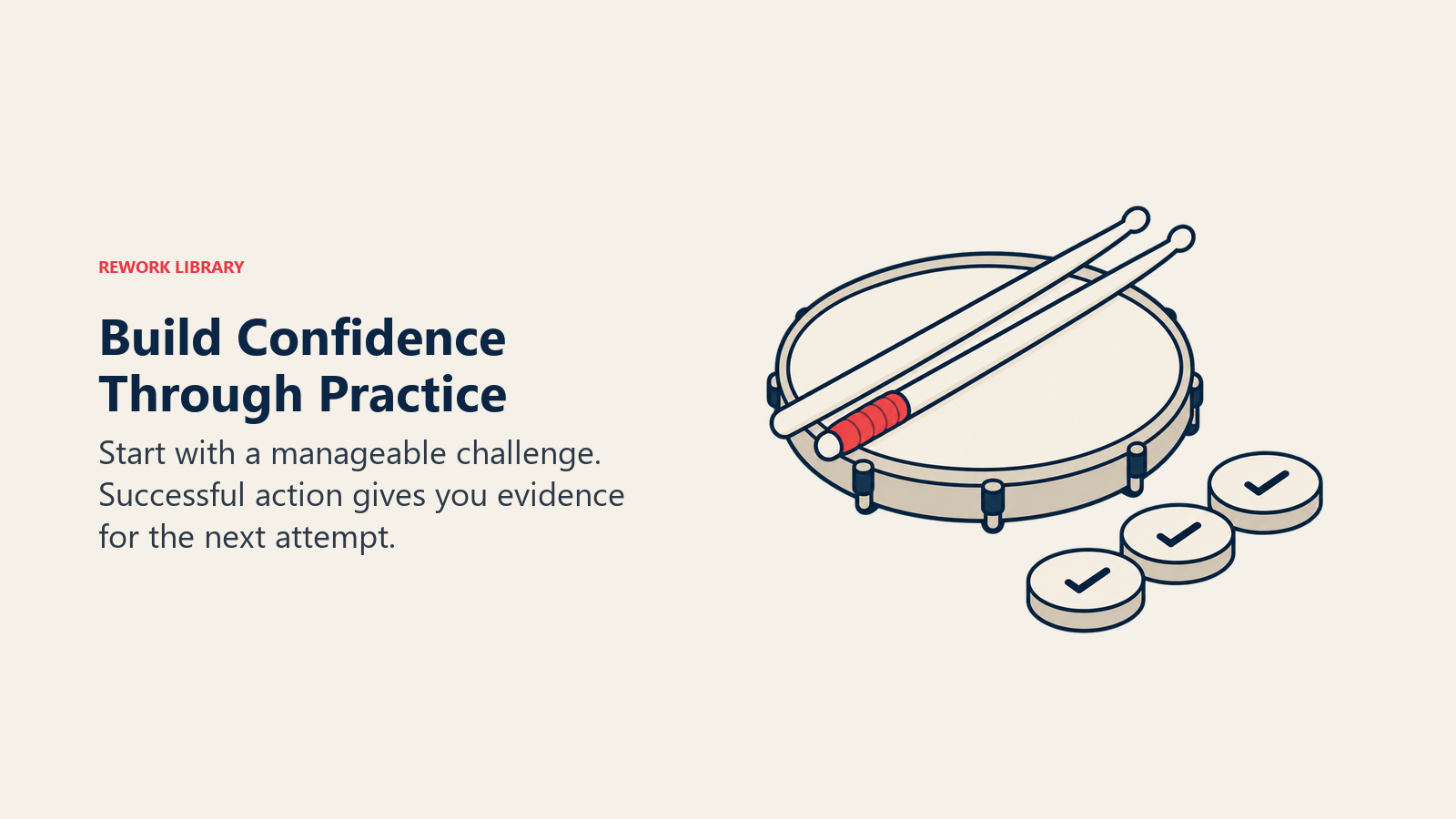
Bandura's original theory names four sources of self-efficacy: mastery experience (having actually done the thing successfully before), vicarious experience (watching someone similar to you do it), verbal persuasion (being credibly told you're capable), and your physiological or emotional state in the moment. A 2025 study of 335 adults ranked those sources against each other using dominance analysis and found mastery experience strongest by a clear margin, ahead of verbal self-persuasion and emotional state, with the sources together accounting for about 56% of the variance in how self-efficacious people felt. That study measured self-efficacy for physical activity rather than for work, so it is evidence for the ordering Bandura proposed rather than a workplace-specific number. In plain terms: doing the hard thing and succeeding builds more real confidence than any amount of being told you can.
That's also consistent with the strength of the link between self-efficacy and actual performance. Stajkovic and Luthans's 1998 meta-analysis, still one of the most cited findings in organizational psychology, found a weighted average correlation of about 0.38 between self-efficacy and work performance across 114 studies and more than 21,000 people. Self-efficacy isn't a side effect of good performance; it's a working ingredient in producing it, which is exactly why building it deliberately, rather than waiting for it to arrive, pays off.
This is also why "fake it till you make it" gets the sequence backwards. It asks you to manufacture the feeling first and hope the competence follows. The more reliable order runs the other way: stack up small, real wins, let the feeling catch up to the evidence, and treat the feeling as a lagging indicator rather than a prerequisite. Growth mindset is the belief that makes this order tolerable in the meantime, since it reframes "I can't do this yet" as a temporary, closeable gap rather than a fixed verdict.
The Confidence-Competence Gap: Imposter Feelings and Overconfidence
Confidence and competence are supposed to track each other, but they drift apart constantly, in both directions, and both failure modes deserve honest treatment rather than a punchline.
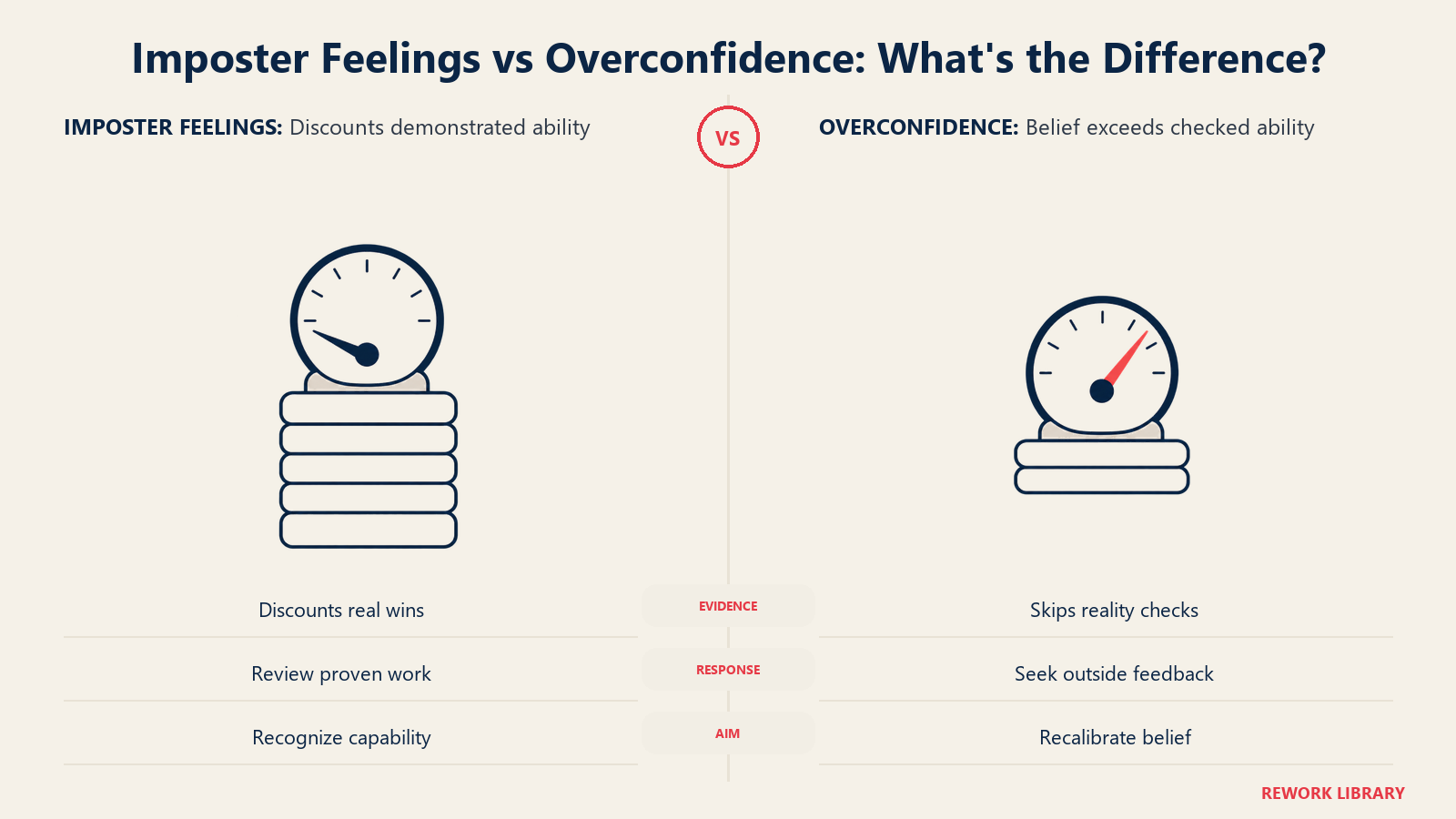
On one side sit imposter feelings: the sense that your accomplishments are down to luck or timing rather than real ability, and that you're one mistake away from being exposed. Bravata and colleagues' 2020 systematic review found these feelings are genuinely common, though far less precisely measured than the popular framing suggests; across 62 studies and more than 14,000 people, reported prevalence ranged from 9% to 82% depending entirely on which screening tool and cutoff a given study used. What the review found consistently, regardless of the exact rate, is that imposter feelings show up across genders, age groups, and professions, and are linked to real costs: worse job performance, lower job satisfaction, and higher burnout. The takeaway isn't a single tidy statistic; it's that the feeling is common enough, and costly enough, to take seriously rather than dismiss as a confidence-building cliché.
On the other side sits overconfidence, and it's the harder failure mode to self-diagnose because it doesn't feel like a problem from the inside. Leaders whose confidence outpaces their actual competence rarely think of themselves as overconfident; they simply haven't closed the feedback loop yet. That's the practical test worth applying to yourself: has your confidence in a specific area been checked against real outside feedback recently, or is it running on a self-assessment that hasn't been challenged in a while? Coachability is what keeps that loop honest, since someone who can't take a hard correction has no reliable way to notice when their confidence has drifted past their actual skill.
The healthiest version of confidence treats both directions as data worth acting on: an imposter feeling is a prompt to check your evidence rather than automatically discount it, and a run of unchallenged confidence is a prompt to go looking for the feedback you might be missing.
Practical Systems to Build Self-Confidence at Work
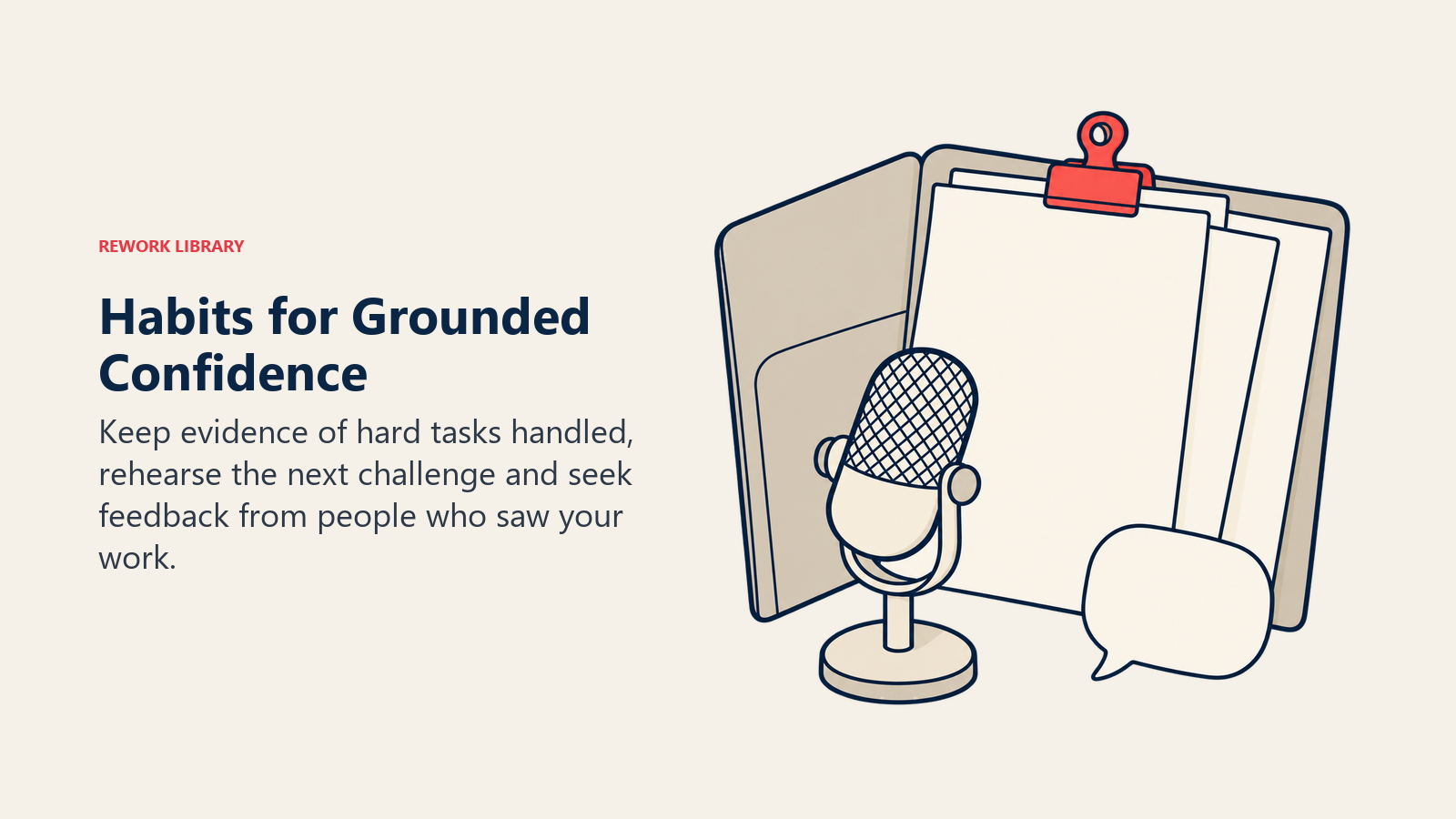
Confidence built on willpower alone erodes the first time you hit real resistance. The version that holds up is built the same way any other competency gets built: with a small number of repeatable habits, mapped to the actual sources of self-efficacy.
| System or practice | Why it works | What it targets |
|---|---|---|
| Sequence tasks from proven to stretch, not the reverse | Builds mastery experience first, the strongest of the four sources | Self-efficacy for the specific skill |
| Keep a running log of hard moments you've actually handled | Converts a vague sense of capability into a specific, checkable track record | Self-efficacy backed by evidence, not memory |
| Get feedback from people who've actually watched you work, not just cheerleaders | Verbal persuasion only moves the needle when the source is credible | The self-efficacy input itself |
| Rehearse the specific moment, not just the content | Lowers the physiological spike that often gets misread as "I'm not ready" | Physiological and emotional state |
| Review a miss for what to change next time, without re-litigating it endlessly | Keeps one bad outcome from quietly overwriting a real track record | Long-term stability of self-belief |
None of these require a personality change. Self-discipline is what keeps the habit running once the novelty wears off, and stress-management is what keeps the physiological piece from hijacking a moment you're actually prepared for. A useful small-scale version of this: before a genuinely high-stakes conversation, spend two minutes naming out loud (or on paper) the specific evidence that you're prepared for it. That's a deliberate, low-cost way of running verbal persuasion on yourself, using material that's actually true.
How to Show Self-Confidence in Interviews and on a CV
Confidence is one of the easiest traits to claim and one of the hardest to prove convincingly on paper, because the word itself carries no evidence. A specific outcome does.
Resume examples:
- Proposed a new pricing structure in a leadership review, defended it under direct pushback, and saw it adopted company-wide
- Took on a project outside prior scope with no formal mandate, and delivered it two weeks ahead of the original timeline
- Reversed a decision publicly after new data contradicted the original plan, avoiding a larger downstream cost
- Presented directly to the executive team on a topic outside their usual function, at their own request
Interview Q&As:
- "Tell me about a time you disagreed with your manager." Walk through the actual disagreement, what you said, and how you said it, not just the fact that you eventually turned out to be right. The interviewer is evaluating whether you'd do it again, not just whether you were correct once.
- "Describe a time you took on something you weren't fully ready for." Name the specific gap honestly, and what you did to close it in real time. Overselling total readiness reads as less credible than an honest account of a manageable gap.
- "How do you handle being told you're wrong?" Describe the actual behavior: what you asked, what you changed, and what you didn't change because the original feedback didn't hold up on closer look. Critical thinking is really what's being tested here, since blind agreement is its own kind of low confidence.
Managers assessing confidence in a live setting, not just on paper, tend to watch a narrower, more reliable set of signals than "do they seem confident."
| Signal a manager watches | What it actually tells them |
|---|---|
| Do they take a position in a meeting, or wait to agree with whoever spoke first? | Whether they trust their own judgment under real scrutiny |
| Do they push back on a decision they disagree with, respectfully? | Whether they'll surface a real problem before it gets expensive |
| How do they handle being wrong in front of others? | Whether the confidence is grounded enough to survive a correction |
| Do they volunteer for the harder, riskier version of an assignment? | Whether the confidence is backed by an accurate self-read |
| Does their tone shift noticeably when the room gets more senior? | Whether the confidence is real, or performed for a specific audience |
Personal branding and career management both depend heavily on this kind of demonstrated confidence; a track record of taking real positions and surviving real scrutiny is what makes a claim of confidence credible to someone who's never worked with you directly.
Self-confidence at work isn't the trait of the person who talks the most in a meeting. It's the quieter, checkable habit of trusting your own read of a situation enough to act on it, and being willing to find out if you were right. Built on real evidence, it holds up under pushback. Built on performance alone, it collapses the first time someone asks a follow-up question. The difference is worth taking seriously, because it's the difference between a career built on a track record and one built on a bluff that hasn't been called yet.
Learn More

Senior Customer Retention Strategist
On this page
- Key Facts
- What Is Self-Confidence at Work?
- Self-Confidence vs Self-Efficacy vs Self-Esteem vs Arrogance
- What Self-Confidence Looks Like in Practice
- As an individual contributor
- As a manager
- As a senior leader or executive
- Why Confidence Pays Off, and What Low Confidence Actually Costs
- How Confidence Is Actually Built: Behavior First, Feeling Second
- The Confidence-Competence Gap: Imposter Feelings and Overconfidence
- Practical Systems to Build Self-Confidence at Work
- How to Show Self-Confidence in Interviews and on a CV
- Learn More