Prioritization Skills: Frameworks and How to Improve
Turn this article into takeaways for your work.


Each assistant summarizes the article only for you and suggests best practices for your work.
Prioritization skills determine whether your effort goes toward what actually moves the needle or just toward whatever showed up loudest in your inbox this morning. They're the competency that sits quietly behind nearly every other strength at work: decision-making, time management, goal-setting, and results orientation all depend on your ability to rank competing demands correctly.
What are prioritization skills?
Prioritization skills are the cognitive and practical abilities that let you assess competing tasks, projects, or goals and rank them by their true importance so that your time, attention, and energy go where they produce the most value. The word "true" matters: strong prioritizers don't just sort by urgency. They weigh impact, effort, urgency, and strategic fit before deciding what comes first.
These skills operate at multiple levels. At the individual level, prioritization is about what you tackle first in your workday. At the team level, it's about which problems your group solves this sprint. At the organizational level, it's about which initiatives get funded. The underlying logic is the same at every level, but the stakes and the complexity scale up.
Strong prioritization is a learnable skill, not a fixed personality trait. It relies on frameworks, habits, and a clear understanding of what "good outcome" means in your specific context.
Key Facts
- A McKinsey study found that executives spend only 9% of their time on activities they rate as highly valuable, largely because poor prioritization routinely pulls attention toward low-impact work (McKinsey Quarterly, 2013).
- Research published in the Harvard Business Review found that employees who explicitly prioritize tasks before starting work are 25% more likely to complete high-value work on time compared to those who work reactively (HBR, 2019).
- A Gallup report found that only 26% of employees say they "always" have enough clarity on priorities to do effective work, indicating prioritization gaps are widespread, not individual (Gallup State of the Global Workplace, 2023).
Prioritization frameworks
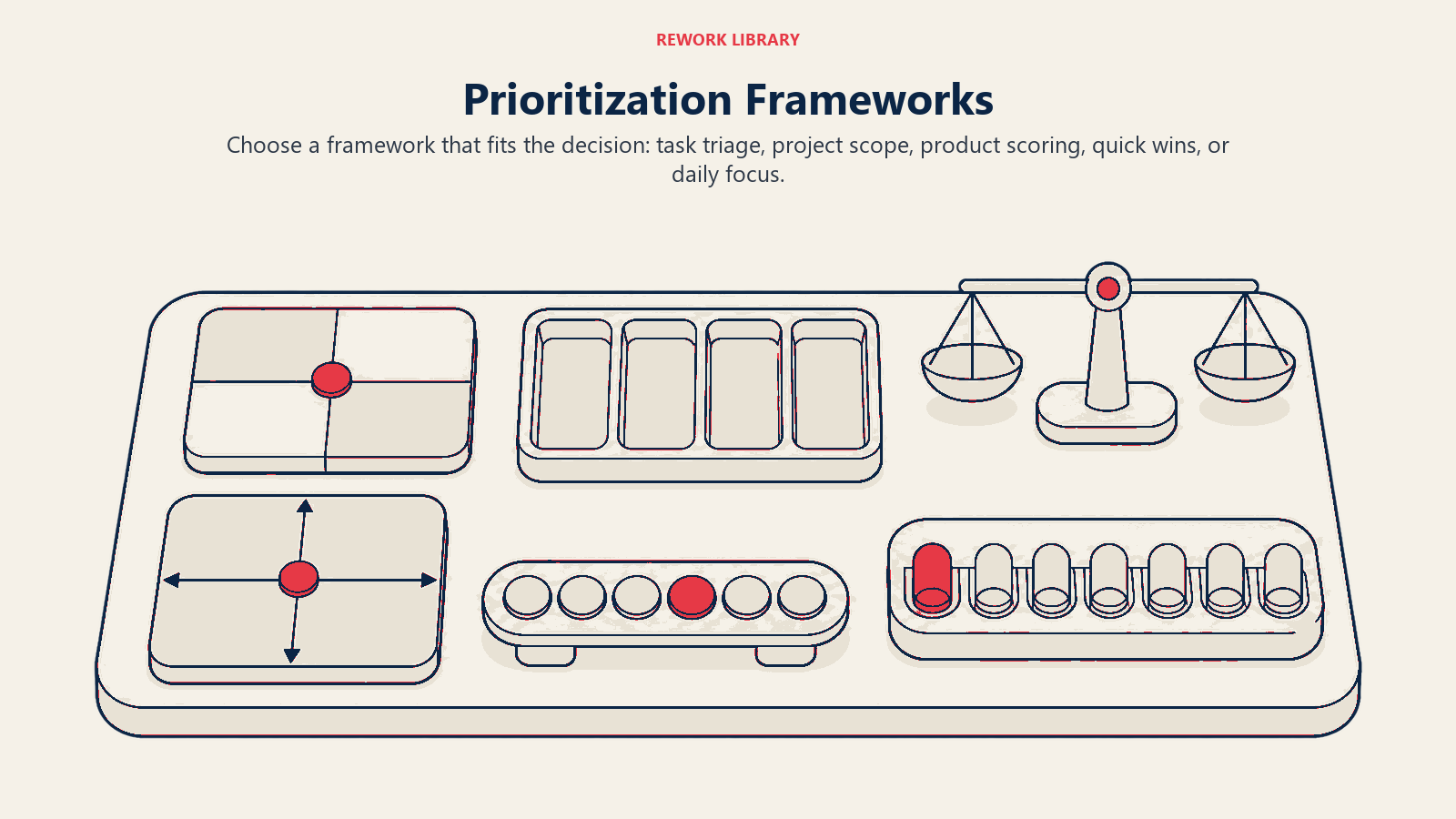
Several frameworks have become standard tools for ranking work. None of them is universally "best." The right one depends on your role, the nature of the work, and how much data you have available.
| Framework | How it works | Best for |
|---|---|---|
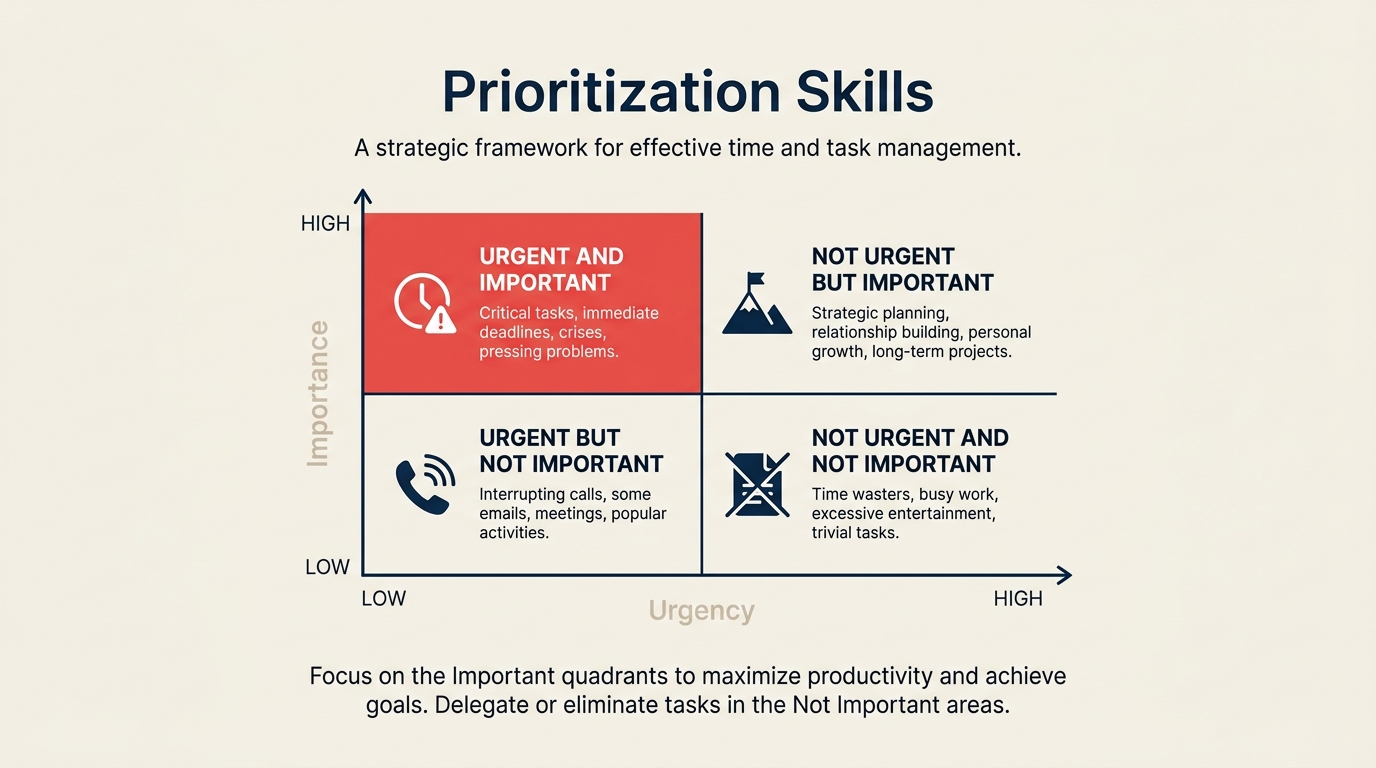
| Eisenhower Matrix | Sort tasks into four quadrants by urgency (yes/no) and importance (yes/no). Do, Schedule, Delegate, or Eliminate. | Daily task triage, individual contributors |
| MoSCoW Method | Label each requirement Must Have, Should Have, Could Have, or Won't Have. | Project scoping, product backlogs, sprint planning |
| RICE Scoring | Score each item on Reach, Impact, Confidence, and Effort. Divide (Reach x Impact x Confidence) by Effort. Higher score = higher priority. | Product teams, feature roadmaps |
| Value vs. Effort Matrix | Plot tasks on a 2x2 of value (high/low) and effort (high/low). Work the high-value, low-effort quadrant first. | Team backlog reviews, quick wins identification |
| ABCDE Method | Label every task A (must do), B (should do), C (nice to do), D (delegate), E (eliminate). Never start a B while an A remains. | Personal task lists, sales professionals |
| Ivy Lee Method | At day's end, write six tasks for tomorrow and rank them 1-6. Work only on task 1 until it's done, then move to task 2. | Deep-focus individual contributors, executives |
For a deeper look at using MoSCoW in a project context, see MoSCoW prioritization in project management.
Why prioritization skills matter
Every role involves more demand than capacity. The question is never "should I prioritize?" but "am I prioritizing consciously or by default?"
When you prioritize well, several things happen at once. You finish the week with concrete progress on what matters rather than a long list of completed low-stakes tasks. You reduce the cognitive overhead of deciding what to do next because the system makes that decision in advance. You communicate more clearly to managers and stakeholders because you can explain why a task is ranked where it is.
Strong prioritizers also tend to manage their organizational skills more effectively: when you're clear on what matters, organizing your workspace and workflows around it follows naturally.
For managers and above, prioritization has compounding effects. When a leader prioritizes poorly, the whole team inherits the misalignment. A manager who keeps pulling the team toward the loudest request rather than the highest-value work trains everyone around them to operate reactively.
Signs of weak prioritization
It's easy to mistake busyness for effectiveness. These patterns usually signal a prioritization problem:
- Urgency bias: treating everything as urgent, so urgent/unimportant tasks crowd out important/non-urgent ones (meetings, admin, reactive emails vs. strategy, deep work, relationship-building)
- Recency effect: whatever was asked for most recently gets done first, regardless of importance
- Pleasing over impact: prioritizing tasks that are visible or requested by vocal people, not tasks that create the most value
- Undefined criteria: not knowing what "most important" means in your context, so the default is whatever feels manageable
- Incomplete lists: juggling priorities mentally rather than externalizing them, which creates mental load and makes ranking impossible
- Over-committing: saying yes to so many things that genuine prioritization becomes irrelevant because there's no slack to act on it
If you recognize yourself in two or more of these, that's normal. Most people develop prioritization habits reactively over time rather than building them deliberately.
How to improve your prioritization skills
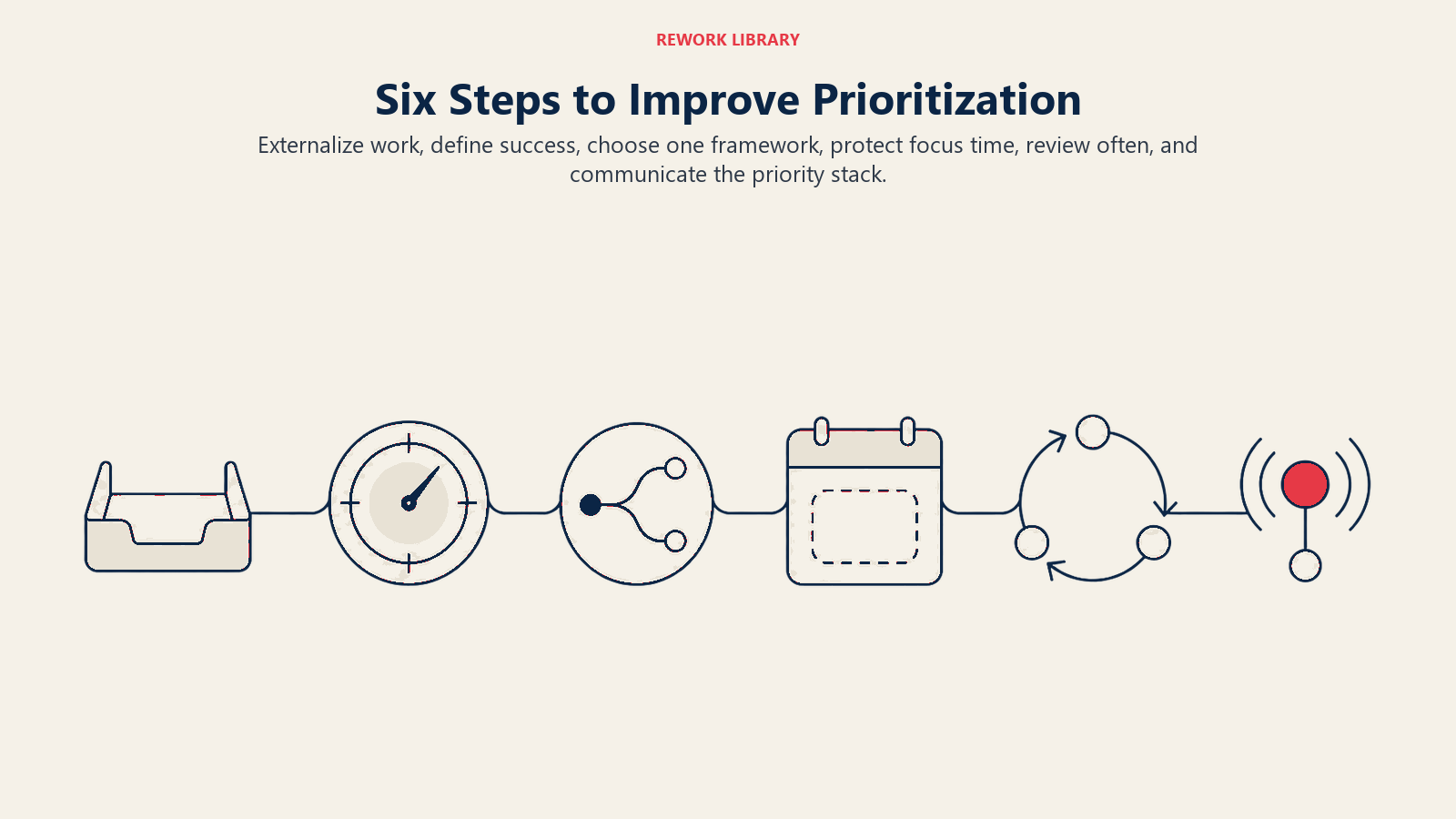
Improvement comes from building a repeatable system rather than trying harder in the moment.
Step 1: Externalize everything first
You can't prioritize what's still in your head. Start by doing a full brain dump: every task, project, commitment, and request you currently hold. Don't rank yet. Just get it all on one surface. This step alone reduces the overwhelm that leads to reactive, urgency-driven work.
Step 2: Define your success criteria
Before ranking, you need a standard to rank against. Ask: what does "high value" mean in my current role? For a sales rep, it might mean activities that directly move deals forward. For a product manager, it might mean work that reduces user friction on the core use case. Write this down explicitly. The clearer your success criteria, the more defensible your priorities become.
Step 3: Choose one framework and apply it consistently
Pick a framework that matches your work type (see the table above) and apply it to your full task list. Don't use four frameworks at once. Consistency matters more than which specific framework you choose. Use the framework as a filter: "By this standard, what's in the top tier?"
This is where problem-solving skills intersect with prioritization: deciding which problems to work on at all is itself a prioritization decision.
Step 4: Protect time for high-priority work
The framework means nothing if you never get to the A-list items. Block calendar time for your highest-priority work before the day fills with reactive tasks. Treat those blocks like a meeting you can't move. If this feels difficult, start with one 90-minute block per day.
Step 5: Review and reprioritize regularly
Priorities shift. A daily five-minute reset (What's the one thing that must happen today?) and a weekly 20-minute review (Did my week reflect my actual priorities?) are enough to catch misalignment early. This is a core time management habit that keeps prioritization from becoming stale.
Step 6: Communicate your priorities to stakeholders
Good prioritization isn't done in isolation. When your manager, peers, or direct reports understand your priority stack and the reasoning behind it, they can redirect requests appropriately, flag when something needs to move up, and stop creating urgency theater that pulls you off course. This connects directly to strategic thinking: articulating why you're prioritizing what you're prioritizing shows you understand the bigger picture.
Prioritization examples by role
How prioritization looks in practice varies significantly across functions. These examples illustrate the same underlying skill applied in different contexts.
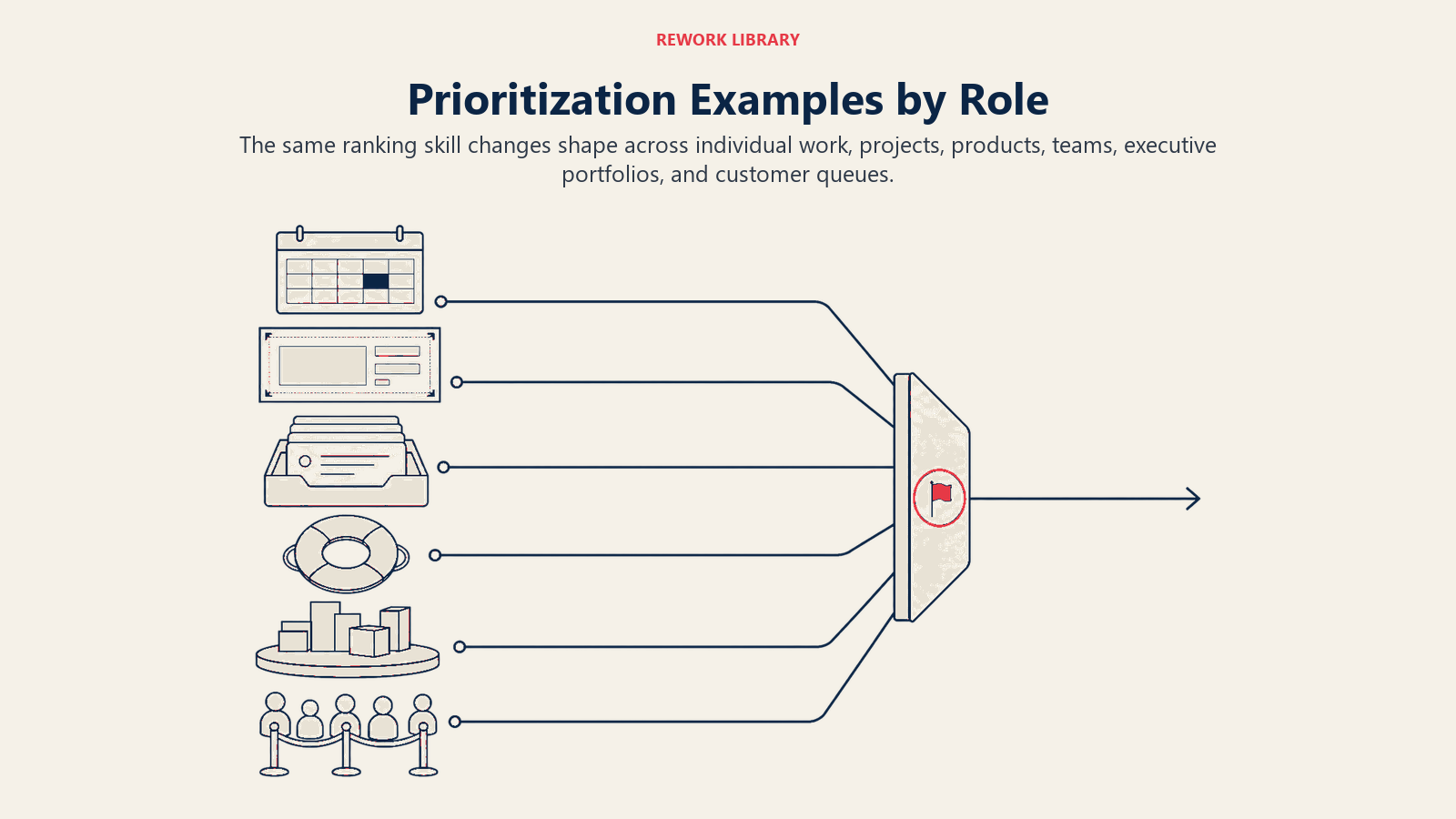
| Role | Typical competing demands | How strong prioritization shows up |
|---|---|---|
| Individual contributor (IC) | Multiple project tasks, ad-hoc requests, admin | Uses Eisenhower or ABCDE to block reactive work; deep work protected first thing |
| Project manager | Scope creep, stakeholder requests, technical blockers | Runs MoSCoW reviews with the team; escalates scope changes rather than absorbing them silently |
| Product manager | Feature backlog, bug fixes, research, roadmap work | RICE or value/effort scoring on every backlog item; says "not this quarter" clearly and with data |
| Team lead / manager | Team's competing asks, leadership requests, 1:1s | Prioritizes team unblocking over their own output; shields the team from organizational noise |
| Executive | Strategic initiatives, operational fires, stakeholder management | Explicitly allocates weeks, not just days, to high-leverage work; delegates entire categories |
| Customer-facing role | Inbound volume, proactive outreach, internal requests | Triages by customer tier and urgency; uses templates for low-priority cases to recover time |
Best practices
A few habits separate people who prioritize effectively from people who have good intentions but still end up firefighting.
Do:
- Start every week by identifying your top three non-negotiable outcomes
- Say no (or "not yet") to new requests until you know where they rank against existing commitments
- Separate the "deciding" work from the "doing" work: plan at a different time than you execute
- Use constraints intentionally: if everything is priority one, nothing is
- Revisit your priorities after each major interruption or unexpected event
Don't:
- Let an empty calendar slot become a tacit yes to low-priority work
- Mistake urgency for importance: urgency is a feeling, importance is a judgment
- Build a priority list and then ignore it when pressure builds
- Treat prioritization as a one-time setup rather than an ongoing practice
- Rely entirely on memory to hold your priority stack

Senior Customer Retention Strategist
On this page
- What are prioritization skills?
- Prioritization frameworks
- Why prioritization skills matter
- Signs of weak prioritization
- How to improve your prioritization skills
- Step 1: Externalize everything first
- Step 2: Define your success criteria
- Step 3: Choose one framework and apply it consistently
- Step 4: Protect time for high-priority work
- Step 5: Review and reprioritize regularly
- Step 6: Communicate your priorities to stakeholders
- Prioritization examples by role
- Best practices